Nikon full-frame mirrorless cameras
Last update: 06/16/2026
Our blog continues to grow thanks to you, our readers. This post may contain affiliate links, which means we can earn a small commission if you make a purchase through them, at no extra cost to you. This helps us to continue to bring you more and support our work!
As you probably know, I’m passionate about camera gear. I enjoy browsing the web, digging through new releases, and keeping up with what has just come out or is about to arrive. After listing and detailing all the lenses for the Nikon Z mount on a dedicated page, I’ll now focus on Nikon’s full-frame cameras using this Z mount.
In July 2018, Nikon entered the mirrorless camera market and introduced a new mount dedicated to its mirrorless system: the Z mount. On this page, I’ll therefore take a closer look at Nikon’s full-frame mirrorless bodies.


To briefly retrace Nikon’s full-frame mirrorless history, the brand first released the Nikon Z6 and Z7 in July 2018. These two bodies were then updated at the end of 2020 with the Nikon Z6 Mark II and Z7 Mark II, bringing several improvements over the original models released two years earlier. Around the same period, Nikon also added a more accessible model to the range: the Nikon Z5. For reference, all of these cameras offer 5-axis in-body image stabilization.
The purpose of this page is not to overwhelm you with technical data, but rather to analyze Nikon’s strategy and better understand who each of these full-frame mirrorless cameras is really designed for. We will of course talk about photography, but also a little about video, since Nikon has made real progress in this area over time. In fact, the latest cameras now offer increasingly strong video features. This has become an important battleground for all manufacturers. Even though I mostly take photos myself, I will still mention video throughout this guide, because it helps us understand how each camera is positioned by the brand.
- 09/17/2025 : Nikon ZR
- 05/14/2025 : Nikon Z5 II
If you are looking for a lens for your Nikon camera, we have put together a list of the best current Nikon Z lenses. You will find the key details you need to know about these lenses and their specifications.
Nikon full-frame mirrorless cameras
Here are the main things to consider if you want to know what to look for when choosing your camera.
If you want to compare the cameras on this page with other brands in detail, we've created our own free comparison tool, so don't hesitate to try it out!
Nikon ZR
Released in 2025, the Nikon ZR is a slightly different model in the range. It is a full-frame Z-mount camera from Nikon’s Z CINEMA series, developed through the brand’s collaboration with RED. It is therefore aimed first and foremost at filmmakers, content creators, and hybrid users who place video at the center of their work.
The ZR uses a full-frame sensor and focuses on advanced video features, including internal RAW recording, RED color science, strong autofocus, and a very compact body for this type of camera. It is not the most logical choice if your priority is still photography, but it is an important model in Nikon’s recent Z strategy because it clearly shows the brand’s ambition in the video and cinema market.
Nikon Z5 II
Five years after releasing the original Z5, Nikon returned with the Z5 II, an “entry-level” full-frame mirrorless camera unveiled in April 2025. It is built around a 24.5 MP back-illuminated CMOS sensor and inherits the EXPEED 7 processor, bringing the camera much closer to Nikon’s more recent high-end models in terms of speed and autofocus. The camera benefits from AI-powered subject detection and 3D tracking, which can recognize people, animals, and vehicles, even when they are moving quickly. Compact and fairly lightweight at around 700 g with the battery, its dimensions remain close to those of the original Z5, but the body feels more modern, with dual UHS-II SD card slots, a fully articulated 3.2-inch touchscreen with 2.1 million dots, and a 3.69-million-dot OLED electronic viewfinder.
The Z5 II’s 5-axis stabilization is rated at up to 7.5 stops, which is a real strength for handheld photography. It also offers a high-resolution mode using sensor shift for highly detailed images. The ISO range is more generous than on the original Z5, and the autofocus is much more capable in difficult conditions. In burst mode, the camera can reach 14 fps with the mechanical shutter, while faster JPEG options are available with the electronic shutter. A pre-release capture mode also makes it easier to catch action at the right moment.

In terms of video, the Z5 II makes a clear step forward compared with the original Z5. It can record 4K at 30p without a crop, 4K at 60p with a crop, and Full HD at 120p. Nikon also adds N-RAW, N-Log, RED LUT support, and useful creator-oriented tools such as Product Review Mode and High-Res Zoom. It is still not a dedicated cinema camera, but it becomes much more credible for hybrid users than the first Z5.
It also keeps the practical side that made the original Z5 attractive, including dual SD card slots, a relatively compact full-frame body, and the EN-EL15c battery. With better autofocus, stronger video features, more modern ergonomics, and a still reasonable position in Nikon’s full-frame lineup, the Z5 II is now one of the most interesting entry points into the Z full-frame system.
Nikon Z6III
The Nikon Z6 III replaces the Z6 II after four years and marks a major step forward in Nikon’s Z series. This full-frame mirrorless model fits perfectly with Nikon’s strategy of offering increasingly capable bodies for advanced amateurs and professionals. Like Sony with the A9 and A1, or Canon with the R3, Nikon is clearly trying to strengthen its position with significant technological improvements.
The Z6 III keeps the same 24.5 MP resolution as the Nikon Z6 II, but introduces a new partially stacked sensor and the EXPEED 7 processor for faster readout, stronger autofocus, and better overall performance. It also features an improved 5.76-million-dot viewfinder, which offers more comfort and clarity when shooting.

On the video side, the Z6 III is a major leap forward, supporting internal RAW video up to 6K at 60 fps and 4K UHD up to 120 fps. These capabilities make it a very strong option for videographers looking for high-end performance in a relatively compact body. The camera can also shoot at speeds of up to 1/16,000 s with the electronic shutter, making it easier to capture very fast-moving subjects.
The weather-sealed body, in-body stabilization, mixed CFexpress Type B/SD card slots, and EN-EL15c battery place the Z6 III in a much more ambitious category than the Z6 II. The improved burst rate, up to 20 fps in RAW, and the huge progress in JPEG burst shooting, up to 120 fps with reduced resolution, underline how far this model has moved forward. The one-second pre-release capture mode also improves responsiveness for action scenes. Taken together, these innovations make the Nikon Z6 III a very competitive answer to the growing expectations of photographers and videographers, and a serious rival to Canon and Sony in the high-end hybrid market.
Nikon Zf
Released on October 23, the Nikon Zf, with its elegant design inspired by the Nikon FM2, combines heritage and modern technology. This full-frame camera uses a 24.5 MP sensor and an EXPEED 7 processor, delivering strong image quality and fast processing. Its stabilization system and weather-sealed construction make it a reliable body for a wide range of shooting conditions. The Zf also performs well in low light, with autofocus down to -10 EV, which helps when capturing night scenes.
This model is also flexible when it comes to storage, with two memory card slots, one SD and one microSD, although the latter is not the most practical solution. The viewfinder, which shares some characteristics with the Z8 and Z9, is slightly below that of the more recent Nikon Z6 III, but still offers a detailed and comfortable viewing experience. Photographers will also appreciate the ability to switch easily between photo and video modes, with 4K recording at 60 fps adding to its creative possibilities.

In terms of performance, the Zf holds its own, with a maximum shutter speed of 1/8000 s and a RAW burst rate of up to 14 fps, making it capable enough for many action situations. The addition of advanced video modes, including Full HD at 120 fps, also gives videographers some useful creative options. The fully articulated touchscreen completes the package and makes operation more intuitive.
In the end, the Nikon Zf combines retro aesthetics with modern technology. Its dedicated mechanical controls for manual settings, together with advanced digital features, give users a very distinctive shooting experience. Whether for street photography, landscapes, or ambitious video projects, the Nikon Zf is a very appealing camera.
Nikon Z8
Released in May 2023, the Nikon Z8 is equipped with a 45.7 MP full-frame stacked sensor, offering excellent resolution for demanding photographers. Its ISO sensitivity ranges from 64 to 25,600, extendable to 102,400, making it highly capable in a wide range of lighting conditions. With its advanced 493-point autofocus system, the Z8 is just as comfortable with landscape photography as it is with fast-paced sports and wildlife.
The camera has two memory card slots, one for CFexpress Type B and one for SD cards, giving photographers flexibility for storage and backup. The Z8’s EXPEED 7 processor delivers impressive responsiveness and processing speed, which is essential for capturing fleeting moments.

Rugged and durable, the Z8 is weather-sealed to withstand demanding conditions, protecting it from dust and moisture and making it well suited to outdoor shooting. It also features 5-axis image stabilization, which helps reduce camera shake for more stable handheld shooting.
Despite its advanced features, the Nikon Z8 remains much more compact than the Z9, weighing approximately 910 g with battery and memory card. Its high-resolution 3.69-million-dot electronic viewfinder and tilting rear screen make it easy to shoot from a variety of angles. On the video front, the Z8 can record 8K footage and offers a maximum RAW burst speed of 20 fps, making it excellent for fast action without compromising image quality. Overall, the Nikon Z8 combines flagship-level performance with a more compact body, making it a very serious tool for photographers who demand quality and speed.
Nikon Z9
In winter 2021, Nikon unveiled its long-awaited flagship mirrorless camera: the Nikon Z9. Nikon and Canon both have a very strong base of professional sports photographers, so it was essential for them to offer a monobloc mirrorless camera, with an integrated grip, capable of delivering their best performance and most advanced technology. Sony had already entered this segment with the A9 and A1, Canon had released the R3, and Nikon was the last major player missing from this part of the market. Panasonic is still less present in this sector, although it may have to move there one day.
The Z9 has impressive and, for some, surprising specifications. It has a 1.35 kg monobloc body, a stabilized 45 MP full-frame sensor, a native ISO range from 64 to 25,600, expandable from 32 to 102,400 ISO, and a 493-point AF system that recognizes people, animals, and vehicles, including cars, motorcycles, trains, planes, and bikes. It also offers 20 fps burst shooting, video up to 8K 30p, later expanded to 8K 60p via firmware, as well as 4K 120p without crop, Wi-Fi and Bluetooth, headphone and microphone jacks, USB-C charging, a 3.7-million-dot OLED viewfinder, a screen that is not fully articulated but tilts in both portrait and landscape orientations, and two CFexpress Type B slots compatible with XQD cards.

The most surprising choice is the removal of the mechanical shutter. Thanks to stacked sensor technology, Nikon decided that the usual drawbacks of an electronic shutter, such as rolling shutter or banding under certain lighting conditions, would not be a major issue on the Z9. The camera can still play an adjustable shutter sound to imitate the noise of a mechanical shutter. A protective sensor shield also closes when the camera is turned off, similar to what Canon and Sony offer, although those brands use the mechanical shutter for that purpose.
Autofocus was one of the areas where earlier Z cameras were often criticized compared with Sony and Canon. Nikon presented the Z9’s AF system as the best it had ever offered, including compared with its professional monobloc DSLRs. Reviews generally confirmed that Nikon had caught up significantly, with a very fast and precise autofocus system that we hoped would later make its way into the successors of the Z5, Z6, and Z7.
Nikon Z6II & Z7II
At the end of 2020, Nikon updated its first two mirrorless cameras. With the Z6II and Z7II, Nikon mainly wanted to solve a few “problems” that users had pointed out. These are therefore improved versions rather than bodies that completely change the concept of their predecessors.
One of the first points addressed was the Z6’s single XQD slot. The Mark II models now offer a dual XQD/SD slot, allowing relay recording, backup, or even the option to record photos on one card and video on the other, which can be very practical. XQD is generally more reliable than SD and offers higher write speeds, but it is also more expensive. Nikon therefore gives users more flexibility and no longer forces everyone to use only XQD cards, as was the case with the original Z6.
You should also know that the Z6II and Z6, and likewise the Z7II and Z7, use essentially the same body. No buttons were moved or added. This is good news for those who already liked the first generation, but users who thought some buttons were poorly placed may be a little disappointed.
In terms of performance, the Z6 II and Z7 II now feature two processors, allowing faster autofocus than before, with face and animal detection even in video. The buffer is also improved, and burst shooting gets close to 14 frames per second, which is no longer so far from sports-oriented cameras.
Another improvement: Nikon now allows the camera to be charged or powered while shooting or recording via USB-C, which was not previously available.
Nikon Z6 II
| Features | Visual |
|---|---|
|

Nikon Z7 II
| Features | Visual |
|---|---|
|

As for the battery, Nikon introduced a newer battery standard with the Z6II and Z7II. It is also worth noting that compatibility works in both directions, which is a very good point and something we do not always see from other manufacturers, who often change the battery type completely.
Regarding the sensor and resolution, nothing really changes. Nikon also announced a vertical grip for the Z6II and Z7II, although it is unfortunately not compatible with the Mark I models because those bodies do not have the required connector.
As you will have understood, the Z6II and Z7II are mainly improvements and corrections of the first versions, rather than truly new cameras. Apart from the dual card slot, the changes remain fairly modest, and many users will probably be able to live without them.
Video follows the same logic, since Nikon mainly adds eye-detection AF and 4K at 60 fps, made available in February 2021 through a firmware update.
As for the Z7II, the improvements follow the same pattern as the Z6II and remain fairly minor overall.
The Z7II also has a dual XQD/SD slot, dual processors, autofocus that is considered much better than on the Z7, and USB-C charging or power delivery. It also uses the newer battery standard, and on the video side, there is no major change apart from 4K at 60 fps. Note that the Mark II also lacks a low-pass filter, just like its big brother, the Z7.
Nikon Z5
Now, let’s move on to the Nikon Z5, released in summer 2020. With this 24.3 MP camera, Nikon targeted photography beginners, people looking for a high-performance second body at a lower cost, enthusiasts, and anyone wanting to start shooting with a full-frame mirrorless camera.
Given its price positioning at launch, it was clear that Nikon wanted to offer a more affordable full-frame mirrorless camera than what was already available on the market. There was still room alongside models such as the Canon EOS RP, to name just one.

In terms of specifications, you could see it as a more affordable Z6. Among the key points to remember, the Z5 offers:
- Dual SD card slots, which are cheaper to use,
- The same maximum shutter speed as the Z6/Z7 (1/8000)
- The same number of focus points as the Z6 (273)
- 5-axis in-body image stabilization
- An ISO range similar to the Z6, up to 51,200.
The main difference compared with its bigger brother is the burst rate. The Z5 is limited to 4.5 fps, compared with 12 fps on the Z6. For video, you have to settle for Full HD at 60 fps maximum, compared with 120 fps on the Z6, and 4K at 30 frames per second. In terms of connectivity, nothing fundamentally changes compared with the other Z bodies.
As you can see, Nikon had to make a few concessions to offer a more affordable camera to people wanting to buy a full-frame body at a lower cost, although everything is relative. The LCD screen quality and the EVF are also slightly below those of the Z6.
Older Nikon full-frame cameras
Below is a list of “older” Nikon Z full-frame mirrorless cameras that have either been replaced, are no longer available or are very hard to find, or are mainly found second hand.
Nikon Z6
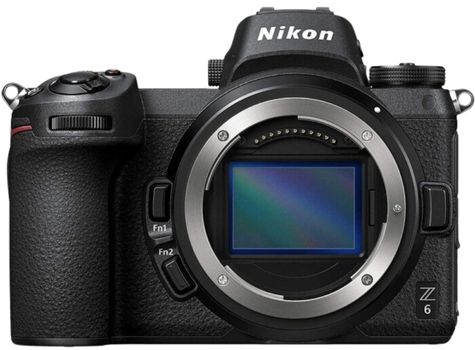
Let’s start with one of Nikon’s first full-frame mirrorless cameras, released alongside its high-resolution sibling, the Z7. Back in July 2018, Nikon introduced the Z6, offering 24 MP, ISO sensitivity from 100 to 51,200 ISO, expandable to 204,800, 273 focus points, RAW burst shooting at 12 frames per second, 4K UHD video at 30 frames per second, and solid connectivity, including microphone and headphone jacks, mini-HDMI, USB-C, and a remote-control port. For memory cards, Nikon opted for a single XQD card slot.
In terms of sensor resolution, 24 MP is, to me, a standard definition for a full-frame sensor. It offers several advantages, including enough pixels for fairly large prints. But in my opinion, the main advantage is that the files remain a reasonable size, especially when shooting in RAW. As a reminder, the more megapixels you have on your sensor, the larger your files will be and the harder they will be to process, which also requires a more powerful computer.
| Features | Visual |
|---|---|
|  |
The burst rate of up to 12 frames per second in RAW is not the very best on the market, especially for someone looking for a camera mainly for sports or action photography. However, in-body image stabilization helps you shoot at slower shutter speeds while limiting motion blur.
For video, this body already offered some very interesting features. Beyond the ability to record 4K at 30 frames per second, its connectivity clearly showed its hybrid orientation. User feedback often mentioned well-defined video with pleasing skin tones. But the video focus does not stop there. The microphone input is important, of course, but the headphone jack is especially useful because it allows audio monitoring while recording. This may seem like a small detail, but some more video-oriented cameras still lack it.
As you will have understood, the Z6 does not necessarily outperform all its competitors, but it is versatile enough to meet many different needs, especially since its value for money has become very good over time. There is also a second version of this camera, the Mark II, which improves many points, particularly autofocus.
Nikon Z7
While the Z6 is more photo/video oriented, the Z7 fully embraces its photographic side, especially with its 45 MP resolution, 14-bit RAW files, and 493 focus points. For video, it offers 1080p at 120 frames per second with a slight crop, as well as the same connectors as the Z6.
As a result, the Z7 is not fundamentally different from the Z6 in terms of body or connectivity. Overall, it offers almost all the same features as the Z6. However, the Z7 has a much higher image definition, with 45 MP, and almost twice as many focus points, giving autofocus more precision and flexibility. Also note that the RAW files are 14-bit compared with 12-bit on the Z6, offering a wider color range, and that the Z7 has a native ISO of 64, compared with ISO 100 on the Z6.
| Features | Visual |
|---|---|
|

One very important point deserves its own paragraph: the Z7 has no low-pass filter, just like the Z7 Mark II. This information is not always highlighted enough, even though it matters. For those who are not familiar with it, an AA filter helps reduce moiré effects but also slightly reduces image sharpness. In the case of the Z7, the sensor has enough megapixels to limit this issue, allowing Nikon to remove the low-pass filter found on some other cameras in this range. This gives the Z7 excellent image sharpness.
As you can see, this is a high-end camera, but not without compromise. Because the Z7 has such a high resolution, its burst rate is a little slower than the Z6’s, at 9 fps versus 12 fps. The Z7 will therefore be better suited to studio or landscape work, while the Z6 remains more comfortable for more versatile outdoor use.
Summary table - key features
Finally, here is a short summary table comparing the cameras mentioned above.
| Camera | Definition | Stab. | Weight | Dim. | Burst(electr.) | Video | Battery Life(Viewfinder) | Battery | Approx.price | Best price |
|---|---|---|---|---|---|---|---|---|---|---|
| Nikon Z9 | 45.7 Mp | YES | 3 lb / 1340g | 149 x 150 x 91 mm | 20 fps | 8K 30 fps | 650 images | EN-EL18d | $5 896 | Amazon B&H |
| Nikon Z5 | 24.3 Mp | YES | 1.5 lb / 675g | 134 x 101 x 71 mm | 5 fps | 4K UHD 30 fps | 390 images | EN-EL15c | $1 386 | Amazon B&H |
| Nikon Z6 | 24.5 Mp | YES | 1.5 lb / 675g | 134 x 101 x 68 mm | 12 fps | 4K UHD 30 fps | 290 images | EN-EL15b | $2 010 | |
| Nikon Z6 II | 24.5 Mp | YES | 1.6 lb / 705g | 134 x 101 x 70 mm | 14 fps | 4K UHD 60 fps | 340 images | EN-EL15c | $1 746 | Amazon B&H |
| Nikon Z7 | 45.7 Mp | YES | 1.5 lb / 675g | 134 x 101 x 68 mm | 9 fps | 4K UHD 30 fps | 330 images | EN-EL15b | $1 800 | Amazon |
| Nikon Z7 II | 45.7 Mp | YES | 1.6 lb / 705g | 134 x 101 x 70 mm | 10 fps | 4K UHD 60 fps | 330 images | EN-EL15c | $2 495 | Amazon B&H |
| Nikon Zf | 24.5 Mp | YES | 1.6 lb / 710g | 144 x 103 x 59 mm | 14 fps | 4K UHD 60 fps | 360 images | EN-EL15c | $2 196 | Amazon B&H |
| Nikon Z8 | 45.7 Mp | YES | 2 lb / 910g | 144 x 119 x 83 mm | 20 fps | 8K 30 fps | 325 images | EN-EL15c | $4 296 | Amazon B&H |
| Nikon Z6 III | 24.5 Mp | YES | 1.7 lb / 760g | 139 x 102 x 74 mm | 20 fps | 6K 60 fps | 360 images | EN-EL15c | $2 695 | Amazon B&H |
| Nikon Z5 II | 24.5 Mp | YES | 1.5 lb / 700g | 134 x 100 x 72 mm | 14 fps | 4K UHD 30 fps | 470 images | EN-EL15c | $1 696 | Amazon B&H |
| Nikon ZR | - | - | - | - | - | - | - | - | $2 196 | B&H |
If you are looking for a Nikon camera, I recommend checking out our dedicated page covering the most interesting Z-mount wide-angle lenses. We mention the best choices for a full-frame camera, the ones covered on this page, but also what to choose if you have a Nikon Z APS-C camera.
Which Nikon full-frame mirrorless camera?
So, what is my opinion on these bodies? The goal of this short section is to guide you as clearly as possible in your future purchase.
Let’s start with the “affordable full-frame mirrorless camera,” the well-known Nikon Z5. In my opinion, it still performs well compared with the few full-frame cameras in its category, especially the Canon EOS RP. It is a very good choice for anyone wanting to start with a full-frame camera, with solid specifications, very good image quality, and without necessarily spending a fortune. It could also be a good option for occasional video use. Another positive point, still in terms of cost, is the dual SD card slot, which is much cheaper to use than XQD.
If you are an amateur or intermediate photographer on a budget, the Nikon Z5 remains a good choice, even if it is starting to show its age. It works well for portraits, landscapes, and family photos. With its 24.3 MP sensor, 5-axis stabilization, and dual SD card slot, it offers excellent image quality. However, it is less suitable for action scenes, such as sports or wildlife, and for more advanced video work.
The Nikon Z6 II and Z7 II are still interesting options if you are looking for a more powerful and versatile camera with a bigger budget, although both are now starting to age. The Z6 II, with its 24.5 MP sensor and 14 fps burst rate, is suitable for versatile photographers and videographers, especially thanks to its 4K video at 60 fps. The Z7 II, with its 45.7 MP sensor and improved autofocus, is better suited to detail lovers, especially for landscape and studio photography. Since April 2025, the Nikon Z5 II has become a camera worth considering, with a reasonable price, modern autofocus, and impressive burst capabilities for its position in the range.
For more experienced photographers or professionals looking for the best performance, newer models such as the Z6 III, which offers excellent value, the Z8, and the Z9 clearly stand out. The Z6 III, with its 6K video and 24.5 MP sensor, is a powerful camera for photographers who want strong stills and video performance. The Z8, with its 45.7 MP sensor and 8K video capabilities, is ideal for demanding creative projects, a bit like a smaller and more affordable Z9. Finally, for professional photographers and well-equipped sports or wildlife enthusiasts looking for top-level performance, the Z9 remains the flagship option. With its ultra-fast burst shooting, advanced autofocus, and monobloc design, it is the camera Nikon needed to bring professional sports photographers from DSLR to mirrorless, while competing effectively with cameras such as the Canon R3 and Sony A1.
In short, whether you are starting out in full frame, already an advanced enthusiast, or working professionally, Nikon now has a body for almost every profile: from the Z5 and Z5 II for value, through the Z6 II/Z7 II for versatility, to the Z6 III, Z8, and Z9 for more demanding uses. The Nikon ZR also deserves a mention if your priority is video and cinema-style production.
I hope this page will be useful if you are seriously thinking about buying a full-frame camera body. For those who want to go further, you can also take a look at our page dedicated to Nikon APS-C mirrorless cameras, which covers the current Nikon APS-C Z range.
Of course, this page will be updated as Nikon releases new full-frame mirrorless cameras.
Feel free to leave a comment if you have any questions. And if you are still unsure about your choice, you can also have a look at the page summarizing everything about Canon full-frame mirrorless cameras. You may find what you are looking for.

Written by Sylvain PONS
I've been passionate about photography since 2010, learning as I went along. Today, I dedicate myself to guiding others in their choice of camera gear and sharing a variety of tips to improve their photography skills.
Despite our care, a mistake may have slipped into this article. If you find any, please don't hesitate to let us know so we can correct it as soon as possible and keep our information up-to-date!