Winter Via Ferrata at Cap Jaseux on the Saguenay Fjord
Last update: 06/18/2026
Our blog continues to grow thanks to you, our readers. This post may contain affiliate links, which means we can earn a small commission if you make a purchase through them, at no extra cost to you. This helps us to continue to bring you more and support our work!
Today, I’m sharing the third activity we tried during our 15-day February vacation in Quebec, more specifically in the Saguenay–Lac-Saint-Jean region. Mélanie has already written about her electric snowmobile experience in the village of La Baie, where she had a fantastic two-hour outing. Take a look at her article if you are curious about the experience.
In a previous article, I also shared our snowshoeing experience in Monts-Valin National Park, another memorable winter activity. This time, though, I’m focusing on something less familiar to me: via ferrata. I had never tried one in summer or winter, so the chance to experience the winter route at Cap Jaseux above the Saguenay Fjord immediately caught my attention.
I had never had an opportunity to try via ferrata in France, let alone during our more recent years in Tahiti and Guadeloupe, so I was genuinely excited to discover it. This article was produced in partnership with Manawa, the activity-booking platform we regularly use before our trips. Their team recommended this outing as one of the region’s standout experiences, and without giving too much away, those two hours lived up to the recommendation.
I hope this account gives you a clear sense of the experience and perhaps inspires you to try it for yourself.

My Winter Via Ferrata Experience
Arriving at the Site
The via ferrata site was a little over an hour from where we were staying. Mélanie chose to remain at the house with the kids, giving them a quiet half-day to rest, stay warm, and catch up on a little homework. We were not certain there would be a comfortable place for them to wait on site, so the arrangement worked well for everyone.
I leave at around 8:30 a.m., driving once again through beautiful scenery, and arrive at Cap Jaseux 30 minutes before the activity begins. At the main reception, I learn that I am the only participant that morning, which means I will have a private outing with the guide—an ideal introduction for a first-timer.
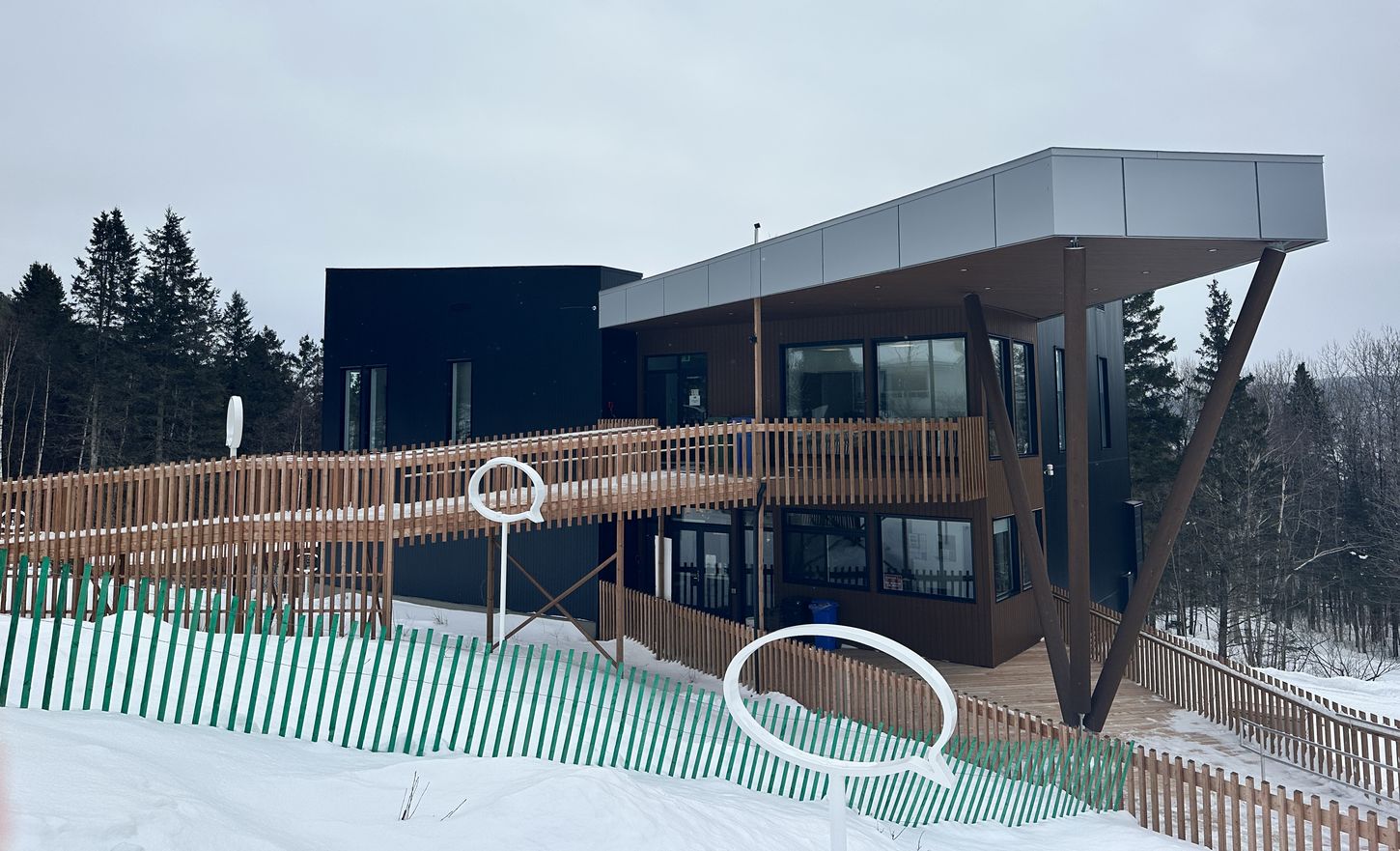
The staff explain that I need to get back in the car, pass through the gate, and follow the road down to the Murdock Pavilion, a black cabin where the guide will meet me. The temperature is surprisingly mild for winter, around -7°C to -8°C (19°F to 18°F), which makes the morning feel quite comfortable.
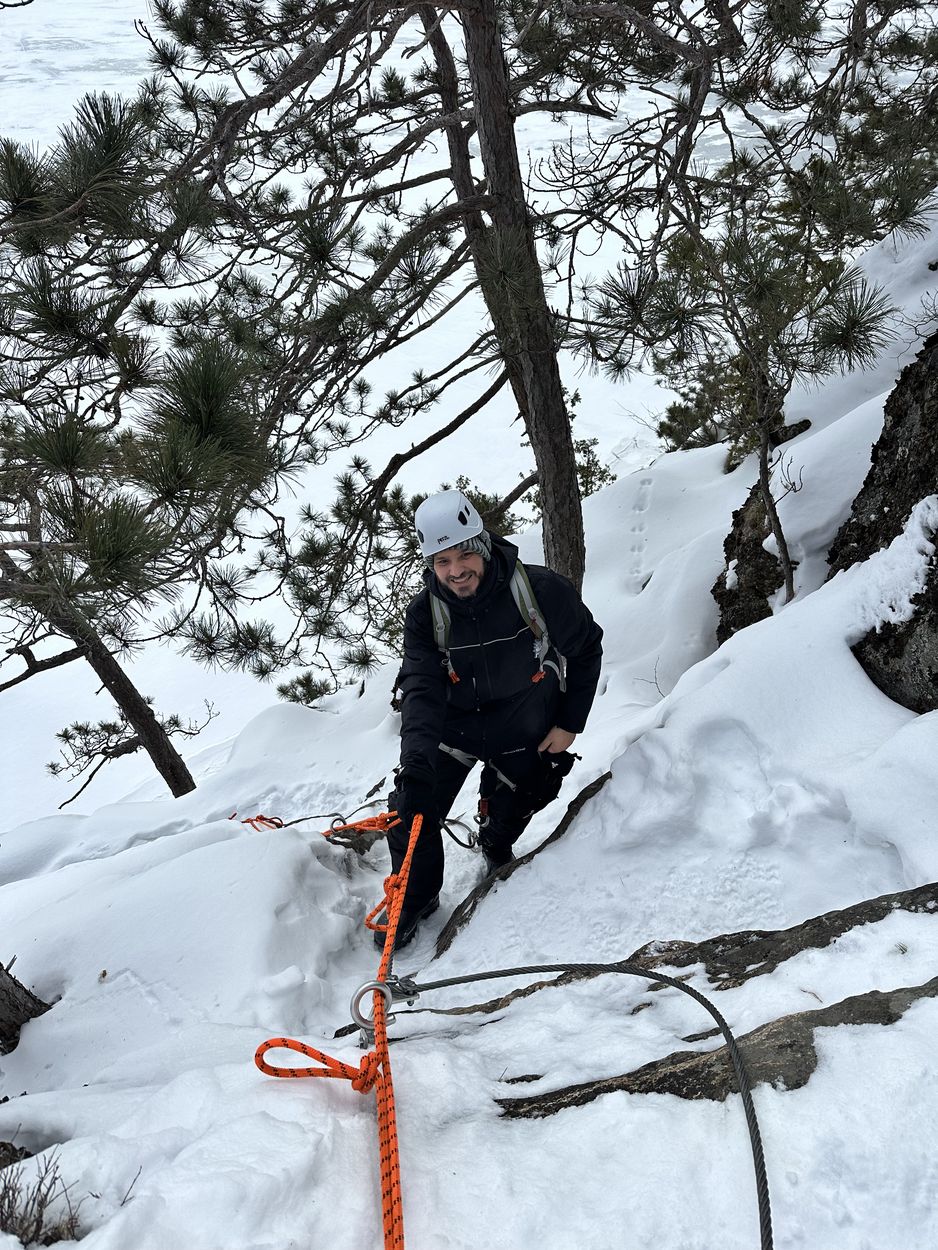
I drive down to the pavilion, park in the lower lot, and meet Victor, my guide for the next two hours. He confirms that no one else has booked the time slot, so it will be just the two of us. Amusingly, he looks remarkably like my childhood friend Anthony, whom I knew in college—almost an exact copy, only with more of a beard.
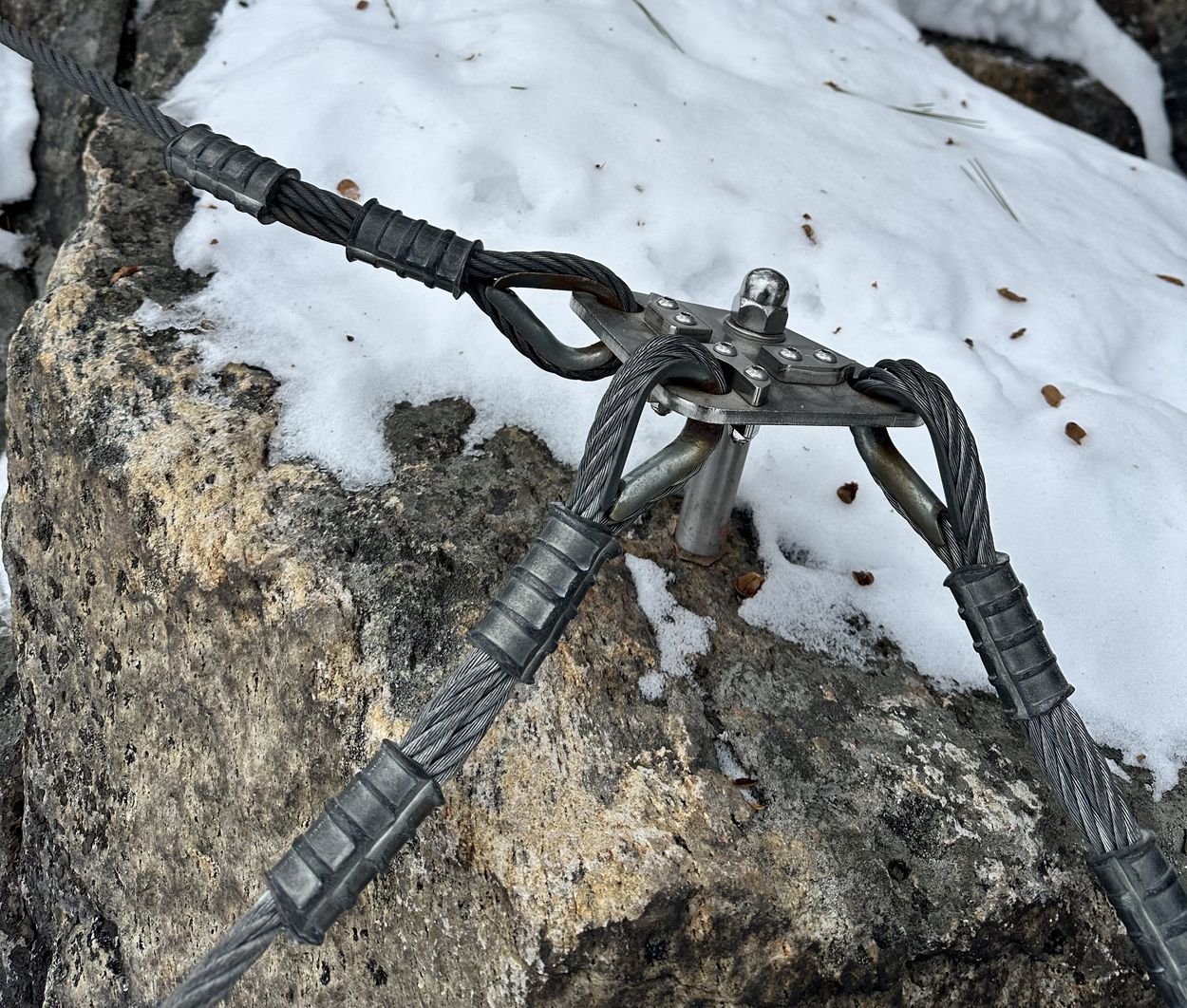
Victor explains how the outing will unfold and asks whether I have ever tried via ferrata before. Since the answer is no, he starts with the basics: how the harness works, how to use the carabiners, and how to remain connected to the safety cable throughout the route. He also shows me the additional resting carabiner, which can be clipped to an anchor point so I can relax my arms and sit back in the harness while facing the rock wall.
The system is not especially complicated. Victor has me practice on a small training wall, moving the safety attachment and carabiner along a short section. Although I have never done via ferrata, we have tried treetop adventure courses several times with the kids in Guadeloupe, and the basic principle feels similar. The main attachment follows a cable and must be passed through a series of metal junctions in the correct direction. That takes a little concentration at first, but the movement soon becomes intuitive. This particular winter route, however, is clearly more demanding than a family treetop course.
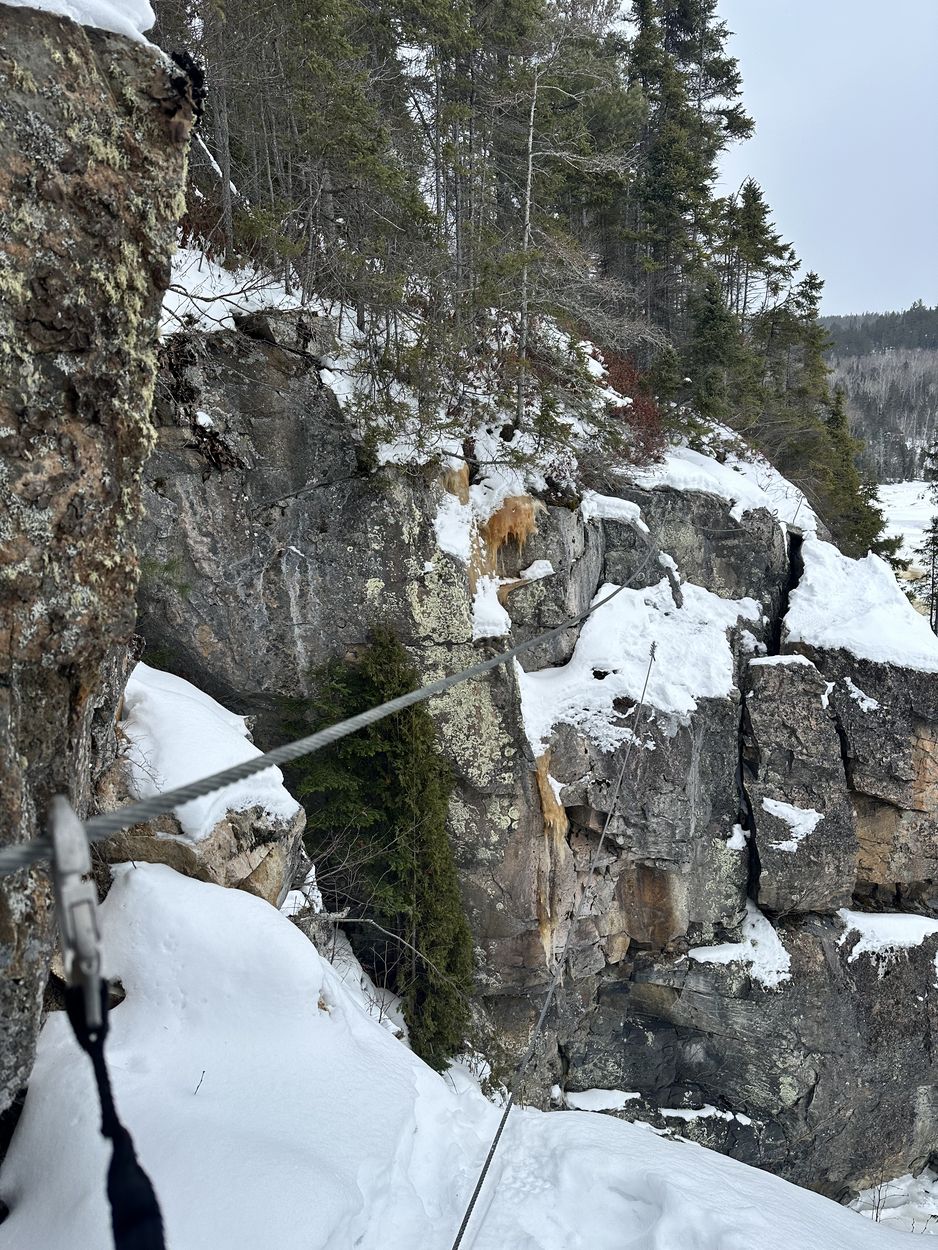
At several points, the route places you 20 to 30 meters (65 to 100 feet) above the drop, which may feel intimidating for anyone uncomfortable with heights. It also involves genuine rock climbing, so I quickly understand why Louis, at age 10, would not have been able to join me on this winter course.
I spend about five minutes practicing the carabiner movements with Victor before putting on the helmet provided for the activity. It proves essential: several times along the route, especially beneath overhanging rock, I bump it against the stone above me.
I bring the rest of my own clothing and personal gear. As a quick aside, we rented our winter clothes in partnership with Émilie from TUC & Bicycle Experience. As during our previous trip to Canada, the service was extremely practical: the clothing could be collected directly or delivered to the hotel, and several sizes were available. Coming from Guadeloupe, we own very little equipment suited to temperatures as low as -20°C (-4°F), so renting saved us from purchasing an entire winter wardrobe. I share more details in a separate article, but for now, back to the via ferrata.
Starting the Route
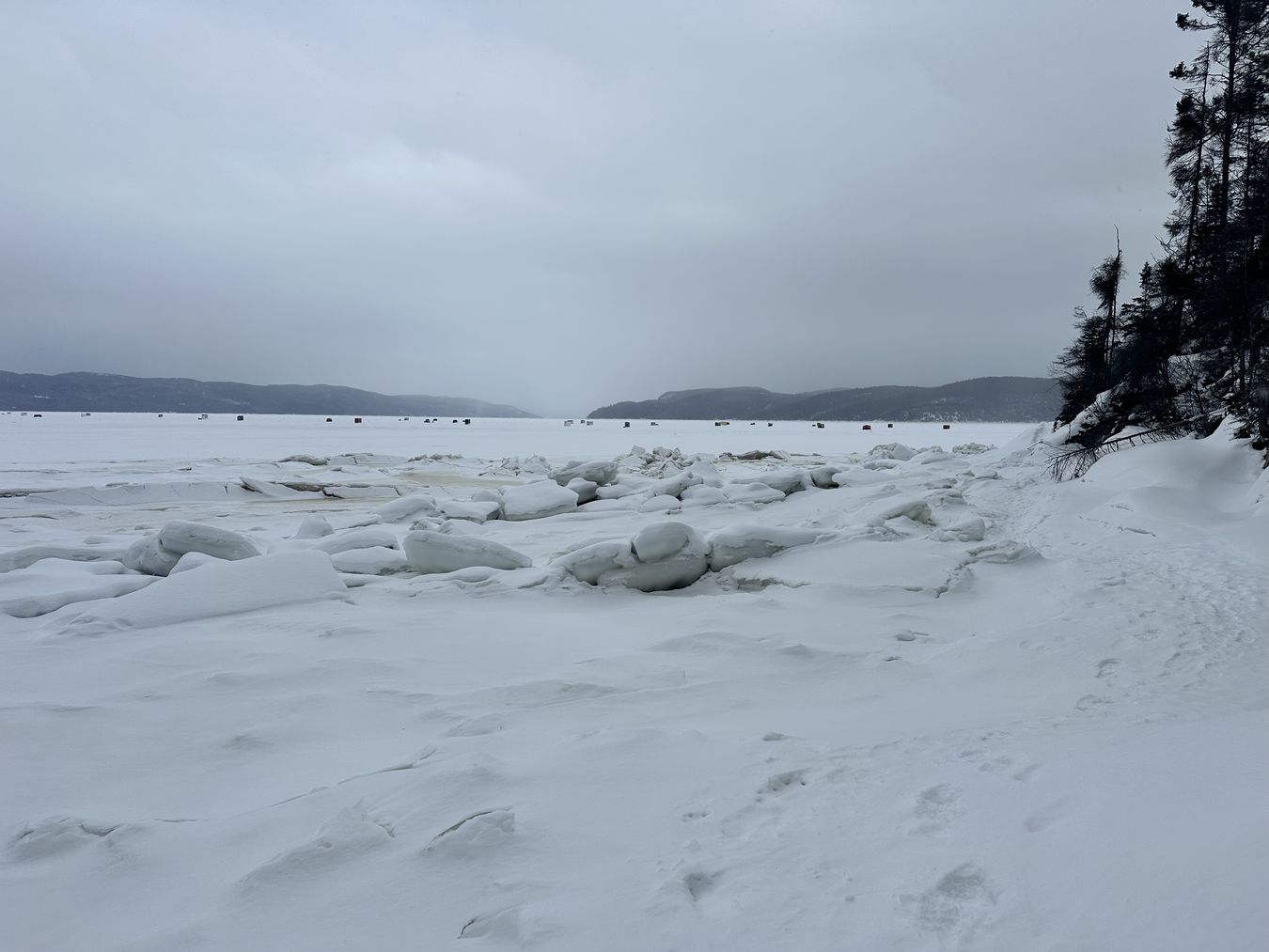
Once we are ready, Victor and I leave the pavilion on foot and head toward the “beach”—in quotation marks because the fjord is completely frozen at this time of year. A two-minute walk brings us to the shoreline. The sky is overcast, but the subdued light gives the landscape a distinctive atmosphere. I had noticed something similar while exploring the fjords of Norway a few years earlier: cloudy weather can sometimes make these places feel even more dramatic.
We follow the frozen shoreline for a few minutes in unexpectedly mild conditions and soon reach the start of the route. Victor reviews the system one last time, I attach myself to the safety cable, and we set off. He stays ahead so he can watch my progress and point out each obstacle as we approach it. The opening section is an easy warm-up: for about ten minutes, it feels much like hiking along the fjord, except that we remain clipped to the cable fixed against the rock. The frozen scenery is beautiful, and ice fishing huts are already visible across the fjord.
The first real obstacle is a narrow suspended crossing made from two cables: one for our feet and another for our hands. It sways noticeably above the drop, but remains manageable and leads us to the next section of rock. We gradually gain height until we are roughly ten meters (30 feet) above the ground. Despite the gray sky, being alone with a guide on the edge of the fjord feels like a rare privilege. Victor is also easy to talk to and tells me about his quiet life in a simple cabin in a nearby village.
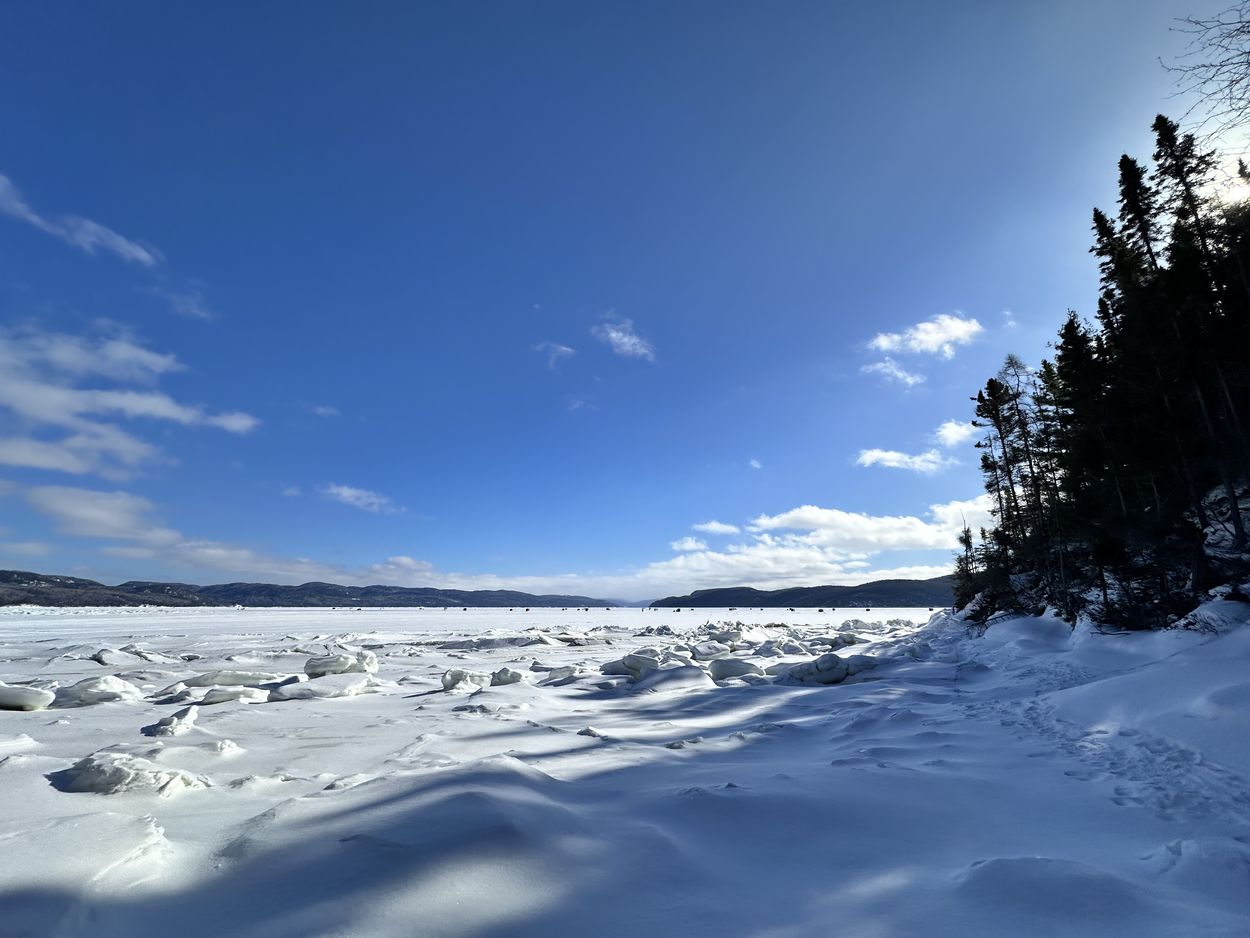
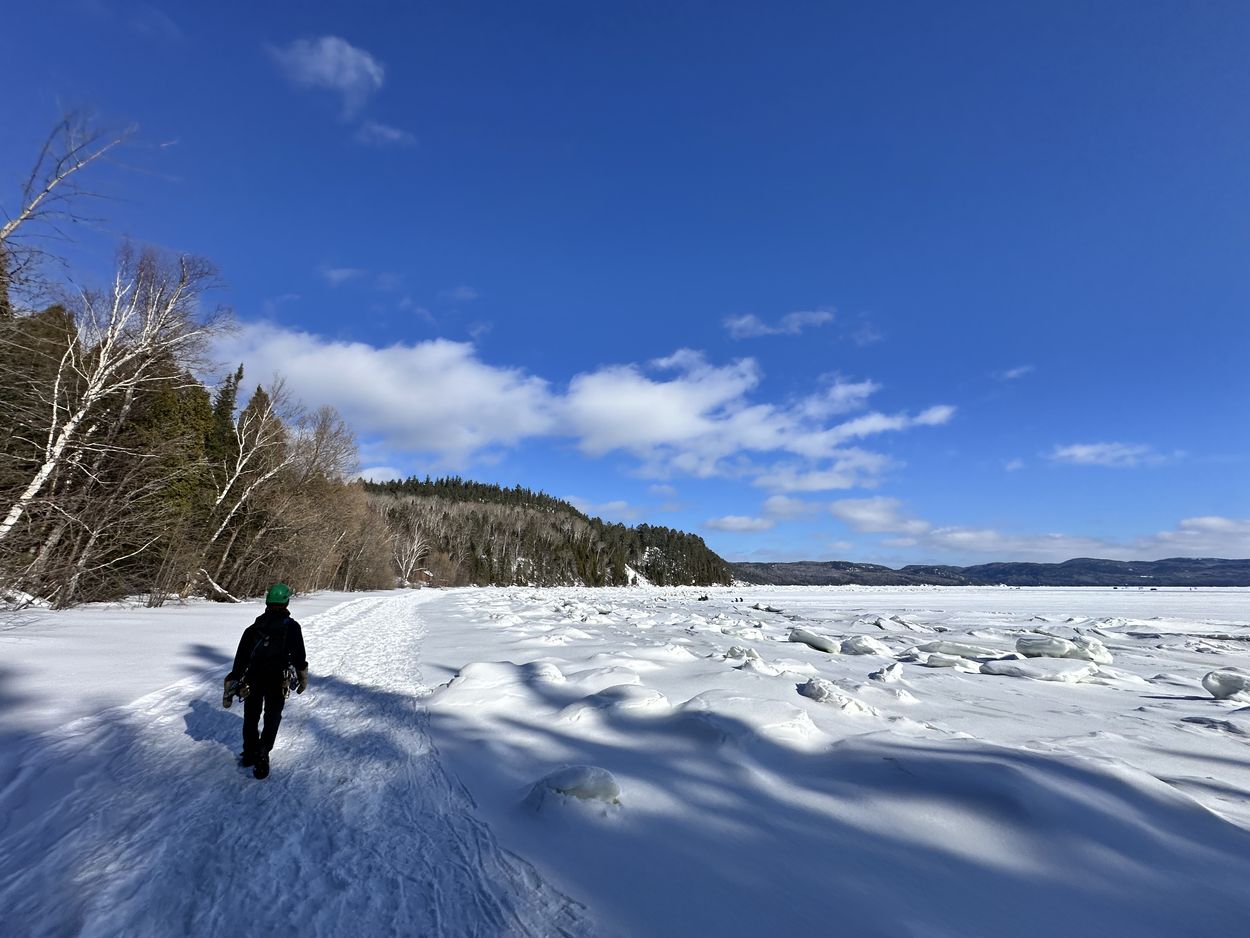
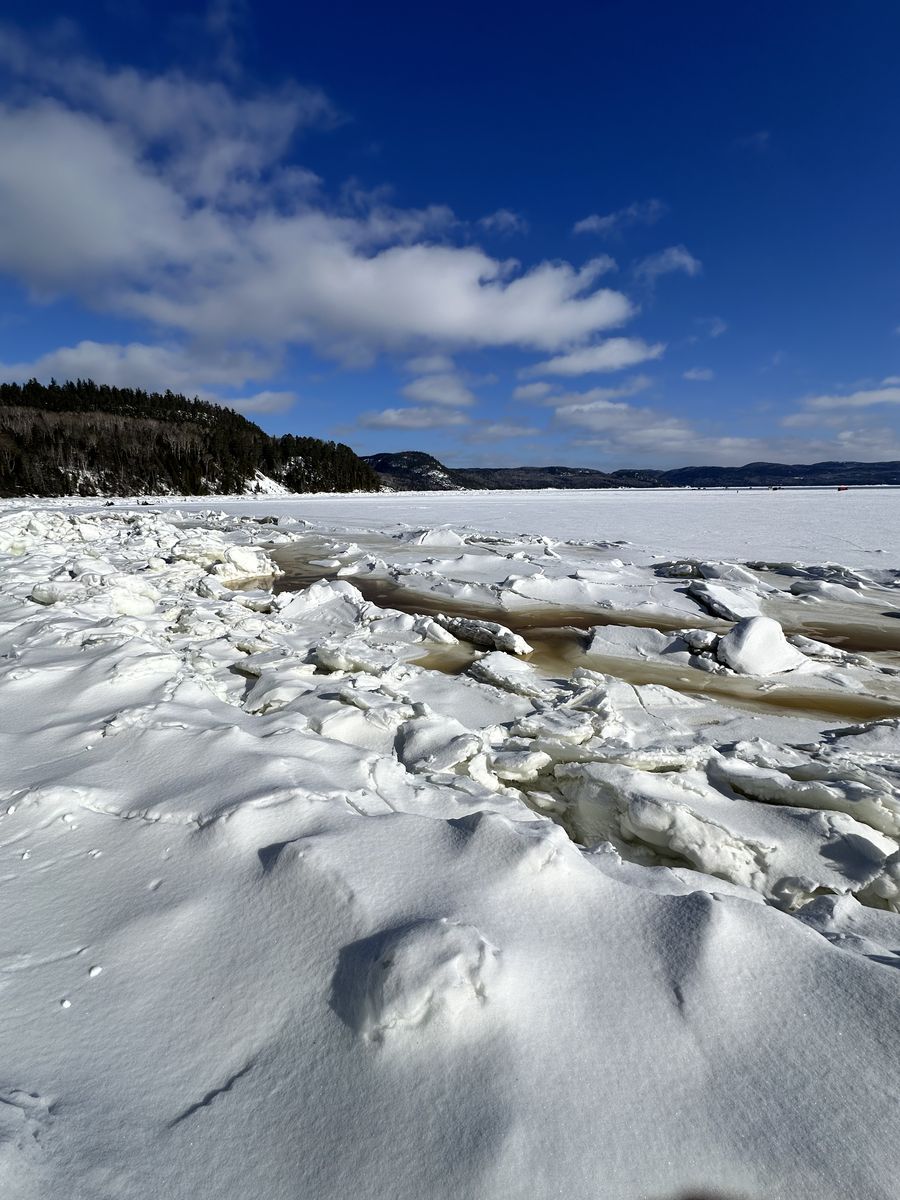
As we climb, the piles of ice along the rocky shoreline become increasingly visible. Victor explains that the tides press and crush the ice against the edges of the fjord, creating the distinctive mounds and rounded formations below us. They are highly photogenic, especially once the weather begins to clear later in the morning.
Victor also tells me about the fishing huts scattered around the bay. We had seen many more the previous day in La Baie, where they formed something resembling a small village and pickup trucks were driving across the ice. Once the fjord freezes, people set up huts and spend the season ice fishing. I later wrote about our own ice fishing experience, an outing Victor encouraged us to try because it is such a local and family-friendly winter tradition. He also explains that an icebreaker keeps a channel open for vessels supplying the small ports in the area.
Back on the via ferrata, the route becomes gradually more technical. Several sections require us to climb the wall vertically. None is exceptionally difficult, but some demand real effort, especially while continually moving the safety attachment past the cable anchors. By this point, we are around 30 meters (100 feet) above the frozen fjord, so I hold my phone very carefully whenever I stop for a photo. Taking pictures is not always easy because the safety system must be moved through another anchor every 5 to 10 meters (15 to 30 feet). Metal steps and handholds fixed into the rock provide welcome support along the steeper passages.
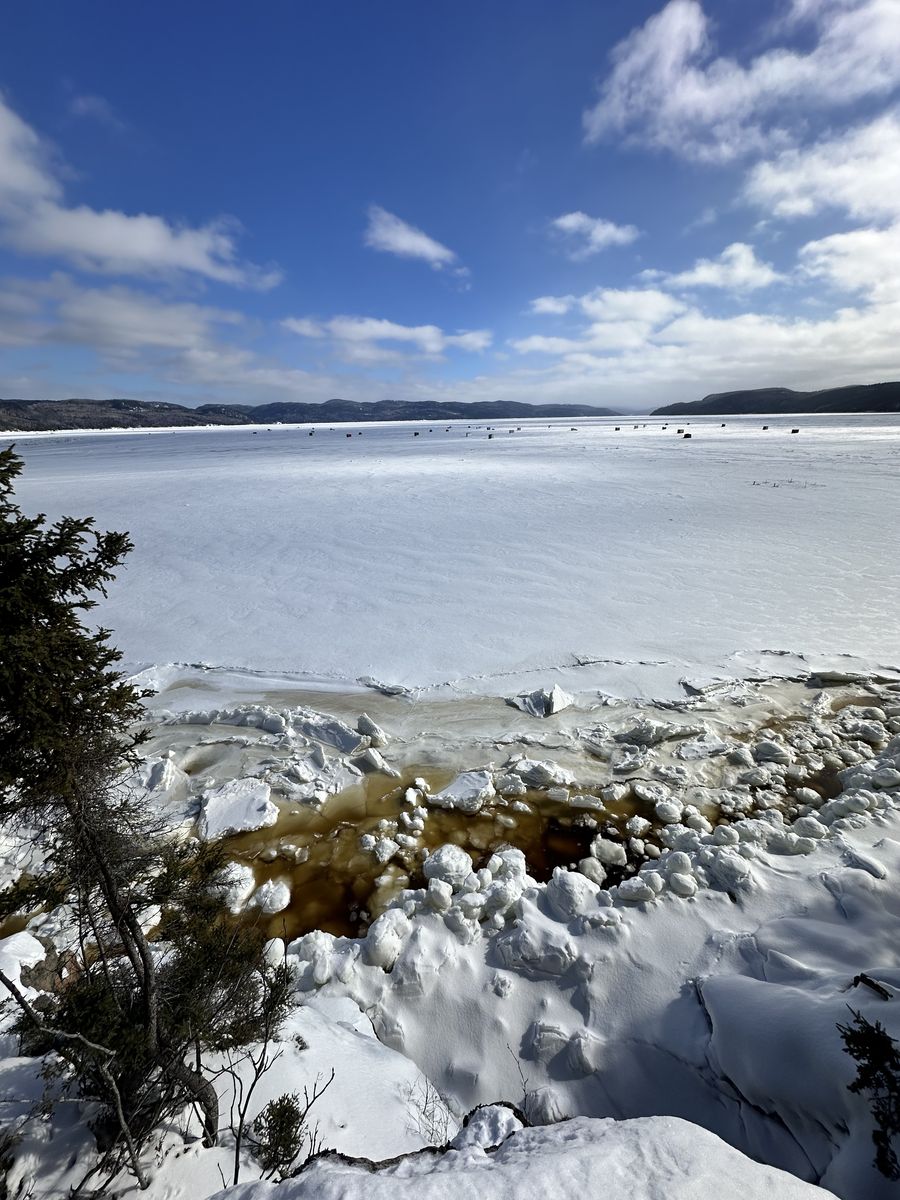
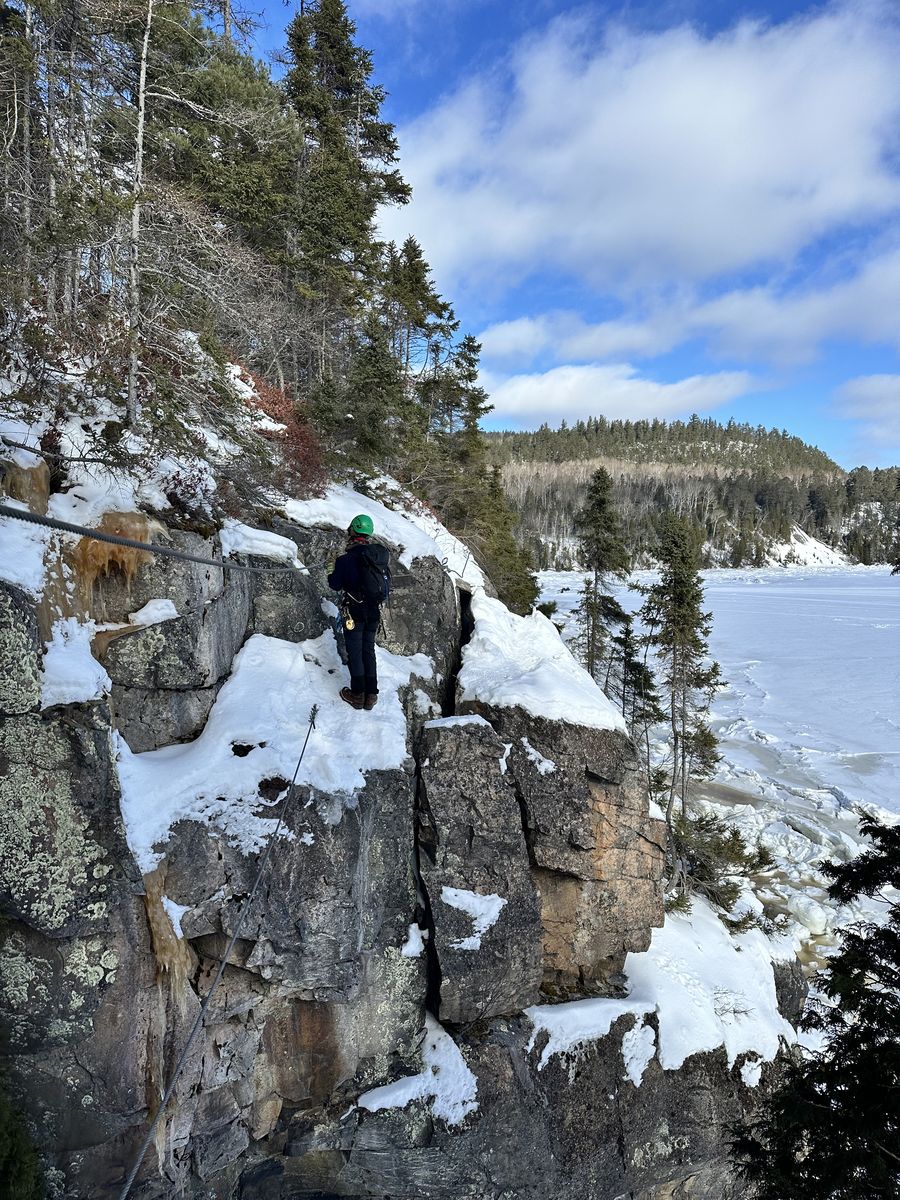
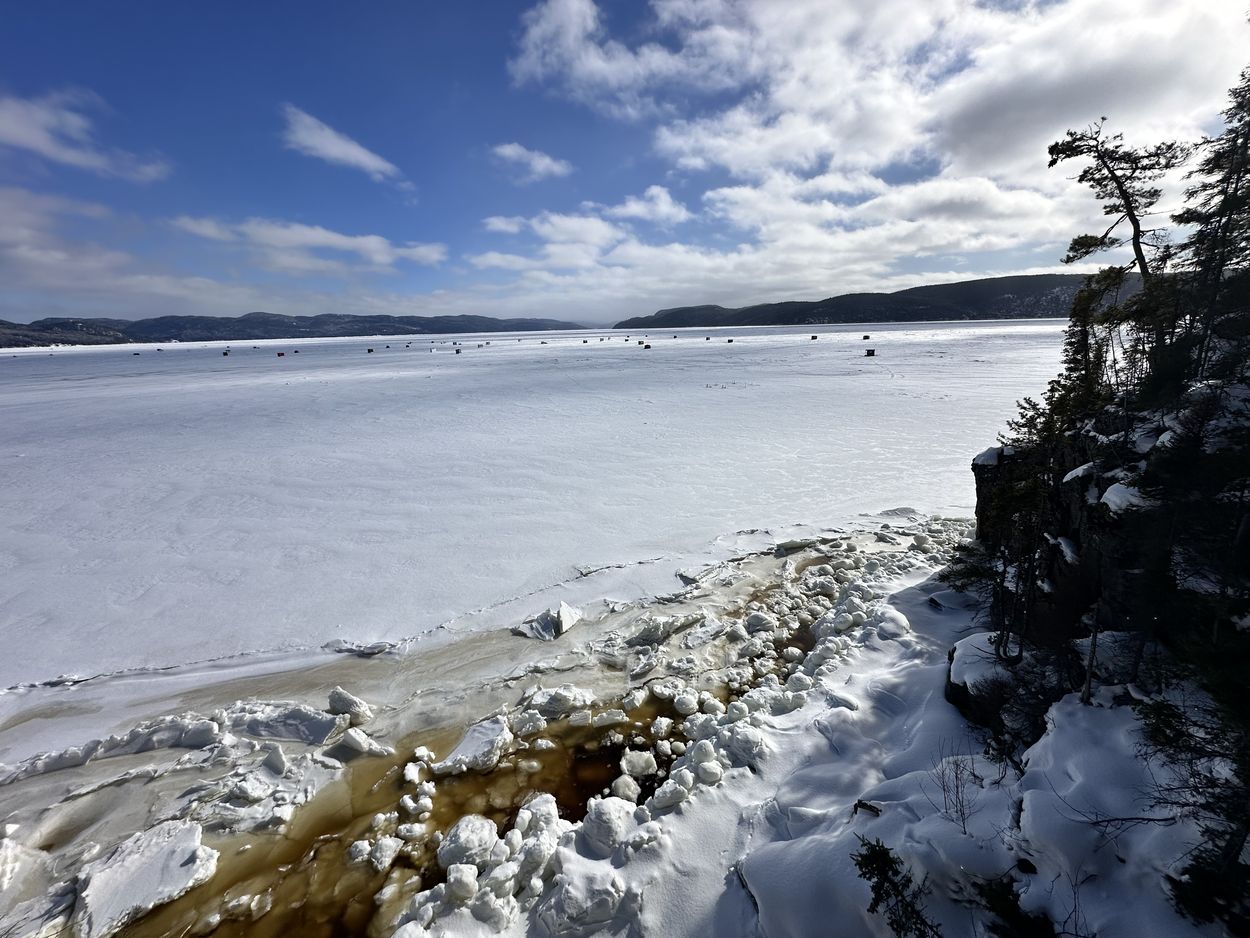
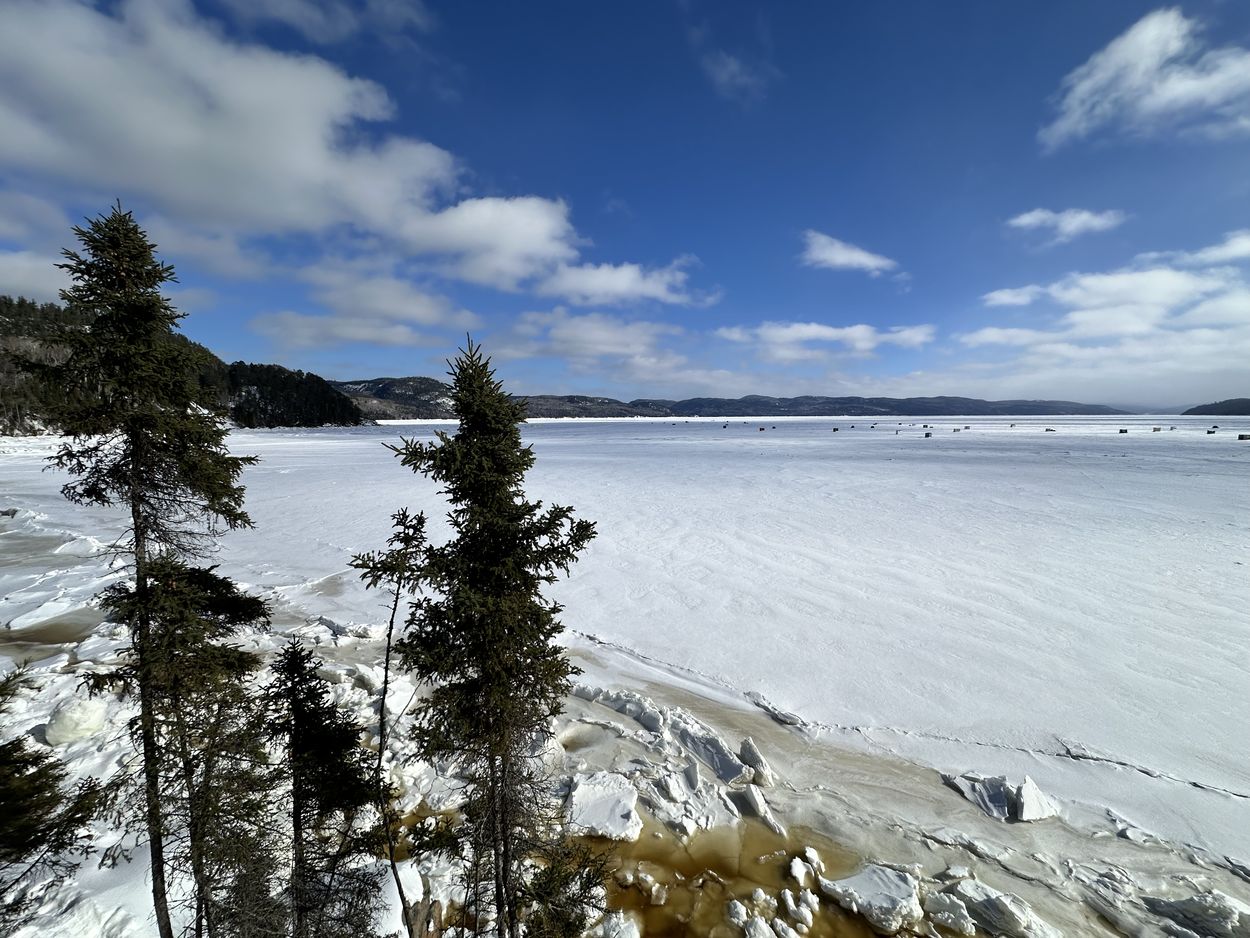
The most demanding section comes after 30 to 40 minutes, when the route traverses a vertical wall that occasionally becomes slightly overhanging. I have to pull on the metal holds and, for the first time, clip into a resting point to give my arms a break. Sitting back in the harness also gives me a moment to talk with Victor and take in the view. The section is challenging, but entirely manageable.
The final section climbs higher but is technically easier. The physical effort keeps me warm, and Victor and I talk throughout the ascent. After about an hour and 15 minutes, we reach a lookout with a wide view over the frozen fjord and its fishing huts. Patches of blue sky begin to appear, transforming the landscape. We spend about 15 minutes at the viewpoint before Victor offers me two options: a ten-minute forest trail back to the start or a descent along another section that reconnects with part of the via ferrata. Naturally, I choose the via ferrata, haha.
The return section is just as enjoyable, especially as the clouds continue to break and the views across the fjord open up. Perched high above the ice in this remote setting, I savor every moment. We return to the starting point in about 30 minutes. By then, the shoreline looks completely different: blue sky stretches above the fishing huts, the fjord is brighter, and the unusual ice formations along the edge stand out clearly. I stop for a few final photos before we walk back to the pavilion at an easy pace, delighted with the two hours I have just spent on the route.
My Final Thoughts on the Via Ferrata
This was an experience I would readily recommend. I have never tried via ferrata in summer, so I cannot compare the atmosphere, but the winter setting above a frozen fjord felt genuinely special. Having Victor to myself for the full two hours undoubtedly made the outing even more memorable. For anyone looking for a moderately athletic activity in the region, whether in winter or summer, via ferrata is well worth considering.
Practical Information
Here are a few practical details to help you plan your visit.
How to Get to Cap Jaseux
Travel time will depend on where you are staying in the region. We were based in the countryside near Alma, about an hour away. You can find the exact location on Google Maps. Renting a car is generally the easiest way to explore Saguenay–Lac-Saint-Jean independently. As on our other trips, we used DiscoverCars to compare offers from several rental companies and found a very good rate.

Where to Stay Nearby
We used HomeExchange for the first time on this trip. The platform allows travelers to exchange homes directly or use a points system, and our accumulated points enabled us to stay in the home of a Quebec family nearby. To learn more or create an account, you can use our referral link. Both you and we receive 250 bonus points, which may cover roughly two nights depending on the destination.
For more traditional accommodations, these are a few nearby options worth considering:
- Gite du Lac Docteur: This lakeside bed and breakfast in Saint-Honoré offers comfortable family rooms with balconies, direct access to canoes, pedal boats, and kayaks, and a peaceful setting near the Monts-Valin. The property is also known for its warm welcome and generous homemade breakfast,
- Exode en Nature: This eco-friendly cabin for four in Sainte-Rose-du-Nord offers a private hot tub, sauna, and river views in a quiet forest setting near the Saguenay Fjord,
- Ferme Jardin Potager: Set in a historic farmhouse dating from around 1900, this charming property in Sainte-Rose-du-Nord offers rooms and apartments with beautiful fjord views. Its atmosphere blends village heritage with nature, along with a warm welcome and homemade breakfast.
You can also use the map below to browse accommodations in the part of the region that best suits your plans.
Book your accommodation near Saguenay
Use the interactive map below to find your future accommodation!
What Else Can You Do at Cap Jaseux?
Although I visited specifically for the two-hour winter via ferrata, Parc Aventures Cap Jaseux offers a wide range of activities depending on the season. These include summer via ferrata, aerial adventure courses in summer and winter, ice fishing, kayaking during the warmer months, and several hiking trails. Other experiences may include outdoor discovery activities and nature-focused workshops. With so much available on and around the site, it can easily justify more than a single visit.
I hope you enjoyed this account of the via ferrata above the Saguenay Fjord. For travelers visiting the region in winter, it is an activity well worth considering.
For another memorable winter outing in the Saguenay region, read our account of dog sledding in La Baie, just outside Saguenay.
See you soon,

Written by Sylvain PONS
I had the opportunity to explore the beauty of this country I love on several different occasions and in different places (Canadian Rockies, the Island of Newfoundland for 1 month, Yukon and Québec)!
Despite our care, a mistake may have slipped into this article. If you find any, please don't hesitate to let us know so we can correct it as soon as possible and keep our information up-to-date!