FujiFilm APS-C mirrorless cameras
Last update: 05/04/2026
Our blog continues to grow thanks to you, our readers. This post may contain affiliate links, which means we can earn a small commission if you make a purchase through them, at no extra cost to you. This helps us to continue to bring you more and support our work!
In this article, I will discuss Fujifilm mirrorless cameras. Founded in 1934, Fujifilm is a historical brand of photography which has built a solid reputation during the film era, especially thanks to its films with appreciated and recognizable effects. When digital photography came into play, the brand became more discreet, until the release of the X100 in 2011, an expert compact with an APS-C sensor.
It was not long before, the same year, Fujifilm released its mirrorless cameras introducing the X mount. Designed for APS-C sensors, Fujifilm chose to focus on this format only and to offer high-end gear, when other brands such as Sony, Nikon and Canon considered (and continue to do so) this format as amateur gear, a jumping-off point to full frame. If you’re interested in this brand, we’ve just started writing our first comprehensive guide about the best Fujifilm wide angle lenses.
If you are still hesitating about buying an APS-C camera, Canon has just released their first two Canon RF APS-C cameras.
Thus, Fujifilm was able to enter a previously unoccupied market segment, with relatively affordable cameras that were also light and compact, especially compared to DSLRs in this format, and offering high-end lenses with serious construction and large apertures. This type of offer being limited in other brands or requiring to switch to compatible lenses but designed for full frame, which adds to the weight, size and price.
Since then, these cameras have found a large audience, and Fujifilm has not only attracted a nostalgic clientele but also newcomers who have quickly appreciated the expertise of the brand, both on ergonomics and JPEG treatment. On this point, Fujifilm had to be particularly attentive because at that time, few software were able to process their RAW, which does not take anything away from their merit – in particular the possibility to simulate film renderings directly in the camera, which few brands offer. Fujifilm has also expanded its camera line-up, which we’ll look at in more detail now. If you are interested in buying a Fujifilm camera, I invite you to have a look at all X-mount lenses available.
To help you choose the right camera for your needs, we have put together a comprehensive guide to the best Fujifilm cameras on the market right now.
- 10/28/2025 : Fujifilm X-T30 III
- 06/15/2025 : Fujifilm X-E5
Are you interested in Fujifilm? Are you considering buying a camera? Be sure to check out what macro lenses the brand offers!


FujiFilm APS-C mirrorless cameras
Before explaining in detail the most important functions of each camera, I invite you (especially if you are looking for a camera) to read our comprehensive article explaining all the things to keep in mind when choosing your digital camera.
If you want to compare the cameras on this page with other brands in detail, we've created our own free comparison tool, so don't hesitate to try it out!
Fujifilm X-E5
Announced for June 2025, the Fujifilm X-E5 succeeds the X-E4, bringing a major upgrade to Fujifilm’s compact mirrorless line. Its “retro” design is reminiscent of classic film cameras, yet behind this vintage look lies modern technology. The camera is equipped with a 40.2 MP APS-C X-Trans CMOS 5 HR sensor with 5-axis stabilization, paired with the X-Processor 5—a combination already proven in other Fujifilm models. This duo ensures excellent image quality, rich detail, and plenty of flexibility for RAW editing. The native sensitivity range runs from ISO 125 to 12,800 (expandable to ISO 64–51,200), while burst shooting reaches 8 fps with the mechanical shutter and 13 fps electronically, along with video recording options in 6.2K 30p or 4K 60p (with crop).
The X-E5 keeps the strengths of its predecessor—compactness and lightness—but introduces a refined design. It features a more pronounced grip for improved handling, a 3-inch tilting LCD, and a 2.36M-dot OLED viewfinder, which makes framing more comfortable in different situations. Fujifilm also added a dedicated film simulation dial, giving instant access to 20 color profiles, including well-known looks such as Classic Chrome, Acros, and Reala Ace.
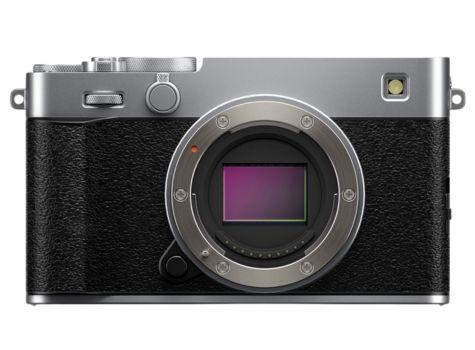
With its 124.9 x 72.9 x 39.1 mm body and a weight of just 445 g including battery, the camera is perfectly suited for street photography, lightweight travel, or discreet reportage. Its versatility is further enhanced by the launch of a new lens designed specifically for it: the XF 23mm f/2.8 R WR pancake, compact and weather-sealed, making it the ideal everyday companion for capturing daily life or travel moments without extra bulk.
In practice, the X-E5 offers the charm of the Fuji X100VI but with the full flexibility of the X-mount system. Its 425-point autofocus system combined with in-body stabilization ensures fast and accurate performance, whether shooting stills or moving subjects. While the price is noticeably higher than that of the X-E4, Fujifilm has addressed the main weaknesses of the previous generation—lack of stabilization and limited AF. The result is a compact, stylish, and highly capable mirrorless camera that delivers strong performance for both photo and video.
Fujifilm X-M5
The Fujifilm X-M5, released in October 2024, marks the revival of compact mirrorless cameras in the Fujifilm range, four years after the X-E4, which was released in March 2021. Featuring a 26.1 MP APS-C sensor and the all-new X-Processor 5 processor, it combines performance and compactness in a body weighing just 355g. Its compact size, without a viewfinder, echoes the philosophy of the X100 series, but with the freedom to use interchangeable lenses (X-mount). Its 1.04 million-dot swivel screen makes it easy to capture images from any angle, an advantage for vloggers and content creators.
Despite its small size, the X-M5 is extremely responsive thanks to its 20 fps electronic burst, which captures the fastest moments with precision. Its native ISO range of 160 to 12,800, extendable to 51,200, guarantees performance in a wide range of lighting conditions. However, like its predecessor, the X-M5 does not offer sensor stabilisation or tropicalisation, economical choices designed to keep the price affordable. The minimalist design is elegant and functional, with intuitive controls and ergonomics reminiscent of Fuji’s traditional film cameras.

On the video front, the Fujifilm X-M5 offers 6.2K at 30 fps, a remarkable new feature for this range. It also offers 4K at 60 fps and Full HD slow-motion at up to 240 fps. Although the camera does not have mechanical stabilisation, powerful digital stabilisation is available, albeit at the cost of slight image blurring. The X-Processor 5 processor also optimises autofocus, which is boosted by AI algorithms. It accurately tracks a wide range of subjects, including human faces, animals, vehicles and even insects, making your life much easier.
Finally, the X-M5 honours Fujifilm’s DNA with 20 film simulation modes, including the latest REALA ACE for faithful colour reproduction. This mirrorless camera combines creativity, the latest technology and accessibility, making it the ideal camera for everyday photographers.
Fujifilm X-T50
The Fujifilm X-T50, introduced in May 2024, arrives almost three years after its predecessor, the X-T30 II. In order to focus its efforts on this model, Fujifilm decided not to release an X-T40. One of the most important changes in this model is the integration of a new 40.2 MP APS-C sensor and the X-Processor 5. The latter offers improved performance. Another significant development is the UHS-II SD card slot, which allows faster transfer speeds, ideal for processing high-resolution files. The viewfinder resolution has also been improved to 2.36 m-dots. However, its weight has increased slightly to 438g, making it slightly larger than its predecessors.
The Fujifilm X-T50 boasts significant improvements in image and video quality. The touchscreen resolution has been increased slightly to 1.84 m-dots, while the video capacity has been increased to 6.2K at 30 fps, giving videographers more flexibility. The ISO range has also been extended downwards, starting at ISO 125. In terms of performance, the camera achieves an impressive electronic shutter speed of 1/180,000 and an electronic burst at 20 fps, ideal for capturing fast-moving action.
| Features | Visual |
|---|---|
|

Despite these advances, some aspects, such as battery life, remain average and do not allow the X-T50 to fully stand out in its category. The ergonomics have been redesigned to provide a better grip, with more rounded shapes and a more pronounced thumb rest. With its compact, lightweight design, this camera is well suited for street or travel photography. However, the lack of tropicalization and the single SD slot could be a drawback for some demanding users.
In conclusion, the Fujifilm X-T50 is a very good APS-C mirrorless camera that combines elegance, performance and compactness. It could easily be positioned between an XT-5 and an XS-20. It offers excellent image quality and advanced video capabilities, while incorporating Fujifilm’s latest technologies.
Fujifilm X-S20
In June 2023, Fujifilm has released the successor to the famous X-S10 in a solid, high-quality 26.1 MP body. Fujifilm continue to use its stabilised 26.1 MP APS-C sensor and incorporate the X-Processor 5, found in recent cameras such as the Fuji X-H2S, which significantly improve the camera’s capabilities, particularly in terms of subject tracking, autofocus and continuous shooting.
In terms of main features, there are many similarities with the X-S10, including the same ISO range (ISO 160 to 12800, expandable from 80 to 51200), a 2.36MP electronic viewfinder, Wi-Fi and Bluetooth, and the same number of AF points (425).

However, there are a number of improvements over its predecessor, in particular an improved and larger battery (NP-W235), which extends video recording time (from 40 minutes in 4K to 80 minutes) and, above all, increases the camera’s autonomy to around 750 shots according to the CIPA standard (whereas the X-S10 was limited to 350 shots). Autofocus has also been improved, including artificial intelligence technologies similar to the X-T5’s or X-H2’s tracking. Stabilisation is said to be slightly better. The burst rate remains the same as the previous model, with the possibility of shooting at 30 fps in sports mode. The resolution of the LCD screen has also been improved and is now fully articulated.
On the video front, the Fujifilm X-S20 follows in the footsteps of the X-T5, offering 6.2K resolution at 30fps and 4:2:2 colour depth in 10-bit. There’s also a choice of 4K quality in DCI format at 60fps or 4K UHD. The buffer has also been improved, thanks to a better processor and larger memory card capacity (UHS-II compared to the old UHS-1).
All in all, Fujifilm has come up with a very attractive camera that will appeal to a lot of people, making it a great alternative to the much more expensive Fujifilm X-T5.
Fujifilm X-T5
The Fujifilm XT-5, a jewel in their APS-C mirrorless lineup, stands out as a testament to the brand’s commitment to innovation and quality. At first glance, the XT-5 might look very similar to its predecessor. However, upon closer inspection, you’ll notice some subtle changes that make a big difference in terms of ergonomics and handling. The grip is deeper and more contoured, making it more comfortable to hold for extended periods. The buttons and dials have been slightly repositioned for improved accessibility, and the overall layout feels more intuitive. This compact powerhouse measures a mere 130.3 x 92.9 x 58.2mm and weighs 557g (body only), making it a travel-friendly dream.
The XT-5 boasts a newly developed 40MP APS-C X-Trans CMOS sensor, paired with the powerful X-Processor 5. This combination delivers exceptional image quality, with sharp details, accurate colors, and impressive low-light performance. Whether you’re shooting landscapes, portraits, or action shots, the XT-5 is capable of capturing stunning images.

The XT-5 benefits from a significant upgrade in the autofocus system. It now features a 425-point phase-detection autofocus system with subject tracking, eye detection, and animal detection. This makes it easier than ever to lock onto your subject and maintain focus, even in challenging lighting conditions. For videographers, the XT-5 is a dream come true. It can record 6K video at up to 30fps and 4K video at up to 120fps, making it perfect for capturing slow-motion footage. The camera also supports 10-bit internal recording and F-Log output, giving you more flexibility in post-production.
The XT-5 isn’t just about specs; it’s about a seamless workflow that empowers your creativity. The new USB-C port with charging support keeps you powered up for longer adventures, while Bluetooth and Wi-Fi connectivity make sharing your masterpieces a breeze. The intuitive controls and customizable shooting modes let you personalize your experience, while the intelligent “Auto ISO” mode takes the guesswork out of capturing perfect exposures in challenging light. Building on Fujifilm’s legacy of film expertise, the XT-5 offers a range of film simulation modes. From the classic tones of Classic Chrome to the high-contrast monochrome of Acros, these modes provide photographers with creative options for in-camera image processing.
Fujifilm X-H2S & Fujifilm X-H2
For the 10th anniversary of the Fujifilm X-mount, the company presented in 2022 not one but two new cameras. First, released in May, the XH2-S (S stands for speed): a 26 MP mirrorless APS-C camera built around a stacked BSI 5 CMOS sensor. Then, a few months later, Fujifilm announced the release of its latest APS-C mirrorless camera, the XH2: a 40.2 MP definition around the 5th generation CMOS BSI sensor.
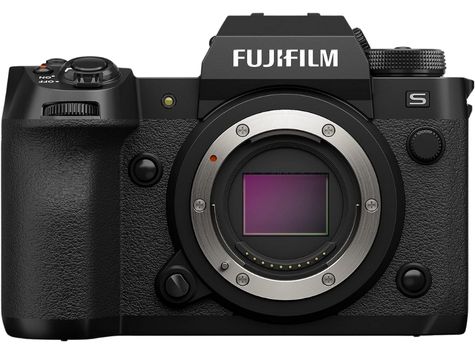
As far as appearance goes, the X-H2 body is identical to the X-H2S, except for the camera name and the “S” badge on the front of the high speed version. They have both robust and weather sealed bodies, a bit bigger than an XT-4 or X-S10. Their dimensions are identical: 136.3 x 92.9 x 84.6 mm, with a weight of 660g including battery and memory card. There is also a large ergonomic grip. The viewfinder and screens are the same, the rear touchscreen is fully articulated and the large OLED viewfinder has a 0.8x zoom factor.
The sensor is one of the biggest differences between the Fujifilm X-H2 and the Fujifilm X-H2S. Both cameras benefit from a 5th generation X-Trans CMOS sensor, but the introduction of a stacked CMOS sensor on the X-H2S comes with a significant increase in the camera’s readout speed. This combination allows for faster shooting burst speeds up to 40 fps, faster and more sophisticated autofocus, and higher frame rate video with minimal rolling shutter. For sports use, the advantage goes to the Fujifilm X-H2S. On the other hand, the non-stacked BSI sensor of the X-H2 is simpler but still keeps a 15 fps burst, which is often enough.
The Fujifilm X-H2S
The Fujifilm X-H2
| Features | Visual |
|---|---|
|
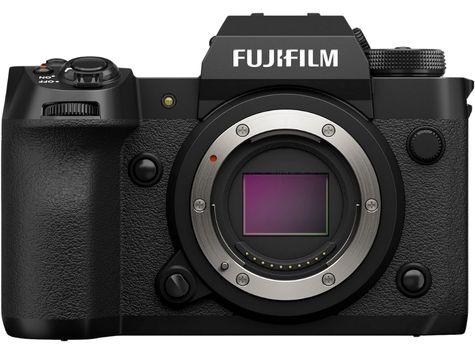
For high-definition photography, the X-H2 is the one to look to. With its 40 MPX sensor, it is currently, at the time of writing this article, the most high definition APS-C mirrorless camera on the market. Its 5th generation sensor offers better low light performance, better dynamic range and higher level of details.
Regarding autofocus, the AF system of the X-H2S was significantly improved for a more persistent subject tracking. The subject recognition modes work very well. The X-H2 uses the same processor and the same algorithms, but the performances are not identical with a significant disadvantage of the X-H2 in action scenes, the stacking of the sensor of the X-H2S is clearly seen. Thus, we note an advantage to the “S” body where the faster sensor performs better with high speed subjects and where trajectories are more random.
We still have to compare videos on these two cameras, and on this point the X-H2 has a small advantage on the definition, obviously. With its 40 MP sensor, the X-H2 can produce 8K 30p video. If 8K is too much for you, you have the option of shooting 6.2K 30p and 4K UHD and DCI at 60p. All in 4:2:2 10 bits. Obviously the X-H2S is not limited to 6.2K 30p and 4K 60p without a crop. On the other hand, the 4K 120p mode applies a 1.29x crop, but at least it offers 4K 120p unlike the X-H2. Of course, the X-H2’s slower sensor means it can’t match the X-H2S’s impressive readout rates. In short, whether it’s stills or video, the X-H2 is designed more for static or slow subjects. The conclusion is that there is not really one better than the other… Each one has its own area of expertise, speed for the X-H2S and high definition for the X-H2, as Fujifilm probably intended them. Both are ultra powerful and will be able to meet the needs of a large number of wealthy photographers and videographers.
Older Fuji X mirrorless cameras
In this section you’ll find details of all the “old” cameras, as they have been redesigned or are no longer available on the market. Some are still available.
Fujifilm X-T30 II
Released shortly after the X-E4, the X-T30 II is the second version of the X-T30 (it is the first Fujifilm camera with the “mark II” designation). Many expected an X-T40 inspired by the X-T4 with stabilized sensor, but Fujifilm preferred to take most of the X-T30 and update the firmware to improve the AF, the scene recognition in automatic mode, and add some movie simulations and options in the video mode.
| Features | Visual |
|---|---|
|

We thus find the X-T30 body with a slot for SD card, a thin grip but more pleasant than the X-A and X-E for the handling, as well as the 26MP X-Trans sensor with a native sensitivity range of 160 to 12800 ISO extensible from 80 to 51200, the AF with 425 AF points and the electronic viewfinder of 2.36MP. The autonomy is, as for the X-E4, of 380 images, and the burst rate of 30 images per second, as on the 1st version. On the other hand, if the rear screen remains touch-sensitive and tiltable but not orientable, it gains a better definition. The video mode still offers 4K at 30 frames per second, but it benefits from a larger video stream with a recording time limit of 30 minutes. Full HD also gains in slow motion with a rate of 240 frames per second, instead of 120 with the 1st version. Again, like all recent Fuji cameras, we still have Wi-Fi and Bluetooth.
The price, weight and performance of this camera can make it more interesting than the X-E4. The design and the grip will make the difference between them.
Fujifilm X-T4
We now come to what can be called the Fujifilm pro range with the X-T4. Here we find the essence of Fujifilm ergonomics and all the expertise of the brand for the construction of the body since it is a range of bodies with an all-weather construction.
| Features | Visual |
|---|---|
|  |
We find, once again, the 26MP X-Trans sensor which, as for the X-S10, benefits from stabilization with a native sensitivity range of 160 to 12800 ISO extendable from 80 to 51200. An AF of 425 AF points, a burst of 20 images per second, Wi-Fi, Bluetooth, and the orientable touch screen are all included. But what comes next becomes more interesting: 2 SD slots, an electronic viewfinder of 3.7MP, a 4K video mode at 60 frames per second (but with a crop of 1.18x), a battery life of 500 shots, and an overall more responsive body, including its AF.
The X-T4 offers the best of Fujifilm’s performance in a robust body with an excellent grip, which increases its weight and size. There is now only one camera really more high-end than this X-T4.
Fujifilm X-S 10
In 2020, in order to “convert” users used to DSLRs or to the ergonomics of most other brands, Fujifilm decided to release the X-S10, a camera that gives up the graduated exposure time dials to make room for mode dials and a more “solid” grip. This camera is therefore a little heavier than the X-T30 and is more practical for large hands.
| Features | Visual |
|---|---|
| 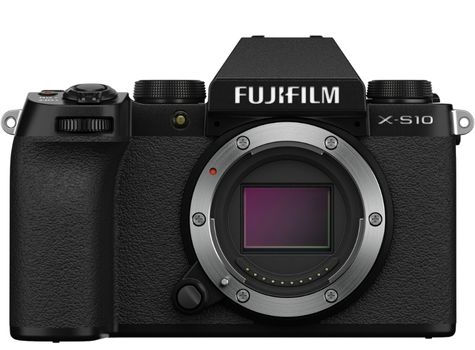 |
We find again many elements of the above-mentioned cameras, like the 26MP X-Trans sensor with the same sensitivity range of 160 to 12800 ISO extendable from 80 to 51200, an SD slot, an electronic viewfinder of 2.36MP, an AF with 425 AF points, Wi-Fi and Bluetooth. The burst rate is 20 frames per second, which is slightly lower than the X-T30 II, but this time, the sensor gains the stabilization. The autonomy loses slightly, going to 325 shots. The video mode is quite similar to the X-T30 II, still no 4K at 60 frames per second but again a slow motion at 240 frames in Full HD.
The price difference with the X-T30 II is mainly the addition of stabilization. Your choice will have to be made on this argument as well as on the general design of the body, including its rear screen still touchable but orientable and not just tiltable. The X-T30 II remains more “faithful” to the Fujifilm ergonomics while the X-S10 is more easily compared to the expert DSLR’s.
Fujifilm X-Pro3
In 2019, Fujifilm decides to renew its most atypical body by releasing the X-Pro3. Why atypical? First, because usually, the higher-end bodies are bigger and heavier, while here we have a fairly compact body, almost as light as an X-S10. Second, because it offers a unique hybrid viewfinder since you can choose to display in its viewfinder either an electronic or an optical viewfinder. Be careful, it is not the optical viewfinder of an DSLR but a rangefinder offering only a single field of view, and which is therefore more delicate to use with long focal lengths.
| Features | Visual |
|---|---|
|  |
Inside the body, we once again find the 26MP X-Trans sensor with a sensitivity range of ISO 160 to 12800 expandable from 80 to 51200, this time without stabilization, and the 425 focus points. The electronic viewfinder is the same 3.7MP of the X-T4. Not being a body particularly intended for sports photography or video, the burst is only 8 frames per second, the autonomy of 370 shots (more important in rangefinder), and the video mode limited to 30 frames per second in 4K and 60 in Full HD. It does not even have a shortcut button to start recording. The screen is touch-sensitive but not adjustable, only tiltable, with a certain originality since it displays a small secondary screen on the back, on which we find a “film” illustration of the selected rendering, and by default the sensitivity and white balance information that can be customized.
This camera is proposed at a rather high price and is particularly intended for nostalgic photographers who are fond of rangefinder photography. Indeed, the secondary screen is an invitation to not display images on the back and to enjoy without distraction the ocular viewfinder.
Fujifilm X-E4
Released in 2021, the X-E4 has a design more similar to the compact expert X100 with its graduated exposure time dial and its lack of grip. We finally get the 26MP X-Trans sensor found in the higher-end cameras which offers a slightly higher quality than the 24MP of the lower-end ones, with a native sensitivity range of 160 to 12800 ISO extendable from 80 to 51200. The electronic viewfinder is the same (2.36MP) and the AF still offers 425 AF focus points. The burst rate increases to 20 frames per second and the autonomy to 380 shots. The 4K video is still limited to 30 frames per second, but the quality of videos is clearly improved compared to the X-T200 – and there is no cropping. The rear screen is also touch-sensitive and adjustable.
| Features | Visual |
|---|---|
| 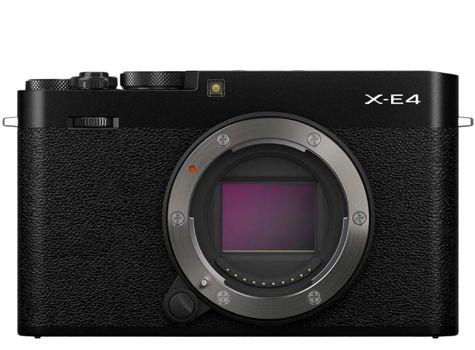 |
The X-E4 has a more vintage design and can be found alone. It is also more compact and of the same weight as the X-T200, which makes it an easily transportable camera. Its performance is very honorable, it is more responsive with a faster electronic shutter burst than the X-A7 and X-T200 for a price barely higher. It can be bought without kit lenses, although we can ask ourselves, here again, if it is not more interesting to go for a camera with a better grip for the same price, such as…
Fujifilm X-T200
Released in 2020, the X-T200 is the entry level of the X-T cameras, even if the segmentation is not very clear. We find here an entry-level camera with a rather plastic design, slightly bigger and heavier than the X-A7 but with a 2.36MP electronic viewfinder. We still find the classic 24MP sensor of the X-A7 and its predecessor the X-T100, still no X-Trans sensor, as well as the same sensitivity range 200-12800 ISO extendable from 100 to 51200 and a 425 AF points. The burst rate goes up to 8 frames per second, but the video and autonomy are the same as for the X-A7. The screen is also touch-sensitive and adjustable.
| Features | Visual |
|---|---|
|  |
Again, it seems that the AF is less efficient than higher-end models. And once again, it’s hard to find this camera other than with a kit lens, which adds to the bill and puts it close to the price of some higher-end and overall more interesting cameras. For example, the one below…
Fujifilm X-A7
The X-A range of Fujifilm is considered to be an entry-level camera for the X-mount. These cameras differ by the absence of electronic viewfinder. Because of this, Fujfilm has included a large touch-sensitive, steerable rear screen on this X-A7, released in 2019. The camera offers an APS-C sensor, like all Fujifilm’s X-mount cameras, but does not use the 26MP X-Trans of higher-end cameras. We find here a classic 24MP sensor, probably the same as the one used in Sony and Nikon APS-C cameras, with a native sensitivity range from 200 to 12800ISO extendable from 100 to 51200, 425 AF points, a 6 frames per second burst, 4k 30p video (60p in Full HD and 100p in HD) and a 270 shots autonomy.

From reviews, although the AF does have as AF points as higher-end cameras, it seems to be less effective. The lack of an electronic viewfinder is also a big concession. It is therefore a camera for beginners who can’t afford or do not have the requirements of higher-end cameras. Even if it has been well thought to offer simple and intuitive settings and shortcuts, it does not offer the ergonomics so appreciated by Fujifilm users.
This camera could be quite interesting if it was not so difficult to find in stores and on traditional websites, and usually supplied with an entry-level kit zoom. Its price is therefore quite variable and rather high for a camera that is supposed to be entry-level, the more easily available cameras like the X-E4 or the X-T200 (which also have an electronic viewfinder) being not much more expensive.
Fujifilm APS-C cameras in brief
You will find below a table summarizing the main features of Fujifilm APS-C cameras mentioned above. The table is sortable, and you just have to click on the desired column to classify.
| Camera | Definition | Stab. | Weight | Dim. | Burst(electr.) | Video | Battery Life(Viewfinder) | Battery | Approx.price | Best price |
|---|---|---|---|---|---|---|---|---|---|---|
| Fujifilm X-S10 | 26.1 Mp | YES | 1 lb / 465g | 126 x 85 x 65 mm | 20 fps | 4K DCI 30 fps | 325 images | NP-W126S | $1 738 | |
| Fujifilm X-T4 | 26.1 Mp | YES | 1.3 lb / 607g | 135 x 93 x 64 mm | 20 fps | 4K DCI 60 fps | 500 images | NP-W235 | - | |
| Fujifilm X-T5 | 40.2 Mp | YES | 1.2 lb / 557g | 130 x 91 x 64 mm | 13 fps | 6.2K 30 fps | 580 images | NP-W235 | $1 700 | Amazon B&H |
| Fujifilm X-S20 | 26.1 Mp | YES | 1.1 lb / 491g | 128 x 85 x 65 mm | 20 fps | 6.2K 30 fps | 750 images | NP-W235 | $1 499 | Amazon B&H |
| Fujifilm X-T200 | 24.2 Mp | NO | 0.8 lb / 370g | 121 x 84 x 55 mm | 20 fps | 4K UHD 30 fps | 270 images | NP-W126S | - | |
| Fujifilm X-T30 II | 26.1 Mp | NO | 0.8 lb / 378g | 118 x 83 x 47 mm | 13 fps | 4K DCI 30 fps | 380 images | NP-W126S | $900 | B&H |
| Fujifilm X-E4 | 26.1 Mp | NO | 0.8 lb / 364g | 121 x 73 x 33 mm | 20 fps | 4K DCI 30 fps | 380 images | NP-W126S | - | |
| Fujifilm X-Pro3 | 26.1 Mp | NO | 1.1 lb / 497g | 141 x 83 x 46 mm | 20 fps | 4K DCI 30 fps | 370 images | NP-W126S | - | |
| Fujifilm X-H2 | 40.2 Mp | YES | 1.5 lb / 660g | 136 x 93 x 85 mm | 13 fps | 8K UHD 30 fps | 540 images | NP-W235 | $2 299 | Amazon B&H |
| Fujifilm X-H2S | 26.1 Mp | YES | 1.5 lb / 660g | 136 x 93 x 85 mm | 40 fps | 6.2K 30 fps | 580 images | NP-W235 | $2 899 | Amazon B&H |
| Fujifilm X-T50 | 40.2 Mp | YES | 1 lb / 438g | 124 x 84 x 49 mm | 20 fps | 6.2K 30 fps | 305 images | NP-W126S | $1 477 | Amazon |
| Fujifilm X-M5 | 26.1 Mp | NO | 0.8 lb / 355g | 112 x 67 x 38 mm | 20 fps | 6.2K 30 fps | - | NP-W126S | $799 | Amazon B&H |
| Fujifilm X-E5 | 40.2 Mp | YES | 0.9 lb / 396g | 125 x 73 x 39 mm | 20 fps | 6.2K 30 fps | 305 images | NP-W126S | $1 699 | Amazon B&H |
| Fujifilm X-T30 III | - | - | - | - | - | - | - | - | $1 149 | B&H |
Which Fujifilm X-mount mirrorless camera to choose?
Although I’ve already given my opinion on each of these cameras, I’ll try to summarise what I think is the best choice, according to your requirements and what the cameras offer.
With its wide range of APS-C cameras, Fujifilm has something for every type of photographer, from beginners to demanding amateurs and professionals. Here are our recommendations to help you choose according to your needs and purposes.
For beginners or amateurs looking for a compact, affordable camera: Fujifilm X-M5
The Fujifilm X-M5 is ideal if you’re looking for a compact, lightweight and easy-to-use camera. Without an electronic viewfinder, but with an adjustable screen, it’s perfect for street photography, travel or content creation, especially if you want a discreet camera. It offers excellent image quality in an affordable body, ideal for beginners or to complete an ensemble.
For serious amateurs : Fujifilm X-S20, X-T50 and X-T30 II
If you’re looking for better performance and a versatile camera, the Fujifilm X-S20 is an excellent choice. With a 26MP stabilised sensor and impressive battery life, it’s ready for anything, including video thanks to its 6.2K capabilities and AI autofocus. Compact and rugged, it’s ideal for those who want to explore multiple areas of photography with a single camera.
The Fujifilm X-T50, on the other hand, will appeal to those looking for retro design combined with modern performance. With a 40MP sensor and 20fps burst, it excels at street photography, landscapes and moving subjects. More affordable than high-end models, it remains an excellent option for taking your photography to the next level without breaking the bank.
The slightly older X-T30 II completes this category, offering an interesting balance between compactness and performance. With a 26MP sensor and excellent image quality, it is suitable for almost all types of photography. More affordable than the X-T50 or X-S20, it retains Fujifilm’s retro DNA while remaining a reliable camera for those who want to progress without investing in a more expensive model.
Fujifilm X-T5: a top-of-the-range all-rounder for the advanced enthusiast
The Fujifilm X-T5 is the perfect compromise between compactness and high-end performance. With a 40MP sensor and advanced image stabilisation, it’s ideal for demanding photographers who want to capture the finest details in landscape, architecture and portraiture. It also excels in video thanks to its 6.2K recording capability, all housed in a stylish body with a retro design. It’s a versatile option for those looking for a high performance camera that’s fun to use.
For sports or high definition: Fujifilm X-H2 and X-H2S
The X-H series offers two different models to suit your needs.
The X-H2S is particularly suited to working with moving subjects. Its ultra-fast autofocus, 40 fps burst and stabilisation make it the ideal choice for sports, wildlife and action photography. It also has advanced video capabilities, perfect if you’re an amateur videographer+.
With its 40MP sensor, the X-H2 is designed for landscape, portrait and commercial photography. It delivers outstanding image quality with high dynamic range and incredible detail. It also excels in 8K video, making it the tool of choice for the most demanding content creators.
I hope this page on Fujifilm X mirrorless cameras is useful and helps you make your choice. In my opinion, Fujifilm has the best range of APS-C hybrids on the market at the moment, rivalling the entry-level and mid-range FFs from other manufacturers, and offering better overall value for money than the micro 4/3 range. If you’re interested in Fujifilm’s more upmarket cameras, check out our full guide to Fujifilm medium format cameras.
See you soon,

Written by Sylvain PONS
I've been passionate about photography since 2010, learning as I went along. Today, I dedicate myself to guiding others in their choice of camera gear and sharing a variety of tips to improve their photography skills.
Despite our care, a mistake may have slipped into this article. If you find any, please don't hesitate to let us know so we can correct it as soon as possible and keep our information up-to-date!