Canon APS-C DSLR cameras
Last update: 06/15/2026
Our blog continues to grow thanks to you, our readers. This post may contain affiliate links, which means we can earn a small commission if you make a purchase through them, at no extra cost to you. This helps us to continue to bring you more and support our work!
If you have decided to buy an APS-C DSLR, this guide covers the main Canon APS-C DSLR cameras in the beginner and enthusiast/semi-professional ranges. These are often the models considered by people starting out in photography or working with a relatively limited budget. If you are still unsure which type of camera is right for you, take a look at my guide to the differences between DSLR and mirrorless cameras.
For many years, DSLRs were the standard choice for demanding photographers. Despite growing competition from mirrorless cameras, they continued to offer strong image quality, versatility, and access to a broad range of lenses.
APS-C models also have several advantages. They are generally smaller and lighter than full-frame cameras, and their crop factor makes it easier to fill the frame with distant subjects. DSLRs still offer robust bodies, clear optical viewfinders, long battery life, and good value for money.
If you are also considering a mirrorless camera, take a look at Canon’s RF APS-C mirrorless cameras, including the Canon R7 and Canon R10.



APS-C DSLR cameras
I will not repeat everything covered in my guide to choosing a DSLR, but it explains the main points to consider before buying. You can also read our detailed guide to choosing a camera and the criterion that matter most.
The beginner range
Canon’s entry-level DSLR range was designed to help beginners take their first steps into EOS photography. Below are three of the most recent models in this category.
Canon Rebel T7/ EOS 2000D and Rebel T100 / EOS 4000D
Introduced in 2018, both DSLRs are clearly aimed at beginners. Of the two, the EOS 2000D is the more advanced model, with a 24 MP APS-C sensor instead of the 4000D’s 18 MP unit, a larger and higher-resolution screen, a diopter adjustment for the viewfinder, and a pop-up flash. Its controls are also more user-friendly, with a dedicated power switch and a separate flash-release button.
It uses Canon’s DIGIC 4+ processor and offers a native sensitivity range of ISO 100 to 6400, expandable to ISO 12,800. Burst shooting reaches 3 fps, while the autofocus system uses nine points with a cross-type sensor in the center. The rear screen is fixed and not touch-sensitive. On the positive side, the camera includes direct-access buttons for common settings and a practical Q menu for quick adjustments.
The EOS 2000D also includes Wi-Fi and NFC for sharing images through Canon’s Camera Connect app. Battery life is rated at approximately 410 to 500 shots depending on use, which is one of its main advantages over similarly priced mirrorless cameras. Video performance is much more limited: there is no 4K recording, and Full HD is restricted to 30p or 24p.
The EOS 4000D is Canon’s most affordable DSLR. To reach that price, however, Canon made several compromises, including an 18 MP APS-C sensor, a fixed non-touchscreen display, and no diopter adjustment, which may be inconvenient for photographers who wear glasses.
Like the EOS 2000D, it uses Canon’s DIGIC 4+ processor, offers a native ISO range of 100 to 6400 expandable to 12,800, and shoots at up to 3 fps. It also has a nine-point autofocus system and records Full HD video at 30p or 24p. Its Wi-Fi connection is easy to configure for transferring images to a smartphone, which can also act as a remote control for group shots.
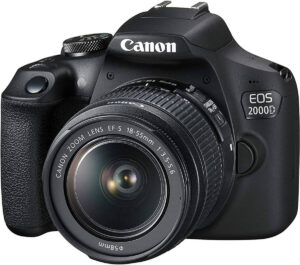
Here is the Canon Rebel T7/ EOS 2000D, a camera slightly better than the Canon Rebel SL 3 (which is the most affordable) – More details on Amazon

And the Canon Rebel T100, a perfect camera to begin and learn about photography, all at a lower cost – More details on Amazon
Rebel SL 3 / Canon EOS 250D
Released in the first half of 2019, the Canon EOS 250D is an accessible entry point into Canon’s DSLR system. It is an unusually compact DSLR, weighing just 449 g, while its relatively deep grip provides a comfortable and secure hold.
The EOS 250D also offers a solid set of features. Its 24.1 MP APS-C sensor delivers good image quality, while shooting in Live View through the fully articulated touchscreen is simple and intuitive. In this mode, face- and eye-detection autofocus helps improve focusing accuracy.
Its DIGIC 8 processor supports sensitivity up to ISO 25,600, expandable to ISO 51,200, with good image quality up to around ISO 3200. Through the optical viewfinder, the camera relies on a basic nine-point autofocus module. Live View autofocus is more advanced, however, making the 250D more appealing than the EOS 2000D and 4000D. It records Full HD video at 60p, shoots bursts at up to 5 fps, and can capture 4K video, although with a heavy crop and without Dual Pixel AF. Connectivity includes Wi-Fi, NFC, and Bluetooth for image transfer, remote control, and GPS data synchronization through a smartphone.
One disappointing cost-saving measure is the removal of a dedicated flash-release button. As on the EOS 4000D, the flash must be raised manually.

The Canon Rebel SL 3, a small APS-C DSLR camera but with attractive features! – More details on Amazon
The expert/semi-pro range
The following models are more advanced and better suited to photographers who want stronger performance, more direct controls, and a broader range of manual features.
When buying a DSLR, avoid spending your entire budget on the body alone. A good lens can remain useful for many years. Our guide to EF-S lenses for Canon APS-C cameras covers both Canon lenses and compatible third-party options.
Canon Rebel T8i / EOS 850D
I have included the EOS 850D in this section because it is better suited to enthusiasts than complete beginners. Canon’s three-digit DSLR series has traditionally offered one of the best compromises between accessibility and performance.
Launched in 2020, the Canon EOS 850D uses a 24.2 MP APS-C sensor, like the earlier 800D and 77D, together with Canon’s DIGIC 8 processor. Its native ISO range extends from 100 to 25,600 and can be expanded to 51,200, with generally good noise control.
The EOS 850D uses a conventional optical viewfinder covering 95% of the frame. Its autofocus system includes 45 cross-type points, as on the EOS 90D. Face tracking is available through the optical viewfinder, while eye detection works in Live View. The camera also includes Dual Pixel AF and burst shooting at up to 7 fps.
The EOS 850D also adds 4K video recording at 24, 25, or 30 fps, while Full HD is available at up to 60 fps. Connectivity includes an SD/SDHC/SDXC card slot with UHS-I support, Wi-Fi, Bluetooth, a 2.5 mm remote-control port, a microphone input, micro-USB, and mini-HDMI. Battery life is rated at up to around 800 shots when using the optical viewfinder.


Canon EOS 90D
Announced in August 2019, the Canon EOS 90D is a highly versatile enthusiast DSLR. It replaced the EOS 80D while also serving as an alternative to the EOS 7D Mark II.
The EOS 90D stands out with its 32.5 MP APS-C sensor and DIGIC 8 processor. It also adds weather sealing, addressing one of the limitations of the previous model.
For autofocus, the camera uses Canon’s effective Dual Pixel system in Live View and 45 cross-type AF points through the optical viewfinder. The EOS 90D is responsive and produces strong image quality up to around ISO 6400. Wildlife and sports photographers will appreciate its 10 fps burst with autofocus tracking, while portrait photographers benefit from eye detection in both stills and video. Low-light autofocus is less convincing, although still acceptable.
For video, the EOS 90D records uncropped 4K at 30p or 25p and Full HD at up to 120 fps for slow-motion footage. Its fully articulated touchscreen remains comfortable and practical to use.
The camera includes the main connections most users need, including microphone and headphone jacks and mini-HDMI. However, the use of micro-USB instead of USB-C is dated, and the absence of dual SD card slots is disappointing.

Even if the camera is rather old now, the 7D Mark II remains a very good camera at a very interesting price now – More details on Amazon
Canon EOS 7D Mark II
The original EOS 7D, introduced in September 2009, was a major success for Canon. Its successor, the Canon EOS 7D Mark II, brought numerous improvements. Although it is now an older model, it remains a serious high-end APS-C DSLR.
The EOS 7D Mark II combines several ideas borrowed from two of Canon’s flagship full-frame cameras: the EOS 5D Mark III and EOS-1D X.
It adopts much of the EOS 5D Mark III’s control layout, although the rear LCD remains fixed and non-touch-sensitive. Weather resistance is improved, however.
The camera uses a 20 MP APS-C sensor. Its optical viewfinder covers 100% of the frame and offers 1× magnification. Two DIGIC 6 processors work together to improve overall performance, enabling burst shooting at up to 10 fps and a native ISO range of 100 to 16,000. Noise control is noticeably better than on earlier models, with strong results up to ISO 3200 before image quality begins to decline more quickly.
The EOS 7D Mark II also inherits ideas from the EOS-1D X autofocus system. It uses 65 cross-type focus points spread across a large portion of the frame. Subject tracking is highly effective, and the broad coverage makes it easier to follow moving subjects.
The camera also has several obvious limitations. Video recording is restricted to Full HD at 60 fps, with no 4K support, and built-in Wi-Fi is absent.
Connectivity is otherwise comprehensive, with USB 3, flash sync, headphone and microphone ports, uncompressed HDMI output, remote-control support, dual memory card slots for SD and CF cards, and built-in GPS.
Visual summary
The table below summarizes the main specifications of these cameras.
| Camera | ISO range | Weight | Size | Range | AF points | Burst rate (fps) | Autonomy | Wifi (BT) | Video | MP |
|---|---|---|---|---|---|---|---|---|---|---|
| Canon 2000D | 100 - 6400 (12800) | 475 g | 129 x 101,3 x 77,6 mm | Beginner | 9 | 3.0 fps | 500 | yes (no) | FHD 30p | 24,1MP |
| Canon 4000D | 100 - 6400 (12800) | 436 g | 129 x 101,6 x 77,1 mm | Beginner | 9 | 3.0 fps | 500 | yes (no) | FHD 30p | 18 MP |
| Canon 250D | 100 - 25600 (51200) | 449 g | 122 x 93 x 70 mm | Beginner | 9 | 5.0 fps | 1070 | yes (no) | 4K 30p | 24 MP |
| Canon 850D | 100-25600 (51200) | 515 g | 131 x 102.6 x 76.2 mm | Expert | 45 | 7.5 fps | 800 | yes (yes) | 4K 25p | 24.1 MP |
| Canon 90D | 100-25600 (51200) | 701 g | 141 x 105 x 77 mm | Expert / Semi-pro | 45 | 11.0 fps | 1300 | yes (yes) | 4K 30p | 32.5 MP |
| Canon 7D Mark II | 100-16000 (51200) | 910 g | 149 x 112 x 78 mm | Expert / Semi-pro | 65 | 10 fps | 670 | no | FHD 30p | 20.2 MP |
Which cameras to choose for my use?
Now that we have reviewed Canon’s APS-C DSLRs, the next step is choosing the right model. The recommendations below are based on different uses, experience levels, and budgets.
If you want to start photography with a DSLR, the EOS 250D is one of the most sensible choices. It is light, comfortable to use, and capable of producing good image quality. Its Live View autofocus is also effective, making it suitable for beginners who want room to improve.
For a tighter budget, the EOS 2000D remains easy to use and delivers respectable image quality for its price. It also benefits from compatibility with a wide range of EF and EF-S lenses, an optical viewfinder, and phase-detection autofocus. That said, similarly priced mirrorless cameras generally offer more modern features.
Choosing among the more advanced models is more difficult because each body has its own strengths and weaknesses. Performance improves as you move up the range, but so does the price, so the right choice depends mainly on your intended use.
If you want a more advanced APS-C DSLR at a relatively reasonable price, the EOS 850D is a well-balanced option. It is easy to learn, offers good overall performance, and suits enthusiasts looking for a capable camera for everyday photography, travel, and family use.
The Canon EOS 90D is the stronger choice for sports and wildlife photography. It combines a high-resolution APS-C sensor, burst shooting at up to 10 fps, effective face detection, and weather sealing. It is also the most capable video option in this group and retains the advantages of an optical viewfinder.
The EOS 7D Mark II is older, but it remains one of Canon’s most serious semi-professional APS-C DSLRs. It is rugged, fast, and equipped with an advanced autofocus system. Its main weakness is video, but for action photography it still offers a compelling set of features.
That brings us to the end of this guide to Canon APS-C DSLRs. Although this category is now outdated, these cameras can still make sense on the used market, especially for photographers who already own EF or EF-S lenses. You can also visit our guide to Canon APS-C mirrorless cameras to compare them with newer alternatives.
See you soon,
Check the prices of Canon APS-C (SLR) cameras

Written by Sylvain PONS
I've been passionate about photography since 2010, learning as I went along. Today, I dedicate myself to guiding others in their choice of camera gear and sharing a variety of tips to improve their photography skills.
Despite our care, a mistake may have slipped into this article. If you find any, please don't hesitate to let us know so we can correct it as soon as possible and keep our information up-to-date!
- The Canon 2000D
- The Canon 4000D
- The Canon 250D
- The Canon 850D
- The Canon 90D
- The Canon 7D Mark II