Terra Nova National Park: A Complete Guide
Last update: 06/18/2026
Our blog continues to grow thanks to you, our readers. This post may contain affiliate links, which means we can earn a small commission if you make a purchase through them, at no extra cost to you. This helps us to continue to bring you more and support our work!
I’m finally getting back to writing about Newfoundland, Canada—more specifically, about Terra Nova National Park. We returned at the end of July 2022, and I have to admit that it took me a while to sit down and start writing. As soon as we got home, family life took over. Then the kids went back to school, and other blog projects demanded our attention. In short, life got busy. A short stay in mainland France finally gave me the motivation to start sharing the trip with you.
In my first article, I shared everything you need to know about traveling to island of Newfoundland. We spent a month on this beautiful Canadian island and loved the experience. There is a lot to cover, given how many places we visited. Newfoundland is much larger than it may seem, and even during a month-long trip, we could not see everything. We selected a few regions based on our research and recommendations from other travelers.
Today, I’m sharing our three full days in Terra Nova National Park, one of the national parks on the island of Newfoundland. I’ll cover Gros Morne National Park in a separate article.
This guide covers the essential information you need for visiting Terra Nova National Park. Although poor weather prevented us from completing every hike we had planned, we found the park peaceful, uncrowded, and full of beautiful scenery. Terra Nova National Park, established in 1957, protects approximately 402 square kilometers and is situated in the northeastern part of Newfoundland, overlooking Bonavista Bay. I also plan to write a separate guide to the highlights of the Bonavista Peninsula.
Terra Nova Park is known for its distinctive coastal boreal scenery: vast spruce forests, meadows, ponds, rivers, and peat bogs. While we didn’t have the opportunity to spot any wildlife, the park is home to various species, including lynx, black bears, ospreys, moose, and Newfoundland martens.
Here is everything we discovered during our stay.
What to Do in Terra Nova National Park
Located approximately 250 km northwest of St. John’s, the provincial capital, Terra Nova National Park is easily accessible. Most visitors come to slow down, enjoy the scenery, and explore the park’s hiking trails. The terrain is generally far less demanding than the steep mountain trails found in other parts of the world. The landscape is better described as gently hilly than mountainous, with elevations remaining relatively low. In other words, Mélanie had little reason to complain, as most of the walking was fairly easy. Although, I must admit, with time and all the hiking we’ve done here in Guadeloupe, she’s grown to appreciate walking!
Here are the walks we completed and the places we considered worth seeing.
Blue Hill Viewpoint
We began with an easy viewpoint stop rather than a true hike. Located in the northern part of the park, it is easy to reach from the Trans-Canada Highway. It is well signposted from the road.


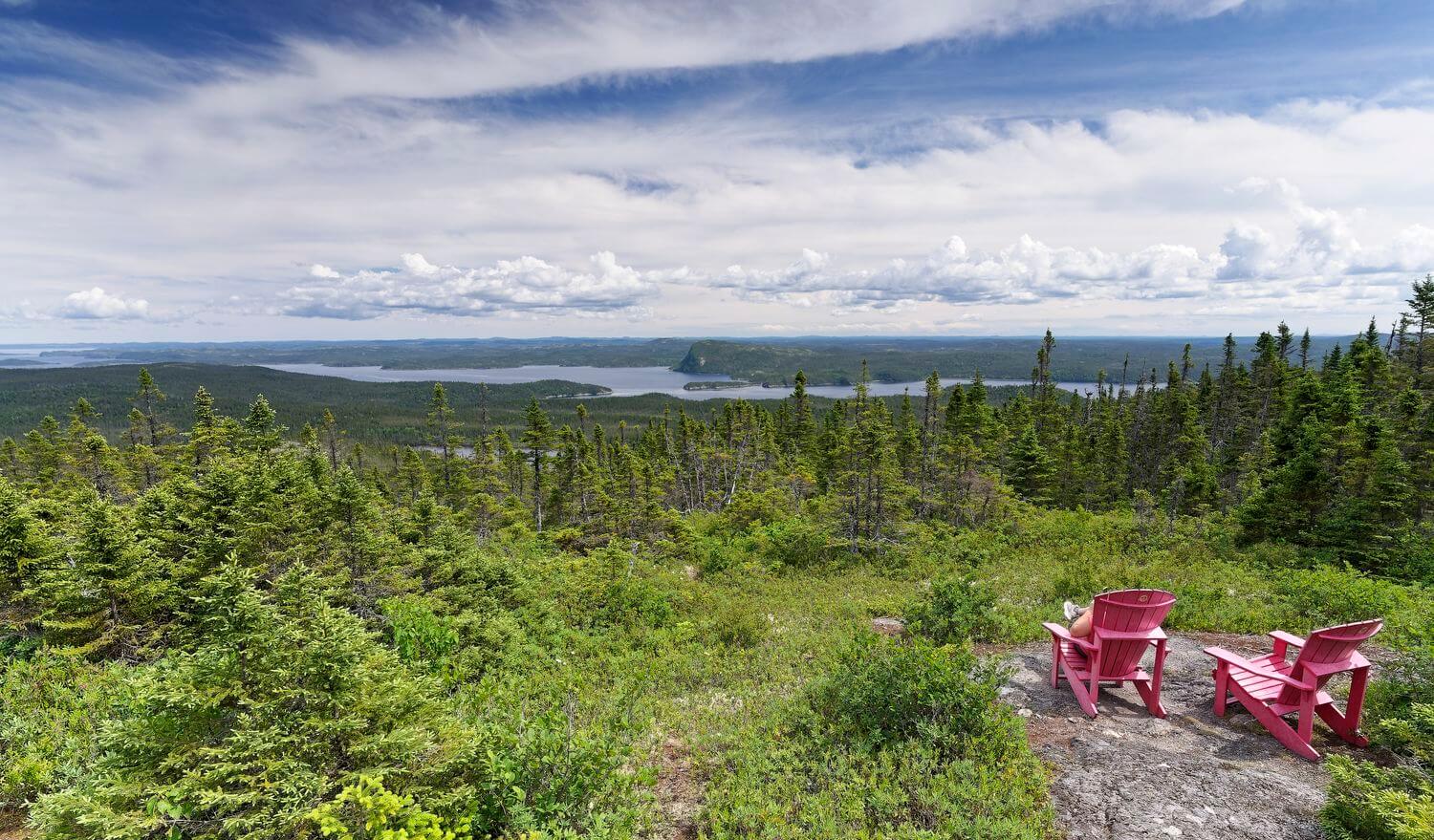
It may not be the park’s most dramatic stop, but it is still worth visiting. Follow the short access road to the parking area. From there, a walk of less than 100 meters leads to the viewpoint. You’ll spot the famous red chairs that are scattered throughout this area, along with a stunning panoramic view of the surrounding scenery. The panorama is especially photogenic. You do not need to spend long here, but the place is peaceful, pleasant, and perfect for unwinding. When we visited, we had the place to ourselves.
Ochre Hill
If you continue south toward Charlottetown, you’ll notice a sign on your left that points to the renowned Ochre Hill. It’s easily accessible from the main road, and you’ll discover two distinct points of interest in this vicinity.
Follow the road to the parking area at the end to reach the first point of interest. The spruce-lined access road is beautiful in its own right. From the top, you can either proceed directly to the impressive watchtower right in front of you or, as we did, choose to ascend the wooden staircase on your left. An information panel summarizes several facts about the national park: a total area of approximately 402 square kilometers, 134 ponds, 169 bird species, 523 plant species, and 70% of the park covered by black spruce (fir).
A five-minute climb up the stairs rewards you with a broad 180-degree view of the surrounding landscape. From the top, forests, ponds, and rivers stretch into the distance. We had fine weather and no one else around.


If you continue up the wooden steps, you’ll discover two iconic chairs placed in a perfect spot for a break. Take a few minutes to enjoy the quiet. As you continue along the path, it leads you to a towering watchtower. We managed to climb nearly to the very top with the children (the final section is restricted). Even for someone unafraid of heights like me, the tower feels surprisingly high, and offers a sweeping 360-degree view of the surrounding landscape. At the tower’s base, informative panels provide insights, including the fact that this park is a remnant of an ancient volcano shaped by glaciers. Additionally, you have the opportunity to ascend to several well-equipped platforms that provide further detailed explanations.


Allow about one hour for the entire visit. We were with the children, so we took our time. We were in no rush during our month-long trip. Once the walk is over, drive down a little further. We parked in the small parking lot on the right, which is the starting point for a very nice hike in the area. We got ready with the children, although I have to admit that the weather is fine and it’s really not cold during the day with this beautiful sunshine.
The trail sign lists a 5 km route taking about two hours, with a moderate difficulty rating. That felt accurate to us. In my opinion, this walk is well worth the effort, especially as we were practically alone, meeting only one or two tourists along the way.
The trail begins in the region’s characteristic boreal forest, but alternated with wetter sections in the woods. Colorful mosses and lichens add plenty of detail along the way. There are also a number of carnivorous plants in the area. Later in the walk, the trail passes two ponds, which are dark in color but stand out very well in the landscape. The varied scenery makes this a rewarding trail for photography.


After passing the ponds, the trail returns to the forest before finishing with a gentle final climb up into a drier, less sheltered area. The sun was still out, and the temperature felt pleasantly warm. The view from the top of the small hill is lovely. You can even see the watchtower you climbed earlier in the distance.
You can return the same way or complete the loop. It’s just as enjoyable. In my opinion, it was a lot of fun for everyone. It is not a particularly difficult walk, given the small difference in altitude, and the length of the walk is perfect for walking with children: not too long and not too short. We highly recommend it.
Malady Head Trail
This was another enjoyable hike, which I completed with Louis. Mélanie stayed at the campground while Téo napped. The start of the Malady Head Trail was very convenient for us. The trail begins directly in Malady Head Campground, where we stayed during our three-day visit. We drove there, but you can easily walk (just north of loop B) if you stay at this campsite. It is located at the northernmost point of Terra Nova National Park.
The trail is known for its viewpoint over Northeast Arm, just north of the campground. I knew from the start that the weather would probably hide the view. We set off with Louis to get some fresh air, but the weather that day was terrible: rain, thick fog that reduced visibility to about 50 meters, and chilly temperatures. But I wanted to go outside, so Louis joined me!


The official trail information lists a 3.4 km round trip taking about one to one and a half hours. We expected to take closer to two hours between Louis, who sometimes doesn’t walk so fast, and me, who stops to take photos. Wearing warm coats and hats, we started walking. The trail winds through the pine forest at the beginning. It’s very damp. But it’s really nice to walk in this otherworldly environment. The path is full of flowers (it’s summer here) and there’s a succession of passages through the forest and some very wet areas full of water. In many places, raised boardwalks have been installed across the wettest sections. There were also plenty of mushrooms, though I would not have trusted myself to identify them. But it’s always fun to take pictures of them. The trail felt wonderfully remote. An anecdote: about ten years ago, Mélanie and I went to the Åland Islands between Norway and Finland. While cycling near the forest, I saw some boletus mushrooms growing there from the road. We picked up half a bag. We ate them that evening at the campsite… I remember the tourists with us looking at us and saying: “You’re sure you’ve got it right? Yes, yes, don’t be afraid, I’m in the know, haha!


The route is not especially difficult and remains fairly level for much of the way. Some of the sections, with the fog all around us, are really beautiful. I love the atmosphere of the place, the feeling of walking through a forest at the edge of the world. We are walking with Louis, who is enjoying it as much as I am, I think. The path is very well maintained. The trail is easy to follow as long as you stay on the marked route.
The end of the walk is a bit more difficult, with a series of slightly steeper climbs, but nothing too serious. We arrived at the wooden platform that was supposed to offer the magnificent view below, as I had planned before we set off. It was so foggy we could not see 20 meters when you arrived! But it didn’t matter. We took a short break and waited to see if it would dissipate. But it didn’t… After a good two hours of walking, we made our way back at an easy pace, still in that beautiful, humid atmosphere. Despite the weather, I thoroughly enjoyed it.
Sandy Pond Trail
In the southern part of Terra Nova Park, Mélanie and I had noticed Sandy Pond in photos before our visit. We’d seen pictures of it and it was a beautiful, colorful pond. The next morning, the weather was fine. We decided to take the whole family to discover this beautiful pond. Like Ochre Hill, the trail is accessed directly from the main road.
We parked in the large parking area. It’s early. We were among the first people to arrive. We set off on the walk through the forest which, according to the signs, should take about 90 minutes at a normal pace. With the kids and the photos (as usual) it’ll take much longer. The area is much less humid than what Louis and I did yesterday. It was very different. We’re still in the woods, but in a much more open area. Unfortunately, the mosquitoes are still there, as they have been on many of the hikes we’ve done so far (apparently a characteristic of summer in this part of Canada, which we can confirm!) The trail, always well maintained, winds through this beautiful forest from the start of the hike. You’ll see lots of flowers and mushrooms.


This is when the landscape changes completely. The landscape opens into a series of peat bogs, those well-known bogs full of water, moss, lichen and small trees. The forest no longer exists here. We follow several sections of this type. We often cross wooden bridges over the water. There are several information boards along the way. They explain the importance of the peat bogs, their composition and much more about the local flora and fauna. The views all around us are magnificent.
And then, in my opinion, comes the highlight of the walk. As the trail curves around the pond (the path goes around the pond), we come to a large wooden bridge overlooking a dream landscape: an ochre-colored river, beautiful vegetation and flowers all around. We spent a quarter of an hour (despite the children’s impatience) photographing this beautiful spot.


We continue on the way back. It takes us back into the forest and offers several equally beautiful views of the pond. It’s a really nice place to be. We found this side of the loop more scenic than the first. You come back along the small sandy beaches at the end of the walk. You’ll even find those two famous red chairs you see all over the trails. They’re perfect for sitting by the pond and simply enjoying the view.
Unfortunately, in a sense, the end of the walk is a little less interesting in the sense that you return to the starting point. This is near a very beautiful beach, but at this time of day it is full of people. It seems to have become a meeting place for all the local Canadians who’ve come to enjoy themselves. Everyone is in the water, children and adults alike… the locals clearly found the temperature perfectly acceptable To us, accustomed to tropical water, it felt very cold—but for local families, it was simply summer.


We enjoyed a family meal beside the pond, which was a lovely way to end the walk.
Louil Hill Trail
This was the final hike I completed, as no one else felt motivated enough to join me. The Louil Hill Trail is at the northern end of Terra Nova National Park, a short distance from the Malady Head campsite where we were staying. I set off again in fine weather, in the heat and, of course, with the ever-present mosquitoes, as usual.
The official route is a 3.7 km loop taking about one to one and a half hours. The path winds gently through the forest for most of the way. The atmosphere is as beautiful as ever, but it is more open and less humid than what we’ve experienced so far. It’s pleasant, if you can ignore the mosquitoes. They were relentless. I don’t know if it’s the heat, the time of year or something else. But it’s definitely not pleasant.


I reached the top after about an hour and a final climb up the stairs. There’s a beautiful 360° view of the surrounding area. Lakes and forests as far as the eye can see. You can explore the open ground near the summit for additional viewpoints. There are other interesting vantage points. Note that you can even see the arrival of another short walk. It starts more or less opposite the parking lot for this walk. It is a half-hour walk to the Mill Cove Lookout Trail. But I wasn’t really motivated to go there. The weather is starting to cloud over and I think the viewpoints are pretty much the same. Overall, it was an enjoyable walk, but there were too many mosquitoes for my liking.
The Visitor Center and Nearby Walks
I’ll finish with a few words about the Visitor Center and the trails around it. We didn’t have time to go walking any further.
The Visitor Center is a really nice place. Especially if you’re on trip with your family. It is located beside Newman Sound, in the middle of Terra Nova National Park. Easy to get to from the main road, it’s well worth a visit, especially on a bad weather day. The staff were welcoming and helpful. You can also buy your National Park passes here, which we did.
We came back late in the afternoon, on a day when it was raining heavily. It’s a nice place to explore with the kids when the weather doesn’t allow you to go hiking unless you are prepared to get completely soaked. There is a small interpretive area inside. There’s lots of information about the local flora and fauna. It’s a lot of fun and will definitely attract the youngest visitors. There is even a children’s activity area with drawing materials.
Outside, there are a number of nice little spots by the lake for relaxation and food. As far as we’re concerned, the weather was terrible when we were there. So we did not spend much time outside. We did, however, take the opportunity to walk around the center for an hour. There is a fun trail with questions hanging from the trees. There are other, much longer walks you can do from the Visitor Center. These include the Goowiddy Trail (an 8 km loop taking three to four hours), Heritage Trail (a 500 m walk taking about 15 minutes), and Coastal Trail (9.5 km, taking approximately three to four hours).
Other Trails We Did Not Complete
The trails we completed were among the most appealing options for our family. However, you should know that there are other possible walks in the park, such as
- Dunphy’s Pond Trail: a 10 km walk, too long for us with kids, but apparently leads to a beautiful pond,
- Southwest Brook: a 4 km walk that is more accessible, but we didn’t have time to take it into consideration,
- Platters Beach: a coastal walk from Charlottetown, which we’d also heard good things about.
Terra Nova National Park: Practical Tips
For your stay in Terra Nova National Park, here’s everything you need to know.
Buying a National Park Pass
Outside temporary free-admission periods, visitors generally need a park pass to enter Terra Nova National Park. Passes can normally be purchased at several locations: at the visitor center or at one of the two official campgrounds of the national park: Malady Head and Newman Sound.
We personally bought our pass directly from the campsite on arrival, paying at the same time for the pitch we’d reserved for our three nights there.
During our 2022 visit, the daily admission prices were as follows:
- Adult: CAD $6.25
- Senior: CAD $5.25
- Youth age 17 and under: free.
Annual passes and other admission options are also available. The best way to be sure of prices is to have a look at the details on this page.
You can also purchase a Parks Canada Discovery Pass, which provides admission to participating national parks, national marine conservation areas, and national historic sites across the country, mainly national parks, national marine reserves and national historic sites. Full details here.
During our trip, the pass cost CAD $72.25 per adult, with a family or group option priced at CAD $145.25. It can be a worthwhile purchase if you plan to visit several national parks during your trip to Canada, or if you are visiting Canada for several months. Prices and conditions can be found here.


How to Get to Terra Nova National Park
The best route depends on where you are traveling from. In our case, we live in Guadeloupe. There are direct flights from Pointe-à-Pitre to Montreal at a reasonable price when booked early. We then took a flight from Montreal to St. John’s for our trip.
Renting a car is the most practical way to explore the island once you arrive on the island of Newfoundland. We personally found what we were looking for (as is so often the case) on the car rental comparison site DiscoverCars.
The national park is in eastern Newfoundland, approximately 250 km northwest of St. John’s and 60 km south-east of Gander, the nearest larger town with an airport, which also has an airport. Flights to Gander may suit some itineraries, although driving is usually more practical for most visitors.
Otherwise, the easiest way to get around is to drive the main road that crosses the island, the Trans-Canada Highway. It will take you about two to two and a half hours to get there. That makes it an easy road-trip stop.
If you want to know more, we’ve just published an article. It explains how to get to the island of Newfoundland.
What Activities Are Available in Terra Nova Park?
As mentioned earlier, hiking is one of the main reasons to visit. Many visitors also come for canoeing, kayaking, and fishing.
For canoeing, there are several well-known paddling areas in the park, on both freshwater ponds and sheltered coastal waters. These include Sandy Point, the Newman Sound campsite, the Visitor Center, the Southwest Arm and the Malady Head campsite. Depending on your level, you can paddle for anywhere from 1 to 8-10 hours, for example, from Sandy Pond to Dunphy’s Pond.


Where to Stay Overnight in the Park
The options are fairly straightforward. There are basically two options for overnight accommodation in Terra Nova Park. The park has two developed campgrounds: Newman Sound (in the middle of the park) and Malady Head (at the northern end of the park). We personally chose the latter. We had heard positive feedback about it and liked its smaller, quieter atmosphere. We had also heard that Malady Head could have fewer mosquitoes, though conditions vary. It is also closer to the towns for shopping.
We have always been advised to book our pitches well in advance. This is especially true between June and August, the park’s busiest season. We booked several weeks in advance and followed the advice. However, we had to cancel our bookings and found places at the last minute due to a number of last-minute changes of plans. Perhaps we were simply lucky, but last-minute availability can sometimes appear. To book a pitch in the park: Click here.
As far as staying in the National Park is concerned, it’s important to know that even though we’re talking about two campsites, there are several types of accommodation to choose from:
- Tent pitch: this is what we had and it is a choice on the basis of the size of your tent and the size of your car,
- Camping pitch: it depends on the size,
- oTENTik: we tried it out for one night and it’s very nice, a large canvas-and-wood shelter with real beds, heating and a barbecue,
- Oasis accommodation (formerly “Goutte d’Ô”): a typical accommodation that looks like a drop of water.
Of course, prices vary according to your choice at the time of booking.
Staying Outside the Park
A few practical tips at the end of this article. You do not have to stay inside the park, as several nearby communities offer accommodation. It’s perfectly possible to sleep in the towns on the park’s borders, such as Traytown, Glovertown or Alexander Bay (to the north). Or Charlottetown, which is surrounded by park territory but not administered as part of the national park.
When Is the Best Time to Visit?
July and August generally offer the warmest weather, based on temperature alone. However, as is often the case, these are also the busiest months for tourists and therefore the most difficult to find accommodation in campsites. But it’s not impossible. And Terra Nova is generally less crowded than Canada’s most famous national parks, so a flexible itinerary can help. Late spring and early fall can also be appealing, depending on weather and seasonal facility openings. That way the crowds are smaller and the temperatures are still decent. Outside the main season, temperatures become colder and services are more limited.
I’ll leave you with that. I hope this guide to Terra Nova National Park has inspired you to explore it for yourself. It is a beautiful and enjoyable place to visit. It’s a must if you’re planning a road trip to Newfoundland for a few weeks. However, I don’t think the views are as spectacular as those found in the Canadian Rockies, especially if you go to Banff or Jasper National Parks.
I’ll be back soon with another article about Newfoundland. In the meantime, have a look at our guide to Fogo’s must-sees.

Written by Sylvain PONS
I had the opportunity to explore the beauty of this country I love on several different occasions and in different places (Canadian Rockies, the Island of Newfoundland for 1 month, Yukon and Québec)!
Despite our care, a mistake may have slipped into this article. If you find any, please don't hesitate to let us know so we can correct it as soon as possible and keep our information up-to-date!