The best Nikon wide-angle lenses
Last update: 05/06/2026
Our blog continues to grow thanks to you, our readers. This post may contain affiliate links, which means we can earn a small commission if you make a purchase through them, at no extra cost to you. This helps us to continue to bring you more and support our work!
If you are following this blog, you know that there is already an article on the topic of how to choose a wide-angle lens and another one about landscape photography lenses, which mainly mentions these lenses. Nevertheless, here the goal is to present the ones that I consider to be the best and more particularly why I consider them as such. After the article on the best Canon wide-angle lenses, here is my selection on the best Nikon wide-angle lenses.
Of course, some of these lenses are mentioned in the other two articles, but I hadn’t presented their characteristics in detail, nor what makes them the best choices at the moment. If you’ve already thought about it, you may have already chosen another one that may not be in the article. If that choice is well thought out and meets the criteria you have set for yourself, you do not, of course, have to change your mind unless one of the choices mentioned proves to be more interesting.
Wide angles are very appreciated as they cover a large amount of scenery and they are useful when there is not enough distance between the lens and the subject. They also allow you to accentuate the relief of a scene as long as the framing is done conscientiously and gives an impression of immensity. Finally, they can be chosen to use distortion to accentuate the importance of a shot or element in relation to the others.


For all these lenses, a lot of research was necessary; I was able to try some of them but obviously I could not test them all. It was therefore necessary for some of the lenses to compile the numerous tests and opinions in order to come up with the most objective ranking possible. You will therefore find an illustration of these lenses, some extra specifications and my appreciation for each one. For each format (APS-C and Full Frame), I will also mention a few alternatives because many of them can be considered as top of the range and therefore a bit excessive or too expensive for some of you.
I have gathered my choices according to the size of the sensor to simplify the matter, especially since mounted on a full frame sensor, APS-C lenses do not cover the whole sensor and mounted on an APS-C, full frame lenses do not cover the same field of view. I also don’t intend to go into technical considerations such as vignetting or distortion that you can easily find on test sites with precise numbers, especially since most of these defects can be rectified by the body or otherwise by a processing software.
Nikon Z wide angle lenses (mirrorless)
Although Nikon entered the world of mirrorless with its Z-mount a little later than other brands, the choice of Nikon Z wide-angle lens is interesting.
Nikon Z Wide Angle Full-Frame (Z)
In my opinion, these are the best lenses currently available if you are looking for a Nikon wide-angle lens for your full-frame camera:
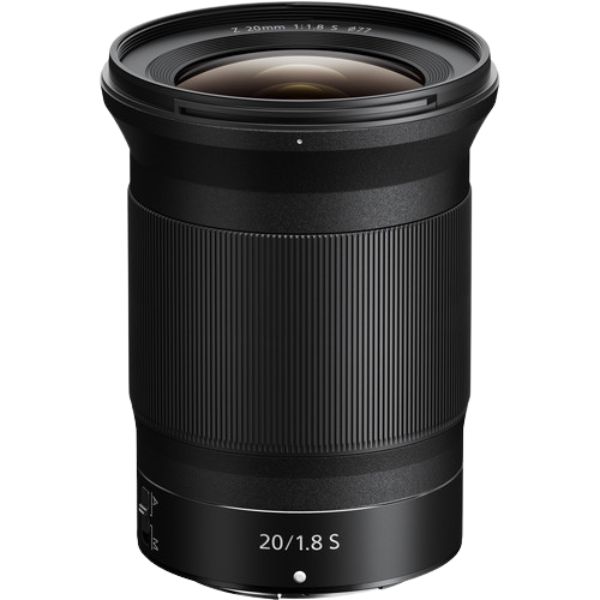
- Nikon Z 20mm f/1.8 S
- Nikon Z 14-24mm f/2.8 S
- Nikon Z 14-30mm f/4 S
- Nikon Z 17-28mm f/2.8
- Viltrox AF 16mm f/1.8 Z
Below, you’ll find a table listing all the features of these lenses.
Nikon Z 20mm f/1.8 S
| Features | Visual |
|---|---|
|
|
Released in 2020, the Nikon Z 20mm f/1.8 S is positioned as a quality lens. Indeed, you get good image quality from full aperture, which can even be improved from f/2.8. Its size and weight make it a rather heavy and bulky lens, not the most practical for travelling.
In terms of use, the lens is primarily intended for landscapes and architecture. The coma remains visible throughout the entire focal range, making it clearly not suitable for astrophotography. Finally, the autofocus is fast and quiet, with good flare resistance.
As you can imagine, this lens is more expensive than its (old) DSLR counterpart, although the two are not really comparable. In my opinion, the Nikon Z 20mm f/1.8 S is an excellent choice!
Nikon Z 14-24mm f/2.8 S
| Features | Visual |
|---|---|
|
|
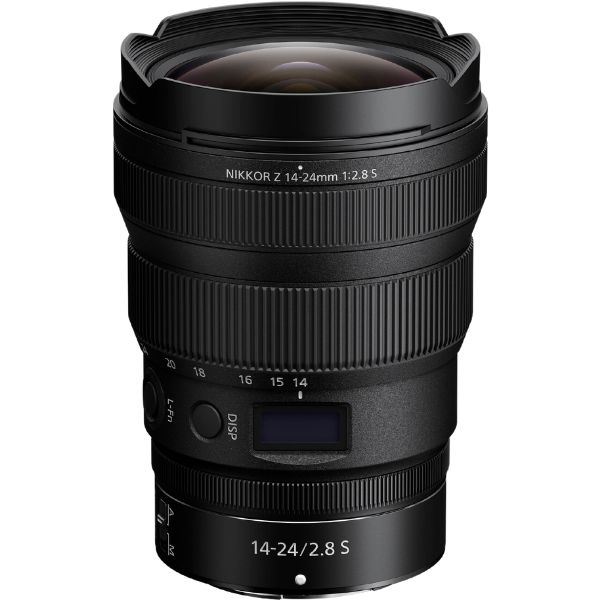
Also in 2020, Nikon released a mirrorless version of the famous 14-24mm f/2.8. It must be said that the DSLR version was a unanimous success! For this new version, the brand has retained its advantages in a more compact format.
In terms of performance, the lens is remarkable at full aperture, even if there is a slight lack of homogeneity at the edges. This is the only criticism we can make. In terms of construction, it is of the highest quality and includes an LCD screen. The autofocus system is very fast and efficient.
In conclusion, the Nikon Z 14-24 mm f/2.8 S is one of Nikon’s best lenses. As you can see, this lens is not cheap, but if you have the budget, go for it!
Nikon Z 14-30mm f/4 S
| Features | Visual |
|---|---|
|
|
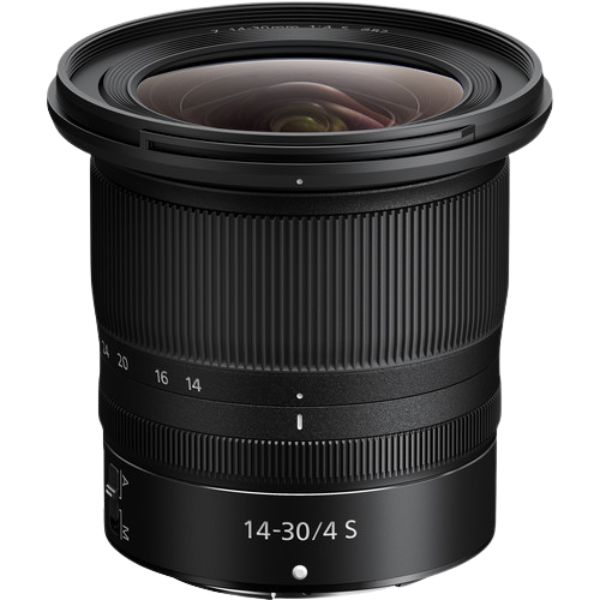
Introduced in 2019, the Nikon Z 14-30mm f/4 S took many by surprise. At the time, Nikon had changed the usual range of 16-35mm f/4 zooms. Its strengths include its weight and compatibility with screw-on filters. Although its image quality is inferior to that of the 14-24 mm f/2.8 S, it is still very good. Note that it gradually deteriorates as you zoom to longer focal lengths.
In terms of use, even if the lens is not specifically designed for astrophotography, it offers very good performance for other types of photography, while being compact and light (a real plus).
In the end, the Nikon Z 14-30mm f/4 S is rather expensive compared to its competitors, but its price is fully justified. If you are looking for a compact wide-angle zoom with good performance, this is the lens for you!
Nikon Z 17-28mm f/2.8
| Features | Visual |
|---|---|
|
|
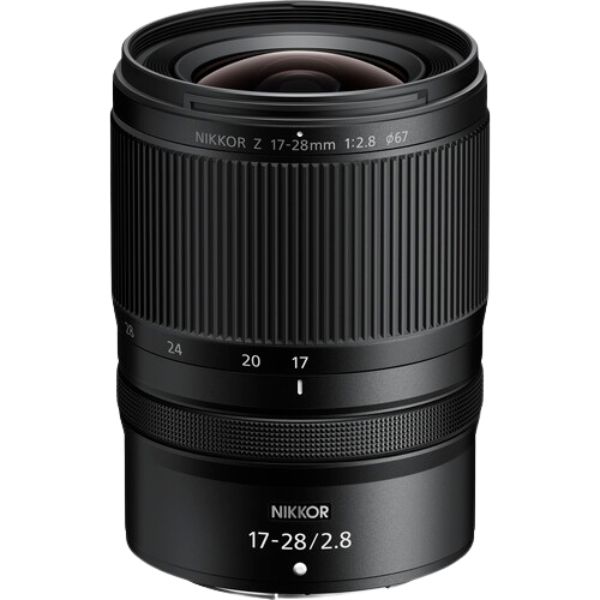
With this lens, Nikon has adopted the optical formulas of certain Tamron mirrorless lenses. In fact, this 17-28mm f/2.8 Z is the equivalent of the Tamron 17-28mm f/2.8 Di III RXD.
It is solidly built, with a fairly fast and efficient autofocus. Its optical quality is remarkable, although it tends to drop off slightly at longer focal lengths. On the downside, vignetting and distortion are noticeable, especially at 17mm. On the other hand, chromatic aberrations and flare are absent, which is rare for a lens in this category. Finally, the focal length range remains narrow, but this is also what makes it one of the lightest.
We agree that the equivalent Tamron version for Sony is more affordable than the Nikon one. However, the construction of the Nikon Z 17-28mm f/2.8 is more robust. Nevertheless, it has a hard time competing with the 14-30mm f/4 S, which is available for the same price and offers a wider focal range, despite being slightly heavier. If the f/2.8 aperture is not important to you, this lens is an interesting option.
Viltrox AF 16mm f/1.8 Z
| Features | Visual |
|---|---|
|
|
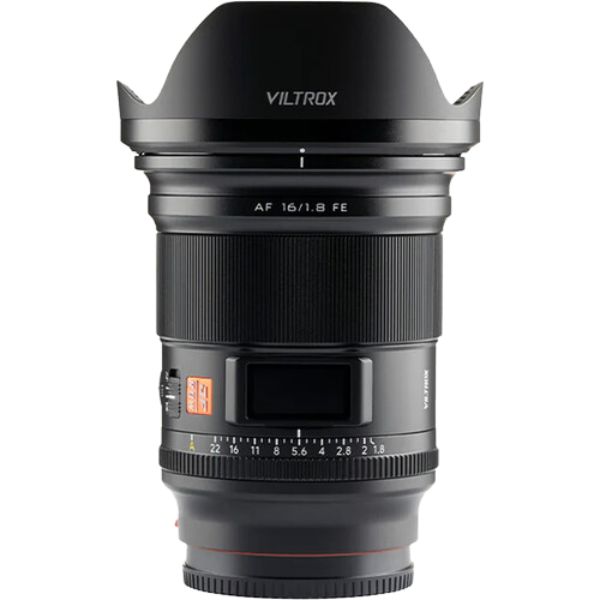
The recently announced Viltrox AF 16mm f/1.8 Z is an ultra wide-angle lens for Z-mount full-frame mirrorless cameras. Its optical construction consists of 15 elements in 12 groups, including 3 aspherical lenses and 4 low dispersion elements. It also features a 9-blade diaphragm for good control of background blur. The autofocus is precise and silent.
In terms of construction, the lens is robust and tropicalised, made entirely of metal. Its size and weight make it compact for a bright ultra wide angle lens. Thanks to its ultra-wide-angle focal length and wide aperture, the 16mm f/1.8 Z is suitable for landscape, architectural and even astrophotography.
In short, the Viltrox AF 16mm f/1.8 Z is aimed at discerning photographers who want an ultra-wide-angle lens without having to resort to more high-end and therefore more expensive lenses. In my opinion, its value for money makes it a good alternative to more premium lenses.
The following table summarizes the characteristics of the lenses presented:
| Nikon Z Full frame wide angle lenses | Focallength | Max.Aperture | Weight | Dim. (Ø x L) | Min. FocusDist. | Approx.price | Best price | |||
|---|---|---|---|---|---|---|---|---|---|---|
| + | Nikon Z 14-24mm f/2.8 | 14-24mm | f/2.8 | 1.4 lb / 650g | 3.5 x 4.9" / 89 x 125 mm | 11" / 28 cm | $2 495 | Amazon B&H | More info + | |
|
||||||||||
| + | Nikon Z 14-30mm f/4 S | 14-30mm | f/4 | 1.1 lb / 485g | 3.5 x 3.7" / 89 x 95 mm | 11" / 28 cm | $1 345 | Amazon B&H | More info + | |
|
||||||||||
| + | Viltrox AF 16mm f/1.8 Z | 16mm | f/1.8 | 1.2 lb / 550g | 3.3 x 4.1" / 85 x 103 mm | 10.6" / 27 cm | $580 | Amazon B&H | More info + | |
|
||||||||||
| + | Nikon Z 17-28mm f/2.8 | 17-28mm | f/2.8 | 1 lb / 450g | 3 x 4" / 75 x 101 mm | 7.5" / 19 cm | $1 195 | Amazon B&H | More info + | |
|
||||||||||
| + | Nikon Z 20mm f/1.8 S | 20mm | f/1.8 | 1.1 lb / 505g | 3.3 x 4.3" / 85 x 109 mm | 5.5" / 14 cm | $1 045 | Amazon B&H | More info + | |
|
||||||||||
Nikon Z wide angle APS-C (Z DX)
I present Nikon’s most interesting wide-angle lenses for APS-C SLRs.
In fact, here’s a table summarising the main features of these objectives.
Nikon Z DX 12-28mm f/3.5-5.6 PZ VR
| Features | Visual |
|---|---|
|
|
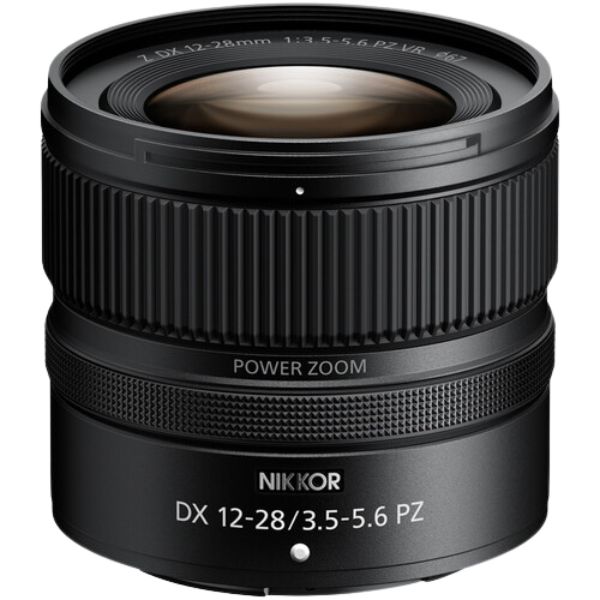
Announced in April 2023, the Nikkor Z DX 12-28mm f/3.5-5.6 PZ VR is positioned as an ultra-wide-angle zoom for Nikon’s Z-mount APS-C mirrorless cameras. With a focal length equivalent to 18-42mm in full frame, it is suitable for a wide range of applications: landscape, architecture, vlogging and reporting. Its optical stabilisation provides a 4.5 stop boost and is based on a formula of 12 lenses in 11 groups, including one ED lens and one aspherical lens.
Suitable for mirrorless cameras, this zoom is easy to use, with silent focusing and smooth zooming. The lens is ideal for vloggers and videographers looking for smooth transitions. The stabilisation also makes handheld shooting easier.
In short, the Nikkor Z DX 12-28mm f/3.5-5.6 PZ VR is a versatile and compact lens for landscape, architecture and reportage photography. Even if its focal length is too short for portraits, it can be used to capture moving subjects. Frankly, its price is attractive given all its advanced features.
Sigma 16mm f/1.4 DC DN Contemporary Z
| Features | Visual |
|---|---|
|

|
The Sigma 16mm f/1.4 DC DN Contemporary is an ultra wide angle prime lens that was already available for the Sony E mount. The lens is very bright thanks to its f/1.4 aperture. The optical design consists of 16 elements in 13 groups, with aspherical, FLD and SLD elements.
In terms of construction, the lens is rather heavy, imposing and tropicalised. It has a wide focus ring for good manual control. With an aperture of f/1.4, it is capable of producing sharp images even in low light. In fact, its sharpness is very good, even at full aperture. As for the drawbacks, there is nothing to complain about: the optics control distortion and vignetting.
To sum up, the 16mm f/1.4 is perfect for reportage or landscapes. Its optical quality and brightness are its main assets. What’s more, it offers excellent value for money. That’s always a bonus for your wallet!
Viltrox AF 13mm f/1.4 Z
| Features | Visual |
|---|---|
|
|
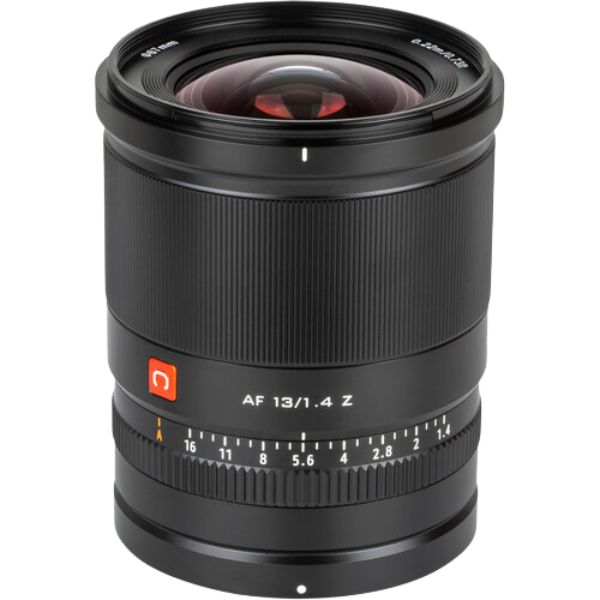
Available since 2022, the Viltrox AF 13mm f/1.4 Z is a very interesting wide-angle lens for Nikon APS-C cameras. In fact, it is the lens with the widest field of view on the market, excluding manual focus lenses.
Its dimensions and weight are rather imposing for an APS-C lens, but its construction is of high quality, made entirely of metal. On the other hand, this Viltrox is not tropicalised, which may limit its use. We also note that the lens is not stabilised, although this is not essential with such a long focal length.
In terms of image quality, sharpness is very good in the centre and at the edges, even if the corners are a little soft at full aperture. You can always close the aperture to f/2.8 to improve the quality of the edges.
In conclusion, the Viltrox AF 13mm f/1.4 Z is an excellent choice for photographers looking for a high-performance wide-angle lens. It’s also a versatile tool: it works very well for landscapes, interiors and astrophotography. In my opinion, it’s a good lens at an affordable price.
Find all the characteristics of the lenses in the following table:
| Nikon Z APS-C wide-angle lenses | Focallength | Max.Aperture | Weight | Dim. (Ø x L) | Min. FocusDist. | Approx.price | Best price | |||
|---|---|---|---|---|---|---|---|---|---|---|
| + | Nikon Z DX 12-28mm f/3.5-5.6 PZ VR | 12-28mm | f/3.5-5.6 | 7.23 oz / 205g | 2.8 x 2.5" / 72 x 64 mm | 7.5" / 19 cm | $355 | Amazon B&H | More info + | |
|
||||||||||
| + | Viltrox AF 13mm f/1.4 Z | 13mm | f/1.4 | 1 lb / 455g | 2.9 x 3.5" / 74 x 90 mm | 8.7" / 22 cm | $485 | Amazon B&H | More info + | |
|
||||||||||
| + | Sigma 16mm f/1.4 DC DN Contemporary Z | 16mm | f/1.4 | 0.9 lb / 405g | 2.8 x 3.6" / 72 x 92 mm | 9.8" / 25 cm | $435 | Amazon B&H | More info + | |
|
||||||||||
Nikon wide angle lenses for SLRs
Nikon wide angle lenses for APS-C (DX) SLR
The range of cameras at Nikon remains very wide, from the D3500 body (amateur) to the D500 which is an example of a professional body. In general, the optics manufactured for Nikon APS-C bodies are lighter and more compact than those manufactured for full-frame bodies. I present above the best Nikon lenses for APS-C body.
By the way, if you are looking for wide-angle alternatives and/or want to have a good idea of what Nikon offers for its APS-C format (DX format from Nikon), do not hesitate to have a look at our dedicated page.
Here are in my opinion the 4 best Nikon lenses for an APS-C body:
- Tamron 10-24mm f/3.5-4.5 Di II VC HLD
- Nikon AF-P DX 10-20mm f/4.5-5.6G VR
- Tokina AT-X 116 PRO DX II AF 11-16 mm f/2.8
- Sigma AF 10-20mm f/3.5 EX DC HSM
Details of the main technical characteristics of these 4 lenses can be found in the table below.
Tamron 10-24mm f/3.5-4.5 Di II VC HLD
| Features | Visual |
|---|---|
|

|
This new version of the Tamron 10-24mm stands out from the previous one by its stabilization and from the 10-24mm f/3.5-4.5G proposed by Nikon. This Tamron wide-angle lens benefits from a good construction in line with the recent Tamron lenses for a relatively light weight.
The maximum aperture of this lens is not very large, but for landscape images with large depth of field, it won’t be a concern, not even on light since its stabilization will help more than an f/2.8 aperture in many cases. It delivers a very good image quality in the center but it will be better to close the diaphragm to obtain a better homogeneity. Considering its price, features and performance, it is for me the most interesting wide-angle lens for Nikon APS-C bodies at the moment.
Nikon AF-P DX 10-20mm f/4.5-5.6G VR
| Features | Visual |
|---|---|
|
|
Recently released, this wide-angle lens for APS-C will delight fans of brightness, delivering good quality images and stabilization that can often prove useful. Its focal range matches very well with standards such as 18-55mm or 17-50mm.
Compared to the Tamron, it decreases a little bit in terms of of maximum aperture, but gains in weight. You will also have to close the diaphragm, especially at the shortest focal lengths, to gain homogeneity, but at the longest focal lengths and once closed, the quality is excellent. Added to that with its very affordable price, you have here an excellent alternative to Tamron if you accept the reduction of the aperture.
Tokina AT-X 116 PRO DX II AF 11-16 mm f/2.8
| Features | Visual |
|---|---|
|
|
With a f/2.8 aperture and Tokina’s usual construction that uses less “plastic”, this new version of the Tokina 11-16mm is a very good choice, even better than the previous ones if you have the use of a large aperture.
For night photography or astrophotography, its large aperture offers great possibilities. The quality at full aperture is certainly not the highest, but it improves quickly when closing. Don’t forget that it is an f/2.8 so closing at f/4 or f/5.6 will sometimes prove better than Tamron and Nikon.
Sigma AF 10-20mm f/3.5 EX DC HSM
| Features | Visual |
|---|---|
|
|
The last ultra-wide-angle lens recommended for a Nikon APS-C DSLR, this Sigma appears to be good choice for a good budget and often recommended.
Its maximum aperture is less important than the Tokina f/2.8, but it has the merit of being constant, unlike the Tamron and Nikon. It’s very appreciated for value in APS-C.
There are a few other possibilities for Nikon APS-C wide-angle lenses, but the lenses mentioned above are, in my opinion, the best recommendations. Another possibility would be to look at the Tokina 11-20mm f/2.8 Pro Dx which also offers a large fixed aperture at f/2.8 and a slightly wider focal range than the 11-16mm of the same brand. The table below summarizes the main characteristics of the lenses mentioned above.
| Nikon wide-angle lenses for APS-C SLRs | Focallength | Max.Aperture | Weight | Dim. (Ø x L) | Min. FocusDist. | Approx.price | Best price | |||
|---|---|---|---|---|---|---|---|---|---|---|
| + | Sigma 10-20mm f/3.5 EX DC HSM | 10-20mm | f/3.5 | 1.1 lb / 520g | 3.4 x 3.5" / 87 x 88 mm | 9.4" / 24 cm | $373 | Amazon | More info + | |
|
||||||||||
| + | Nikkor AF-P DX 10-20mm f/4.5-5.6G VR | 10-20mm | f/4.5-5.6 | 8.11 oz / 230g | 3 x 2.9" / 77 x 73 mm | 8.7" / 22 cm | $276 | Amazon B&H | More info + | |
|
||||||||||
| + | Tamron Di II 10-24mm f/3.5-4.5 VC HLD | 10-24mm | f/3.5-4.5 | - | - | - | $436 | Amazon | More info + | |
|
||||||||||
| + | Tokina ATX-I 11-16mm f/2.8 CF | 11-16mm | f/2.8 | 1.2 lb / 555g | 3.3 x 3.5" / 84 x 89 mm | 1' / 30 cm | $349 | Amazon B&H | More info + | |
|
||||||||||
Nikon wide-angle lenses for full-frame SLRs (F)
Regarding wide-angle and ultra-wide-angle lenses for Nikon full-frame bodies, the choice will be much wider, some people even put forward this argument to encourage choosing full-frame rather than APS-C because at the same focal length, the full-frame is wider and it is therefore “easier” to design wide-angle lenses for this format. Here is a selection of my opinion of the five best zooms and the five best fixed focal lengths in this category. However, I also present below the possible alternatives.
Here are below the 10 lenses (5 zooms and 5 fixed focal length) that I consider the best for a Nikon Full Frame camera:
If you want to compare the main specifications of the 10 lenses, I have summarized everything in the table below for the wide-angle zooms and in the following table for the fixed wide-angle lenses.
Sigma 24-35mm f/2 DG HSM ART
| Features | Visual |
|---|---|
|
|
Sigma’s 24-35mm f/2 art is the first full-frame zoom to offer an f/2 aperture. Its focal range is short, too short for some who would have preferred it to start at 20mm or end at 50mm but that would have meant extra weight and dimensions. It is basically designed to give access to a 24, 28 and 35mm in one lens with the same quality as have the best fixed focal lengths.
Sigma has succeeded, since this zoom offers a remarkable image quality at all focal lengths at full aperture. Its quality/price ratio is excellent since it is offered at a price below 1000$, which might seem high but would certainly have been much more if it had been designed by Nikon or Canon. Nevertheless, its limited focal range makes it less versatile and therefore less interesting in many situations compared to the lenses mentioned below.
Tamron SP 15-30mm Di VC USD f/2.8 G2
| Features | Visual |
|---|---|
|
|
For me it is currently the best wide angle and ultra-wide-angle lens for a Nikon full frame sensor. This Tamron lens is up to the level of the high-end Canon and Nikon lenses and even offers new features.
In addition to being of a quality close to the latter, and not necessarily in the worse sense, with a constant f/2.8 aperture, it also has a stabilization that further increases its range of possibilities in low light as well as in handheld video. Not to spoil anything, it’s also cheaper with a very high level construction, ready to face any conditions.
Sigma 14-24mm f/2.8 DG HSM ART
| Features | Visual |
|---|---|
|
|
Sigma has taken over the focal length range and aperture of the famous Nikon 14-24mm f/2.8G but has not integrated a stabilizer, which is usual at Sigma for these kinds of lenses. It is already a high level reference and does not let itself be impressed by the mythical 14-24mm of the brand.
Its quality is excellent, especially at the longest focal lengths, from the full aperture. Compared to the Nikon, it remains excellent but for a softer price. It’s the ideal lens to pair with a 24-70mm f/2.8 of the same brand, especially if you have the USB dock allowing you to customize them.
Nikon AF-S 16-35mm f/4G VR
| Features | Visual |
|---|---|
|
|
For those who don’t need an f/2.8 aperture, this 16-35mm is a very good option. Compared to most f/2.8 zooms, this 16-35mm gains a stabilization that can again be interesting in situations where the f/2.8 aperture would not bring as much to the table.
Although its quality is not of the same level as the previous ones, it remains very good and even excellent when closing the diaphragm with its stabilization that is very efficient. The loss of the f/2.8 aperture, however, allows a significant loss in weight and dimensions, which will be pleasant especially with bodies such as the D610 or the D750.
Sigma 12-24mm f/4 DG HSM ART
| Features | Visual |
|---|---|
|
|
Among the Nikon wide-angle lenses, this Sigma is one of the few to offer a focal range starting at 12mm. Canon users can choose the 11-24mm f/4L but at a price much higher than the Sigma.
It delivers excellent image quality at full aperture, but its price, weight, dimensions and lack of stabilization make it less interesting than the 16-35mm f/4G if you don’t have an absolute need for focal lengths between 12 and 16mm.
If you are interested, I suggest you to compare the main specifications of the 5 wide-angle zoom lenses mentioned in the table below. You can sort the table according to the information you are interested in.
| Nikon wide-angle lenses for full-frame SLRs | Focallength | Max.Aperture | Weight | Dim. (Ø x L) | Min. FocusDist. | Approx.price | Best price | |||
|---|---|---|---|---|---|---|---|---|---|---|
| + | Sigma 12-24mm f/4 DG HSM Art | 12-24mm | f/4 | - | - | - | $1 630 | Amazon B&H | More info + | |
|
||||||||||
| + | Sigma 14-24mm f/2.8 DG HSM Art | 14-24mm | f/2.8 | 2.5 lb / 1150g | 3.8 x 5.3" / 96 x 135 mm | 10.2" / 26 cm | $1 249 | Amazon B&H | More info + | |
|
||||||||||
| + | Tamron Di SP 15-30mm f/2.8 VC USD G2 | 15-30mm | f/2.8 | - | - | - | - | Amazon B&H | More info + | |
|
||||||||||
| + | Nikkor AF-S 16-35mm f/4G ED VR | 16-35mm | f/4 | 1.5 lb / 680g | 3.2 x 4.9" / 83 x 125 mm | 11.4" / 29 cm | $996 | Amazon B&H | More info + | |
|
||||||||||
| + | Sigma 24-35mm f/2 DG HSM Art | 24-35mm | f/2 | - | - | - | $605 | Amazon B&H | More info + | |
|
||||||||||
Regarding the Nikon fixed wide-angle and ultra-wide-angle full frame lenses, here are my 5 recommendations.
Sigma 20mm f/1.4 DG HSM
| Features | Visual |
|---|---|
|
|
By releasing this lens, Sigma has achieved the amazing trick of offering an excellent lens quality, which is not easy for a focal length lens of this type. It also offers an incredible aperture of f/1.4, which neither Nikon nor Canon had tried before.
Its image quality is very good at full aperture and even becomes excellent once the diaphragm is slightly closed with a very sharp center and remarkable edges. The ideal lens for wide-angle fans who especially like landscapes and often shoot in low light conditions as well as astrophotographers.
Sigma 24mm f/1.4 DG HSM
| Features | Visual |
|---|---|
|
|
Another Sigma! The brand has distinguished itself by releasing this Art range, and this 24mm is a worthy representative of it since it allows itself the luxury of surpassing the Nikon and Canon models on many points.
Very good at full aperture, it becomes excellent very quickly once the diaphragm is closed by barely a notch to deliver stunning images at medium apertures. Its price is almost half the Nikon’s, which doesn’t spoil anything. Among all the 24mm currently available in DSLRs for Nikon, if you are looking for the best, look no further!
Nikon AF-S 24mm f/1.8G
| Features | Visual |
|---|---|
|
|
The latest lens in the f/1.8G range released by Nikon. Its fourth place in the ranking is mainly due to the fact that it costs the same price as the Sigma for a smaller aperture.
However, its optical quality is at the same level as the Sigma, it is much more compact which makes it above all much lighter. If you don’t need an f/1.4 aperture, it’s THE 24mm to have at Nikon. Its construction is also very neat with a gasket on the bayonet, unlike the Sigma.
Nikon AF-S 20mm f/1.8G
| Features | Visual |
|---|---|
|
|
The f/1.8 lens with the shortest focal length at Nikon. It is perfectly in line with the f/1.8G range of the brand, a rather light lens with a serious construction although plastic appearance and good performance.
Compared to the Sigma f/1.4 for the same price, it is a slightly less good quality but has other assets. Like the 24mm, it is much lighter and less bulky and allows the use of screw-in filters, unlike the Sigma. A very good choice, therefore, to consider if you don’t need the f/1.4 aperture.
Sigma 14mm f/1.8 DG HSM ART
| Features | Visual |
|---|---|
|
|
One of the shortest focal lengths if we don’t take into account the fisheye, this 14mm stands out for its maximum aperture, the largest you can find on a 14mm.
It delivers very good performances, superior to the 14mm f/2.8 offered by Nikon and Canon which have aged quite a bit. If you have the use of a 14mm and the conditions or the type of pictures you take require a large aperture to capture more light, this lens is for you.
The table below lists the main characteristics of the 5 wide-angle fixed-focal lens for a Nikon Full Frame camera body. The table can be sorted by clicking on the desired columns.
| Nikon wide-angle lenses for full-frame SLRs | Focallength | Max.Aperture | Weight | Dim. (Ø x L) | Min. FocusDist. | Approx.price | Best price | |||
|---|---|---|---|---|---|---|---|---|---|---|
| + | Sigma 14mm f/1.8 DG HSM Art | 14mm | f/1.8 | - | - | - | $1 629 | Amazon B&H | More info + | |
|
||||||||||
| + | Nikkor AF-S 20mm f/1.8G ED | 20mm | f/1.8 | 12.52 oz / 355g | 3.2 x 3.2" / 83 x 81 mm | 7.9" / 20 cm | $796 | Amazon B&H | More info + | |
|
||||||||||
| + | Sigma 20mm f/1.4 DG HSM Art | 20mm | f/1.4 | 2.1 lb / 950g | 3.6 x 5.1" / 91 x 130 mm | 11" / 28 cm | $899 | Amazon B&H | More info + | |
|
||||||||||
| + | Nikkor AF-S 24mm f/1.8G ED | 24mm | f/1.8 | 12.52 oz / 355g | 3.1 x 3.3" / 78 x 83 mm | 9.1" / 23 cm | $676 | Amazon B&H | More info + | |
|
||||||||||
| + | Sigma 24mm f/1.4 DG HSM Art | 24mm | f/1.4 | 1.5 lb / 665g | - | - | $649 | Amazon B&H | More info + | |
|
||||||||||
Here are in my opinion the 5 best zooms and the 5 best fixed focal lengths available for Nikon full frame DSLRs. Some of these lenses have a curved front lens which prevents the use of screw filters. You will therefore have to use adapted (and usually very expensive) filter systems. I wrote a very in-depth article on filter holder systems adapted for wide angles.
Alternatives
The lenses listed in the paragraphs below as alternatives are summarized in the table below.
Some of these optics may not be to the taste of some, or too expensive. As for the possible alternatives, here are some perspectives to consider.
For a bright ultra wide angle zoom other than the Tamron and Sigma, you can of course choose the Nikon 14-24mm f/2.8G although in my opinion, it’s not worth the price anymore. A good alternative remains the Tamron 17-35mm f/2.8-4, offered at a very affordable price with a nice aperture, all for a serious very light construction (450g) and a good image quality.
Finally, there is the Nikon 18-35mm f/3.5-4.5G, the lightest of its category (385g) but which remains in my opinion too expensive since for 33% less, we find the Tamron 17-35mm, with a larger maximum aperture and more performant.


Regarding prime lenses, there are few recent lenses that are interesting compared to those shown in the table. Nikon offers a 14mm f/2.8D (old), and moreover at a much too high price. If you’re really interested in a 14mm but you can’t afford Sigma Art, you should rather consider the 14mm f/2.8 AF from Samyang/Rokinon recently released, at least as good and much cheaper than the Nikon.
In the old lenses, Nikon also has a 20mm and a 24mm f/2.8D, both still quite good especially at medium apertures, with not-so-sharp edges at the largest aperture.
Manual focus wide-angle lenses alternatives for Nikon DSLRs
As with Canon, the Zeiss 15mm f/2.8, 18mm f/2.8 and 21mm f/2.8 lenses are often considered collector’s items, except that a collector’s item is more for display, whereas these are intended to provide you with images of remarkable quality. But like all collector’s items, they are also very expensive, especially since they will impose a less comfortable manual focus even if, on this kind of lenses, it is not a big restriction.
For those who can’t afford these jewels, Samyang/Rokinon offers a remarkable 14mm f/2.8 MF that deserves all your consideration because it has nothing to envy to Nikon and Canon models except of course their autofocus.
Finally, the brand Irix made a lot of noise by introducing a 15mm f/2.4 lens. A lot of photographers are quite satisfied for this low cost wide angle lens (less than 500€). Two existing versions : Firefly and Blackstone.
Choosing your wide-angle lens - Reminders
The sensor
This is the main element of your camera body, the part that captures the light. At Nikon, mirrorless cameras and DSLRs can feature either an APS-C or a full frame sensor. In absolute terms, as long as the mount is the same, lenses can be used with any body, but in practice, lenses labeled DX are designed for an APS-C sensor and those labeled FX for full frame sensor. For example, Nikon’s 16-35mm f/4G FX is designed for full frame. Mounting this lens on an APS-C body would make little sense, as there are 17-50mm f/2.8 lenses available for these sensors, offering a wider focal length range and larger aperture at a lower weight and price. However, for fixed focal lengths, the choice in APS-C is so limited that you will often be forced to go for full-frame lenses.
The mount
Nikon has two mounts, the F-mount that has lasted from 1959 to today, which can be found on all their DSLRs, and the Z-mount introduced less than two years ago, which can be found on their new mirrorless camera bodies. While the F-mount lenses can be adapted to the Z-mount through an adapter ring, I would recommend that you stick with the lenses designed for their native mount. This mount is important because when choosing your lens, you might be tempted to turn to a third party brand like Sigma or Tamron, which offer very good quality lenses that are often cheaper than the Nikon versions. Moreover, they mostly offer their lenses in several brands with several different mounts so you will have to be careful to select the right mount according to your brand.
The focal length
The focal length represents the field of view of your lens, the shorter it is the wider it will appear and vice versa. Wide-angle lenses are therefore short focal lengths, covering focal lengths from 20 to 35mm and what are called ultra-wide angles, which are focal lengths less than 20mm on a FF sensor. In APS-C, the sensor being smaller, a conversion factor (x1.5) must be applied, so the wide angles will be the lenses between 14 and 24mm and the UWA will be the lenses below 14mm.
The maximum aperture
The smaller the “f/” number on a lens, the wider it will be able to open, allowing more light to be recovered and the depth of field to be reduced. In daytime landscape photography, for example, wide angles are often appreciated and it is often preferable to maximize depth of field by using small apertures such as f/8 or f/16. In other areas, such as astrophotography, architecture, interior photography or even landscape photography in low light conditions, a larger aperture will be interesting to compensate for the lack of light.
However, keep in mind that the shorter the focal length, the greater the depth of field at the same aperture. If you use a 14mm lens on a full-frame body at f/2.8 for example, as soon as you focus on a subject more than 2m away from you, you will already have a sharp image to infinity. In reality, most of the time on these very short focal lengths, you close the diaphragm instead to improve the level of detail, the so-called sharpness, because it is often not as good at large apertures. But with a very high quality lens, you will be able to use larger apertures and have the whole image sharp. If the light conditions are average, this will allow you to limit the increase in ISO or the increase in exposure time.
Of course, if you’re using a tripod, you might as well use your lens at its best level, which will often be around f/5.6-f/8. Especially since a larger aperture usually implies a bigger, heavier and more expensive lens. If you’re going to use your wide-angle lens at these apertures most of the time, you will save yourself a lot of hard work by making a modest choice.
Stabilization
Stabilization can be very useful in handheld and low-light situations, when subjects are fixed, or when moving subjects have no relevance in your image. Stabilization will reduce your exposure time by reducing motion blur. It is also useful in video.
Prime lens or zoom?
Fixed focal lengths are said to have many advantages, to the point where they are described as “creative” and are said to force you to move. The reality is that in this scenario, creativity has to come from you. For instance, having a fixed focal length of 24mm if you are prepared to move or putting your 16-35mm at 24mm is the same. The real differences are between the generally larger aperture on fixed focal lengths and the obviously greater versatility on zooms. It’s up to you to choose your priorities.
Filter Uses
Some wide-angle lenses, and even more so when covering ultra-wide angle lenses, have a curved front element that requires manufacturers to permanently fix the lens hood to protect it. This prevents the use of screw-on filters and will force you to use adapted filter holder systems to be able to enjoy the effects allowed by GND, ND or polarizing filters.
The range
Nikon’s pro lenses have a serious, weatherproof construction and are generally the lenses with the largest apertures. They are easily recognizable by the golden edging around the end of the lens. Of course they are also recognizable by their price…
That’s the end of this article about the best Nikon wide-angle lenses for DSLR and mirrorless cameras, I hope I’ve helped you make your choice and, as much as possible, it will be updated to include the next releases. Do not hesitate to give your opinion on the choice of lenses presented in this article! For Canon fans, you will find on the same website the same article to present you with the best Canon wide angle lenses. For landscape fans, I invite you to read our complete guide about the best lenses for landscape photography.
See you soon,

Written by Sylvain PONS
I've been passionate about photography since 2010, learning as I went along. Today, I dedicate myself to guiding others in their choice of camera gear and sharing a variety of tips to improve their photography skills.
Despite our care, a mistake may have slipped into this article. If you find any, please don't hesitate to let us know so we can correct it as soon as possible and keep our information up-to-date!