Visit the Gros Morne National Park in Newfoundland, our complete guide
Last update: 04/16/2026
Our blog continues to grow thanks to you, our readers. This post may contain affiliate links, which means we can earn a small commission if you make a purchase through them, at no extra cost to you. This helps us to continue to bring you more and support our work!
I’m back to writing about our trip to the island of Newfoundland in Canada. I have to admit that I’ve been completely bogged down on the blog for some time now and the list of articles to write is getting longer and longer! So I’m going to try to keep the text a bit shorter and at the same time show you more photos. Hopefully this will inspire you to discover the place during an expedition. In this article I tell you about Gros Morne National Park, Newfoundland’s largest national park. In a more recent article, I invited you to discover another beautiful park of its kind, Terra Nova National Park, also in Newfoundland.
Before I started writing about Newfoundland’s national parks, I started writing an advice article on when to go to Newfoundland. In it, you’ll find everything you need to know about visiting the island, depending on what you want to do, the weather, tourists, things to see and do, etc.
Anyway, back to the point. Today I’m going to tell you all about Gros Morne Park, where we stayed for five days. Yes, you might think that 5 days is a long time. But we haven’t done all the hikes yet, which would take much more time. And just to remind you, we’re also travelling with our two children, Téo, who was just 2 when we set off, and Louis, aged 6 and a half, who walks quite well but ends up grumbling quite quickly too, haha.
We made a big last minute change to our trip to the island of Newfoundland. We were supposed to visit Gros Morne on the way up to St. Anthony, at the northernmost tip of the island. But in the end we decided to rush past the park without stopping to see the icebergs in St. Anthony Bay before they melted! So we made a stop on the way back to St. John’s.
Discovering Gros Morne National Park
A few quick words about Gros Morne National Park, which I thought was worth mentioning. The park is located on the west coast of the island of Newfoundland. It is about 700 km from St. John’s, the island’s capital. The park is renowned for the beauty of its varied landscapes and its geological curiosities, in particular the famous Western Brook valley, which we had the opportunity to visit on a boat trip, carved out by retreating glaciers. The park, which covers an area of 1805 km2, was inaugurated in 1973. It was declared a UNESCO World Heritage Site in 1987.
I’ve decided to do the list of things to do and see in this beautiful park simply in the order we did them. There are a huge number of walks and hikes to be done in the National Park. To be honest, a good week wouldn’t be too much to cover all the different corners.
But, as is often the case, we have family life, our two children and the weather, which can be very capricious in these parts!
Lobster Cove Head Lighthouse
I’d like to start with the first place we saw when we were in Gros Morne. It’s not listed as a hike in the park at all, but it’s been recommended to us several times. So we finally did it! And frankly, we didn’t regret it. Even though the weather wasn’t great when we were there.


This is the northernmost campsite in the park. As I said, the weather was quite overcast, but the views were spectacular as we arrived at the surrounding mountains. To be honest, the rest of the island of Newfoundland is quite flat and Gros Morne National Park is a bit of an oddity with its beautiful mountains jutting out on the horizon.


People come here to see the famous Lobster Cove Head Lighthouse. It’s a really nice and majestic place to explore. We took a good two hours to walk around the lighthouse and along the various paths that allow you to explore the surrounding area. Several of them lead down to the beach, and we even took the opportunity to do an impromptu photo shoot with Mélanie, who joined in! Even if it’s a bit busy, it’s still a great place to explore, and if you’re in the area, I really urge you to stop by! Judge for yourself!


Tablelands
This is one of the most famous walking-tours in the park. Once again, it’s well worth the detours. We stayed for 4 days at the Trout River campsite in the extreme southwest of Gros Morne Park. The location of this campsite is perfect for discovering the Tablelands Hike. It is less than a 15 minute drive along the famous Route 431, which connects the village of Trout River to Woody Point.


This part of the Tablelands is very different from the rest of the park and as you approach you can see the difference, especially in the colour of the rock and the environment. The Tablelands are unique in that they are one of the few outcrops of the Earth’s mantle. The mantle is formed from the underside of the oceanic crust. It’s quite curious geologically.
The walk consists of a long false flat that rises for the whole 2 km of the route and is not really difficult. It is given as 4 km and 1 to 2 hours, depending on your walking ability. I’d say that’s about right and we must have spent a good two hours on it. If you want to take your time, take photographs and enjoy the magnificent scenery that this short walk offers, allow 2 hours for your day hike.


You know you’re in a tourist area from the size of the car park at the start of the walk. We got there early in the morning and the crowds hadn’t arrived yet, which was good for us. We walked quietly with the children along this beautiful, well-maintained path with vegetation. It follows the landscape and climbs inland.


Along the way, the landscape is full of contrasts and variety. Some areas are forested, while others are dry and ochre-coloured. The higher you go, the more lunar the landscape becomes, ending at the bottom of the valley in a chaos of boulders. Louis and I even took the opportunity to go a bit further, but in the end it was a bit tricky and Mélanie was waiting for us with Téo.


Southeast Brook Falls
A small waterfall is signposted in the eastern part of the national park, more or less along the road. We decided to have a look at it. Even though the weather was very bad when we passed through. It’s announced that the trail is 700 metres long. It takes about 30 minutes. That’s enough!


You can get to the famous Southeast Brook Falls on a small, well-maintained path through a beautiful green forest. Frankly, it’s not the waterfall of the century, but it’s still a fun little hike with the kids and no problem at all.
Eastern Point Trail - Trout River
Again, this isn’t really an official walk that you’ll find on a map, but we loved this walk as a family. Talking to some locals gave us the information. As we were camping at Trout River, they recommended the Eastern Point Trail, which runs along the cliffs starting at the end of the sandy beach in Trout River village.


The trail starts at the end of the town. It’s reached via an imposing wooden staircase. It’s a real leg-breaker. But it’s worth the effort. We spend a good hour walking along these beautiful cliffs and Trout River Bay. The views of the surrounding area are superb and everyone enjoys walking in this dream setting at sunset. We bumped into some people who, like us, came to enjoy the place in this beautiful light!
Coastal Trail and Green Point
Recommended to us on several occasions, this is an official walk-tour in Gros Morne Park. It’s a beautiful walk along the coast. This is the type of walk we like to do with the kids. It’s often easy for them to follow. It’s signposted as a 6 km round trip and takes about 2 hours to complete. The whole walk is completely flat.
We started the walk at Green Point, which offers some very nice views of the surrounding area and a few geological curiosities. A short but interesting walk, especially in good weather.


A little further on is the start of the famous Coastal Trail. We took the car back, but you can get there on foot. We’ve found it particularly enjoyable to walk with the kids. The whole area is flat, airy and easy to get to, and the walk along the seafront offers some lovely views of the rather rocky, pebbled coastline here.


The path passes through several shady wooded areas, with the usual large wooden structures. There were also a few flowers along the way. Frankly, the whole family enjoyed it and we turned back at the end. In fact, there’s little point in returning by road as the walk is not a loop.
Western Brook Pond
In my opinion, this is the highlight of the show and probably, at least for me, one of the most beautiful landscapes we saw during our month-long trip to Newfoundland. This is clearly the most touristy post and the reason is obvious: the scenery is simply breathtaking and you really have to see it to appreciate the beauty of the place. However, I’ll tell you all about it in my own words and with some photos that I hope will make you want to go there!
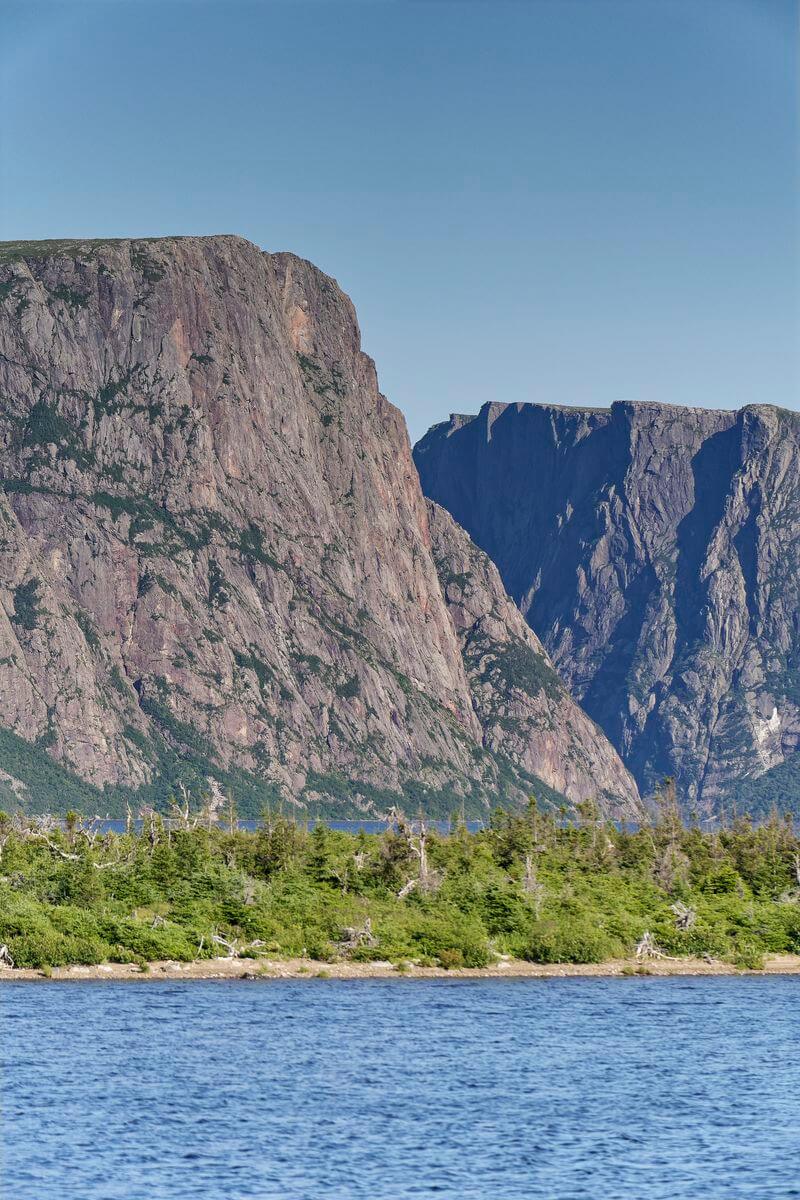
The Western Brook Pond is, as the name suggests, a picturesque pond. It is a former fjord, once connected to the glacial sea. What’s special about this walk is that you have to park at the main roadside car park and walk about 3km through some very beautiful countryside, ending with a wonderful boat trip on the pond. The walk itself is not difficult. The terrain is fairly flat all the way. However, it’s best to bring a hat and water as you’ll be in direct sunlight!
As soon as you take your first steps, you can see the famous cliffs in the background. They overlook the pond at a height of more than 600 metres. It’s really impressive, a rare sight in my opinion, and clearly a thing of beauty. In a way, it reminds me of the landscapes I saw in the Norwegian fjords to the north of Bergen back in 2010. But again, these were fjords connected to the sea. In short, the kids and I had a great time walking around and observing the surroundings. For your viewing pleasure, here are some photos.


We finally reached the area reserved for the famous boat trip after almost an hour’s walk from the car park. Let me make this clear, even though it’s obvious: you have to pay to go and it’s expensive. There is only one boat company that offers this kind of service. On our visit we paid $72 per adult and $39 per child. For the 4 of us, €180 for a 2-hour boat trip is quite a lot. Bookings can be made here.


But honestly, it’s worth it. We spent 2 hours on this boat, our hair blowing in the wind (freezing, haha). The landscapes are simply breathtaking. It’s really impressive to see these cliffs so high up. You feel so small in the middle of the lake. The driver will even stop a couple of times so we can have a look at the impressive waterfalls cascading down from the top of the cliffs. As a bonus, we even got to see an Original eating grass on the edge of the lake. To be honest, it was magnificent. What’s more, we made the most of the day as the weather was perfect. For your information, we had already postponed our trip to the lake because the weather in the area was very uncertain. So keep an eye on the weather, because even if the boat trip is beautiful in bad weather and even impressive with low clouds, it won’t be the same as it would be in sunny conditions… A few photos of the trip to share!




Green Gardens
Here’s a nice walk we had the chance to start, but didn’t finish because it was late and the kids had had enough, haha. The Green Gardens Walk starts, like the Tablelands Walk (which isn’t too far away), on the 431 raod, not too far from the Trout River. As far as we could see, it’s a really pleasant walk to admire the natural beauty.
The track meanders across a large plain, mainly rocky for the whole early part of the walk. The kids are having a great time, even though it’s still mid-afternoon and clearly not hot.


After crossing the ridge, the next part of the trail descends into a wooded area that slopes down towards the seaside. We weren’t that far from the end, judging by the photos I was able to see. The trail ends at sea level, with some great views of the local cliffs. A must do! The whole walk is listed as 9km round trip, between 3 and 4 hours depending on your walking ability.
Trout River Pond
The Trout River Pond walk was another one we tried. It was not far from the Trout River campsite where we stayed for 4 days. As is often the case (haha), we didn’t make it to the end of the hike because we didn’t have enough time. But from what we could see, it’s definitely a hike we would recommend, even if it’s not the one with the most views in general.


We particularly enjoyed walking in the grass at the start and then in the woods. It was great for everyone to take the time to discover the local flora and fauna.
Lookout Trail
Here’s a walk I had the chance to do on my own while Mélanie and the kids had a rest (travel can be exhausting too!). As always, the hike is indicated as 6 km and 2/3 hours, depending on your level. It’s worth noting, however, that there’s a climb of around 335m, so your legs will probably be a bit tired. It starts at the Discovery Centre, not far from the village of Woody Point. I’ll end with this little corner (the Discovery Centre) of what there is to see and do in Gros Morne National Park. But first back to the hike.
The weather was really nice in the early morning. I set off alone. There was a beautiful trail winding through the forest. Some signs reminded us of the basic rules and that we were among wild bears. We’re all in agreement that it would be better if I didn’t have any bear encounters, wouldn’t it? The start of the hike is easy on a gentle to moderate slope, all sheltered from the sun. It didn’t take me long to reach the first viewpoints along the way, which already offered beautiful panoramic views of the surrounding area. If the weather is good, it’s a real treat.


The trail continues to climb, getting quite steep but still shaded (which is something). At the end of the hike we continue on a slightly flatter section where we can see beautiful meadows and the famous flower of Newfoundland, the pitcher plant. This magnificent flower can be found everywhere. This magnificent flower is everywhere and once again the views of the surroundings and the bay below are magical. Judge for yourself.


At the end of the hike, I chatted with two Quebec women who’d come to hike in Gros Morne National Park. We chat about our respective lives as we finish the hike, which is much flatter and more pleasant, still in large grassy meadows. The break at the top, at the height of the two famous red benches that can be seen everywhere in Newfoundland, is well deserved!


Discovery Centre
With a few words about the famous Discovery Centre, located near the village of Woody Point, I’ll end this article about the must-sees in Gros Morne National Park. As I said in my article on when to go to Newfoundland, it’s clear that the weather is not always good on the island, and we had one day when the weather was really bad.
We decided to go for a walk in the famous centre instead of staying in a tent on the campsite and doing nothing with two kids going berserk in a 2m2 tent. And frankly, we weren’t disappointed, and neither were the kids. It’s really big, perfectly laid out and, above all, a lot of fun. There’s something for everyone. At the time of our visit, there were several exhibitions of photographs of the surrounding area, a huge, very well-done presentation on the geology of the island of Newfoundland and numerous rooms for children. Frankly, if you’re staying in Gros Morne National Park for a few days and have a day to kill in bad weather, it’s definitely worth a visit.
I’ll stop here with the walks we were able to do during our visit to Gros Morne National Park. Of course there’s more to see and do. But in 4 days there and knowing that we have small children, we’re happy to have seen all these places.
The other walks we didn't try
As I said above, we obviously didn’t do all the walks. I’d like to mention some of those that were recommended to us:
- Gros Morne Mountain: the most famous, longest and certainly one of the nicest hikes in the park. It has two variations (9a and 9b). The 9a is the approach path to Gros Morne (but does not take you to the top). Trail 9b takes you to Gros Morne’s summit. Both are listed as 9/10km and apparently it’s a tough climb. Difficult with the little ones and we didn’t stay long enough to do the hike,
- Stuckless Pond: a walk around a lake, given as 9.5km and about 3 hours,
- Stanleyville: a walk from the Lomond campsite (4km and 1-2 hours).
There are of course many others. If you’re looking for a nice map with all the walks listed, here’s the official link.
After Gros Morne National Park, we spent 5 days on the island of Fogo, also a wonder. Have a look at our article.
Gros Morne National Park - The practical side
As usual at the end of my travel articles, I’ll end with the practical side and everything you need to know for an excursion to the Gros Morne National Park.
Buying a Gros Morne National Park Pass
As with Canada’s other national parks, such as Banff National Park in the Rocky Mountains (or Jasper National Park, for that matter), which we visited two years ago, you’ll need to pay an entrance fee to explore Gros Morne.
At the time of our visit to Newfoundland in July 2022, the entrance fees were as follows
- Adult: $10.50/day
- Seniors: $9/day
- Youth (under 17): free
Annual rates are also available. You’ll find all current annual and daily rates on the following page.
As with Terra Nova National Park, which we visited when we were there, you can also buy a Parks Canada Discovery Pass. This card allows you to discover over 80 destinations, mainly Canadian reserves and national parks. All the locations and details are on this page.
For just $75.25 per adult, or even around $145 for a whole family, it’s a really good deal. Obviously, if you’re planning a trip to Canada for a month or more and want to visit several national parks/reserves, it’s well worth it! Prices and conditions can be found here.

How to get to Gros Morne National Park?
As always, it depends on where you live and where you come from. When we went to visit the island of Newfoundland, we were living in Guadeloupe. So the choice was pretty simple, with a flight from Pointe-à-Pitre to Montreal and then another flight from Montreal to St. John’s, the island’s capital. Have a look at our full guide to things to do and see in Montreal if you haven’t already.
When we got there, the island was far too big for us not to consider hiring a car. We regularly compare prices with different car hire companies using the DiscoverCars platform. A reputable site and our 100% recommendation.
If you fly in from St. John’s, it’s a good day’s drive to the west of the island. The park is over 650km away. That’s quite a few miles, even if the road is pretty good. We stopped here on our way down from the north of the island. To give you an idea, we drove down from St Anthony to Shallow Bay, in the north of the park, in a single day with the kids.
After that, if you’re coming by boat from Quebec or Nova Scotia, it’s a different story. Read our article on how to get to Newfoundland. There you’ll find all the options, whether boating or flying.
What activities are available at Gros Morne Park?
The main reason people come here is to hike and enjoy the magnificent scenery of the national park, as you’ll have gathered from the first part of this article. On the agenda: discovering the trails, views of the surrounding peaks, river crossings, mammal sightings, discovering the island’s natural heritage, simply enjoying the outdoors and the wide open spaces… There are plenty of trails. There are plenty of trails and you can spend 10 days in the park without getting bored.
As well as hiking, there are other activities on offer:
- Kayaking: there are several spots where you can kayak the local fjords and lakes for a few hours or several days. Some of the most popular spots are Western Brook Pond (where we took the boat trip), Anse St. Pauls, Bonne Bay, Trout River Pond and Shallow Bay,
- Fishing: If you’re a fishing enthusiast, you can go fishing in the area with a permit and special permits,
- Snowmobiling and snowshoeing: in winter you can try both activities in the park!
Where to stay in the park?
There are plenty of options. If you want to stay overnight in Gros Morne National Park, there are several official campsites. There are five official campgrounds in the park:
- Trout River Campsite
- Lomond Campsite
- Berry Hill Campsite
- Green Point Campsite
- Shallow Bay Campsite.
We spent one night at Shallow Bay and 4 nights at Trout River. You can find the 5 campsites and their location in the park on this map. You can also use the same link to make a reservation, which is always advisable, especially if you’re coming during high season in the summer.
As in Terra Nova National Park, you can choose between:
- A tent site: as we did at Trout River, depending on the size of your car and tent,
- A camping site: depending on the size you want,
- An oTENTik tent: we tried this at Shallow Bay when we arrived from the north. It’s a big tent with real beds, heating and a barbecue,
- Oasis Accommodation (formerly “Goutte d’Ô”): unusual accommodation in the shape of a drop.
Each campsite has its own characteristics and by clicking on the page above you’ll see the differences between them. Some have special tents, others do not. Some are bigger than others, etc.
However, I would pay particular attention to the location of the campsites and the size (immensity, if I may say so) of the park. To give you a general idea, if you start at Trout River (at the very south) and drive all the way north to Shallow Bay, it’s a 2 hour, 140km drive. That’s a lot and I have to admit we hadn’t really calculated it.
One (invaluable!) piece of advice would be: Look at the walks and areas you are interested in in the National Park and book the campsites accordingly. The campsites at Shallow Bay and Trout River are very remote compared to those at Green Point or Berry Hill, which are more central to be honest. But after that it depends on you and what you want to do. For example, to go to the Tablelands and Green Garden, being in Trout River was perfect because we were only 10 minutes away by car. But the day we went on a boat trip to Western Brook Pond, it took us 1? hours to drive to the start of the walk…

Where to stay near the park?
Gros Morne National Park is unique in that it is divided among several small communities that are not officially part of the park itself. You will therefore find a number of small towns offering various types of accommodation—everything from homestays and hotels to entire‑home rentals. You can look for a place to stay in the following towns (listed north to south)
- Cow Head
- St. Pauls
- Sally’s Cove
- Rocky Harbour,
- Norris Point,
- Bonne Baie,
- Woody Point,
- Trout River.
I even found accommodation around Wiltondale, Bonne Bay Pond, Jack Ladder and, a little farther away, Deer Lake. It all depends on your budget and preferences.
Finally, please note that there are quite a few other campgrounds near the park—particularly in the towns listed above. These are private campgrounds, not ones managed by the national park.
When should I visit the park?
I’ve already written a full article on when to travel to Newfoundland in general. You can refer to it without too much trouble. Otherwise, to talk specifically about Gros Morne National Park, I’d say that September and October are probably the best months. The temperatures will start to drop and it will be a little cooler, but you’ll avoid the summer crowds (June to August).
I’ll stop here for a visit to Gros Morne National Park. I hope you’ve enjoyed this article and that the descriptions and photos inspire you to visit this beautiful park, which I think is one of the best parts of our trip to Newfoundland.
See you soon for another article.

Written by Sylvain PONS
I had the opportunity to explore the beauty of this country I love on several different occasions and in different places (Canadian Rockies, the Island of Newfoundland for 1 month, Yukon and Québec)!
Despite our care, a mistake may have slipped into this article. If you find any, please don't hesitate to let us know so we can correct it as soon as possible and keep our information up-to-date!