Best camera for kids
Last update: 06/18/2026
Our blog continues to grow thanks to you, our readers. This post may contain affiliate links, which means we can earn a small commission if you make a purchase through them, at no extra cost to you. This helps us to continue to bring you more and support our work!
Do you know what Mélanie has been asking me for more than a year? “Have you started that article on kids cameras yet?” It’s funny because she’s not the one writing it, and the more time goes by, the longer my list of photography and travel articles gets… Anyway…
So yes, at the beginning of 2023, as part of my New Year’s resolution, I decided to finally write this article. It’s a topic that’s especially close to our hearts, because our kids, however young they are, love photography just as much as we do! It’s probably partly imitation, but over time they’ve started fighting more and more over our camera gear, to the point where we’ll soon have to buy each of them their own camera!
Today, after many, many days of research, we’re going to share what we think are the best cameras for kids!
At the start of the article, you’ll find a selection of cameras we’ve divided into 3 clear categories: simple digital cameras for children, instant cameras, and waterproof cameras. We’ve also just published our full guide to the best instant cameras.
So, no need to complain too loudly (well, almost, haha): I had to make choices based on the cameras I knew and the ones I thought made the most sense. Other children’s cameras could definitely have been included. Feel free to let me know in the comments if you’d like me to add another one!
The best cameras for kids right now
Here’s my selection, broken down by camera type.
Digital cameras for kids
I’ve selected what I think are the 5 best classic cameras for kids.
1 - V-Tech Kidizoom Smile
The KidiZoom Smile is a great 7-in-1 digital camera for children aged 3 to 10, designed to introduce them to photography and video in a simple, fun way. The camera has a 2MP resolution, a panorama mode, more than 35 special effects, face detection, a microphone for recording messages and changing the voice, a stop-motion animation feature, and, last but not least, 4 built-in games — something kids always love. It’s easy to use, with a dual viewfinder, a large shutter button that’s easy to reach, and a wrist strap. The camera also has 128MB of internal memory, expandable with a microSD card, plus rubber bumpers.
The camera is said to be very durable and has a 4x digital zoom. With its internal memory, it can store up to 760 photos or 9 minutes of video, and it comes with a USB cable for connecting it to a computer. It runs on 4 LR06 batteries (not supplied). I think it’s an ideal gift for children over the age of 3. Personally, I’d say it’s best for ages 3 to 7 at most.
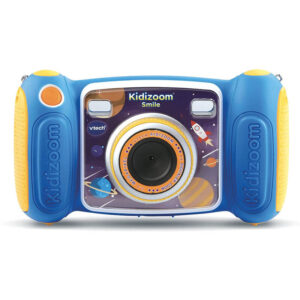
Reviews are fairly unanimous: this digital camera is a big hit with kids. Most people mention how easy it is to use and how well it fits into small hands. The camera’s sturdiness and durability also come up often. Image quality, while limited to 2MP, is decent without being anything special — but it’s perfectly fine for a child who will mostly be playing with it. If you want to print photos or view them on a larger screen, I’d recommend a VTech model with 5MP instead. The included mini-games are also very popular. It’s worth knowing that VTech makes several similar children’s models, such as the KidiZoom Touch, the KidiZoom Pix Plus, and the KidiZoom Duo.
2 - VTech KidiZoom Studio Video Camera
The Kidizoom Video Studio HD is a digital camera for children aged 5 to 12 (although I’d say 8 at most) that lets them capture fun moments and, above all, add their own personal touch with 70 special effects, filters, and frames. The camera comes with video creation tools that are perfect for younger users, allowing them to create montages, short films, and plenty of fun effects.
This 5MP camera is packed with features, including automatic face detection for photos and 720p HD video. You can also edit images with more than 20 different themes and use a movie-studio-style green screen to create special effects. It isn’t that easy at first (I know what I’m talking about), but once you get the hang of it, it’s great fun and really makes the kids laugh, haha.
The Kidizoom Video Studio HD comes with several accessories, including the green screen mentioned above for creating special effects, a tripod that doubles as a handle (very handy), a USB cable, a wrist strap, and three games. We bought this model for Louis, and he loved being able to make little video montages, magic effects, and photos with his own personalized video camera. The battery is rechargeable, and the memory can be expanded with a microSD card (not included).
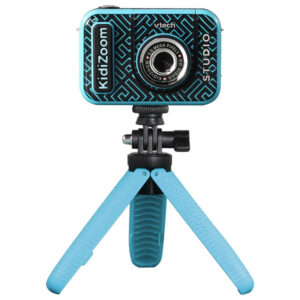
We think this is a very good camera for children. Louis used it for 2 years before losing it while we were traveling. Other user reviews are also very positive, often highlighting the product’s quality and durability. Overall, kids seem to be very happy with this camera, especially because of the green screen. The price is more than fair compared with other products that aren’t necessarily any better.
3 - GlobalCrown camera
GlobalCrown offers this camera for children aged 3 to 8. It has a 2-inch screen and plenty of features, including 4 fun photo modes, burst shooting, 4 color filters, and timer options. Thanks to its compact, lightweight design, this camera is easy to use and well suited to young children. It also has an 8MP photo sensor and can record 1080p HD video.
The GlobalCrown camera for kids has a rechargeable lithium battery and comes with a 32GB microSD card. It also has a non-toxic silicone case that acts as shock protection. Feedback on this protection seems very good, and it should help protect the camera well if your child drops it.
This children’s camera is a great way for your child to play and learn at the same time. It comes with 5 fun puzzle games that can help improve coordination while getting them to think a little too! The photo and video modes also add some interesting options, such as 6 scene modes and 4 zoom levels, which should appeal to kids.

Feedback on this camera has been overwhelmingly positive. The price is very low for a camera that I think will be enough for a child between the ages of 3 and 5, though probably not much beyond that. Users praise how easy the camera is to use, the various functions and games (including a puzzle game), and the USB charging. On the downside, you’ll need to insert the included SD card for it to work.
4 - Gofunly Dinosaur Camera
Here’s another kids’ camera that has received excellent reviews. This Gofunly camera has two lenses (front and back), so your little one can take selfies (starting early!). It comes with a 32GB SD card, records 1080p video, and has a rechargeable battery. I thought it looked really fun, especially for a young child. I’d recommend it for children between the ages of 3 and 5.
Interesting features include, as is often the case, 3 puzzle games (Tetris, Snake, and Push Box), so your child can spend a little time playing when they get bored of taking pictures. The camera has an 8x zoom, which will come in handy when kids want to zoom in on a detail. It’s also worth noting — and this is fairly rare for this type of camera — that it has 2-, 5-, and 10-second self-timer modes, so you can press the shutter, stand with your child, and take a photo of the whole family.
You’ll also find 6 types of photo filters and 5 mirror effects that let kids edit their pictures in some pretty fun ways. There are also 26 cartoon frames and stickers. I know Louis and Téo would have a lot of fun with these features. The camera comes with a silicone case to protect it from knocks and bumps.
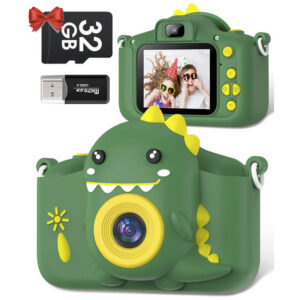
As I said, the feedback has been very good, with users often mentioning how easy it is for children to use and how sturdy and shock-resistant it feels. The fact that it is rechargeable is also a real plus. The mini-games and the fun side of the camera are often highlighted, as are the included accessories (SD card and USB cable for connecting it to a PC).
5 - Hangrui camera
I’m going to end this section on the best classic children’s cameras with this model, available in versions aimed at both boys and girls. As often happens with pink and blue models, they didn’t exactly go for originality. Like the others, this camera will help your child get into photography while also letting them play, thanks to a set of mini-games, frames, and stickers for customizing images. The camera has two 16MP lenses and a 1080p video mode.
Like the previous model, it comes with a protective silicone case to shield the camera from knocks and bumps (I can’t tell you how many times Louis dropped his camera between the ages of 3 and 5). The device is battery-powered, with up to 5 hours of continuous battery life, which isn’t bad compared with other models. It also comes with a 32GB card for storing photos and a cable for transferring them to a computer if needed.
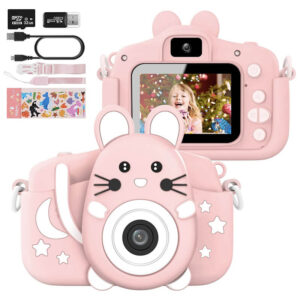
User reviews are also very good. In particular, people highlight how compact the camera is (both weight and size), which makes it perfect for a young child, along with all the available functions: selfies, timer, videos, games, and — as a small bonus — the pack of animal stickers in the box. It’s not much, but it’s a nice little touch.
Instant cameras for kids
Here are the 4 cameras in this category that I especially recommend.
1 - Gofunly Instant Camera
If you’re looking for an instant camera for kids, this is the model I’d recommend first based on my research and reading. Also from Gofunly, this 12MP camera (like all the ones I’m going to cover below) lets your little ones print their pictures in black and white. It comes with 3 rolls of paper, colored pencils for drawing on the pictures, a neck strap, and animal stickers.
Specifications include a 2.0-inch screen, 1080p video, a 1000mAh battery, and a weight of just 170g, which is very light for a small camera. There’s also burst mode, a self-timer, and 4 mini-games, ideal for passing the time in the car on a long trip (we do that a lot).

User feedback is relatively good. Kids love the device, especially the fun of being able to print and write on their photos. People also say that it charges quickly, that photo quality is satisfactory, and that the filters and stickers are a big hit with kids. Photo paper refills are relatively easy to find and inexpensive. In my opinion, it offers very good value for money.
2 - Selvim Instant Camera
Here’s another brand and another model that stood out during my search for an instant camera for kids. This Selvim camera offers instant printing in 1 second using thermal printing technology. The pictures can then be customized with the crayons included in the box. The camera has a dual lens, a 2.4-inch LCD screen, selfie mode, 8x digital zoom, automatic power saving, time-lapse mode, a timer, and slow-motion mode. As is often the case, it also comes with a wrist strap.
You can improve photo and video quality by adjusting the settings directly in the camera (with an adult’s help, haha). Print quality can also be adjusted in the camera. This instant camera for kids also includes a range of photo frames and filters.

Users especially appreciate this camera’s fairly original shape compared with other models of this type. As always, kids love the selfie function, the filters, and the ability to add frames. Battery life also seems very good. In my opinion, it’s a good model at a very reasonable price.
3 - Canal Toys Instant Camera
Here’s another instant camera, this time from Canal Toys, that stands out a little and came up several times in my research. Designed for children aged 3 to 8, this camera (like the others in this range) has more or less the same features as its competitors. In short: two lenses for a 12MP selfie mode, a 1000mAh battery that charges via USB, and, as with the other models, 4 filters and 22 frames for customizing images.
The package also includes 4 felt-tip pens for coloring the black-and-white images you’ll be printing, 4 rolls of thermal paper for printing your images in 1 second, a wrist strap so your child can wear the camera around their neck, and a sheet of stickers for decorating the prints.

Reviews from people who have bought this instant camera for children are, once again, very good (otherwise I wouldn’t recommend it). They often mention how simple the camera is to use, the fairly good print quality (for a child, of course), useful features like filters and frames that add something extra, and finally the stickers and markers, which are a nice little bonus!
4 - GlobalCrown Instant Camera
Here’s the last camera in this section, designed to let your little ones print black-and-white photos of everyday life, vacations, or weekends with their grandparents! It’s made for children aged 3 to 12, although I’d personally narrow that down to ages 4 to 7: before that, it may be a bit early, and after that they may feel too “grown up” for this type of camera. The camera has a large 3.5-inch screen, photo and video modes, an MP3 mode so your child can listen to music, and a few games to pass the time. There’s also selfie mode with a timer, time-lapse mode, 1080p video, and a range of fun frames and filters.
As with most of these models, the package also includes a 32GB SD card for storing more photos, videos, or music, plus 4 rolls of thermal paper for printing your masterpieces. A few accessories are missing, though, such as stickers and crayons.
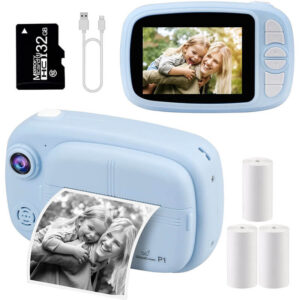
Apart from a few bad experiences (wrong model?), people are generally happy with this instant camera for kids — and let’s not forget that children are beginners. As is often the case, the camera is easy for kids to use. Print quality is said to be quite good for a camera of this type, and the included SD card is a real bonus.
Waterproof cameras for kids
I’ve deliberately limited my selection to 2 waterproof cameras for children. Generally speaking, these cameras are more advanced, and therefore tend to be bigger. But that wasn’t really the aim of this article, and I think most people will be looking for a camera for younger children.
We’ve put together a full guide to the best waterproof cameras (for adults) if you’re looking for this type of camera.
1 - Olympus TG-6 Waterproof Camera
Okay, I’m cheating a little here, because I’m about to talk about a camera I wouldn’t recommend for a young child, but rather for a teenager. But teenagers are big kids too, right? The Olympus TG-6 is a waterproof camera we’ve been using for years, and we’ve been lending it to Louis more and more. Yes, he hasn’t mastered everything yet, but he’s getting the hang of it. We even had the previous model, which was just as good.
The camera is described as an expert compact for adventurers (with good portability), and that’s exactly what it is. In that sense, it can work well for a child because it can handle being dropped into water or from a few feet. It is waterproof without a case to 15m. This waterproof camera can shoot in 4K and has several macro/microscope modes, which aren’t easy to get to grips with at first, but are great once you do. You can also send photos directly to your smartphone or PC via Wi-Fi, for example, to share them on social media.

Personally, we’re more than happy with it. So yes, don’t buy this waterproof camera for your 5- or 7-year-old, but I’d say a 10-year-old should be fine, or maybe a little older if your child is comfortable with cameras. Like many users, we love that it’s compact, solid, waterproof, shockproof, and dustproof. In my opinion, it’s much better than a GoPro for still photography (especially macro and underwater shots), though not for action video. Its 4K video works really well, and Full HD 120p is great for slow-motion clips. The macro quality is genuinely excellent, and we also use it a lot for underwater photography, where photo quality is impressive. We’d recommend it wholeheartedly. As a teenager’s first camera before moving on to a DSLR or mirrorless camera, I think it’s perfect.
2 - ISunFun camera
We’re moving down the range here, as I’m now talking about a waterproof camera that’s more suitable for children and, more importantly, comes at a much lower price. I’d recommend it for children aged 7 or 8 and up. Before that, I’m afraid it may be a bit too “advanced” in some ways! The camera has a 24-megapixel sensor and can record 2.7K video. It has a 16x digital zoom and is said to be shockproof and waterproof to 3m for 1 hour (although some users seem to doubt that…).

It also has a flash, burst mode, dual screens, a self-timer, and support for SD cards (not included) up to 128GB. The battery operation seems to work very well. The package includes the camera, a small pouch, and a USB cable for transfers. All in all, for the price, this is a good waterproof camera for getting started with photography.
There are many other waterproof cameras for children, but I found 3 solid-looking options with very good reviews. So if you’re looking for a waterproof camera for your little one (roughly between 3 and 7 years old, I’d say), take a look at the following links:
- GKTZ waterproof camera for kids (top rated with very good feedback)
- Ushining waterproof camera for children
- Uleway waterproof camera for kids
Tips for buying a camera for your child
As I said in the introduction, your choice of camera may depend mainly on your budget, but I still think it’s worth knowing a few things before buying, especially when it comes to your child’s age and a few technical criteria. Of course, you’re not buying them a £1000 mirrorless camera, and they’re not going to be printing A3 versions of their masterpieces, so technical criteria are still relative for a 3-year-old, haha.
How do you choose a digital camera for children?
I see two key criteria when buying a digital camera for a child: your child’s age (and therefore their abilities, so to speak) and the technical side of the camera, especially how easy it is to use.
The child’s age
In my opinion, this is the most important criterion when choosing a camera for your son or daughter. We’ve bought several cameras for Louis since he was 3, and we’re going to start with Téo a little before he turns 3. I’ll share a few funny anecdotes about cameras and Téo at the end of this article.
In general, if you look around, you’ll see that people don’t usually recommend buying a camera for a child under the age of 3. But I’d be a little more nuanced. Téo and Louis, our two children, are good examples. On our last trip to Canada (Newfoundland) in July 2022, Téo was barely 2. And honestly, he saw us taking photos so often that he really wanted to try it too. On several occasions, we lent him a small, sturdy, waterproof compact camera that we use when we travel, our excellent Olympus TG-6. So yes, it’s far too complicated for him (it’s not a children’s camera), but what I mean is that between ages 2 and 3, some children, especially if you’re into photography yourself, may already show interest. In that case, I think it can be a nice purchase.
In general, the age groups are often broken down like this:
- Cameras for children aged 3 to 6: this is obviously a great age for this, but you’ll still mostly be looking at cameras that resemble toys, with big, wide buttons and bright colors to catch your child’s attention (they’ll usually be very enthusiastic). The camera will be very simple and basic, and at this age the goal isn’t to take really good photos or print them out, but to let them try photography and learn on their own. In this age group, you’ll often find cameras with headphones, video, and the ability to add frames to photos, for example. Between ages 3 and 6, there’s a huge range, and you’ll find major differences between models, from very cheap (and low-quality) cameras to much more interesting options like the famous VTech Kidizoom Duo,
- Cameras between 7 and 12 years old: again, I’m not the one who created these age brackets, but this is the one I see most often. And again, there’s a big difference between a 7-year-old child (Louis is that age at the time of writing) and a 12-year-old preteen. I’d say this is the age when a child may no longer want a “baby” camera with big buttons and odd colors, and may start wanting something “more serious,” something bigger and closer to a small adult compact camera (although those are disappearing fast, haha). For example, 7-year-old Louis already knows how to use our Olympus, which I mentioned above. Even if he doesn’t know all the functions, he already understands how to zoom in and out, take photos or videos, change the basic modes, view a photo, zoom in on it to check a detail, and so on.
- Cameras for children over 12: I think that by the age of 12, your child will usually be mature enough to handle a small compact camera. Of course, this depends on your budget, and everyone will decide what they can afford, but there are several small compact cameras I recommend near the top of the article.
Technical criteria to consider
As I said above, I think age is one of the most important factors, if not the most important, when buying a camera for your child. Manufacturers have generally done a good job, and the technical criteria often go hand in hand with the child’s age.
Here are the criteria I think are worth considering when you’re looking for a camera for your little one.
Sturdiness and shock resistance: In my opinion, and based on my experience with Louis, sturdiness and shock resistance are essential when buying a camera for a child. Children are often quite clumsy (even at 7) and may drop their cameras. That’s why I still don’t lend my mirrorless cameras to Louis, haha. So make sure you choose a model that can handle knocks and bumps and will last a long time.
Ease of use: It’s important to choose a camera that’s easy for your child to use, especially for younger kids (under 7, I’d say). I really recommend choosing a camera with a limited number of buttons and settings so your child can focus on having fun taking pictures. An LCD screen is a plus for viewing photos, editing them directly on the camera, and, why not, playing games.
Age-appropriate features: Depending on your child’s age, the camera will offer different features. For very young children, access to games, videos, and music can be a plus. Some manufacturers, for example, make cases featuring popular comic-book or cartoon characters, which your child may enjoy too. Other features may include adding frames, taking selfies, recording your voice, or distorting photos. For older children, take a closer look at more advanced features, such as sharing via Wi-Fi or Bluetooth.
Image quality: If your child wants to view their photos on a computer screen or even print them with you, a few extra megapixels will make a difference and improve image quality. Depending on the camera, you’ll often have at least 2 or 3MP. A quick calculation tells me that 3MP is enough to get decent image quality when printing a standard 10x15cm photo. An HD screen, for example, only displays 2MP! For a good-quality A4 print, we recommend 8MP. Something to keep in mind if you plan to print.
Size, weight and grip: I’ve deliberately grouped these 3 criteria together because they’re often linked. For very young children, there are cameras with side grips (like the VTech Kidizoom) or a wrist strap option, which I find practical for a child. In my experience, they even like wearing the strap! For very young children, try to choose a lightweight camera, ideally under 300 to 400g, I’d say.
Battery life: this is as important for them as it is for you. For them, because if the battery dies quickly, your child will be frustrated while waiting for the device to recharge (I know from experience). For you, because if you have to buy batteries every few days, it quickly becomes a real hassle, not to mention the environmental and financial side. That said, you can absolutely buy rechargeable batteries, which I recommend if you’re buying a children’s camera that uses batteries. Most of the battery-powered models I’ve seen use standard AA batteries. I especially recommend this charger + battery set.
The ability to send photos: it’s unlikely that your child will have a Facebook account or a personal PC at the age of 6, but for a preteen or teenager, I think this is an important criterion to consider. Some children’s cameras offer Wi-Fi so they can share memories and photos from the moment.
The different types of cameras for kids
Here’s a quick look at the different types of cameras you can choose for your child.
- Digital cameras for kids
These are the classic cameras, the best known and probably the best-selling. Of course, you’ll find big differences in quality and functionality between models in this category.
- Instant cameras for kids
Everyone knows them by the generic term “Polaroid” (which is actually a brand name). Instant cameras for children have been growing in popularity for a while now, alongside similar models for adults. As the name suggests, these cameras instantly print the photo you’ve just taken, often in black and white. They often let children personalize images with built-in frames or filters placed in front of the lens. They’re usually a little more expensive to buy, and you’ll also need to think about buying extra paper for prints. It’s a great way for your child to keep memories in a notebook or album.
- Waterproof cameras for kids
These are also becoming increasingly popular, especially with preteens. They are often cameras with more “advanced” features. In particular, they are waterproof (up to a few meters, often 5m), dustproof, and generally shockproof thanks to sturdier construction materials.
Which brand should you choose when buying a camera for children?
Broadly speaking, two solid benchmark brands stand out from the crowd: VTech (THE benchmark) and Fisher-Price, which also has a range of cameras for children.
There are also a number of lesser-known brands that offer this type of camera. Just be careful with very cheap brands… Some of the more visible names include Gofunly, Astgmi, Faburo, and AgfaPhoto.
What’s the average price of a camera for children?
It’s all very well talking about technical criteria and brands, but chances are you’re also thinking about the budget for buying a camera for your little one. Personally, that’s been the case every time we’ve bought a small camera for Louis.
To sum up, I’d say you can find children’s cameras in all price ranges, but they generally cost between €30 and €150. Prices vary depending on the brand, model, and, of course, features.
Bear in mind, of course, that the cheapest models tend to be the simplest and come with the fewest features, such as video, games, or accessories like a headset. Conversely, more expensive models may offer more advanced features such as optical zoom, higher resolution, the ability to share images via Wi-Fi or Bluetooth, or a built-in flash. One final piece of advice: buying the most expensive camera isn’t necessarily the best solution. The most important thing is choosing a camera that suits your child’s age and abilities.
Practical tips and personal thoughts
The benefits of photography for children
There are many benefits to encouraging children to take photographs. Most importantly, I’d say:
- Develops creativity: by searching and looking around, they’ll create their own ideas and little stories in their heads,
- Develops self-confidence: we congratulate them when they take good photos of something, and of course they’re really happy!
- Captures precious memories: it’s a good way to keep memories of vacations, for example, and in that sense I think buying a camera for your little one can be a good idea,
- Helps them concentrate: when I’m with Louis and I try to explain things to him, he listens, focuses, and I think he takes a lot in. It helps him concentrate,
- Builds technical skills: when they start thinking about their photo and what they’re going to shoot, you can teach them the basics of photography and a few extra functions!
- Encourages them to explore their surroundings: photography lets them poke around, look for things, and see their environment differently, noticing details they might otherwise have missed.
How do you introduce children to photography?
Just because Mélanie and I are photographers doesn’t mean we wanted to push them into it, but I have to say that both of them became naturally interested in photography when they saw us doing it.
- Interesting subjects for children
In my experience, children can enjoy almost any subject as long as you guide them and keep them interested. When you’re traveling, children are often drawn to landscapes (because they’re right in front of them), but also to anything “small.” I’ve seen them photograph lots of stones, bits of trees, snails, and so on. I think you can help them develop an interest in almost anything.
- Tips for stimulating their creativity / Activity ideas
As parents, we find that photography is a great way to stimulate their creativity. We always encourage them to try new things: new angles, new colors, new subjects. I think children should be encouraged to experiment with photography. Obviously, it depends on the child’s age, but once they get a little older, you can come up with plenty of activities for them.
Once your child is a little older, probably around 4 or 5, you can ask them to:
- Photograph something specific in the house or outdoors.
- Photograph certain objects that start with a given letter, or even the whole alphabet if you want a bit of peace and quiet for a while, haha,
- Play with colors and find specific colors to photograph — it’s fun and gets them thinking and searching,
- When they’re older, you can start explaining the basics of photography, semi-automatic modes, how to frame a shot, how to keep the horizon straight — simple things that a child like Louis can do at 7.
A few funny anecdotes about cameras and children
I wanted to share two funny anecdotes that made us laugh out loud and convinced us that kids really do love photography!
The first one is about Louis, when he was about 4, I think. He’d received a camera for Christmas and was always playing with it. One day, while he wasn’t home, we were curious to see what he had been filming. We came across a series of at least 20 videos of him on the toilet, singing and, above all, making up stories all by himself, which is hilarious when it’s your own kid.
More recently, during our trip to Canada, Téo, who was only 2 years old, loved imitating us with our cameras. He didn’t have a camera of his own yet, so he had a lot of fun picking up pebbles on the boardwalks and telling me “photo, photo.” Then he would bend down and pretend to take a picture with his pebble, which was really cute. Often, as we walked along the paths together, he would stop and say “photo, photo.” He wanted me to stop and photograph whatever he was photographing, whether it was flowers or pebbles. In short, we laughed a lot.
I’ll stop here for this rather long article on cameras for children. We spent a lot of time writing and researching it. As we often say, we are not paid by any brand to write this article. However, if you found it useful, you can use the Fnac or Amazon links in this article, which may earn us a small commission at no extra cost to you. That way, you can support our blog and our work, help us stay independent, and allow us to keep publishing content without advertising!
Tell me in the comments what kind of camera your kids have. What’s your feedback? Do your kids love theirs as much as ours do?
Thanks again for reading, and see you soon,

Written by Sylvain PONS
I've been passionate about photography since 2010, learning as I went along. Today, I dedicate myself to guiding others in their choice of camera gear and sharing a variety of tips to improve their photography skills.
Despite our care, a mistake may have slipped into this article. If you find any, please don't hesitate to let us know so we can correct it as soon as possible and keep our information up-to-date!