What is the best lens for travel?
Last update: 05/07/2026
Our blog continues to grow thanks to you, our readers. This post may contain affiliate links, which means we can earn a small commission if you make a purchase through them, at no extra cost to you. This helps us to continue to bring you more and support our work!
In a previous article, I explained in detail how to choose your camera lens and what were the criteria to consider when choosing your DSLR. I hope you can see more clearly now? From the beginning of this blog, I wanted to discuss and connect my two main passions: travel and photography. So it’s quite naturally that I present to you today this article: Which lens to choose for travel photography?
In parallel, I have already written an article explaining how to choose your camera and which one to choose (bridge, mirrorless camera, DSLR, etc.)? So, I’m focusing today on people who have taken the plunge and bought a DSLR. This article is written in parallel with the complete guide to know and understand how to choose your camera lens?
So in your opinion, is there a better lens for traveling? Should you choose a fixed focal length? If not, what focal length should you consider? Is it mandatory to have an ultra-wide angle for a trip? Basically a lot of questions on this subject…

Choosing lenses for a trip is not easy, and you will have to find a compromise between weight, budget, versatility, personal desires/passion, local needs, etc. In my opinion, before knowing which lens to choose for a trip, you should ask yourself three pertinent questions.


The best lenses to choose for travel?
1 - What kind of photos do you want to shoot?
In order to know which lens to choose for a trip, it is necessary to ask yourself what type of photos you want to take. In other words, what type of photo do you like? What do you shoot most often when traveling?
On the other hand, you can exclude some lenses if you don’t practice the kind of photo to which they are initially intended. The simplest example to give are specialized lenses for macro photography. These are very specific lenses and unless you want to shoot dragonflies or snails, a macro lens will not be of much use to you. You can of course shoot other types of photos (portrait for example), but you might as well buy a lens dedicated to portraits.
If you want to specialize in wildlife photography, you will have to pay particular attention to the aperture of your lens, the induced depth of field (the background blur = the bokeh), or the sharpness. No matter the mount (Cannon, Nikon, Panasonic lens or other), this consideration will have to be done in parallel depending on whether you have an APS-C or or full-fame sensor. I will talk about it below. If you want to go further into this subject, I invite you to read my article “the best lenses for wildlife photography”.
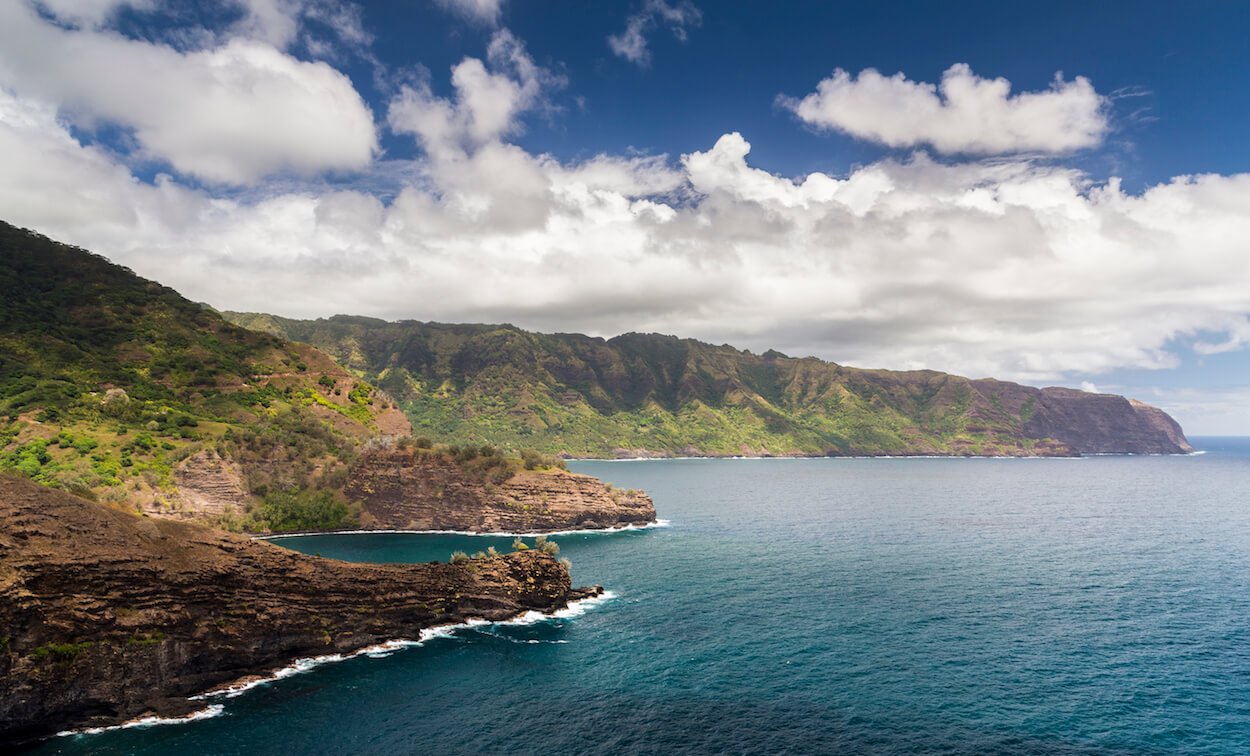
So try to answer this simple question, as it is ultimately what will most influence your choice of lenses for your trip. The answer can be very easy for specific trips or holidays, for example a safari in Tanzania, where you would prefer a telephoto lens and a landscape lens.
If you don’t have any particular ideas about the type of photo you’d like to take while traveling, that’s okay. Just know that depending on what you’re carrying with you, some photos will be more complicated to take on site.
2 - In what conditions?
This is in my opinion a second question that can be asked to know which lens to choose when traveling. Indeed, according to the general shooting conditions throughout your trip, you may not necessarily have to rely on top-of-the-range equipment.
Let me quickly explain, if you want to focus on night photography, or even in the early morning or evening, having a bright lens (with a large aperture) can be very useful, because you will lack brightness otherwise.

Conversely, if you shoot most of your travel pictures during the day and in good lighting conditions, having an ultra bright lens will not necessarily be essential (not to mention its primary purpose, which could be to highlight your subjects).
So it’s up to you to see under what conditions you will generally take your pictures!
3 - What type of trip?
Finally, the last question that can be considered to know which lens to choose to go on a trip: the type of trip or vacation you practice in general?
Indeed, depending on what you are planning, the equipment may not be the same at all. Can you imagine carrying several kilos of equipment when hiking in the mountains? It is a questionable choice but, in any case, depending on what you are going to do, the final choice will surely not be the same. For example, when I go on a photo trip, in addition to my camera and my lenses, I always carry my camera bag and all the photo accessories with me (tripod, ND filter, polarizing filter, remote control, filter holder, grip, adapter ring, etc.). These to me are essential for successful photos, but it clearly comes into play at the end of the day!

Another example, if you travel a lot in tropical areas, it could be worth buying tropicalized lenses (dust and water).
Well there you have it, I have finished presenting all the questions I think you should ask yourself to know which lens to choose for traveling!
On a side note, depending on your needs, it might be a good idea to get a waterproof camera for travel. I detail in the link above our best selection of the moment!
So, which lens should you choose for traveling? My recommendations
In this paragraph, I give you my vision of things on the choice of travel lenses to take. It is obviously impossible to answer all the possible cases, everyone making their own choices according to its utility, their needs, and very often their budget.
Generally speaking, I would recommend buying several specific lenses rather than one single wide focal length lens, called “multi-purpose”. In reality, these are often of lower quality and you will surely be very quickly disappointed by this kind of equipment (e.g. 18-300 mm).
Note that you will have to pay attention to the type of body you have, either an APS-C or a Full Frame. Lenses for APS-C will very generally be cheaper than those for Full Frame. All Full Frame lenses can be installed on an APS-C body. The reverse is usually not true.
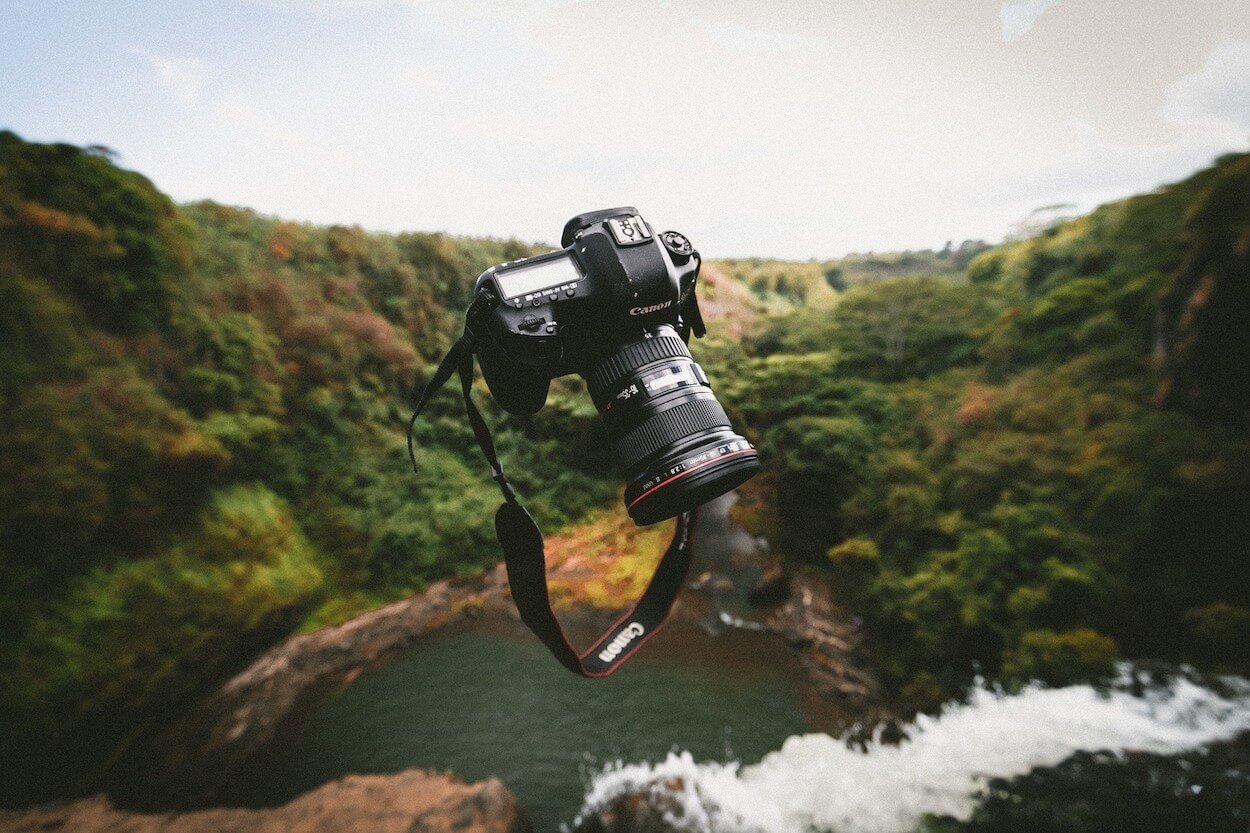
So, here is my answer to the question “which lens to choose to go on a trip” to cover more or less all the possibilities during your trip.
For the 3 types of lenses listed below, I specify my recommendations for an APS-C body (or small budget) or for a Full Frame body (for those who own one or for larger budgets). For information, I currently own a 6D (full frame).
Which wide-angle lens to choose?
This type of lens will be perfect for landscape photography but also for street photography. It will allow you to highlight your landscapes with great perspectives and a wide angle of view, and will offer you very wide fields of view in street photography, for example markets or scenes of city life.
This type of lens may not be required for people who are new to photography and cannot afford to buy one. You can very well start taking landscape and street pictures with a standard lens, such as 18-55mm on an APS-C or 24-70mm on a Full Frame sensor.
For this type of lens, you will need a focal length of 10-12mm on an APS-C body and a focal length of about 17-24mm on a Full Frame body to get the equivalent. This is referred to as a wide-angle zoom, since they are not fixed focal lengths. However, there are for example ultra-wide-angle fixed lenses, such as the Canon 14mm f/2.8 (reputed excellent but out of price).
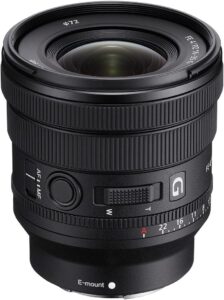
Here are my recommendations based on what I know, what I have read and researched on each of its lenses. Be careful to choose your lens according to your body (APS-C) or Full Frame. I personally owned the first version of the Tokina 11-16 mm f/2.8 AT-X PRO DX II when I first started with my Canon 500D. Since being in Full Frame, I recently equipped myself in 2019 with a Canon 16-35 f/4 L IS, which is superb.
Here is a series of wide-angle lenses that I recommend with my eyes closed for APS-C and Full Frame.
Lens Focallength Max.Aperture Weight
Dim. (Ø x L) Min. FocusDist. Approx.price Best price
+
Sigma 10-18mm f/2.8 DC DN Contemporary X
10-18mm f/2.8 8.82 oz / 250g 2.8 x 2.5" / 72 x 64 mm 4.7" / 12 cm $599 Amazon B&H
More info +
+
Canon RF-S 10-18mm f/4.5-6.3 IS STM
10-18mm f/4.5-6.3 5.29 oz / 150g 2.7 x 1.8" / 69 x 45 mm 5.5" / 14 cm $299 Amazon B&H
More info +
+
Fujifilm XF 10-24mm f/4 R OIS WR
10-24mm f/4 13.58 oz / 385g 3.1 x 3.4" / 78 x 87 mm 9.4" / 24 cm $999 Amazon B&H
More info +
+
Sony E 11mm f/1.8
11mm f/1.8 6.38 oz / 181g 2.6 x 2.3" / 66 x 58 mm 4.7" / 12 cm $549 Amazon B&H
More info +
+
Tamron 11-20mm f/2.8 Di III-A RXD X
11-20mm f/2.8 11.82 oz / 335g 2.9 x 3.4" / 73 x 86 mm 5.9" / 15 cm $699 Amazon B&H
More info +
+
Tamron 11-20mm f/2.8 Di III-A RXD
11-20mm f/2.8 11.82 oz / 335g 2.9 x 3.4" / 73 x 86 mm 5.9" / 15 cm $699 Amazon B&H
More info +
+
Nikon Z 14-24mm f/2.8
14-24mm f/2.8 1.4 lb / 650g 3.5 x 4.9" / 89 x 125 mm 11" / 28 cm $2 495 Amazon B&H
More info +
+
Nikon Z 14-30mm f/4 S
14-30mm f/4 1.1 lb / 485g 3.5 x 3.7" / 89 x 95 mm 11" / 28 cm $1 345 Amazon B&H
More info +
+
Canon RF 14-35mm f/4 L IS USM
14-35mm f/4 1.2 lb / 544g 3.3 x 3.9" / 84 x 99 mm 7.9" / 20 cm $1 399 Amazon B&H
More info +
+
Canon RF 15-30mm f/4.5-6.3 IS STM
15-30mm f/4.5-6.3 13.76 oz / 390g 3 x 3.5" / 77 x 88 mm 5.1" / 13 cm $449 Amazon B&H
More info +
+
Fujifilm XF 16mm f/1.4 R WR
16mm f/1.4 13.23 oz / 375g 2.9 x 2.9" / 73 x 73 mm 5.9" / 15 cm $999 Amazon B&H
More info +
+
Sigma 16mm f/1.4 DC DN Contemp.
16mm f/1.4 0.9 lb / 405g 2.8 x 3.6" / 72 x 92 mm 9.8" / 25 cm $439 Amazon B&H
More info +
+
Sony FE 16-25mm f/2.8 G
16-25mm f/2.8 0.9 lb / 409g 2.9 x 3.6" / 75 x 91 mm 7.1" / 18 cm $1 199 Amazon B&H
More info +
+
Sony FE PZ 16-35 mm f/4
16-35mm f/4 12.45 oz / 353g 3.2 x 3.5" / 81 x 88 mm 9.4" / 24 cm $1 199 Amazon B&H
More info +
+
Tamron 17-28mm f/2.8 Di III RXD
17-28mm f/2.8 0.9 lb / 420g 2.9 x 3.9" / 73 x 99 mm 7.5" / 19 cm $799 Amazon B&H
More info +
+
Tamron 20mm f/2.8 Di III OSD M 1:2
20mm f/2.8 7.8 oz / 221g 2.9 x 2.5" / 73 x 64 mm 4.3" / 11 cm $249 Amazon B&H
More info +
Which transtandard lens to choose?
A transtandard lens is a lens that roughly corresponds to a focal length of 18-55 mm for an APS-C body and 24-70 mm for a Full Frame body. With this type of lens, you can take the vast majority of travel photos, whether it’s portraits, street photos or even landscape pictures. You won’t have the same wide angle as with a dedicated lens (see previous paragraph), but you can get by without it, at least at first. The framing here will be standard, neither too wide nor too zoomed. This is the recommended lens for learning photography.
As proof, I have currently sold my Tokina 11-16 mm wide-angle lens that I had on my old body. Since then, I only own a 24-70 mm f/2.8 for landscape or portrait photography when traveling. It’s not ideal all the time and I sometimes want to invest in a good wide angle for a full frame body, but I can live with it for now!
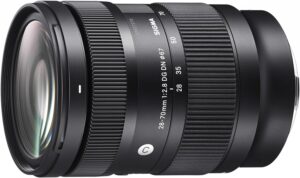
Here are some serious recommendations for APS-C and Full Frame bodies
Lens Focallength Max.Aperture Weight
Dim. (Ø x L) Min. FocusDist. Approx.price Best price
+
Sigma 18-50mm f/2.8 DC DN Contemporary X
18-50mm f/2.8 10.05 oz / 285g 2.4 x 3" / 62 x 77 mm 4.7" / 12 cm $529 Amazon B&H
More info +
+
Sony E 18-105mm f/4 G
18-105mm f/4 0.9 lb / 427g 3.1 x 4.3" / 78 x 110 mm 1.5' / 45 cm $649 Amazon B&H
More info +
+
Canon RF-S 18-150mm f/3.5-6.3 IS STM
18-150mm f/3.5-6.3 10.93 oz / 310g 2.7 x 3.3" / 69 x 84 mm 6.7" / 17 cm $499 Amazon B&H
More info +
+
Tamron 18-300mm f/3.5-6.3 Di III-A VC VXD X
18-300mm f/3.5-6.3 1.4 lb / 620g 3 x 5" / 76 x 126 mm 5.9" / 15 cm $699 Amazon B&H
More info +
+
Panasonic Lumix S 20-60mm f/3.5-5.6 L
20-60mm f/3.5-5.6 12.35 oz / 350g 3 x 3.4" / 77 x 87 mm 5.9" / 15 cm $599 Amazon B&H
More info +
+
Nikon Z 24-70mm f/4 S
24-70mm f/4 1.1 lb / 500g 3.1 x 3.5" / 78 x 89 mm 1' / 30 cm $995 Amazon B&H
More info +
+
Sigma 28-45mm f/1.8 DG DN Art L
24-70mm f/2.8 2.1 lb / 960g 3.5 x 6" / 88 x 151 mm 1' / 30 cm $1 349 Amazon B&H
More info +
+
Canon RF 24-105mm f/4L IS USM
24-105mm f/4 1.5 lb / 700g 3.3 x 4.2" / 84 x 107 mm 1.5' / 45 cm $1 299 Amazon B&H
More info +
+
Panasonic Lumix S 24-105mm f/4 Macro O.I.S. L
24-105mm f/4 1.5 lb / 680g 3.3 x 4.6" / 84 x 118 mm 1' / 30 cm $1 299 Amazon B&H
More info +
+
Sony 24-105mm f/4 G OSS
24-105mm f/4 1.5 lb / 663g 3.3 x 4.5" / 83 x 113 mm 1.2' / 38 cm $1 299 Amazon B&H
More info +
+
Canon RF 28-70mm f/2L USM
28-70mm f/2 3.2 lb / 1430g 4.1 x 6.7" / 104 x 170 mm 1.3' / 39 cm $2 899 Amazon B&H
More info +
+
Sigma 28-70mm f/2.8 DG DN Art Contemp.
28-70mm f/2.8 1 lb / 470g 2.8 x 4" / 72 x 102 mm 7.5" / 19 cm $729 Amazon B&H
More info +
+
Nikon Z 28-75mm f/2.8
28-75mm f/2.8 1.2 lb / 565g 3 x 4.7" / 75 x 121 mm 1.6' / 50 cm $995 Amazon B&H
More info +
+
Fujifilm XF 50-140mm f/2.8 R LM OIS WR X
50-140mm f/2.8 2.2 lb / 995g 3.3 x 6.9" / 83 x 176 mm 3.3' / 100 cm $1 599 Amazon B&H
More info +
Which telephoto lens to choose?
In the end, it’s impossible to answer the question “which lens to choose for a trip”, without mentioning the telephoto lens. For a trip, I would strongly recommend a classic 70-200mm lens. Note that for beginners in photography, it is often a 55-250mm or 55-200 mm type lens with small relative apertures (f/4 to f/5.6, or more). While traveling, the telephoto lens will allow you to take pictures of everyday life (street, market, life scene, etc.), original landscape photos as well, or even superb close-up portrait photos (usually around 100mm). On this subject, here is the full guide for choosing your lenses for portrait photography.
In short, it’s the ideal addition to your standard lens that we discussed in the previous paragraph. To put it simply, each brand generally offers several 70-200mm lenses, whose characteristics vary according to:
- Whether the lens has stabilization or not,
- Depending on the lens aperture (typically f/2.8 or f/4).
Obviously, prices will go up when you choose a stabilized lens with a large aperture.
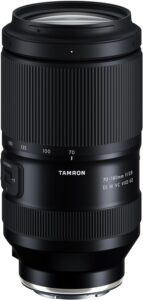
However, these telephoto lenses will often be too short for wildlife photography, where a longer focal length (300 mm minimum) is required. I personally chose the superb Canon EF 70-300 f/4-5.6L IS USM, which in my opinion is the ideal travel lens for its small size and long focal length.
For wildlife photography enthusiasts on a trip, I highly recommend 100-400 mm focal lengths which are particularly suitable for traveling.
Here are my recommendations for choosing your telephoto lens when traveling.
Lens Focallength Max.Aperture Weight
Dim. (Ø x L) Min. FocusDist. Approx.price Best price
+
Canon RF-S 55-210mm f/5-7.1 IS STM
55-210mm f/5-7.1 9.52 oz / 270g 2.7 x 3.7" / 69 x 94 mm 2.3' / 70 cm $349 Amazon B&H
More info +
+
Sigma 60-600mm f/4.5-6.3 DG DN OS Sports L
60-600mm f/4.5-6.3 5.5 lb / 2500g 4.7 x 11" / 119 x 279 mm 1.5' / 45 cm $1 999 Amazon B&H
More info +
+
Canon RF 70-200mm f/4 L IS USM
70-200mm f/4 1.5 lb / 695g 3.3 x 4.7" / 83 x 120 mm 2' / 60 cm $1 599 Amazon B&H
More info +
+
Canon RF 70-200mm f/2.8 L IS USM
70-200mm f/2.8 2.4 lb / 1070g 3.5 x 5.7" / 90 x 146 mm 2.3' / 70 cm $2 599 Amazon B&H
More info +
+
Sony 70-200mm f/4 Macro G OSS II
70-200mm f/4 1.8 lb / 794g 3.2 x 5.9" / 82 x 149 mm 10.2" / 26 cm $1 699 Amazon B&H
More info +
+
Canon EF 70-200mm f/4L USM
70-200mm f/4 - - - $759 Amazon
More info +
+
Sigma 70-200mm f/2.8 DG DN OS Sports L
70-200mm f/2.8 3 lb / 1345g 3.6 x 8.1" / 91 x 205 mm 2.1' / 65 cm $1 499 Amazon B&H
More info +
+
Sigma 100-400mm f/5-6.3 DG DN OS Contemporary X
100-400mm f/5-6.3 2.5 lb / 1135g 3.4 x 7.8" / 86 x 197 mm 3.6' / 110 cm $789 Amazon B&H
More info +
+
Fujifilm XF 100-400mm f/4.5-5.6 R LR OIS WR
100-400mm f/4.5-5.6 3 lb / 1375g 3.7 x 8.3" / 95 x 211 mm 5.7' / 175 cm $1 899 Amazon B&H
More info +
+
Nikon Z 100-400mm f/4.5-5.6 VR S
100-400mm f/4.5-5.6 3.2 lb / 1435g 3.9 x 8.7" / 98 x 222 mm 2.5' / 75 cm $2 695 Amazon B&H
More info +
+
Sigma 100-400mm f/5-6.3 DG OS HSM Contemp.
100-400mm f/5-6.3 2.6 lb / 1160g 3.4 x 7.2" / 86 x 182 mm 5.2' / 160 cm $868 Amazon
More info +
+
Canon RF 100-500mm f/4.5-7.1 L IS USM
100-500mm f/4.5-7.1 3 lb / 1365g 3.7 x 8.2" / 94 x 208 mm 3' / 90 cm $2 699 Amazon B&H
More info +
+
Fujifilm XF 150-600mm f/5.6-8 R LM OIS WR
150-600mm f/5.6-8 3.5 lb / 1605g 3.9 x 12.4" / 99 x 315 mm 7.9' / 240 cm $1 999 Amazon B&H
More info +
+
Nikon Z 180-600mm f/5.6-6.3 VR
180-600mm f/5.6-6.3 4.4 lb / 1995g 4.3 x 12.4" / 110 x 316 mm 4.3' / 130 cm $1 899 Amazon B&H
More info +
Which lenses to choose for a trip? My winning combos?
I present here two trio of lenses that I think would be perfect for a trip.
For small budgets in full frame, from Canon for example :
Canon RF 15-30mm f/4.5-6.3 IS STM (wide-angle) + Canon RF 24-105mm f/4-7.1 IS STM (Sstandard) + Canon RF 100-400mm f/5.6-8 IS USM (telephoto)
For about 1 500€ in total
If you wish you can add a small lens for perfect portrait when traveling (light), the 50mm f/1.8.
For those with a larger budget and with full frame camera.
Canon RF 15-35mm f/2.8L IS (Wide-angle) + Canon RF 24-70mm f/2.8L IS (Standard) + Canon RF 70-200mm f/2.8 L IS USM (Telephoto)
You may want to consider adding this portrait lens, the Canon 85mm f/1.8.
I hope that this article has helped you understand which lens you should choose to travel with and that you see more clearly now. Before taking the plunge, if you have any doubts, please feel free to leave me a comment at the bottom of this article, I will help and advise you in choosing your lens.
If you are still unsure of which lens to choose, I invite you to come and read the article on how to choose your camera lens, it could be useful for you to understand the elements to take into account. In regards to cameras, I wrote an article on which camera to choose for travel? You’ll find a whole bunch of possibilities!
If you want to go further, I invite you to read the articles on the choice and use of photo accessories when traveling (polarizing filter, ND filter, safari accessories, etc.).
It’s never easy to make a purchase, and we’re often afraid of making the wrong choice or making a mistake! I’ve been there too, but after months of reading and researching, you have to go for it!
I hope you make the right choice and wish you a good trip!
I hope this article isn’t too technical. I voluntarily decided to open a section dedicated to the basics of photography, in order to explain to you all the notions present in the article and others necessary for a good understanding (autofocus, image stabilization, shutter speed, focus, sensitivity, etc.).
What lens would you usually take with you on a trip? Are you more of the type to carry a lot? or travel light?

Written by Sylvain PONS
I've been passionate about photography since 2010, learning as I went along. Today, I dedicate myself to guiding others in their choice of camera gear and sharing a variety of tips to improve their photography skills.
Despite our care, a mistake may have slipped into this article. If you find any, please don't hesitate to let us know so we can correct it as soon as possible and keep our information up-to-date!