Best Canon RF Macro Lenses
Last update: 06/16/2026
Our blog continues to grow thanks to you, our readers. This post may contain affiliate links, which means we can earn a small commission if you make a purchase through them, at no extra cost to you. This helps us to continue to bring you more and support our work!
I’m continuing my guide to the best camera lenses by brand. Today, I’m going to talk about the best Canon RF macro lenses, in other words, lenses designed for the brand’s mirrorless cameras. The world of macro photography fascinates a lot of people, myself included, and I have to admit that being able to photograph details you cannot see with the naked eye is really, really cool. Don’t hesitate to check out the page dedicated to all Canon RF lenses (Canon and other brands).
Some time ago, I started talking about the RF mount. In particular, I wrote an article about the best Canon RF wide-angle lenses. More recently, I also started writing about Canon’s best sports lenses, where you’ll find the best current options for the RF mount, as well as older options if you’re still using a DSLR with the brand’s EF or EF-S mounts.
So let’s get down to business without further ado. If you’re looking for more information, have a look at our article on what matters when choosing a macro lens.
Don’t hesitate to check out our article on the best all-round Canon lenses, suitable for different types of photography and smaller budgets.
Canon RF Macro Lenses for Full-Frame Cameras
Here is some information on macro lenses designed for Canon’s RF full-frame camera mount.
Canon RF Macro Lenses with Autofocus
Macro lens options are still relatively limited, although some interesting 1:2 options are available and may work well in certain situations.
The main features of these lenses are summarized in the table below.
- Excellent image quality
- Superior construction
- Optical stabilisation
- Tropical optics
- Fast, silent autofocus

- Versatile lens
- Compact and lightweight
- Excellent image quality
- Optical stabilisation
- Adjustable control ring

- Versatile portrait/macro lens
- Good image quality
- Optical stabilisation
- Pleasing bokeh with 9 blades
- Adjustable control ring
You can click on the lens names to access the descriptions for more details.
- Canon RF 100mm f/2.8L IS USM Macro
- Canon RF 24mm f/1.8 Macro IS STM
- Canon RF 85mm f/2 Macro IS STM
- Canon RF 35mm f/1.8 Macro IS STM
The table below compares the different characteristics of these lenses.
1 - Canon RF 100mm f/2.8L IS USM Macro
| Features | Visual |
|---|---|
|
|
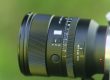
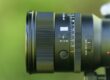
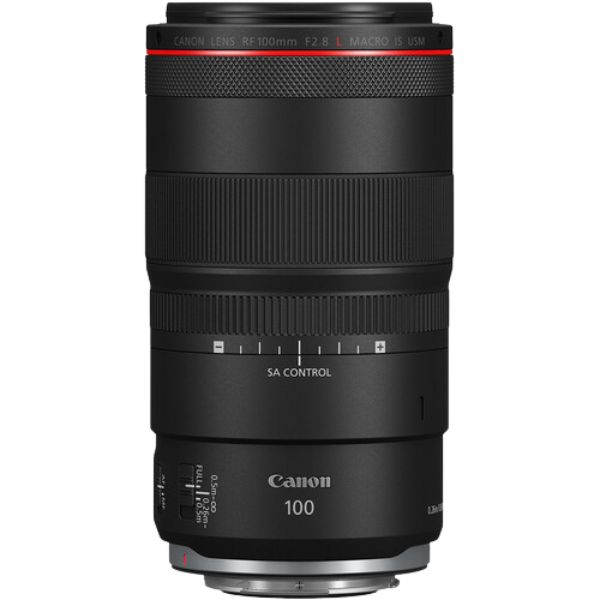
In 2021, Canon introduced its first dedicated macro lens for the RF mount, opening up a new era for close-up photography in the Canon mirrorless system. While the excellent EF 100mm f/2.8L Macro IS USM was a benchmark for Canon DSLR users for many years, the RF 100mm f/2.8L Macro IS USM is its modern successor.
The build quality of this weather-sealed and stabilized lens is exemplary, with 17 elements in 13 groups and special coatings to reduce flare and ghosting. Canon has also included an SA Control ring, which allows photographers to adjust spherical aberration and the look of the bokeh, although feedback often describes this option as more of a creative extra than an essential feature. Autofocus is both fast and quiet, with a distance limiter for faster, more reliable focusing.
In terms of image quality, this lens does not disappoint, offering exceptional sharpness from wide open, which also makes it excellent for portraits. Stopping down further improves sharpness and consistency across the frame. What’s more, the 1.4× magnification ratio exceeds the traditional 1:1 macro standard, allowing you to explore even finer details, although this level of magnification naturally results in an extremely shallow depth of field. As for optical flaws, distortion and vignetting are low and well corrected, enhancing the overall image quality.
In short, the Canon RF 100mm f/2.8L Macro IS USM is a top-of-the-range macro lens with exceptional build quality, impressive optical performance, and innovative features. However, its high price makes it more suitable for macro enthusiasts or demanding professionals. It is also the only Canon RF autofocus macro lens in this selection to go beyond the true 1:1 macro ratio.
2 - Canon RF 24mm f/1.8 Macro IS STM
| Features | Visual |
|---|---|
|
|
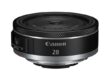
Introduced for the Canon RF mount in June 2022, this lens is a versatile option. Its 24mm focal length makes it an interesting choice for a variety of situations, including everyday shooting, environmental portraits, street photography, and close-up photography. It weighs 270 g and measures 74.4 x 63.1 mm, making it a relatively compact and lightweight lens. It is similar in size to the Canon RF 35mm f/1.8, and both lenses share a 52mm filter diameter.
The overall build quality of this lens is good, with 11 elements in 9 groups, two switches (AF/MF and stabilization), and a customizable control ring. It also uses an STM motor. It comes without a hood and is stabilized, but not weather-sealed. The minimum focusing distance is 14 cm (0.14 m). Despite being labeled “Macro,” the lens offers a 1:2 magnification ratio rather than true 1:1 macro. However, this is perfectly adequate for many close-up applications.
When it comes to image quality, the lens offers excellent sharpness in the center from the full aperture of f/1.8, with good sharpness at the edges and corners. When you stop down to f/2.8, you get a very sharp and more consistent image. In terms of optical flaws, vignetting and distortion are very noticeable if not corrected in-camera, especially in JPEG. Canon, like many other manufacturers, increasingly relies on software corrections in this area. Chromatic aberrations are generally well managed.
To sum up, the Canon RF 24mm F1.8 Macro IS STM is a versatile lens suited to many different styles of photography. It is compact, lightweight, and offers excellent image stabilization for handheld shooting. However, it does have some optical shortcomings. In particular, distortion and significant vignetting require electronic correction. Nevertheless, image quality is very good and the price/performance ratio is excellent.
3 - Canon RF 85mm f/2 Macro IS STM
| Features | Visual |
|---|---|
|
|
Introduced by Canon in 2020, this is an affordable and versatile alternative for portrait and close-up photographers, filling the gap between the expensive f/1.2L lenses and the needs of more casual photographers. The lens measures 78 x 90.5 mm and weighs around 500 g, so it remains reasonably compact. It has image stabilization and a 1:2 macro function. However, it still does not come with a hood and is not weather-sealed.
In terms of build quality, although it does not reach L-series standards, the lens, with its classic 67mm filter diameter, is relatively well built. It has separate focus and control rings, as well as three switches on the side of the barrel. These include a focus limiter, an AF/MF switch, and an on/off switch for image stabilization (IS). What’s more, the nine-blade diaphragm helps produce pleasing, rounded bokeh. It is an attractive option for close-up photography, with a minimum focusing distance of around 35 cm and a 1:2 magnification ratio. Autofocus performance is generally decent, though not exceptional.
Even at full aperture, the lens delivers high-quality images with good contrast and sharpness. However, sharpness improves when you stop down to f/2.8 and then to f/4. Distortion is low. Vignetting is quite pronounced, although it can be corrected in post-production. Chromatic aberrations are also well controlled.
In conclusion, the Canon RF 85mm F2 Macro IS STM is a versatile lens, especially for portraits and close-ups, that offers very good image quality for a reasonable price. The autofocus could be better, but this lens still offers very good value for money.
4 - Canon RF 35mm f/1.8 Macro IS STM
| Features | Visual |
|---|---|
|

|
This is an interesting lens for Canon’s RF mount, released in September 2018. It is positioned as a compact and affordable option, weighing around 305 g and measuring 74.4 x 62.8 mm. This makes it a suitable choice for smaller bodies such as the Canon EOS RP. The Canon RF 35mm F1.8 Macro IS STM offers attractive value for money.
The lens has a 52mm filter diameter and is made up of 11 elements in 9 groups. Special lens elements and optical coatings are used to help ensure good image quality. The lens is stabilized and features STM autofocus for smooth, if occasionally noisy, focusing. Please note that the lens is not compatible with Canon teleconverters. Although it is not weather-sealed, the build quality is good. There are two switches (AF/MF and stabilization), plus a focus ring and a customizable control ring. The minimum focusing distance is 17 cm and the macro magnification ratio is 1:2, so it is not a true 1:1 macro lens.
As far as image quality is concerned, the lens performs well at full aperture, producing sharp images in the center of the frame, but less so at the edges. Sharpness improves and becomes excellent when the aperture is stopped down to around f/2.8. However, the lens suffers from noticeable vignetting. There is also slight distortion and some chromatic aberration.
In conclusion, the Canon RF 35mm f/1.8 Macro IS STM is a compact and versatile lens that offers excellent value for money. Despite some optical flaws, it produces sharp, high-contrast images, making it a solid choice for many types of photography, including close-ups thanks to its 1:2 magnification ratio. For photographers looking for an affordable lens for their Canon camera, this is a great option.
Here are the main characteristics compared between these lenses.
RF macro lenses with autofocus Focallength Max.Aperture Weight
Dim. (Ø x L) Min. FocusDist. Approx.price Best price
+
Canon RF 24mm f/1.8 Macro IS STM
24mm f/1.8 9.52 oz / 270g 2.9 x 2.5" / 74 x 63 mm 5.5" / 14 cm $549 Amazon B&H
More info +
+
Canon RF 35mm f/1.8 Macro IS STM
35mm f/1.8 10.76 oz / 305g 2.9 x 2.5" / 74 x 63 mm 6.7" / 17 cm $449 Amazon B&H
More info +
+
Canon RF 85mm f/2 Macro IS STM
85mm f/2 1.1 lb / 500g 3.1 x 3.6" / 78 x 91 mm 1.1' / 35 cm $549 Amazon B&H
More info +
+
Canon RF 100mm f/2.8 L IS USM Macro
100mm f/2.8 1.6 lb / 730g 3.2 x 5.8" / 82 x 148 mm 10.2" / 26 cm $1 099 Amazon B&H
More info +
Canon manual focus RF macro lenses
In addition to the autofocus RF macro lenses mentioned above, there are many manual-focus macro lenses, which is not necessarily a problem for macro photography, where manual focus is often used. Laowa, in particular, offers very good lenses in this area.
Here are the main lenses you can have a closer look at. To access the description, simply click on the lens name.
- Laowa 100mm f/2.8 2x Ultra Macro APO RF
- Laowa 90mm f/2.8 2X Ultra-Macro APO RF
- Laowa 85mm f/5.6 2x Ultra Macro APO RF
- Laowa 24mm f/14 2x Macro Probe
- Laowa 25mm f/2.8 2.5-5X Ultra Macro RF
- Laowa 58mm f/2.8 2X Ultra-Macro APO
The main features of these lenses are compared in the table below.
1 - Laowa 100mm f/2.8 2x Ultra Macro APO RF
| Features | Visual |
|---|---|
|

|
The Laowa RF 100mm is certainly one of the best options if you are looking for a classic macro focal length and do not mind manual focusing. The lens remains reasonably compact for this type of optic, with a high-quality all-metal construction. It features an apochromatic (APO) optical design, which effectively corrects chromatic aberrations. Also note the 2:1 magnification ratio, compared with the classic 1:1 ratio of many macro lenses.
Image quality is excellent at full aperture in the center and remains very good at the edges and corners. Sharpness improves significantly when the aperture is stopped down. As far as optical flaws are concerned, there is slight pincushion distortion and moderate vignetting, both of which can be corrected in post-production. Depending on the situation, you should also be aware of flare. The bokeh of this lens is, according to many users, one of its strongest qualities.
All in all, this is an excellent macro lens that offers exceptional image quality in a very well-made package. Considering its price compared with the Canon option, if you are looking for a dedicated macro lens for your body, you can hardly go wrong.
2 - Laowa 90mm f/2.8 2X Ultra-Macro APO RF
| Features | Visual |
|---|---|
|

|
Also available in other mounts (Sony E, Leica L, and Nikon Z), the Laowa 90mm is a macro lens introduced in 2022. It has the same high-quality metal construction, apochromatic design, manual focus, and lack of stabilization as the Laowa 100mm, but is more compact, measuring around 120 mm long and weighing about 619 g depending on the mount.
In terms of image quality, the Laowa 90mm performs exceptionally well. It offers excellent sharpness across the image, which improves further around f/5.6. Distortion is low and vignetting remains moderate. Bokeh quality is very good overall.
To sum up, the Laowa 90mm f/2.8 2X Ultra-Macro APO RF is an exceptional macro lens, both in terms of image quality and construction. It is a great choice for macro photographers thanks to its APO design, 2:1 magnification ratio, compact size, and attractive price.
3 - Laowa 85mm f/5.6 2x Ultra Macro APO RF
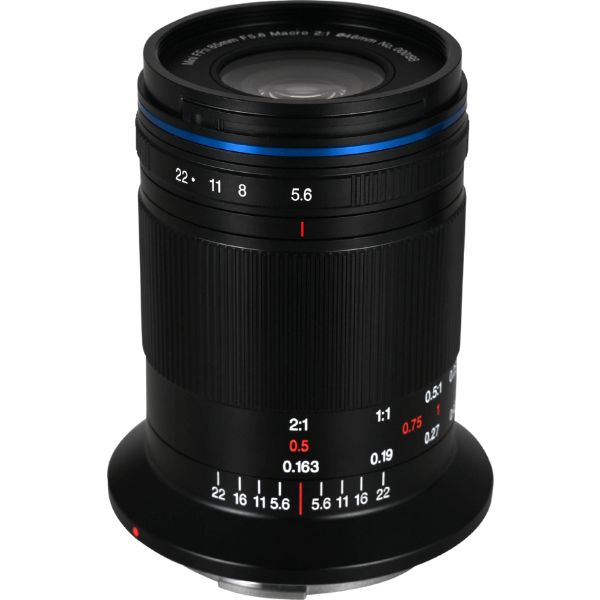
This lens, available since December 2021, is compact and very light, weighing around 295 g depending on the version and measuring about 78 mm in length. It is one of the most compact full-frame macro lenses available. To minimize chromatic aberration, it uses an apochromatic optical design with extra-low-dispersion elements. Manual operation is smooth and well thought out. At a minimum focusing distance of 16.3 cm, the lens reaches 2:1 magnification. It is neither weather-sealed nor stabilized, which may require the use of a tripod for extreme close-ups. Note that the maximum aperture of f/5.6 is not necessarily a problem for macro photography, where it is common to stop down to maximize depth of field.
In terms of optical performance, the Laowa 85mm performs very well wide open, offering remarkable sharpness in the center of the frame and even toward the edges. Stopping down further improves sharpness, with very good results around f/8 to f/11. Optical flaws such as vignetting and distortion are minimal. Chromatic aberrations are well controlled, highlighting the APO construction of the lens.
In conclusion, this Laowa 85mm is a high-quality macro lens at a very competitive price. It is compact, serious, and very appealing if you are looking for a manual-focus macro lens.
4 - Laowa 24mm f/14 2x Macro Probe
| Features | Visual |
|---|---|
|

|
This is a truly unique lens that offers unusual and creative possibilities in macro photography. The lens weighs around 474 g and is about 40 cm long! It features an unusual aperture range from f/14 to f/40. The construction is remarkable, with a waterproof front barrel and very solid build quality. With 27 elements in 19 groups, this lens has a complex optical design. However, due to its special design, it makes a clear compromise in terms of brightness, with a maximum aperture of f/14.
From an optical point of view, the Laowa 24mm f/14 offers rather mixed results. At full aperture, sharpness is generally considered good enough, and as is often the case, it improves as the aperture is stopped down. Although distortion and chromatic aberration are kept under control, overall sharpness remains more specialized than spectacular, which might be a compromise for demanding photographers. It should also be noted that the bokeh, although possible despite the small aperture, can be a little harsh in complex environments.
In conclusion, the Laowa 24mm f/14 2x Macro Probe is a unique lens that excels at its very specific mission, especially for macro shots in hard-to-reach places. Its price may seem high to some, but there is no other lens that offers quite the same possibilities. If you are looking for a fresh perspective on your photography, this could be an interesting choice, especially for creative and video applications.
5 - Laowa 25mm f/2.8 2.5-5X Ultra Macro RF
| Features | Visual |
|---|---|
|

|
This is another excellent lens with a magnification range from 2.5x to 5x. It is a lightweight and compact macro option, and an attractive choice for photographers who want to explore the world of macro photography at very, very close range. As always with Laowa, the build is robust, and the optical design is made for high-magnification work. The lens is neither weather-sealed nor stabilized.
In terms of image quality, the Laowa 25mm f/2.8 2.5-5X Ultra Macro RF performs very well, offering impressive sharpness in the center of the frame. Stopping down further improves sharpness, with very good results around f/8 to f/11. Optical flaws such as vignetting and distortion are minimal, and chromatic aberrations are generally well controlled.
In conclusion, this lens offers a unique macro solution. Its solid build, excellent optical quality, and affordable price make it an attractive choice for those who want to explore the invisible details of the macro world.
6 - Laowa 58mm f/2.8 2X Ultra-Macro APO
| Features | Visual |
|---|---|
|

|
Available from September 2022, this lens is compact and relatively lightweight. The 58mm Laowa is slightly shorter than the 90mm while remaining versatile, with a focal length suitable for macro, street, and portrait photography. In terms of build quality, it is still excellent, with an all-metal construction. Although the lens hood is made of plastic, the manual focus ring feels high quality.
The lens is apochromatic (APO), which reduces chromatic aberration and increases contrast, and it offers a 2:1 macro ratio. Image quality is excellent throughout the frame. Stopping down improves sharpness slightly, with very good results around f/8, which is not unusual for a macro lens that is often used at smaller apertures. Bokeh is also of high quality, and optical defects are very well controlled.
In conclusion, the Laowa 58mm f/2.8 APO 2x Macro offers excellent optical quality at a reasonable price. Its robust construction, apochromatic design, and versatility make it an excellent choice.
The main features of the Laowa optics described above are summarized in the table below.
RF Laowa macro lenses Focallength Max.Aperture Weight
Dim. (Ø x L) Min. FocusDist. Approx.price Best price
+
Laowa Aurogon FF 10-50x NA0.5 Supermicro APO RF
- - - - 6.6' / 200 cm $1 499 B&H
More info +
+
Laowa 24mm f/14 2x Macro Probe RF
24mm f/14 1 lb / 474g 1.5 x 16.1" / 38 x 408 mm 1.5' / 47 cm $1 449 B&H
More info +
+
Laowa 25mm f/2.8 2.5-5X Ultra Macro RF
25mm f/2.8 0.9 lb / 400g 2.6 x 3.2" / 65 x 82 mm 6.7" / 17 cm $399 Amazon B&H
More info +
+
Laowa 55mm f/2.8 Tilt-Shift 1x Macro RF
55mm f/2.8 3 lb / 1345g 3.3 x 6.4" / 85 x 162 mm 10.6" / 27 cm $1 249 B&H
More info +
+
Laowa 58mm f/2.8 2X Ultra-Macro APO RF
58mm f/2.8 1.3 lb / 595g 2.9 x 4.6" / 74 x 117 mm 7.1" / 18 cm $466 Amazon B&H
More info +
+
Laowa 85mm f/5.6 2x Ultra Macro APO RF
85mm f/5.6 10.93 oz / 310g 2.1 x 3.2" / 53 x 81 mm 6.3" / 16 cm $449 Amazon B&H
More info +
+
Laowa 90m f/2.8 2X Ultra-Macro APO RF
90mm f/2.8 1.4 lb / 619g 2.9 x 4.7" / 74 x 120 mm 7.9" / 20 cm $499 Amazon B&H
More info +
+
Laowa 100mm f/2.8 2x Ultra Macro APO RF
100mm f/2.8 1.4 lb / 638g 2.8 x 6.1" / 72 x 155 mm 9.8" / 25 cm $499 Amazon B&H
More info +
+
Laowa 100mm f/2.8 Tilt-Shift 1x Macro RF
100mm f/2.8 2.7 lb / 1215g 3.3 x 6.4" / 85 x 162 mm 1' / 32 cm $1 249 B&H
More info +
+
Laowa 180mm f/4.5 1.5x Ultra-Macro APO RF
180mm f/4.5 1.2 lb / 522g 2.7 x 5.3" / 68 x 134 mm 1' / 30 cm $499 B&H
More info +
You’ll also find other, less well-known brands offering macro lenses for the Canon RF mount, such as the Meike 85 mm f/2.8 Macro RF or the Mitakon Zhongyi 200 mm f/4 1x.
Canon RF Macro Lenses for APS-C Cameras
For its RF-S APS-C cameras, Canon does not currently offer any dedicated RF-S macro lenses. Macro enthusiasts using these cameras can use full-frame RF macro lenses, but they can also turn to third-party brands such as Laowa, TTArtisans, and 7Artisans, which offer manual-focus lenses:
1 - Laowa 65mm f/2.8 2x Ultra Macro APO RF
| Features | Visual |
|---|---|
|

|
Introduced in 2020, this is an excellent APS-C macro lens, with a light weight of around 335 g and a short length of about 100 mm. The build quality of the Laowa 65mm is excellent, with all-metal construction, smooth rings, and an anodized metal finish. Like many Laowa lenses, it is manual, unstabilized, and not weather-sealed. The lens has a very high magnification ratio of 2:1.
The APO optical construction ensures excellent correction of chromatic aberrations, delivering sharp images with high contrast. In terms of image quality, this lens offers excellent sharpness at full aperture, which improves further at f/5.6 to deliver remarkable image quality across the frame. Bokeh quality is quite good and optical defects are not a major issue. This is an excellent lens, especially given its price and its potential for close-up and portrait-style work.
2 - 7Artisans 60mm f/2.8 II V2 Macro APS-C RF
| Features | Visual |
|---|---|
|

|
The Chinese brand 7Artisans, known for affordable lenses with generally average image quality, has produced a second version of its 60mm macro lens that brings a noticeable improvement in quality. Compared with the previous version, this new lens is much lighter. It weighs around 350 g compared with about 550 g for the previous version. Image quality at full aperture is good enough, but you should stop down to f/5.6 to get more homogeneous results.
At longer distances, however, performance diminishes, especially for portrait photography, where its limitations become more apparent. We therefore recommend using this lens mainly for macro photography. However, at a price of less than €200, you are not taking a huge risk, which makes it an interesting choice for those who want to try macro photography, provided they do not mind manual focusing. It should also be noted that this lens does not transmit EXIF information to the camera.
Here are the details of manual-focus macro lenses for Canon RF APS-C cameras.
| Manual focus Macro RF-S lenses | Focallength | Max.Aperture | Weight | Dim. (Ø x L) | Min. FocusDist. | Approx.price | Best price | |||
|---|---|---|---|---|---|---|---|---|---|---|
| + | 7artisans 60mm f/2.8 II V2 Macro RF | 60mm | f/2.8 | 11.96 oz / 339g | 2.4 x 3.2" / 60 x 81 mm | 6.9" / 17.5 cm | $179 | Amazon B&H | More info + | |
|
||||||||||
| + | Laowa 65mm f/2.8 2X Ultra-Macro RF-S | 65mm | f/2.8 | 11.82 oz / 335g | 2.2 x 3.9" / 57 x 100 mm | 6.7" / 17 cm | $399 | Amazon B&H | More info + | |
|
||||||||||
If you’re looking for a lightweight, discreet lens, check out our guide to Canon RF pancake lenses!
How to choose a macro lens - Introduction
Macro photography is a specialty within photography. It requires specific equipment and presents a number of challenges, not least the short focusing distance required to achieve a scale of 1:1 or more. When the camera is very close to the subject, ambient light is often blocked, and capturing the subject at life-size magnification increases the risk of camera shake and subject blur.
There is a comprehensive article on choosing a macro lens, which covers everything you need to know. However, here is a summary.
Magnification ratio
The idea is that “true macro” is characterized by an image captured at a ratio of at least 1:1, as mentioned in the introduction to this article. While you can play around with this ratio using accessories such as extension tubes, it is important to note that macro lenses originally designed with a 1:1 ratio generally offer superior image quality. This is partly because lenses designed for more standard use often perform poorly at close range, even if they can achieve a 1:1 ratio with accessories. The increased size and weight of macro lenses compared with conventional lenses can therefore be seen as the price to pay for better close-range performance.
Focal length
When taking macro photographs of insects, it is sometimes suggested that, to reduce the risk of frightening them, you should use longer focal lengths, especially short telephoto lenses. In reality, remember that the distance is measured from your camera’s sensor, even if a lens with a longer focal length has a longer minimum focusing distance. Because longer focal length lenses are also physically longer, the difference in working distance to the subject at a 1:1 ratio between a short and a long focal length will not always be as huge as you might expect.
Your choice of focal length has a greater effect on perspective: longer focal lengths make surfaces look more compressed. This is due to the distance you are standing from the subject, not the focal length itself. Keep in mind that it is the distance to the subject that affects perspective, not the focal length. The focal length will also have a moderate effect on depth of field, because at a shorter focal length, the same aperture will produce a greater depth of field. However, this is partly compensated for by the fact that you need to move closer, so the difference remains relatively small.
However, focal length does not affect the reproduction size of the subject: if you use a 1:1 ratio, the subject will appear the same size on the sensor whatever the focal length. If you want to get even closer, you will need a lens with an even higher magnification ratio. You can also use extension tubes. Alternatively, the simpler solution is to crop into the image. However, this has its drawbacks: perspective remains the same, unlike when you physically move closer, and of course, you sacrifice pixels. Note that almost all dedicated macro lenses have a fixed focal length and a constant aperture.
Focus
Autofocus is not always necessary when it comes to macro photography. In fact, because the 1:1 ratio, or more depending on the lens, is achieved at a specific distance, autofocus is not always very practical. The idea is often to set the desired magnification and then make tiny movements with the camera to adjust focus on the subject. However, autofocus remains useful for moving subjects or other types of photography, such as portraits with 85mm, 100mm, or 105mm lenses.
Maximum aperture
When you get very close to your subject, the sharp area becomes very small. Most macro lenses open to f/2.8. However, you often need to use smaller apertures, such as f/8 or f/11, to get a sharper subject with a little more context. You can even go as far as f/14 with some macro lenses. Another option, when possible, is to use focus stacking. This involves stacking photos of the same subject taken at slightly different focus distances to create an image with much greater depth of field. It should be noted, however, that this method is very difficult to use when shooting handheld or with a moving subject.
Stabilization
One of the features sometimes praised in macro photography is stabilization, although it is often overrated. In macro photography, where the planes of focus are very close together, there is a high risk of both camera shake and subject blur. Even with a shutter speed that is appropriate for your focal length and distance, the slightest movement of the subject can undermine your efforts and force you to use a faster shutter speed. This makes stabilization much less useful than expected, except for handheld shots of stationary subjects.
We’ve come to the end of this article on Canon’s best RF macro lenses, both for full-frame and APS-C bodies. You should now be able to make the best choice for your needs and budget. If you’d like to read on, don’t hesitate to check out our article on the best Canon RF lenses currently available.
See you soon for another article,

Written by Sylvain PONS
I've been passionate about photography since 2010, learning as I went along. Today, I dedicate myself to guiding others in their choice of camera gear and sharing a variety of tips to improve their photography skills.
Despite our care, a mistake may have slipped into this article. If you find any, please don't hesitate to let us know so we can correct it as soon as possible and keep our information up-to-date!