Guide to the best action cameras
Last update: 06/23/2026
Our blog continues to grow thanks to you, our readers. This post may contain affiliate links, which means we can earn a small commission if you make a purchase through them, at no extra cost to you. This helps us to continue to bring you more and support our work!
Hello everyone! I’ve been getting back into photography articles lately. This time, I wanted to put together a guide to the best action cameras. To be honest, I’ve had quite a few questions about this topic. And I can see why: if you’re looking for a small camera that’s light, compact, and easy to carry, an action cam is very tempting. It’s still a different tool from a camera body, which is much heavier but usually delivers better image quality. It’s also different from a smartphone, which is often ideal for travelers who simply want to bring home memories. For our part, we used an action camera a lot during our trip through Asia (a GoPro).
So, whether you want to replace your current action camera with a more recent model or you’re buying your first one, I’ve put together a selection of the best action cameras right now. Let’s take a look! And by the way, even though these cameras are compact, it’s still worth thinking about an appropriate camera bag: always handy for carrying and protecting your gear!
If you’d like to browse other accessories, we’ve also put together a comprehensive guide to the best iPads on the market right now.
The best action cameras right now
GoPro MISSION 1
Announced in April 2026 and available from late May 2026, the GoPro MISSION 1 Series marks a real shift from the HERO Black line. Instead of a simple HERO13 Black refresh, GoPro now offers compact, cinema-oriented action cameras built around a 50 MP 1-inch sensor and the new GP3 processor. The standard MISSION 1 records in 8K/30 and 4K/120 Open Gate, while the MISSION 1 PRO goes further with 8K/60, 4K/240, and 1080p/960. In practical terms, the idea is clear: keep the rugged, compact GoPro spirit, but move closer to a creator-focused camera with more flexibility for cropping, low light, and horizontal or vertical exports.
Build quality remains very GoPro: solid, compact, and designed for demanding use. The big change is the 1-inch sensor, which gives GoPro more room to improve dynamic range, noise control, and highlight recovery. Open Gate recording is also a real plus if you create content for several formats, because it gives you a taller frame to reframe afterward. The MISSION 1 PRO ILS goes even further with an interchangeable Micro Four Thirds lens mount, but for most travelers and action-camera users, the fixed-lens MISSION 1 or MISSION 1 PRO will make more sense.
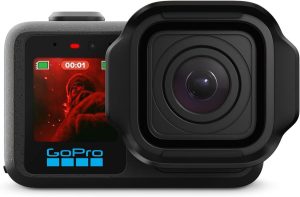
GoPro MISSION 1 action camera
With the MISSION 1 Series, GoPro is no longer just updating the HERO formula; it is moving into a more creator-oriented segment. For sports, travel, vlogging, and mixed-format content, Open Gate recording is a real advantage. If you want a simple setup, the MISSION 1 is already very capable. If you want the most complete fixed-lens version, especially for high frame rates and heavier production work, the MISSION 1 PRO is the one I’d look at first. Honestly, this is GoPro’s most interesting move in years!
DJI Osmo Action 6
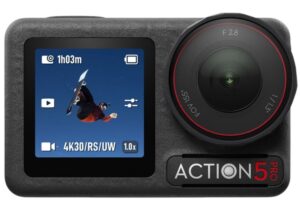
Released in November 2025, the DJI Osmo Action 6 succeeds the Osmo Action 5 Pro and now competes with GoPro’s newer MISSION 1 line. The main upgrade is an all-new 1/1.1-inch square sensor paired with a variable aperture from f/2.0 to f/4.0, which is a first for this type of action camera. It also keeps the strengths DJI has built its reputation on: 50 GB of built-in storage, waterproofing to 20 m without a housing, strong stabilization, direct OsmoAudio microphone connection, and a claimed battery life of up to 4 hours.
In terms of build, it stays compact and practical, with dual touchscreens, simple controls, a microSD slot, and a rugged body made for travel and sports. The variable aperture is the feature that really changes the camera’s personality: f/2.0 helps in low light, while smaller apertures are useful in bright scenes or when you want more control. The square sensor also makes it easier to shoot once and reframe for horizontal or vertical formats. In the field, the Action 6 is clearly more ambitious than the Action 5 Pro, especially for creators who switch between travel footage, sports clips, vlogs, and social media formats.
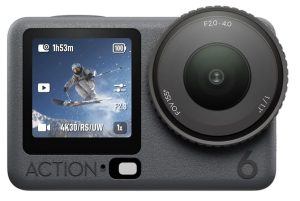
DJI Osmo Action 6 action camera
In summary, the Osmo Action 6 is the current DJI model I would look at first. It is more than a small update to the Action 5 Pro: the new sensor and variable aperture make it more versatile, especially if you film in changing light or want to deliver both horizontal and vertical clips. If you already have the Action 5 Pro, the upgrade makes sense mainly if those two points matter to you. If this is your first action camera, it’s one of the safest and most complete choices right now.
DJI Osmo 360
Released on July 31, 2025, the DJI Osmo 360 is DJI’s first camera in the 360° segment. It positions itself as a direct competitor to the Insta360 X5. It stands out with its dual 1-inch square HDR imaging system, bright f/1.9 optics, 360° video up to 8K/50 fps, and 120 MP 360° photos. In single-lens use, it offers 5K/60 ultra-wide footage at 155° and a Boost mode at 170° in 4K/120.
As for its build, it feels very modern, with a magnetic mount, voice control, and DJI Mimo/DJI Studio software integration. Stabilization relies on RockSteady and HorizonSteady, as on other DJI products. In terms of image quality, the 1-inch imaging system and f/1.9 aperture help with low-light rendering, while DJI claims a dynamic range of 13.5 stops. In 4K/120 Boost mode at 170°, action footage is smooth. In 5K/60 single-lens mode at 155°, you keep more of an ultra-wide action-camera look, which works well for sports. You also get creative tools and software stabilization that handles shake effectively.
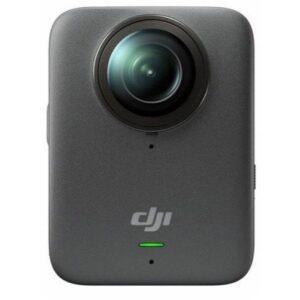
DJI Osmo 360 action camera
Overall, the DJI Osmo 360 is a strong first step into 360° for DJI. It’s a good option for demanding creators who film travel, sports, motorcycling, events, and similar content. Honestly, if your priority is 360° video with a fairly high-end approach, I think you’ll be very happy with it!
Insta360 X5
The Insta360 X5, available since April 22, 2025, positions itself as a high-end 360° camera, succeeding the X4 and taking on DJI’s Osmo 360. It includes two 1/1.28-inch sensors, which are much larger than those of the X4, and records 8K video at 24/25/30 fps. The optics are based on two 6 mm f/2 lenses, while waterproofing is rated to 15 m.
This action camera is designed above all for field use, with a non-slip coating, gesture and voice control, and tougher glass. The ergonomics remain simple so the camera stays as intuitive as possible. For example, there are no rings, dials, or switches. In terms of battery life, it performs very well in its category, with a maximum rating of up to 208 minutes depending on the mode used. Image quality is also a real step forward from the X4: in 8K 360, center sharpness is very good. In broad daylight, video rendering is natural. In low light, the PureVideo mode and triple AI chip system improve dynamic range nicely compared to the X4.
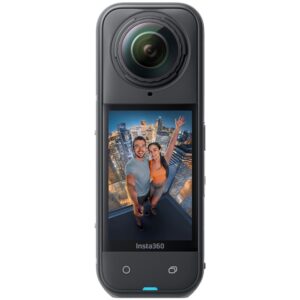
Insta360 X5 action camera
Ultimately, the X5 ticks many boxes: better battery life, solid build quality, 8K for post-production, and effective stabilization. However, it isn’t cheap, so it’s still an investment. But if you have the budget, I don’t think you’ll be disappointed. It can be a great ally for travel, sports, events, reframing, and more.
Insta360 GO Ultra
The Insta360 GO Ultra, released on August 21, 2025, is a tiny camera weighing just 53 g. It features a 1/1.28-inch sensor and a 5 nm AI chip, and it’s waterproof to 10 m.
Build-wise, it comes with an improved magnetic pendant, adhesive mounts, and a cap clip, all designed to multiply your shooting angles. One important change is that there’s no longer built-in storage: instead, you use a microSD card up to 2 TB. Battery life remains decent, at about 70 minutes for the standalone camera. Its compact size and weather sealing are real assets for hiking, BMX, hands-free vlogging, or underwater use. In terms of image quality, the GO Ultra offers good definition and a solid frame rate, with AI processing to help. PureVideo mode improves sharpness and brightness in low light. Active HDR helps control contrast up to 4K/30 fps. The app has also been updated with automatic editing, transitions, effects, music, and sports-data overlays, such as GPS and speed.
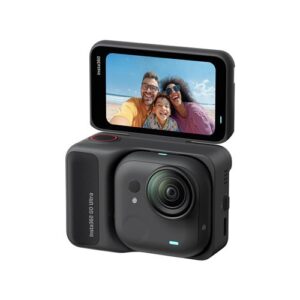
Insta360 GO Ultra action camera
In summary, the GO Ultra is an interesting, compact alternative to classic action cams. It works well for hands-free vlogs, sports, vacations, and social media. For my part, I think this camera offers a lot of possibilities at a price that still feels reasonable for what it does. As is often the case with Insta360, it comes in several bundles, including the Standard Bundle and more complete creator-focused kits. As you can imagine, the more complete versions add useful accessories for shooting, mounting, and extending your setup.
Insta360 Ace Pro 2
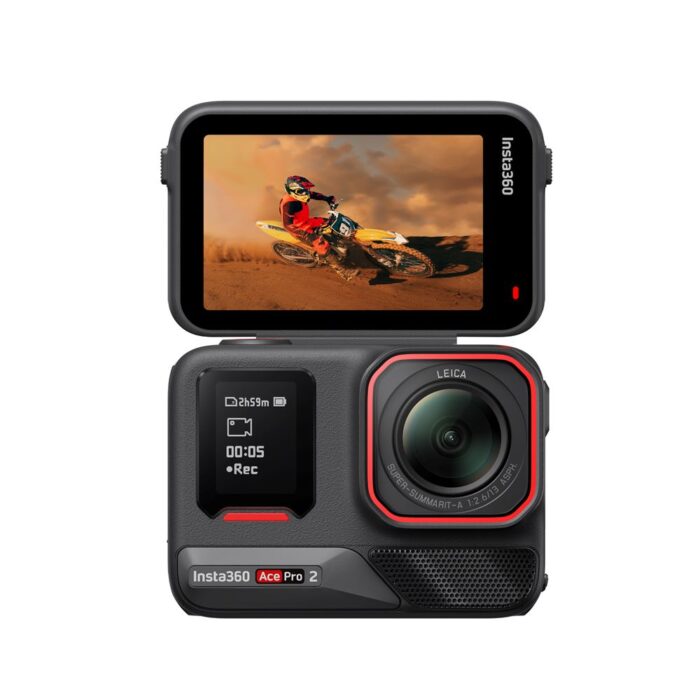
Introduced in October 2024, the Insta360 Ace Pro 2 positions itself as an AI-powered action cam designed to rival GoPro and DJI’s flagship models. It keeps a 1/1.3-inch sensor paired with a 13 mm f/2.6 Leica SUMMARIT lens, records up to 8K/30, and pushes slow motion in 4K up to 120 fps. Nothing to complain about in terms of form factor: it remains compact and light, in the same spirit as the previous version.
As for its build, there are a few useful changes, such as the removable wind guard, sturdier lens protector, and magnetic mount. This camera has a single 2.5-inch flip touchscreen for vlogging. However, we still note the absence of internal storage, so a microSD card is required. In terms of image quality, the camera improves: dynamic range is stated at 13.5 stops, and 8K is useful for reframing, even if stabilization remains limited in that mode. In the field, the best results are still in 4K, especially at 60 or 120 fps, with good FlowState stabilization. In low light, PureVideo remains one of the Ace Pro 2’s strongest arguments. Finally, although battery life is claimed at up to 180 minutes, in practice it will depend heavily on the shooting mode used.
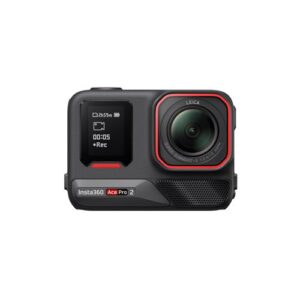
Insta360 Ace Pro 2 action camera
Ultimately, the Insta360 Ace Pro 2 remains a very good alternative to GoPro and DJI. It offers excellent 4K quality and works well for vlogging, motorcycling, sports, travel, and light underwater use. However, if you shoot a lot at night and have high expectations, keep in mind that photo mode is less convincing than video. The camera is available in several bundles. If you already have accessories, the Standard Bundle may be enough. Otherwise, the more complete kits are worth considering, especially if you need extra batteries, mounts, or a microSD card.
How to choose your action camera: all our tips
Determine the main use
To start, list the scenes you shoot most often: travel, vlogs, diving, fast sports, night footage, motorcycle or car videos, and so on. Your choice should follow from there. For extreme sports, prioritize effective stabilization and horizon lock. For vlogging, good sound and a front screen are important. In the water, look closely at native waterproofing or whether you need a housing, and check whether the buttons are easy to use. If you often reframe your footage afterward, I recommend looking at 360 cameras. Finally, if you mainly want crisp results and files that are easy to edit, a simple, classic action camera can still do the job very well!
Take into account sensor, image quality, and low light
Sensor size plays an essential role in dynamic range and low-light rendering. Simply put, the larger the sensor, the more detail and nuance the camera can usually capture. If the lens is bright and ISO is well managed, noise also stays more controlled in low light. It’s also worth looking at highlight handling and whether noise reduction remains balanced.
Resolution, frame rate, and bit rate
For most action scenes, 4K at 60 fps is still the best balance. To create slow motion, you’ll need to go up to 120 or even 240 fps. In 5K or 8K, you can crop while keeping good sharpness when exporting in 4K. However, don’t look only at the “K”; also check the bit rate in Mbps. A higher bit rate can make a real difference on textures like water, grass, and snow. On the codec side, H.265/HEVC also compresses more efficiently than H.264.
Audio: microphone, wind reduction, and accessories
It’s not always the first thing we think about, but sound matters a lot. I recommend prioritizing solid stereo microphones and good wind reduction. A windscreen, for example, can make a real difference outdoors. For a more polished vlog, a mic input or wireless receiver support quickly becomes essential.
Ergonomics, screens, and mobile app
A front screen makes selfie-style framing much easier, while a rear touchscreen is handy for settings. Activity presets can also save a lot of time. Voice control is another useful feature, especially when your hands are busy or the camera is mounted out of reach. Once your clips are shot, the mobile app should make transfer and editing quick and painless. Extras like a remote control, Quick Capture, and settings lock can also help avoid accidental changes. Believe me, that’s always useful!
Durability, waterproofing, and temperature
The camera’s build needs to be solid. To check that, look at whether the body feels sturdy and whether the lens protector can be replaced. Native waterproofing is often enough for surface use, swimming, snorkeling, or casual underwater footage, depending on the model. But if you’re going deeper, choose a dedicated housing instead. As for temperature, extreme heat or cold will usually shorten battery life.
Budget based on your needs
This last point goes back to defining your main use. Let me explain: we often tend to overestimate our needs, while an entry-level or mid-range model can sometimes be enough. For example, if you want an action camera mainly to create crisp 4K memories, an entry-level or mid-range camera may be more than sufficient. On the other hand, if you shoot regularly, it makes more sense to look at a mid- or high-end model. That’s what gives you more room for stylized sequences and a more cinematic look. To estimate your budget properly, you also need to think about accessories: batteries, cards, ND filters, mounts, and so on. As you’ve understood, the goal is to help you avoid breaking the bank while choosing an action camera that actually suits you.
This article on the best action cameras is coming to an end. I hope it helps you find the right model for sports, vlogs, diving, travel, and all the little moments you want to film along the way.
If you’re mainly looking for an action camera to create memories, I think our guide to the best portable printers should interest you too!
And if size is essential because you move around a lot or shoot long sessions, I also suggest checking out expert compact cameras.
See you soon for more photo articles!

Written by Sylvain PONS
I've been passionate about photography since 2010, learning as I went along. Today, I dedicate myself to guiding others in their choice of camera gear and sharing a variety of tips to improve their photography skills.
Despite our care, a mistake may have slipped into this article. If you find any, please don't hesitate to let us know so we can correct it as soon as possible and keep our information up-to-date!