Best Canon lens for sport
Last update: 05/06/2026
Our blog continues to grow thanks to you, our readers. This post may contain affiliate links, which means we can earn a small commission if you make a purchase through them, at no extra cost to you. This helps us to continue to bring you more and support our work!
Canon is renowned in the sports community for its fast, efficient cameras, both in AF and burst, and its latest mirrorless cameras continue in that vein. However, the price of these cameras and the lenses that go with them can put some people off. Of course, not all of us are professionals working for a well-known magazine, but we all want to take these kinds of photos. In this article, we take a look at a selection of the best Canon lenses for sport, both for RF-mounted mirrorless and EF-mounted DSLRs. Don’t forget that you can use EF lenses on RF-mount mirrorless bodies (although the reverse is not possible!), thanks to adapter rings.
If you’d like to find out what Canon has to offer in both mounts, I invite you to have a look at our pages dedicated to Canon RF lenses, the page dedicated to EF-mount lenses, and finally the page dedicated to EF-S lenses for Canon APS-C cameras.
The lenses listed below have long focal lengths (telephoto) or even very long focal lengths. This allows you to get close up shots of distant objects. However, if you’re looking for a shorter (wide-angle) lens for sports, where you can get up close and personal, we recommend lenses with good AF and a wide aperture, such as the 24-70mm f/2.8 RF, 35mm f/1.8 RF, 50mm f/1.8 RF, 85mm f/2 RF or 135mm f/1.8 RF. Canon’s fixed focal length RF lenses tend to have very good AF for sports photography, whereas the SLR versions were often a little less good at this, as they were designed more for portraiture and not really specialized in sports photography.
In fact, we’ve written an article on the best cameras for sports photography. It includes Canon and other brands!
Here are what we consider to be the Canon lenses that are specifically designed for sports photography.
Best Canon RF sports lenses
For full-frame cameras
Here’s our full guide to Canon’s full-frame mirrorless cameras.
1 - Canon RF 70-200mm f/2.8 L IS USM
| Features | Visual |
|---|---|
|
|
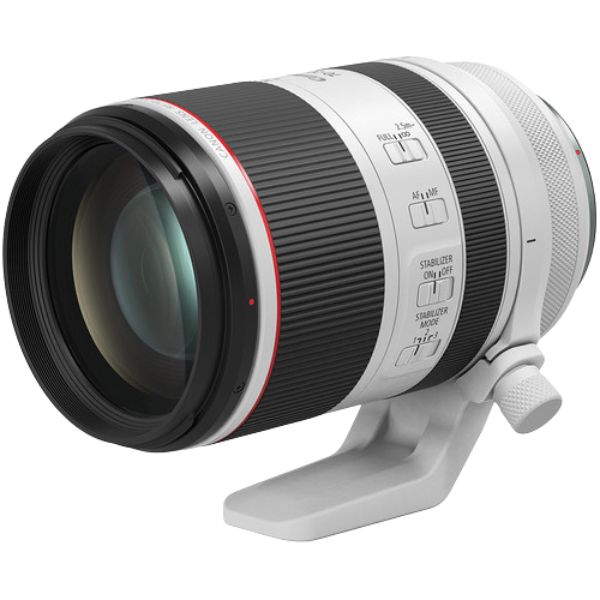
Canon released the 24-70 and 70-200mm f/2.8 L Pro soon after the RF mount was introduced. These lenses are well known and widely used. They are a must-have for any full-frame photographer. The 70-200mm, in particular, is a popular choice for sports photography, thanks to the combination of an adaptive focal length range and a relatively large aperture. It’s a professional telephoto zoom lens showcase for Canon and all other brands with a full-frame sensor, used by sports, portrait and wedding photographers.
However, the design of this 70-200mm differs from its SLR version. It is an external zoom, which means that the zoom extends. The advantage of this design is that it retracts at its shortest focal length, making it less bulky to carry around. The added bonus is that it weighs almost 500g less than traditional internal zoom versions. Some might see this as a drawback, making it less balanced and prone to breakage, but we trust Canon has taken this into account, especially for an L-series. The autofocus system has been designed with sports in mind. Its efficiency is impressive in all conditions. The stabilization is also very effective. It is even better when combined with the sensor stabilization on those cameras that have it. There are a number of functions on the barrel, including a distance limiter, an AF/MF switch and a customisable ring.
As with the last two SLR versions, which are also renowned in this respect, image quality is excellent from full aperture at all focal lengths. Sharpness and contrast are slightly improved when you stop down to f/4, but only a little. Optical flaws such as vignetting, distortion and chromatic aberrations are very well managed. Software corrections are easy to use in the rare situations where they are less pronounced. The bokeh is very pleasant, which will be appreciated when shooting portraits. It also comes in handy for close-ups thanks to the minimum focusing distance.
Unsurprisingly, a top-of-the-range professional lens comes with a hefty price tag. You’ll have to shell out almost €3,000 for it, just as you would for any current top-of-the-range 70-200mm. This is the lens for you if you can afford it and want the best 70-200mm for your Canon mirrorless camera.
2 - Canon RF 70-200mm f/4 L IS USM
| Features | Visual |
|---|---|
|
|
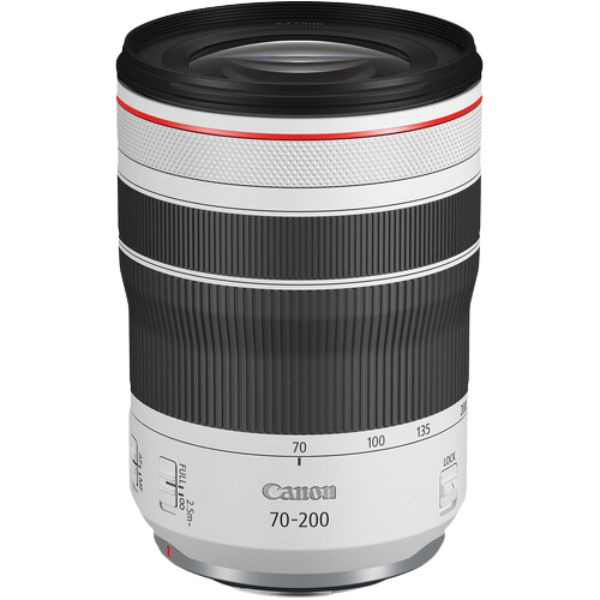
At the beginning of 2021, Canon introduced the f/4 version of the 70-200mm RF, another good Canon lens for sports. The SLR version has been particularly popular, and this new version has everything to appeal to those who can’t afford the f/2.8 version, or who simply don’t need a wider aperture. It is therefore a more ‘affordable’ lens, while still remaining in Canon’s L-series. It is a guarantee of quality in terms of construction, functionality and the images it produces.
Canon understood this, as it would have been absurd not to use the external zoom design of the f/2.8 for this f/4 version. This is the lightest and most compact high-end 70-200mm of any brand, and thanks to this design we once again gain in compactness and weight. Even my Tamron 70-200 (admittedly f/2.8), in spite of its external zoom and lower focal length, is 3 cm longer when folded. The AF is on a par with Canon’s best mirrorless offerings. It is fast and efficient, as is the stabilization. The distance limiter, AF/MF switch, customisable ring, etc. are the same as on the f/2.8 version.
Image quality, although slightly inferior to that of the f/2.8 version, is very good at full aperture at all focal lengths. In particular, there is a greater difference in sharpness between the center of the image and the edges. Distortion and especially vignetting are also more pronounced, but relatively subtle and still easy to correct. Chromatic aberrations are well handled. Bokeh is also less good than with the f/2.8 version. However, it remains very clean.
This 70-200mm f/4 L is an excellent choice if you don’t really need the extra stop, as it costs just over half the price of the f/2.8 version. It is a good sports lens for Canon, especially on an R8 and an R6 II.
3 - Canon RF 100-300mm f/2.8 L IS USM
| Features | Visual |
|---|---|
|

|
In mid-2003, Canon introduced a rather unusual lens, the 100-300mm f/2.8 RF. Sigma had previously offered a 120-300mm f/2.8 for SLRs, but this type of zoom lens was a first for a historic brand. Canon and Nikon were content with 200-400mm f/4 lenses (Nikon had extended its lens to 180mm at the shortest focal length in its latest version). So we have the equivalent of 3 fixed focal lengths of 100, 200 and 300mm, each with a maximum aperture of f/2.8, which is formidable for sport.
To cover this range of focal lengths and keep the f/2.8 aperture constant, it was necessary to use as many as 23 elements, but the lens is still relatively portable with a weight of 2.5 kg, considering that a conventional 300mm f/2.8 SLR weighs almost the same and the 200-400mm f/4 weighs more than 3 kg… AF, while less demanding on the body than the 400mm below, is very effective, as is stabilization.
Once again, the image quality is worthy of the Canon L-series. Sharpness is very good at all apertures and throughout the entire focal length range. Optical flaws such as distortion, vignetting and chromatic aberrations are unobtrusive. Bokeh is soft and pleasing, with the subject well separated from the background and the background nicely blurred. The constant focusing distance of 180cm is admittedly a bit tight for a 100mm focal length, but it is quite interesting at 300mm.
The price of this lens is very high, but in line with what it offers. At an extra cost, it can be converted to 200-600mm f/5.6 with a doubler (or 140-420mm f/4 with a TC14). For many sports, we think the investment in this 100-300mm f/2.8 is far more worthwhile, given the price of the 400mm f/2.8 and 600mm f/4. One of the best Canon lens for sports photography.
4 - Canon RF 400mm f/2.8 L IS USM
| Features | Visual |
|---|---|
|
|
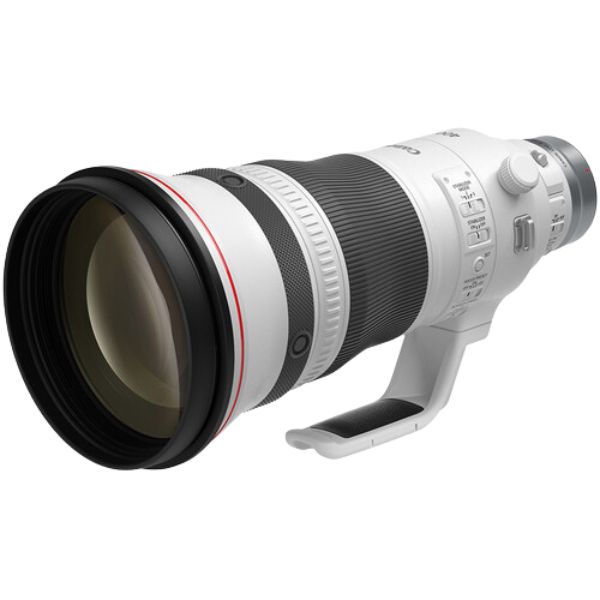
With the introduction of the 600mm f/4 L in 2021, Canon clearly wanted to introduce new high-end lenses for sports and wildlife photographers on this new RF mount. As a major brand in these areas, they needed to release top-of-the-range professional lenses, and this is the case, especially with this f/2.8 400mm.
Canon offers a 400mm lens with a very complex 17-element optical design. It benefits from the latest coatings to reduce aberrations. Compared to the previous SLR version, it benefits from a new mount for even better AF. Combined with the new hybrid AF, it is extremely fast and effective. The same goes for the stabilization system, which, despite its long focal length, is very comfortable to use, making it easier to aim and significantly reducing exposure times for static or slightly moving subjects.
The image quality is excellent, as you would expect from a top-of-the-range lens of this caliber, even at the full aperture. There is a slight improvement when you close the aperture down a stop. This is especially true when you zoom in at 100% on a picture taken with the 45MP of an R5. Vignetting is noticeable at full aperture, which is typical of any lens. It is significantly reduced by stopping down a stop. Distortion is virtually non-existent and chromatic aberrations are well controlled. Bokeh is very soft and pleasant. This is a good point for this type of lens, which combines a long focal length with a large aperture, as bokeh will often be important. The minimum distance of 2.5m seems important, but for a 400mm it’s rather classic. The lens is not primarily intended for macro photography.
For such an exorbitant price, you’d expect exceptional quality. In this respect, the 400mm f/2.8 RF delivers. This lens is also teleconverter compatible. If you’ve got the budget and the Canon R3, this lens is an absolute must when it comes to sport, because it’s very demanding on the body’s battery. The best Canon lens for sports on the RF mount ?
5 - Canon RF 600mm f/4 L IS USM
| Features | Visual |
|---|---|
|
|
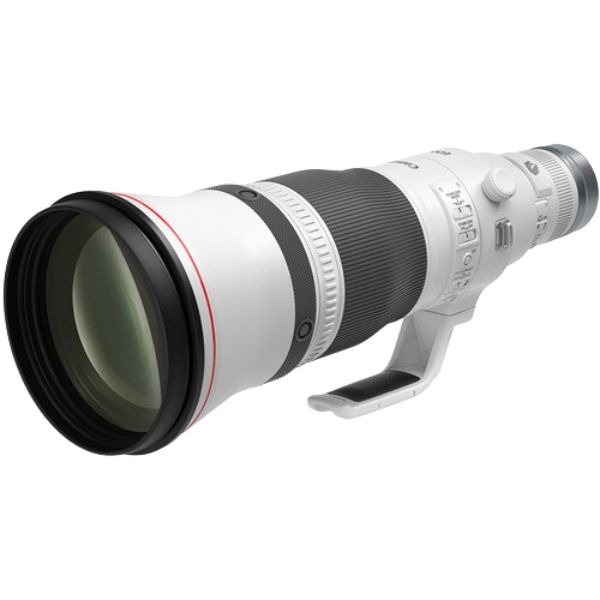
After the 400mm f/2.8, we can’t forget the 600mm f/4, which was released simultaneously. Although we think it’s more interesting for wildlife photography, certain types of sport can also benefit from its characteristics, especially those in which you can’t get too close or those that take place over a large area. Nevertheless, this is a professional lens and, like the 400mm, is included in this ranking not because of its low price but because of its excellent performance.
It has the same number of elements as the 400mm f/2.8 and, despite being 10cm longer, is not much heavier than the latter (although using a tripod is often recommended). Once again, AF is extremely fast and accurate, and stabilization is very effective. The minimum focusing distance makes it clear that this is not a lens for macro photography. However, with this focal length, you will rarely be close enough for sports or wildlife photography to be a problem.
There’s no need to dwell on the subject of image quality. As with the 400mm, it’s virtually flawless, with a very high level of detail at full aperture, good correction of distortion and chromatic aberrations, and relatively significant vignetting at f/4, which is reduced by closing the aperture.
Once again, costing even more than the 400mm f/2.8, this is an exorbitant price for a single lens. Compatible with teleconverters, it can be ‘transformed’ into a 1200mm f/8 with a doubler. Ready to start paying for it?
6 - Canon RF 100-500mm f/4.5-7.1 L IS USM
| Features | Visual |
|---|---|
|
|
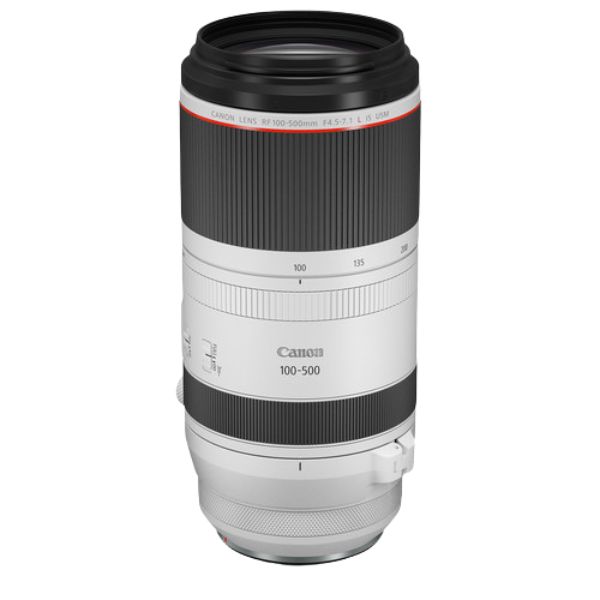
After the release of its big 400mm and 600mm prime lenses, Canon announced the arrival of a more versatile and relatively affordable zoom lens in the form of the 100-500mm f/4.5-7.1. Despite what some might consider to be a small aperture, this is an L-series lens, Canon’s top of the range. Naturally, a larger aperture would have made this lens much bigger, heavier and more expensive, given the quality of construction and optical complexity.
Belonging to the L-series, this lens boasts a very high quality construction and a powerful AF motor. Its AF is just as impressive as the 400mm and 600mm when paired with the newer RF bodies. The stabilisation is a little less effective at the longest focal lengths compared to fixed focal lengths, but is still very effective at the shortest focal lengths on bodies with sensor stabilisation (the longer the focal length, the less effect the sensor stabilisation has). The minimum focusing distance is pretty standard for this type of lens, so it’s still a long way from being a macro lens, but you can still try your hand at some close-up photography.
Image quality is very good right from the widest aperture at the shortest focal lengths, but deteriorates slightly as you zoom in. The same goes for distortion, which is almost non-existent at 100mm. It becomes more pronounced as you zoom in, although it remains very slight, as does vignetting. The chromatic aberrations are slight and the bokeh is not one of the best, but it is still correct. Despite belonging to the L-series, we didn’t expect the 100-500mm f/4.5-7.1 to be as high quality as a 400mm f/2.8 or 600mm f/4. Its main strength, given its focal length, remains its weight and size, which make it very comfortable to use and easy to hold in the hand.
With a price tag of just over €3,000, and sometimes less during promotional periods, this is a considerable budget. However, it is much less than the 400mm or 600mm presented above. It remains the best choice today for high level sports photography, with versatility and a robust construction for all conditions.
The key features of the above Canon sports lenses are compared in the table below.
| Canon RF sports lenses | Focallength | Max.Aperture | Weight | Dim. (Ø x L) | Min. FocusDist. | Approx.price | Best price | |||
|---|---|---|---|---|---|---|---|---|---|---|
| + | Canon RF 70-200mm f/4 L IS USM | 70-200mm | f/4 | 1.5 lb / 695g | 3.3 x 4.7" / 83 x 120 mm | 2' / 60 cm | $1 599 | Amazon B&H | More info + | |
|
||||||||||
| + | Canon RF 70-200mm f/2.8 L IS USM | 70-200mm | f/2.8 | 2.4 lb / 1070g | 3.5 x 5.7" / 90 x 146 mm | 2.3' / 70 cm | $2 599 | Amazon B&H | More info + | |
|
||||||||||
| + | Canon RF 100-300mm f/2.8 L IS USM | 100-300mm | f/2.8 | 5.7 lb / 2590g | 5 x 12.7" / 128 x 323 mm | 5.9' / 180 cm | $9 499 | Amazon B&H | More info + | |
|
||||||||||
| + | Canon RF 100-500mm f/4.5-7.1 L IS USM | 100-500mm | f/4.5-7.1 | 3 lb / 1365g | 3.7 x 8.2" / 94 x 208 mm | 3' / 90 cm | $2 699 | Amazon B&H | More info + | |
|
||||||||||
| + | Canon RF 400mm f/2.8L IS USM | 400mm | f/2.8 | 6.4 lb / 2900g | 6.4 x 14.4" / 163 x 367 mm | 8.2' / 250 cm | $11 999 | Amazon B&H | More info + | |
|
||||||||||
| + | Canon RF 600mm f/4L IS USM | 600mm | f/4 | 6.8 lb / 3100g | 6.6 x 18.6" / 168 x 472 mm | 13.8' / 420 cm | $12 999 | Amazon B&H | More info + | |
|
||||||||||
Alternatives
Canon has recently introduced a more affordable alternative: the 100-400mm f/5.6-8 IS USM. Around 4x cheaper than the 100-500mm L, you can’t expect the same build and image quality. Nevertheless, with this 100-400mm Canon offers a lightweight lens. Considering its focal length range, it’s quite compact and a lot less painful for your bank account. Its apertures are even more limited than those of the 100-500mm, forcing you to quickly increase the ISO sensitivity, and the AF, although quite efficient for this range, will quickly run into difficulties. This is a lens for those on a tight budget, who may wonder why they should choose a full-frame lens over an APS-C or Micro 4/3, when other brands offer at least as attractive options, if not more.
The RF 600mm and 800mm f/11 are two other options, but their focal lengths and especially their limited aperture at f/11 make them far less interesting for sports photography.
The table below summarises these alternatives:
| Canon RF alternatives for sports | Focallength | Max.Aperture | Weight | Dim. (Ø x L) | Min. FocusDist. | Approx.price | Best price | |||
|---|---|---|---|---|---|---|---|---|---|---|
| + | Canon RF 100-400mm f/5.6-8 IS USM | 100-400mm | f/5.6-8 | 1.4 lb / 635g | 3.1 x 6.5" / 80 x 165 mm | 2.9' / 88 cm | $649 | Amazon B&H | More info + | |
|
||||||||||
| + | Canon RF 600mm f/11 IS STM | 600mm | f/11 | 2.1 lb / 930g | 3.7 x 10.6" / 93 x 270 mm | 14.8' / 450 cm | $799 | Amazon B&H | More info + | |
|
||||||||||
| + | Canon RF 800mm f/11 IS STM | 800mm | f/11 | 2.8 lb / 1260g | 4 x 11.1" / 102 x 282 mm | 19.7' / 600 cm | $999 | Amazon B&H | More info + | |
|
||||||||||
For APS-C cameras
Long focal lengths for Canon RF APS-C cameras are currently very limited.
1 - Canon RF-S 55-210mm f/5-7.1 STM
| Features | Visual |
|---|---|
|

|
At the beginning of 2023, shortly after the release of the first RF-mount APS-C hybrids, Canon announced the arrival of the 55-210mm f/5-7.1. It was designed for this format. This is an entry-level ‘kit’ zoom, just like the other zooms for this format that Canon (and Nikon) have released.
As a result, we’re dealing with a rather plastic lens for amateurs. Canon wanted to offer an affordable option for this format. They knew that those who wanted something more high-end would turn to the compatible full-frame versions, since they use the same mount. The autofocus is also at the lower end of the scale and will therefore be less efficient and noisier than that of the full-frame versions.
A zoom in this range with these limited apertures will obviously be more limited, in combination with the lower ISO performance of APS-C sensors. Image quality deteriorates as you zoom in. However, Canon’s engineers have done a good job of correcting vignetting, distortion, flare and chromatic aberration.
For less than 500 euros, if you’re an APS-C user looking for the most economical solution, you’ll also be getting the lightest and most compact one.
In the APS-C format, this is currently the only option that is dedicated to this format. You’ll need to look at the full-frame lenses listed above if you’re looking for something more serious in RF mount.
Canon's best DSLR lenses for sport
For full frame cameras
1 - Canon EF 300mm f/2.8 L IS II USM
| Features | Visual |
|---|---|
|

|
Introduced in 2010, the Canon 300mm f/2.8 L II continues to set the benchmark for sports photography. It’s got everything you’d expect from the L-series. It’s built to a high standard and features barrel shortcuts, fast AF and efficient image stabilization.
With stunning image quality at full aperture and very few optical flaws, this is another benchmark. At over €6,000, it’s still available at a relatively high price. So if you’ve got a hybrid, your best bet is to look on the second-hand market or wait for the release of an RF-mount version.
2 - Canon EF 400mm f/2.8 L IS III USM
| Features | Visual |
|---|---|
|
|
Also for 2010, Canon released the 400mm f/2.8L III. Another benchmark, to be sure, and a monster in every sense of the word. Big, heavy, expensive… so many drawbacks and yet so much appreciated. Firstly, because of its top-of-the-range construction and its impressive functionalities, AF and stabilization.
But it’s also the image quality that makes it such a pleasure to use, as few lenses can compete with this pretty pebble. Optical aberrations are also very well controlled. It still costs €13,000 for a reason! On the other hand, if you have a mirrorless camera, go for the RF version. It won’t cost you any more.
3 - Canon EF 70-200mm f/2.8 L IS III USM
| Features | Visual |
|---|---|
|
|
Canon renewed its famous 70-200mm f/2.8 in 2018. Version II was particularly appreciated and this new version continues its codes, with top quality, functionality, AF and stabilization.
The image quality is still very good, and even excellent if you close it down a stop, with a little less homogeneity in the middle of the zoom range and some very minor optical flaws. New lenses can be found for just over €2,000. If you have a mirrorless camera, consider the f/4 hybrid version mentioned above. If you have an SLR, you’ll find some great deals on used lenses.
4 - Canon EF 70-200mm f/4 L IS II USM
| Features | Visual |
|---|---|
|
|
Canon has also updated the 70-200mm f/4 L IS alongside the 70-200mm f/2.8 L III. Again, there are no surprises compared to the first version, as the construction and functions are similar, even the AF is more or less the same. Only the stabilization has really improved, especially in terms of noise, which could have been a problem with the first version, and the aperture has an extra blade.
The image quality is clearly below that of the f/2.8 version. However, it is slightly better than its predecessor, especially at full aperture. There are some optical imperfections, especially at the longest focal lengths. You can find it new for just under €1,500. If you have a mirrorless, opt for the dedicated version.
5 - Canon EF 400mm f/4 L DO IS II USM
| Features | Visual |
|---|---|
|
|
In the course of 2015, Canon announced a new 400 mm DO, which uses special lens elements to reduce the weight and bulk of the lens. The construction and functionality are, as always, worthy of the L-series, and the stabilization is still very effective, even if we can find even better performance these days.
The optical construction of this lens reduces weight and bulk, but is not as effective as a conventional design when it comes to image quality. Image quality is still very good, but not up to the generally exceptional standards of this type of lens. Vignetting is noticeable at full aperture, but distortion and chromatic aberration are virtually non-existent. At €7,000, it’s still a large budget, but bear in mind that Canon’s 400mm f/4 RF, Sony’s E and Nikon’s Z cost over €12,000…
6 - Canon EF 200-400mm f/4 L IS USM
| Features | Visual |
|---|---|
|
|
For 2014, Canon is introducing the 200-400mm f/4 with an in-built 1.4x multiplier, making it a 280-560mm f/5.6. As with the L-series, the build quality is top-notch. The features are impressive.
Image quality is excellent from full aperture throughout the focal length range. Optical flaws are very slight, with the exception of vignetting at full aperture. AF and stabilization are also very effective. It can be found new for just over €12,000, a hefty sum, and second-hand availability is relatively limited.
7 - Canon EF 100-400mm f/4.5-5.6 L IS II USM
| Features | Visual |
|---|---|
|
|
At the beginning of 2015, Canon brought its 100-400mm back up to date (the first version dates back to 1998!). Once again, we’re back in the L-series, with its high build quality and extensive, modern features.
Image quality isn’t as good as you’d expect from an L-series lens, and there’s some vignetting and distortion, but with such a wide focal range and limited aperture, the lens has to be relatively affordable and compact.
Another possibility
Canon also offers a 600mm SLR lens, the EF 600mm f/4 L IS III USM. However, as mentioned in the description of the newer mirrorless version, it seems to us to be better suited to wildlife photography, and its price of over €14,000 makes it a much less attractive option, since if you have a hybrid, the RF version costs less, and if you have an SLR, there are cheaper and easier to find options.
The table below summarises all the characteristics of the lenses presented:
| Best Canon SLR lenses for sport | Focallength | Max.Aperture | Weight | Dim. (Ø x L) | Min. FocusDist. | Approx.price | Best price | |||
|---|---|---|---|---|---|---|---|---|---|---|
| + | Canon EF 70-200mm f/2.8L IS III USM | 70-200mm | f/2.8 | 3.3 lb / 1480g | 3.5 x 7.8" / 89 x 199 mm | 3.9' / 120 cm | $2 099 | Amazon B&H | More info + | |
|
||||||||||
| + | Canon EF 70-200mm f/4L IS II USM | 70-200mm | f/4 | 1.7 lb / 780g | 3.1 x 6.9" / 80 x 176 mm | 3.3' / 100 cm | $1 499 | Amazon B&H | More info + | |
|
||||||||||
| + | Canon EF 100-400mm f/4.5-5.6L IS II USM | 100-400mm | f/4.5-5.6 | 3.6 lb / 1640g | 3.7 x 7.6" / 94 x 193 mm | 3.2' / 98 cm | $2 399 | Amazon B&H | More info + | |
|
||||||||||
| + | Canon EF 200-400mm f/4L IS USM 1.4X | 200-400mm | f/4 | 8 lb / 3620g | 5 x 14.4" / 128 x 366 mm | 6.6' / 200 cm | $11 099 | Amazon B&H | More info + | |
|
||||||||||
| + | Canon EF 300mm f/2.8L IS II USM | 300mm | f/2.8 | - | - | - | $4 311 | Amazon | More info + | |
|
||||||||||
| + | Canon EF 400mm f/2.8L IS III USM | 400mm | f/2.8 | 6.3 lb / 2840g | 6.4 x 13.5" / 163 x 343 mm | 8.2' / 250 cm | $11 999 | Amazon B&H | More info + | |
|
||||||||||
| + | Canon EF 400mm f/4 DO IS USM II | 400mm | f/4 | 4.6 lb / 2100g | 5 x 9.2" / 128 x 233 mm | 10.8' / 330 cm | - | Amazon | More info + | |
|
||||||||||
For APS-C cameras
1 - Canon EF-S 55-250mm f/4-5.6 IS STM
| Features | Visual |
|---|---|
|
|
Canon made the 55-250mm f/4.5-5.6 available to APS-C SLR users at the end of 2007. In APS-C, Canon (like Nikon and even Sony) has never been keen on offering long focal length lenses for this format, apart from kit lenses, which this 55-250mm is. The construction is plastic and the optical design is not as ambitious as on an L-series lens.
The image quality is therefore worthy of a lens in this range, decent but never really excellent, the AF is relatively noisy and the stabilization, while good, is not top class. What remains is its compactness, lightness and low price of €320.
For Canon DSLR cameras, the choix is limited and it’s better to have a look at Sigma or Tamron lenses when they’re new, or look at second-hand lenses like the 70-300mm f/4-5.6 Di LD macro, but to get something of quality you’ll have to turn to full-frame lenses, as with hybrids.
If you’re interested in Canon lenses, check out our full guide to Canon’s latest macro RF lenses.
How to choose a sports lens?
Sports photography is very demanding on your equipment, as you need a body and lenses that can keep up with the pace and the subjects, as well as performing well in difficult conditions, which generally means you’ll need top-of-the-range equipment.
In fact, conditions will often push you towards large apertures and high technical specifications such as fast autofocus or solid construction. The price will rise quickly when combined with the focal lengths traditionally used in this field.
Focal length
It goes without saying that ultra-wide-angle lenses are rarely suitable for sports photography, as the subjects are usually quite far away, although in many cases they won’t be as far away as a bird of prey. Focal lengths between 70 and 400mm will therefore generally be the most relevant, although shorter focal lengths can also be useful for contextualizing the event.
However, it’s important to understand that the longer the focal length, the longer (and, in most cases, heavier) the lens, and the more difficult it is to obtain large apertures, especially at reasonable prices.
Maximum aperture
Obviously, sports photography involves subjects that are often in motion and require relatively short exposure times. Being able to capture the maximum amount of light with a large aperture such as f/2.8 is a definite plus, with the added bonus of greater distance from the subject with depth of field.
Again, the longer the focal length, the harder it is to find large apertures, unless you are spending as much as you would on a small car. For focal lengths under 200mm, you can find ‘sports’ lenses with a maximum aperture of f/4 that will do the job just fine, such as a 70-200mm f/4, but beyond 200mm you’ll often have to make do with a maximum aperture of f/5.6 at best if you can’t afford the top-of-the-range lenses.
Image stabilization
Optical image stabilization is relatively important, especially at focal lengths above 200mm, because at these focal lengths the sensor stabilization, if your sensor has one, is less effective. The advantage of having stabilization on the lens is that you can benefit from it whether or not your sensor has it.
Although in many cases the exposure time used will not require stabilization. For example, it won’t make any difference whether you have stabilization or not if you’re shooting a basketball player at 1/1000th of a second. However, it will be useful for stabilizing the viewfinder and providing greater comfort. Obviously, the longer the focal length and the longer the exposure time, the more useful it will be for the shot.
Autofocus (AF)
For sports photography, you obviously want a lens with responsive AF that can follow the subject. The good news is that long focal length lenses are generally designed for sports and wildlife photography and therefore have very good AF. Unfortunately, less high-end lenses can sometimes be less good at this (in order to reduce the price). As far as Canon is concerned, most USM lenses are faster and quieter than STM lenses.
Bear in mind, however, that autofocus performance is also heavily dependent on the module built into the camera body. If your lens struggles to focus in low light, it’s not necessarily because the lens doesn’t have good AF, but because the body’s module isn’t very sensitive. Again, higher-end cameras tend to have better AF modules.
TC compatibility
Teleconverters are accessories used to extend the focal length. There are 2 main types, the TC14 and TC20, which multiply the focal length by 1.4 and 2 respectively. There is a 3rd type, the TC17, which multiplies the focal length by 1.7, but this is less common. Most Canon lenses, especially top-of-the-range ones, are compatible with these teleconverters. Some of the lenses on this list even have a built-in TC (x1.4), so you can extend the focal length of the lens with a simple click.
However, TC14s reduce the maximum aperture by one stop, from f/2.8 to f/4 for example, and TC20s reduce it by two stops, from f/2.8 to f/5.6. As a result, lenses with a maximum aperture of f/5.6 go up to f/11 with a doubler, making the option much less attractive. There’s also a loss of quality, because the longer the TC extends the focal length, the more likely it is that your lens will be a top-of-the-range lens with a wide aperture.
That’s it, I’ve come to the end of my article on the best Canon lenses for sport, and I hope you have a clear picture of the choices available to you.
We’ve also written a more general article to help you choose your sports photography equipment. You’ll find lots more advice there.
Hope to see you soon.

Written by Sylvain PONS
I've been passionate about photography since 2010, learning as I went along. Today, I dedicate myself to guiding others in their choice of camera gear and sharing a variety of tips to improve their photography skills.
Despite our care, a mistake may have slipped into this article. If you find any, please don't hesitate to let us know so we can correct it as soon as possible and keep our information up-to-date!