Cameras for sports photography - Our complete guide
Last update: 06/18/2026
Our blog continues to grow thanks to you, our readers. This post may contain affiliate links, which means we can earn a small commission if you make a purchase through them, at no extra cost to you. This helps us to continue to bring you more and support our work!
Some time ago, I wrote a first general article to help you choose the right equipment for sports photography. I hope it helped make things a little clearer. Today, we’re continuing our series on sports photography with an article dedicated to cameras for sports photography.
Investing in the best camera for sports photography can be a smart move, whether you’re a professional photographer or an amateur hoping to capture great shots of your child’s first soccer match. Action photography can be demanding, even for some of the most expensive cameras on the market, because it comes with very specific requirements — and often a higher price tag.
Fortunately, there are plenty of cameras out there that can help you get those shots. In fact, the list of cameras I’m going to present in this article is far from exhaustive! In my opinion, these are among the “best” options available. If you want to go further, you can also take a look at our article on everything you need to know when choosing a camera.
DSLR cameras dominated action photography for many years. However, advances in mirrorless camera technology are starting to change the game. And for beginners who don’t want to invest all their savings just yet, I’ve also selected a few more affordable bridge and Micro Four Thirds cameras.
By choosing one of the cameras below and pairing it with the right lens, you’ll have the tools you need to take great photos at any sporting event.
1. The key features to look for first
Here’s a quick checklist of the most important features to look for in a camera for action photography.
- Lens choice. This is not a camera feature in itself. However, it may be the most important factor to consider when choosing a camera for sports. After all, what’s the point of having a great camera if you can only use a very limited number of telephoto lenses with it? The first thing to look at is the overall performance of the camera system, which depends heavily on the availability of high-quality lenses.
In case you haven’t already noticed, I have a serious passion for photography gear. Mélanie and I decided to list all camera lenses from all major brands on one page, organized by sensor type (full frame, APS-C, Micro 4/3). So don’t hesitate to take a look at that page to see which lenses are available.
- Fast, efficient autofocus. For sports photography, this is essential. Good AF point coverage is a real advantage, and any camera with a sophisticated AF tracking system will have a much better chance of keeping up with sports action.
- Continuous shooting speed. The more frames per second (fps), the better when shooting sports and wildlife.
- Camera buffer. A high frame rate is not enough if the camera can only shoot for a few seconds before the buffer fills up.
- Sensor size. A full-frame camera will generally perform much better at high ISO settings than a camera with a smaller sensor. At the same time, a smaller sensor with a similar resolution gives you extra reach thanks to the crop factor. So it’s a trade-off between low-light performance and reach. Sensor size in photography is covered in a full article.
- Build quality and weather sealing. Sports and nature photographers need to be able to shoot in all kinds of difficult conditions. That’s why weather sealing on both the camera and lens is so important.
- Ergonomics. When you’re shooting fast-moving action, ergonomics matter. You need to be able to switch quickly from one focus mode to another without taking your eye away from the viewfinder. You also need quick access to key settings such as shooting mode, ISO, exposure compensation and metering when conditions change.
2. Choosing the best cameras for sports photography
Keep in mind that sensor size will affect the size, weight and overall cost of the entire system. High-end full-frame cameras generally offer the best autofocus systems and image quality. However, they are also quite large, heavy and expensive. That’s why more affordable APS-C or Micro Four Thirds options may be a better starting point for anyone getting into sports photography.
I’ve broken down my selection of sports cameras by body type, and I’ve tried to list the models from the least expensive to the most expensive.
A compact camera for sports?
For sports photography, a compact camera can be a practical choice if you want something lightweight and easy to carry while still being able to capture fast-moving subjects.
Sony RX100 Mark VII
The Sony RX100 VII is a premium compact camera built around a 1-inch sensor and a very versatile 24-200mm equivalent zoom lens. Despite its small size, it delivers impressive autofocus performance, with phase-detection AF, excellent subject tracking and real-time Eye AF, making it a strong option for travel, street photography and everyday shooting.
It can shoot at up to 20 fps with continuous autofocus and auto-exposure, which is especially impressive for such a compact camera. The zoom range is shorter than on a bridge camera like the RX10 IV, but the RX100 VII is much smaller and easier to carry everywhere. Its lens is less bright at the long end, with an aperture range of f/2.8-4.5, but it still delivers very good image quality for a pocket-sized camera.
The RX100 VII is an expensive compact camera, but it remains one of the most complete expert compacts available, combining excellent autofocus, strong image quality, high-speed shooting, detailed 4K video and a genuinely pocketable design.

Choosing a mirrorless camera for sports photography
Although many experienced sports photographers still use DSLRs with their traditional optical viewfinders and autofocus systems, several mirrorless cameras are now genuinely impressive in terms of shooting speed and autofocus tracking reliability.
Of course, the speed and overall responsiveness of electronic viewfinders continue to improve, and the advantages of an optical viewfinder will probably keep photographers debating for years. Even so, many types of action, from traditional sports to wildlife, can already be captured remarkably well with a mirrorless sports camera.
Micro 4/3 cameras
If you are considering this type of camera, I suggest taking a look at all the lenses available for the Micro 4/3 mount (an article we update regularly). Some of them offer almost unique features, such as the Olympus 40-150mm f/2.8, which is equivalent to a 70-300mm full-frame lens (high-end zooms of this kind usually stop at 200mm).
OM SYSTEM OM-5 Mark II
The OM SYSTEM OM-5 Mark II follows in the footsteps of the original OM-5, keeping the same compact, adventure-ready philosophy. It features a 20.4 MP Micro Four Thirds Live MOS sensor, the TruePic IX processor, a 121-point cross-type phase-detection autofocus system and 5-axis in-body stabilization offering up to 6.5 stops of compensation, or up to 7.5 stops with compatible lenses. Its fully articulating touchscreen, 2.36 M-dot OLED viewfinder and IP53 weather-sealed body make it a solid option for travel, hiking and outdoor photography.
The main improvements are more about usability than image quality. The OM-5 Mark II adds USB-C connectivity, a redesigned grip and a dedicated Computational Photography button, giving you faster access to features like Live ND, High-Res Shot, Focus Stacking, HDR and Multiple Exposure. It also gains Night Vision for easier framing in very dark conditions, new OM Cinema video profiles, unlimited 4K recording and a front tally lamp. It is not a major technical overhaul, but it remains a very lightweight, durable and versatile hybrid camera for photographers who want advanced outdoor features in a compact body.
OM SYSTEM OM-1 Mark II
The OM SYSTEM OM-1 Mark II is the brand’s high-end Micro Four Thirds camera, designed for demanding outdoor, wildlife and sports photographers. Released in January 2024, it keeps the 20.4 MP stacked sensor and TruePic X processor of the original OM-1, but improves overall performance with better subject tracking, a larger buffer and excellent 5-axis stabilization offering up to 8.5 stops of compensation. Its 1053-point Quad Pixel AF system and very fast burst shooting — up to 120 fps in RAW, or 50 fps with continuous autofocus — make it particularly well suited to fast-moving subjects.
The OM-1 Mark II also strengthens OM System’s computational photography approach, with useful features like Live ND128 and Live GND, while keeping a rugged, weather-sealed body, a 5.76 M-dot OLED viewfinder and a fully articulating touchscreen. For video, it can record C4K up to 60p in 4:2:2 10-bit, making it a serious hybrid camera as well. It is more expensive than most Micro Four Thirds bodies, but it remains one of the most complete options in the system, especially for photographers looking for speed, stabilization, durability and advanced outdoor shooting tools.
APS-C mirrorless cameras for sports
Here are a few APS-C mirrorless cameras worth considering.
Sony A6700
The Sony Alpha 6700, released in July 2023, is a major evolution of the Sony A6600 while keeping the compact, lightweight APS-C format of the series. It features a 26 MP Exmor R sensor, a much faster BIONZ XR processor, a single SD card slot now compatible with UHS-II, and a significantly improved autofocus system. The integration of AI technology greatly enhances subject detection and tracking, including people, animals and moving subjects, with accurate eye tracking even in low light.
On the video side, the Sony A6700 also takes a clear step forward with 4K UHD recording up to 120 fps, making it a very appealing camera for content creators. Although some limitations remain, such as the 11 fps burst rate, the 1/4000s maximum shutter speed and the 2.36M-dot viewfinder, it remains a modern, robust and versatile camera. With its improved articulating screen, USB-C port and strong balance between photo quality, video performance, portability and responsiveness, it is aimed at demanding photographers and videographers looking for a complete APS-C body.
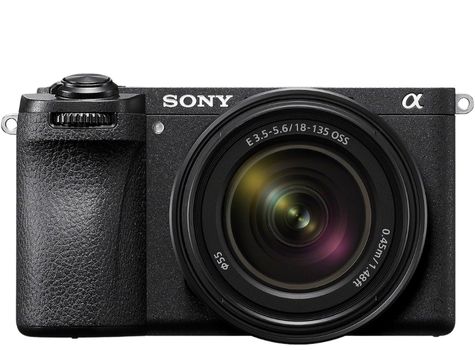
To learn more about the A6000 series, visit the Sony mirrorless camera page!
Canon R7
After Nikon, Canon was the last brand many people expected to release an APS-C body using the RF mount. The mount was introduced with Canon’s full-frame cameras, while the brand already had APS-C mirrorless bodies with the M mount. However, those cameras were not compatible with the RF mount, and Canon’s M-mount cameras were not really designed for sports photography. That’s why the R7 caused quite a stir when it was released. Its 33MP sensor and autofocus system were inspired by the R3, Canon’s flagship full-frame sports camera.
With this camera, Canon offers an AF system that is at least as good as Sony’s. It also has a high burst rate, although it relies on an electronic shutter, with all the drawbacks that can involve. However, as with the A6600, lens compatibility may push you toward larger, heavier and more expensive full-frame RF lenses. Canon’s APS-C history, whether with EF-S or M-mount, doesn’t necessarily suggest that this will change quickly.
If autofocus is your main concern, the lower-end R10 is cheaper and already very capable. But if you really want a fully fledged APS-C system for sports, there’s another recently released option that we’ll mention in a moment.

On our dedicated page, we take a closer look at these two Canon APS-C cameras and the rest of the range, if you’d like to know more!
Fujifilm X-H2s
To celebrate the 10th anniversary of its X-mount, Fujifilm pulled out all the stops with not one, but two new bodies in the X-H series, its high-end APS-C range (if we leave aside the more atypical X-Pro line). First came the X-H2s. This was not exactly the expected successor to the X-H1, but rather the start of a new direction for Fujifilm as the brand tried to break into the action segment. The X-H2, the true successor to the X-H1, focuses on high resolution, with a 40MP sensor and 8K video. It follows the same kind of segmentation we see from full-frame brands at the top of their ranges.
Like the OM-1 and very high-end full-frame cameras such as the Sony A9/A1, Nikon Z9 and Canon R3, the sensor resolution remains at 26MP. As an APS-C camera, it is much cheaper than full-frame options and only slightly more expensive than Micro Four Thirds bodies. It’s a good compromise. Its performance, whether in terms of burst shooting or autofocus, is clearly action-oriented, and Fujifilm emphasizes this on the presentation page of its official website, which is illustrated almost entirely with sports images.
Combined with Fuji lenses such as the XF 50-140mm f/2.8 and XF 200mm f/2, this gives us a fairly complete APS-C mirrorless system for this type of use. Even if we’d like Fuji to offer a few more options, at least the lenses are designed for the format.

If you want more information about Fujifilm’s other camera options, there’s an entire page dedicated to them.
Full-frame mirrorless cameras for sports
Here are 3 detailed suggestions for full-frame mirrorless cameras. I also mention each brand’s top model. Of course, there are other options out there. But I had to make a choice!
Sony a7 V
The Sony A7 V builds on the solid foundation of the A7 IV, keeping a very similar compact, weather-sealed full-frame body, the Sony FE mount, dual card slots, comfortable ergonomics and a full set of professional connections. It does not radically change the design, but it remains a versatile, well-balanced hybrid camera with a 33 MP sensor, a 3.68-million-dot OLED viewfinder and the reliable NP-FZ100 battery.
Its main improvements are in speed, autofocus and overall performance. The new semi-stacked sensor and BIONZ XR2 processor allow burst shooting up to 30 fps, better rolling shutter control, improved stabilization up to 7.5 stops and more advanced subject detection for sports and action photography. With features such as 4K 120p video, Wi-Fi 6, a 4-axis fully articulating screen and AI upscaling, the Sony A7 V offers a strong balance between performance, versatility and value, making it a very compelling investment.

I suggest taking a look at all the lenses available for the Sony FE mount, meaning full-frame mirrorless cameras.
Canon EOS R6 II
Released at the end of 2022, the EOS R6 II is Canon’s mid-range full-frame camera. It adds 4 megapixels compared with its predecessor, with a stabilized 24-megapixel sensor and Dual Pixel autofocus.
The autofocus has not changed dramatically, but it was already very good on the R6 and covers most of the frame. It offers solid tracking and can compete with, or even outperform, Sony in certain conditions.
The EOS R6 II can shoot 4K UHD at up to 60p without cropping, which was still fairly rare in this category when it came out, as cameras at this price from other brands often required a 1.5x crop at this frame rate. The stabilization is also very effective.
The Canon EOS R6 II is more expensive than many of its mid-range full-frame rivals. However, its features are fairly consistent with its price. The first version of the Canon R6, which is less expensive, is still highly recommended, as the performance levels are quite similar.

Sony a9 II
For several reasons, but especially because of its incredibly accurate autofocus system, this is an ideal camera for sports. Face Detection and Eye Detection let you concentrate fully on your subject, while the focus remains accurate throughout the sequence.
Its stacked sensor means that, as with the OM-1 and X-H2s, you can use the electronic shutter without worrying too much about the usual limitations. Unlike its DSLR counterparts, Sony chose to keep the classic design of its mirrorless bodies rather than integrate a vertical grip. The goal is to offer a sports camera that remains compact and lightweight, with the idea that if a grip is essential, you can always add one — and remove it when you don’t need it.
In short, it’s a lightweight, well-built, high-performance camera designed to withstand the demands of professional work. It also gives you the benefits of a stacked full-frame sensor at the lowest possible price.

Sony A1, Nikon Z9 and Canon R3
It would be impossible not to mention the crown jewels from the leading brands: the Sony A1, Nikon Z9 and Canon R3, cameras specifically designed for intensive use across many fields and capable of delivering the very best in sports photography.
That said, they are extremely expensive and specialized, and I don’t think they need to be recommended here. Let’s be honest: if you don’t already know that these are among the best cameras for sports, you probably don’t need them. And if you do, then you don’t need me to recommend them, haha.
Here are the links for these 3 cameras. These are the retailers we usually recommend.
Which DSLR for sports photography?
It’s getting harder and harder for me to recommend DSLRs over mirrorless cameras. I’ve even written an article that explains everything you need to know about mirrorless cameras and DSLRs.
Canon 90D
This is a versatile DSLR designed for a wide range of shooting situations, with weather sealing for outdoor use.
It’s fast enough for sports photographers, with a 10 fps burst rate and AF tracking through the optical viewfinder. Its sophisticated metering system lets you fine-tune exposures in JPEG mode, which is useful because the RAW buffer is a little limited compared with the competition. Surprisingly for a DSLR, the EOS 90D really comes into its own in Live View mode via the LCD screen. The touchscreen controls are excellent and the Live View autofocus system is solid, thanks to Canon’s DPAF.

Canon 7D Mark II
An article on the best cameras for sports photography wouldn’t be complete without at least one of Canon’s brilliant DSLRs.
The Canon 7D Mark II features a 20.2 MP APS-C image sensor and the DIGIC 6 image processor. This combination alone delivers excellent image quality and shooting performance.
In terms of autofocus, the 7D Mark II uses a Dual Pixel CMOS autofocus system for smooth, fast subject tracking, even in demanding conditions. It can capture 10 frames per second in continuous shooting mode. With this level of performance, you’ll have a huge selection of images to capture every moment of the action in high-quality detail.
The Canon 7D Mark II doesn’t have in-camera image stabilization, but it does benefit from Canon’s huge range of high-quality lenses with image stabilization. As a result, shooting at slower shutter speeds to compensate for low light is still very manageable.
Although the 7D Mark II is now an older camera, it remains an impressive option for capturing action at sporting events.

Nikon D500
The D500 is Nikon’s high-end APS-C DSLR. It features a 20.9 MP CMOS sensor, Nikon’s professional-level AF system and 10 fps continuous shooting.
Borrowed from Nikon’s professional D5, the D500’s 153-point phase-detection AF system is extremely powerful in continuous AF. Coverage extends almost to the edge of the frame, allowing the camera’s excellent 3D tracking system to follow subjects across much of the scene. The D500 is capable of outstanding image quality. At high ISO settings, it balances noise reduction, detail retention and saturation well in its JPEGs.
You can shoot 4K/UHD video with the D500, but the catch is a fairly aggressive 2.25x crop.
Although the Nikon D500 was announced in 2016 and has not received a refresh, it remains a great choice for sports photography.

Nikon D7500
The D7500 is an enthusiast-level camera that uses the same sensor as the D500, but with the same AF system as its predecessors. It is still a high-performance camera with excellent tracking when shooting through the optical viewfinder, though it is much less convincing when using the rear screen, as it does not have Canon-style Dual Pixel AF.
It does, however, offer a fairly high burst rate of up to 8 fps, which is not far behind the D500. Its less robust construction and less professional ergonomics do not stop it from performing well in the field, and its light weight makes it a pleasant companion.

Nikon D5
The D5 is a high-end professional DSLR designed to follow and capture the heart of the action, no matter how intense it gets.
It features ultra-fast 14 fps continuous shooting and one of the best phase-detection AF systems of its generation. Optimized for durability, speed and sensitivity rather than pixel count, the D5 is designed for professional use in the toughest environments.
The D5 is optimized for high-speed shooting in all conditions. JPEG quality is crisp and detailed throughout the native ISO range of 100 to 102,400, and rich detail can be extracted from RAW files.
Alongside high-speed stills, the D5 also shoots solid Full HD video, with a 4K UHD option in cropped mode. Overall, the Nikon D5 is a versatile camera that produces excellent images in almost any situation for those with the budget for it.

Canon 1D-X Mark III
This is the third iteration of the world’s best action DSLR, but it brings in advances from the mirrorless world to make it one of the best cameras ever made — especially for sports.
The EOS-1D X Mark III has a very complete feature set for photographers and videographers: a state-of-the-art autofocus system, a 20MP full-frame sensor, a new processor and a redesigned low-pass filter all combine to deliver excellent noise performance and overall image sharpness.
The video quality of the 1D X III is excellent. Autofocus is smooth and accurate, although it is not available at the camera’s highest video settings. Detail levels are excellent too.

That brings us to the end of this article. As you’ll have seen, whatever your budget or skill level, there is always a solution for anyone looking for the best sports camera. At the end of the day, remember that a good action camera needs a few essential features, which we covered at the beginning of this article.
By following this advice, you can feel confident that you’re making the right choice. That way, the next time you’re out shooting sports, you’ll be ready to capture great images with confidence.
To take your sports camera with you wherever you go, take a look at our article on camera bags.
To complete the picture, I suggest reading our advice on how to choose your lens.
See you soon,

Written by Sylvain PONS
I've been passionate about photography since 2010, learning as I went along. Today, I dedicate myself to guiding others in their choice of camera gear and sharing a variety of tips to improve their photography skills.
Despite our care, a mistake may have slipped into this article. If you find any, please don't hesitate to let us know so we can correct it as soon as possible and keep our information up-to-date!