Best Nikon Macro Lenses
Last update: 06/16/2026
Our blog continues to grow thanks to you, our readers. This post may contain affiliate links, which means we can earn a small commission if you make a purchase through them, at no extra cost to you. This helps us to continue to bring you more and support our work!
I’m expanding my lens guides to cover a wider range of options. After sharing my picks for the best Z-mount telephoto lenses and the best Z wide-angle lenses, I’m now turning to my personal selection of the best Nikon macro lenses, for both Z-mount mirrorless cameras and F-mount DSLRs. You can also explore our complete guide to all current Nikon Z lenses, including Nikon and third-party options, with or without autofocus.
Macro photography is all about capturing very small subjects at close range, usually with a minimum magnification ratio of 1:1. In practical terms, this means that one centimeter in real life is reproduced as one centimeter on the camera sensor. For example, a 24x36mm subject would fill the entire frame on a full-frame sensor of the same size. That said, some lenses labeled “macro” do not actually reach a 1:1 ratio, even though they can still be useful for close-up photography in a broader sense. They simply allow you to photograph subjects so they appear larger than they do to the naked eye.
In this article, we’ll focus only on lenses that offer at least a 1:1 magnification ratio. I’ve organized them by camera type, starting with mirrorless cameras, then DSLRs, before breaking them down by sensor size and by autofocus or manual-focus design.
For Nikon mirrorless cameras, the selection is still somewhat limited because the Z-mount is relatively recent. You can still use DSLR lenses with the FTZ adapter, although some of those lenses are now harder to find new. If your budget allows, I’d recommend choosing native Z lenses instead, as they are designed specifically for the mount and take advantage of its features. We’ve also created a dedicated guide to the best Nikon Z macro lenses.
So, which lens should you choose? Let’s take a closer look.
Best macro lenses for Nikon Z cameras
For full-frame Nikon Z cameras
If you want to go further, this page gives you the details of all the full-frame Nikon mirrorless cameras currently available and can also help you choose the right body. Here is also the link for firmware updates for Nikon Z lenses.
With autofocus
If you’re looking for a macro lens for a full-frame Nikon Z camera, the choice is still fairly limited, but it is now more interesting than it used to be. Below, I take a closer look at the main autofocus options currently available. Everything you need to know about these three lenses is summarized in the table below.

- Excellent build quality
- Excellent sharpness
- Comfort features available
- Stabilized lens
- Good control of flare and distortion
- Significant vignetting at f/2.8
- Correct weight/size

- Very good central sharpness
- Correct construction
- No aperture ring
- Non-stabilized lens
- Optical flaws well managed
- Significant vignetting at f/2.8
- Low price
The main features of these three prime lenses are summarized in the table below.
You can click directly on the lens names for a description:
1 - Nikon Z 105mm f/2.8 S MC VR
| Features | Visual |
|---|---|
|
|
In June 2021, Nikon announced the first macro lens for its mirrorless lineup. Following the logic of its DSLR lenses, Nikon added a stabilized 105mm f/2.8 to the Z range. This lens belongs to the S-Line, Nikon’s high-end family for the Z system. The build quality is excellent, with dust- and drip-resistant construction, customizable buttons, a control display, an AF/MF selector, and a focus distance limiter. The manual focus ring is very wide, and its non-linear behavior obviously prevents Nikon from adding a physical magnification scale like the one found on some macro lenses, since the focusing distance changes differently depending on how quickly you turn the ring. Turn it slowly and focusing becomes more precise; turn it faster and the lens responds more quickly.
Optically, this 105mm macro delivers a very high level of detail across the entire frame right from maximum aperture, which is exactly what you expect from this type of lens. Distortion and chromatic aberration are almost nonexistent, which is also expected from a high-end 105mm. Between you and me, macro or not, 105mm is not the most difficult focal length to correct for distortion. Vignetting, however, is very pronounced, and Nikon, like many brands today, relies partly on software corrections in order to prioritize sharpness while keeping size and weight under control. In fact, the lens remains relatively light considering its focal length and features. The bokeh is not perfect, but it stays fairly smooth for a macro lens and makes the lens usable for other purposes, such as portraits. Autofocus is decent, although it depends a lot on the camera body. A Z8 will obviously feel more comfortable than a Z6 thanks to its newer and more powerful technology. For macro photography, however, you’ll often switch to manual focus anyway, and the wide focus ring is very practical.
At around €1,200, it is expensive, but that price makes sense for this type of lens. Competing high-end 100mm macro lenses are usually in the same range. If you want to focus seriously on macro photography with the Nikon Z-mount, this is probably the best lens to choose.
2 - Nikon Z 50mm f/2.8 MC
| Features | Visual |
|---|---|
|
|
Alongside the 105mm macro, Nikon also announced the 50mm f/2.8 macro in June 2021. Unlike the 105mm, this lens does not sit in the high-end category. Its construction is still solid and weather-resistant, but it feels a step below. The main advantage, beyond the shorter focal length, is its compact and lightweight design. There are no customizable buttons or control display, but you still get an AF/MF switch and a focus distance limiter. This time, the linear focusing mechanism allows Nikon to add a scale on the barrel showing the magnification ratios as the lens extends toward its minimum focusing distance.
In terms of optical quality, it is not in the same league as the 105mm and does not deliver the same level of detail, especially because the gap between center and edge sharpness remains noticeable, even when stopped down. That said, the center is quite sharp. For distortion and chromatic aberration, this smaller 50mm performs very well and is close to the 105mm. Unfortunately, vignetting is also very noticeable, just like on the 105mm. Its 50mm focal length can make it more versatile, almost like a standard 50mm lens without the f/1.4 or f/1.8 aperture, but with true macro capability. The bokeh is not among the best, and the autofocus, which is slightly audible, is not a major strength either.
Of course, a lower-positioned lens usually means a lower price. Even so, at around €750, it still feels relatively expensive for its category and features. Compared with the 105mm, I would have expected it to be about €150 to €200 cheaper.
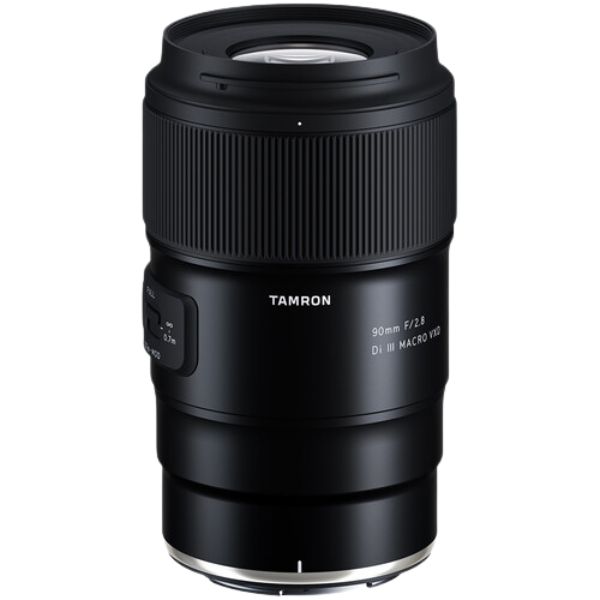
3 - Tamron 90mm f/2.8 Di III Macro VXD
| Features | Visual |
|---|---|
|
|
The Tamron 90mm f/2.8 Di III Macro VXD is a strong option for Nikon Z-mount full-frame cameras. With a maximum aperture of f/2.8 and a minimum focusing distance of 23cm, it offers a 1:1 magnification ratio, which is ideal for detailed close-up images. Its size and weight remain reasonable, making it a fairly compact macro lens. Optically, it uses 15 elements in 12 groups, including four low-dispersion glass elements that help control chromatic aberrations. It also features a 12-blade circular diaphragm, designed to produce smooth bokeh for macro and portrait photography. Note, however, that the lens is not stabilized.
In use, the autofocus is fast, efficient, and quiet, which is a nice advantage for a macro lens, even if manual focus is often preferred in this field. The lens is capable of strong sharpness at maximum aperture, with excellent color rendition, although in macro photography you’ll often stop down to increase depth of field. It can therefore work well for portraits and even some landscape photography too. On the other hand, vignetting is visible at full aperture, but it can always be corrected in post-production.
As you can see, this lens is clearly aimed at macro and portrait photography enthusiasts. It combines performance, compactness, and a relatively reasonable price. In my opinion, it is a very good deal.
The main characteristics of these three lenses are compared in the table below.
| Nikon Z full-frame lenses with AF | Focallength | Max.Aperture | Weight | Dim. (Ø x L) | Min. FocusDist. | Approx.price | Best price | |||
|---|---|---|---|---|---|---|---|---|---|---|
| + | Nikon Z MC 50mm f/2.8 | 50mm | f/2.8 | 9.17 oz / 260g | 2.9 x 2.6" / 75 x 66 mm | 6.3" / 16 cm | $645 | Amazon B&H | More info + | |
|
||||||||||
| + | Tamron 90mm f/2.8 Di III VXD Macro Z | 90mm | f/2.8 | 1.3 lb / 600g | 3.1 x 5" / 79 x 127 mm | 9.1" / 23 cm | $699 | Amazon B&H | More info + | |
|
||||||||||
| + | Nikon Z MC 105mm f/2.8 VR S | 105mm | f/2.8 | 1.4 lb / 630g | 3.3 x 5.5" / 85 x 140 mm | 11.4" / 29 cm | $1 045 | Amazon B&H | More info + | |
|
||||||||||
With manual focus
This is where Laowa’s macro lenses come in. Many of them are adaptations of DSLR versions. Laowa is a serious brand with a strong reputation for specialized macro lenses, and many of its models offer magnification ratios higher than 1:1. Since autofocus is less important in macro photography, these manual-focus lenses can be very appealing. They are truly specialized tools, available at different price points, but their build quality and image quality are generally very good. These full-frame lenses are also compatible with Nikon APS-C mirrorless cameras, just like the 50mm and 105mm Nikon lenses.
I won’t go into as much detail as I did with the autofocus lenses above, but in my opinion, these are the manual-focus Nikon Z macro lenses with the strongest reputations.
The table below summarizes the main features of the lenses listed below.
- Laowa 100mm f/2.8 Ultra Macro APO Z (2:1) : With good image quality and a robust build, this Laowa 100mm is one of the best choices if you want a 100mm macro focal length. It is an affordable Nikon macro lens that still offers very good quality.
- Laowa 90mm f/2.8 2X Ultra-Macro APO Z (2:1) : The Laowa 90mm Macro for Z-mount has a high-quality metal finish and an aperture ring. It produces high-quality images with effective flare control. It is another affordable macro lens for Nikon.
- Laowa 25mm f/2.8 Ultra Macro Z (5:1) : This is a very specialized lens with magnification from 2.5x to 5x. With an extremely shallow depth of field, it opens the door to very detailed close-up work.
- Laowa 85mm f/5.6 2X Ultra-Macro APO Z (2:1) : This Laowa 85mm is a lightweight, compact option at an affordable price. It has solid construction and an aperture ring. Thanks to good control of optical aberrations, image quality is excellent at f/8.
- Laowa 24mm f/14 Ultra Macro Z (2:1) : The Laowa 24mm is a unique lens with a 2:1 magnification ratio, a 40cm barrel, a waterproof front section up to 20cm, and built-in LED lighting. It opens up very creative possibilities and offers excellent image quality. It comes in a metal carrying case.
- Voigtlander MACRO APO-LANTHAR 65mm f/2 ASPH Z (1:2) : This is a high-end manual-focus lens built to excellent standards. Although it is limited to a 1:2 ratio, image quality is exceptional. Optical flaws are generally not an issue. At 625g, however, the lens is fairly heavy, but clearly built to last.
Here are the key points to remember when looking at the manual focusing lenses mentioned above.
| Nikon Z full-frame manual lenses | Focallength | Max.Aperture | Weight | Dim. (Ø x L) | Min. FocusDist. | Approx.price | Best price | |||
|---|---|---|---|---|---|---|---|---|---|---|
| + | Laowa 24mm f/14 Probe Z | 24mm | f/14 | 1 lb / 474g | 1.5 x 16.1" / 38 x 408 mm | 1.5' / 47 cm | $1 449 | Amazon B&H | More info + | |
|
||||||||||
| + | Laowa 25mm f/2.8 2.5-5X Ultra Macro Z | 25mm | f/2.8 | 0.9 lb / 400g | 2.6 x 3.2" / 65 x 82 mm | 6.7" / 17 cm | $399 | Amazon B&H | More info + | |
|
||||||||||
| + | Voigtlander MACRO APO-LANTHAR 65mm f/2 ASPH Z | 65mm | f/2 | 1.4 lb / 618g | 3.1 x 3.5" / 79 x 89 mm | 1' / 31 cm | $699 | B&H | More info + | |
|
||||||||||
| + | Laowa 85mm f/5.6 2x Ultra Macro APO Z | 85mm | f/5.6 | 11.08 oz / 314g | 2.1 x 3.2" / 53 x 81 mm | 6.3" / 16 cm | $449 | Amazon B&H | More info + | |
|
||||||||||
| + | Laowa 90m f/2.8 2X Ultra-Macro APO Z | 90mm | f/2.8 | 1.4 lb / 619g | 2.9 x 4.7" / 74 x 120 mm | 7.9" / 20 cm | $499 | Amazon B&H | More info + | |
|
||||||||||
| + | Laowa 100mm f/2.8 2x Ultra Macro APO Z | 100mm | f/2.8 | 1.4 lb / 638g | 2.8 x 6.1" / 72 x 155 mm | 9.8" / 25 cm | $499 | Amazon B&H | More info + | |
|
||||||||||
There are many other manual macro lenses for Z-mount (full-frame) cameras, but they’re often of average quality, hard to find, but generally not too expensive. Here are a few ideas:
| Manual lens alternatives for Nikon Z full-frame cameras | Focallength | Max.Aperture | Weight | Dim. (Ø x L) | Min. FocusDist. | Approx.price | Best price | |||
|---|---|---|---|---|---|---|---|---|---|---|
| + | AstrHori 25mm f/2.8 2-5x Ultra Macro Z | 25mm | f/2.8 | 1 lb / 474g | 2.4 x 4" / 61 x 102 mm | 4.3" / 11 cm | $249 | Amazon B&H | More info + | |
|
||||||||||
| + | AstrHori 28mm f/13 Macro Probe Z | 28mm | f/13 | 1.5 lb / 698g | 2.4 x 17.8" / 60 x 452 mm | 1.6' / 48 cm | $739 | Amazon B&H | More info + | |
|
||||||||||
| + | 7artisans 60mm f/2.8 II V2 Macro Z | 60mm | f/2.8 | 11.96 oz / 339g | 2.4 x 3.2" / 60 x 81 mm | 6.9" / 17.5 cm | $249 | Amazon B&H | More info + | |
|
||||||||||
| + | AstrHori 85mm f/2.8 Macro Tilt Z | 85mm | f/2.8 | 1.6 lb / 720g | 2.5 x 4.3" / 63 x 110 mm | 9.8" / 25 cm | $329 | Amazon B&H | More info + | |
|
||||||||||
| + | AstrHori 120mm f/2.8 2X Macro Z | 120mm | f/2.8 | 2.1 lb / 930g | 3 x 6.5" / 77 x 165 mm | 1' / 30 cm | $369 | Amazon B&H | More info + | |
|
||||||||||
| + | Mitakon Zhongyi 200mm f/4 1x Macro Z | 200mm | f/4 | 2.9 lb / 1300g | 3 x 7.3" / 75 x 186 mm | 1.6' / 48 cm | $499 | B&H | More info + | |
|
||||||||||
For Nikon Z APS-C cameras
Nikon has yet to release a dedicated APS-C Z-mount macro lens for its mirrorless cameras, so the current options mostly come from third-party brands and are manual-focus lenses. If you’re looking for a macro lens for a Nikon Z APS-C body, here are three options currently available.
The table below compares the key features of these lenses.
- Laowa 65mm f/2.8 2x Ultra Macro APO Z : The Laowa is probably the best macro lens choice for Nikon Z APS-C cameras. It is lightweight and offers a 2:1 magnification ratio. Build quality is excellent, and image quality is very strong even at maximum aperture, with very few optical flaws and excellent chromatic aberration control. Compared with the 7Artisans, the Laowa is more expensive, but it delivers much better sharpness and build quality.
- TTArtisan 40mm f/2.8 Macro Lens Z : This lens offers good build quality, a 2:1 magnification ratio, and solid image quality, especially at maximum aperture and up to f/5.6. Despite a few minor optical flaws, its affordable price makes it a good option for macro photography.
- 7Artisans 60mm f/2.8 Macro Mark II Z : 7Artisans offers an improved version of its 60mm macro lens, with decent image quality at maximum aperture and good results for macro photography. Its performance at longer focusing distances is less convincing, but it remains a good, affordable choice for beginners.
The table below shows and compares the characteristics of the lenses.
| Nikon Z APS-C lenses | Focallength | Max.Aperture | Weight | Dim. (Ø x L) | Min. FocusDist. | Approx.price | Best price | |||
|---|---|---|---|---|---|---|---|---|---|---|
| + | TTArtisan APS-C 40mm f/2.8 Macro Z | 40mm | f/2.8 | 13.09 oz / 371g | 2.5 x 3" / 63 x 77 mm | 6.7" / 17 cm | $99 | Amazon B&H | More info + | |
|
||||||||||
| + | 7artisans 60mm f/2.8 II V2 Macro Z | 60mm | f/2.8 | 11.96 oz / 339g | 2.4 x 3.2" / 60 x 81 mm | 6.9" / 17.5 cm | $249 | Amazon B&H | More info + | |
|
||||||||||
| + | Laowa 65mm f/2.8 2X Macro Z | 65mm | f/2.8 | 11.82 oz / 335g | 2.2 x 3.9" / 57 x 100 mm | 6.7" / 17 cm | $399 | Amazon B&H | More info + | |
|
||||||||||
Best Nikon macro lenses for DSLR cameras (F)
Although DSLR cameras are clearly declining and can now be considered part of the past, I still wanted to mention a few options worth considering if you want to try macro photography with a Nikon DSLR.
For Full-frame Nikon DSLR cameras
There used to be many full-frame macro lenses, most of them also compatible with APS-C sensors, but a lot of them are no longer produced. I’ve divided them into two categories: lenses with autofocus and lenses without autofocus.
With autofocus
1 - Sigma EX DG OS HSM macro 105mm f/2.8
| Features | Visual |
|---|---|
|

|
Thanks to its affordable price and solid image quality, Sigma’s 105mm Macro remains a reference among macro lenses. Like most good macro lenses, it delivers a high level of detail, with fairly minor optical flaws. Autofocus is not the fastest, but again, this is not usually the most important point for macro photography. It is very well built, and image stabilization is relatively effective, even if it is not the lens’s strongest feature.
If you’re looking for a well-designed, relatively affordable stabilized macro lens, this Sigma macro lens for Nikon is a very strong option. It performs very well and is still fairly easy to find. In my opinion, it is one of the best macro lenses for Nikon FX cameras.
2 - Tokina ATX-I macro 100mm f/2.8
| Features | Visual |
|---|---|
|
|
This Tokina is an excellent alternative to the Sigma 105mm if you do not need stabilization. It also comes at an even more attractive price.
This ATX-i version has a more modern look than its predecessor, along with a very reasonable size and weight. However, keep in mind that it does not have an internal motor like the Sigma, so you will need a camera body with one. That means D3x00/D5x00 DSLRs and mirrorless cameras used with an adapter will not be able to use autofocus. It is still a very good macro lens for Nikon.
Alternatives with autofocus
Sigma sold 150mm and 180mm f/2.8 Macro OS lenses for a while, but unfortunately both have been discontinued. If you can find one secondhand at a good price, they are still worth considering, as both perform very well and would be high on this list if they were still in production. The same goes for Tamron’s 90mm f/2.8 VC, which is also no longer produced.
Manual focus
There is a bit more choice in this category, mainly thanks to Laowa, which continues to sell its very specialized range of macro lenses. Most of them offer a magnification ratio higher than 1:1, and they are also compatible with APS-C DSLRs.
- Laowa 15mm f/4 macro (1:1) : Amazon / B&H
- Laowa 24mm f/14 Ultra Macro (2:1) : B&H
- Laowa 25mm f/2.8 Ultra Macro (5:1) : Amazon / B&H
- Laowa 60mm f/2.8 Ultra-Macro (2:1) : Amazon
- Laowa 100mm f/2.8 Ultra Macro APO (2:1) : Amazon / B&H
- Irix 150mm f/2.8 macro dragonfly : Amazon / B&H
In addition to the lenses mentioned above, other brands also offer manual-focus macro lenses for Nikon F-mount. These include:
- Mitakon Zhongyi 20mm f/2 4.5x Super Macro F : Amazon / B&H
- Mitakon Zhongyi Creator 85mm f/2.8 1-5x Super Macro F : B&H
- Mitakon Zhongyi 200mm f/4 1x Macro : B&H
- ZEISS Milvus 100mm f/2M ZF.2 Macro : Amazon / B&H
- ZEISS Milvus 50mm f/2M ZF.2 Macro : Amazon / B&H
- Samyang 100mm f/2.8 Macro F : Amazon / B&H
For Nikon APS-C DSLR cameras (Dx format)
Macro lenses for Nikon APS-C DSLRs are relatively rare, as designing dedicated APS-C macro lenses is not necessarily attractive for manufacturers. After all, why design a 105mm macro lens specifically for APS-C when a full-frame version already exists and can be sold at a higher price? Here are a few references for this format, starting with two Nikon DX macro lenses.
1 - Nikon AF-S DX micro 40mm f/2.8G
| Features | Visual |
|---|---|
|
|
In my opinion, the 40mm f/2.8 is the most interesting Nikon Micro lens for APS-C bodies. It is lightweight, compact, and relatively affordable. If you enjoy close-ups, you’ll probably find it more useful than the 35mm f/1.8 DX, despite its smaller maximum aperture.
Optical performance is very good, as is often the case with macro lenses. Its autofocus is not very fast, although that also depends on the camera body you use. For macro work, however, this is not necessarily a major drawback, since manual focus is often more suitable. In my opinion, it is the best macro lens for Nikon DX cameras.
2 - Nikon AF-S DX VR micro 85mm f/3.5G
| Features | Visual |
|---|---|
|
|
The 85mm f/3.5 Macro is newer, but it costs a lot more and feels less attractive than some full-frame lenses that are also compatible with APS-C bodies, such as Tamron’s 90mm f/2.8 Macro or Sigma’s 105mm f/2.8 Macro.
It has a smaller maximum aperture and is more expensive than the 40mm. In macro photography, however, this is not a major issue, as you will often stop down to increase depth of field. In any case, the effective aperture already decreases automatically at the shortest focusing distances. Image quality and autofocus are slightly better than on the 40mm, but if you really want a longer macro focal length, I would still look at the full-frame alternatives.
If you’re looking for a macro lens for your APS-C camera, Laowa also offers the Laowa 60mm f/2.8 2X Ultra-Macro F, which is designed for APS-C DSLRs. The lens is well built, the 2:1 magnification ratio is very interesting, image quality is excellent, and the price is very affordable. If manual focus is not a problem for you, I think it is a very good choice.
Reminder - How to choose a macro lens?
Macro photography is a very specific field. It requires specialized equipment and comes with several challenges, because the focusing distance needed to reach a 1:1 ratio, or higher, creates an extremely shallow depth of field. With the camera so close to the subject, you can also block ambient light, while the size of the subject in the frame increases the risk of camera shake and subject blur.
I’ve already written a full article explaining everything you need to know about choosing a macro lens, but here’s a quick summary.
Magnification ratio
In theory, as explained in the introduction, a “true” macro image is taken at a minimum magnification ratio of 1:1. You can increase a lens’s magnification ratio with accessories such as extension tubes, but it is important to remember that native 1:1 macro lenses are designed specifically for this discipline and therefore often deliver better image quality. This is especially true because lenses designed for general use usually perform less well at very close distances if they do not offer a native 1:1 ratio. This is one reason why macro lenses are often larger and heavier than conventional lenses. It is a bit like taking a standard lens and adding an extension tube, except the optical design is built around close focusing from the start.
Focal length
Some people recommend long focal lengths, especially telephotos, for photographing insects so you do not scare them away. If you look at the minimum focusing distances of the Nikon Z 50mm and 105mm, the former reaches a 1:1 ratio at 16cm and the latter at 29cm. You might think those extra 13cm make a big difference, but this distance is measured from the sensor. Since the 105mm lens is 7.4cm longer than the 50mm, the front element is only about 5.6cm farther from the subject. Take a ruler and look at what 5.6cm actually represents: it is not much. So an insect that sees you coming with the 105mm is unlikely to be much slower to flee than it would be with the 50mm.
Choosing a focal length mainly affects perspective. The longer the focal length, the more compressed the image appears, but this is not directly because of the focal length itself. It is because you have changed your shooting distance. Always remember that distance to the subject changes perspective, not the focal length alone. Focal length also has a small effect on depth of field, because at the same aperture, a shorter focal length gives a deeper depth of field. That said, this is partly offset by the fact that you have to get closer, so the difference remains fairly small. On the other hand, focal length has NO IMPACT on the size of the subject at 1:1. If you use a 1:1 ratio, the subject will be the same size in the frame, whatever the focal length. If you want to get even closer, you’ll need a lens with a higher magnification ratio, add an extension tube, or crop the image afterward, with all the usual drawbacks. Perspective stays the same when cropping, unlike when you physically move closer, and you obviously lose pixels. Also keep in mind that dedicated macro lenses are prime lenses, not zoom lenses, and they use a constant maximum aperture.
Focus
Autofocus is not really necessary for dedicated macro photography. In fact, it can even be counterproductive. After all, a 1:1 ratio, or higher depending on the lens, is reached at a specific distance. The goal is often to stay at that distance and move slightly forward or backward to place the focus exactly where you want it. However, autofocus can still be useful for following certain moving subjects, or simply for using the lens for something other than macro photography. For example, 100mm and 105mm macro lenses are often used for portrait photography too.
Maximum aperture
Depth of field becomes extremely shallow at such short distances. Most macro lenses have a maximum aperture of f/2.8, but in practice, you’ll often need to use smaller apertures such as f/8 or f/11 to keep at least some context and enough of your subject sharp. You’ll even see in the list that one macro lens has a maximum aperture of f/14. Another option, when possible, is focus stacking: taking several photos of the same subject, each with a slightly different focus point. This allows you, for example, to use a wide aperture such as f/2.8 in low light while achieving the depth of field of a much smaller aperture. The downside, of course, is that all the images must be identical except for the focused area, which makes the technique almost impossible handheld or with a moving subject.
Image Stabilization
On the other hand, this is a feature that can be useful for macro photography, although it is often overestimated. In other words, you might use a shutter speed that works for your focal length and distance, but the slightest movement from the subject can still ruin the shot and force you to increase your shutter speed. In that case, the effect of stabilization becomes almost negligible. So, in practice, it is mainly useful for handheld shots of static subjects.
That’s it, I’ve reached the end of this article on Nikon’s best macro lenses, both for the brand’s newer mirrorless cameras and older DSLRs. Don’t hesitate to check out our full guide to the best Nikon Z lenses currently available!
See you soon for a new article, probably the same kind of guide for Canon!

Written by Sylvain PONS
I've been passionate about photography since 2010, learning as I went along. Today, I dedicate myself to guiding others in their choice of camera gear and sharing a variety of tips to improve their photography skills.
Despite our care, a mistake may have slipped into this article. If you find any, please don't hesitate to let us know so we can correct it as soon as possible and keep our information up-to-date!