The best Fujifilm lenses
Last update: 06/16/2026
Our blog continues to grow thanks to you, our readers. This post may contain affiliate links, which means we can earn a small commission if you make a purchase through them, at no extra cost to you. This helps us to continue to bring you more and support our work!
After publishing articles on lenses for Nikon and Canon, lenses for Sony mirrorless cameras, and the best lenses for Micro 4/3 (Panasonic and Olympus), here is our guide to the best lenses for the Fujifilm X-mount. The choice used to be fairly limited, with Fujifilm making most of the autofocus lenses for the system. Today, however, the X-mount lineup is much richer, with options from Sigma, Tamron, Viltrox, Samyang, Zeiss, and several manual-focus brands.
Fujifilm took some time to fully find its place in the digital era, but the brand has re-established itself as a major player in photography thanks to its APS-C mirrorless cameras, especially the X-T range. By the way, we wrote a comprehensive article explaining all the latest Fujifilm APS-C cameras. Fujifilm’s lens lineup is one of the system’s biggest strengths. Unlike some brands that treat APS-C mainly as an entry point to full-frame, Fujifilm has built a serious, coherent optical range around the format.

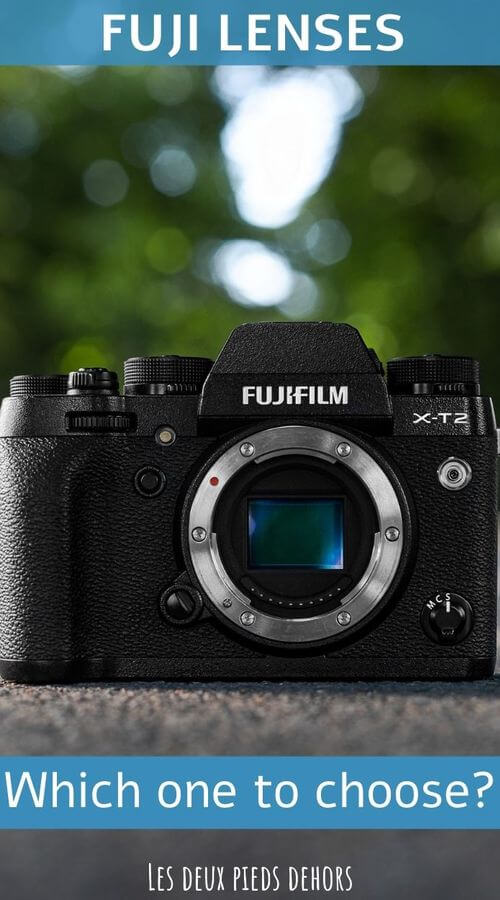

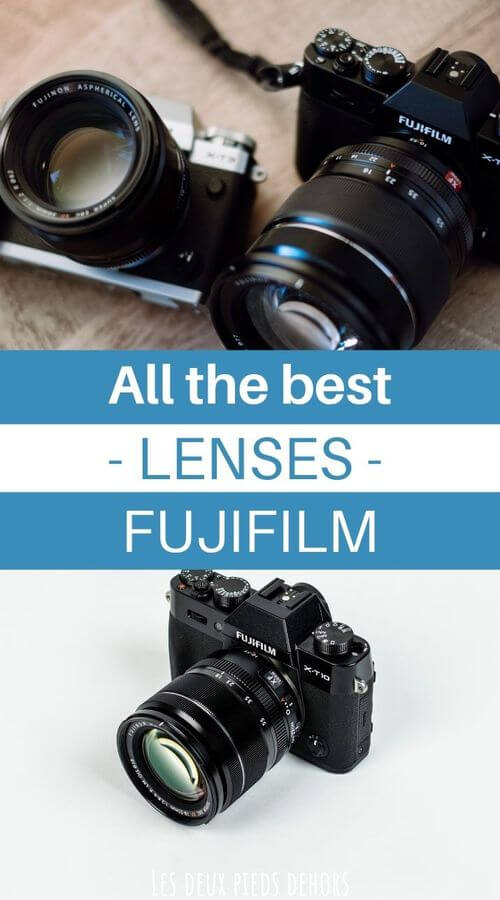
In this article, you’ll still see many Fujifilm lenses, but third-party brands such as Sigma, Tamron, Viltrox, and Samyang now also offer very interesting X-mount options. I will mention some manual alternatives at the end of the chapters.
By the way, I just finished an article on all the lenses available for the Fujifilm X-mount. This will let you compare lenses with one another, but also to discover many lesser-known (and cheaper) third-party brands offering lenses suitable for this APS-C mount.
Best lenses for APS-C Fujifilm
Since it would make little sense to call a 23mm “better” than a 50mm when they are not designed for the same uses, I’ve organized my favorite choices as follows:
- Best standard Fujifilm X lenses
- Best Fujifilm X wide-angle lenses
- Best Fujifilm X telephoto lenses
- Best Fujifilm X macro lenses
Even though the best lenses are often the most expensive, do not forget that in many cases and for many uses, the lenses ranked lower are often still very good and may suit many users’ needs and budgets.
Best standard APS-C Fujifilm lenses
Standard lenses offer a field of view that feels fairly close to what you naturally see with your eyes. Here, I’m considering lenses that cover roughly 24 to 85mm in full-frame terms, or about 16 to 50mm on APS-C.
Here are the best portrait lenses for APS-C sensors:
Fuji X standard prime lenses
- Fujifilm XF 23mm f/1.4 R LM WR
- Fujifilm XF 35mm f/2 R WR
- Fujifilm XF 50mm f/2 R WR
- Fujifilm XF 56mm f/1.2 R WR
- Viltrox 75mm f/1.2 AF X
Fuji X standard zoom lenses
- Fujifilm XF 16-55mm f/2.8 R LM WR II
- Fujifilm XF 16-80mm f/4 R OIS WR
- Fujifilm XF 50-140mm f/2.8 R LM OIS WR X
If you want a quick overview with prices, here is a table allowing you to quickly compare these lenses.
We’ve also gone into much more detail in a full article on X lenses suitable for portraiture, both prime and zoom lenses.
Fujifilm XF 23mm f/1.4 R LM WR
| Features | Visual |
|---|---|
|

|
Available since September 2021, the Fujifilm XF 23mm f/1.4 R LM WR is one of the most highly praised lenses for the Fuji X-mount. Its 35mm full-frame equivalent focal length makes it ideal for environmental portraiture. What’s more, its compact and lightweight format means you can take it anywhere.
In terms of build quality, there is very little to complain about: the lens is weather-sealed and solid. The optical formula is based on 15 elements in 10 groups, including 2 aspherical lenses and 3 ED lenses. Thanks to its f/1.4 maximum aperture and minimum focusing distance of 19 cm, it is perfect for isolating your subject from the background. Its autofocus is fast and efficient, even without built-in stabilization. In terms of performance, sharpness is excellent from f/2.8, both in the center and at the edges. Optical flaws such as chromatic aberrations are well controlled.
In short, this lens combines solid construction with strong optical performance at a relatively reasonable price. In my opinion, it is a good lens to learn portraiture without breaking the bank.
Fujinon XF 35mm f/2 R WR
| Features | Visual |
|---|---|
|

|
Released in 2015, the Fujinon XF 35mm f/2 R WR is a more affordable alternative to the XF 35mm f/1.4. It offers a full-frame equivalent focal length of 50mm, making it ideal for portrait photography. Its light weight and compact size make it easy to carry anywhere.
When it comes to design, the lens is weatherproof and made entirely of metal. It has a click-stop aperture ring with an auto position, which makes it easy to use. Optically, it has Super EBC coated lenses. Although there is no stabilization, the autofocus is fast and efficient (a good point when shooting moving subjects). In terms of performance, sharpness is decent from f/2 in the center, but the edges are still a little soft.
In conclusion, the Fujinon XF 35mm f/2 R WR is an excellent choice if you are looking for a versatile and affordable portrait lens. What’s more, it retails for around €400. Considering its performance, the price remains very reasonable.
Fujifilm XF 50mm f/2 R WR
| Features | Visual |
|---|---|
|

|
Introduced in 2017, the Fujinon XF 50mm f/2 WR is a compact Fujifilm lens with an f/2 aperture. Its focal length is the equivalent of 75mm in full-frame, which is an advantage for portraiture, especially outdoors. Its compact size makes it comfortable and easy to handle.
The construction of the lens is perfect: metal and weather-sealed. Its optical formula includes 9 elements in 7 groups, among them an aspherical lens. The autofocus is well suited to both still and video photography: it is efficient and silent. In terms of performance, sharpness is very good at full aperture and exceptional at f/4. Finally, the bokeh is soft and natural (a real plus for portraits).
In short, the Fujinon XF 50mm f/2 WR is an excellent choice if you want a compact, versatile lens at a more than reasonable price. It is one of Fuji’s most compact short telephoto primes. If you like prime lenses, this lens is clearly a benchmark.
Fujifilm XF 56mm f/1.2 R WR
| Features | Visual |
|---|---|
|

|
The Fujinon XF 56mm f/1.2 R WR is positioned as a premium lens. It offers a focal length equivalent to 85mm in full-frame. In addition, it has a large aperture while maintaining a reasonable size. It will be practical to transport or take with you when traveling.
The lens is made entirely of metal and is weather-sealed. Its optical formula is made up of 13 elements in 8 groups, with two aspherical lenses and one ED lens, ensuring good control of chromatic aberrations and distortion. The autofocus is also fast and accurate. On the other hand, the lens is not stabilized. In terms of performance, sharpness is very good, with uniformity in the center and at the edges. Finally, the bokeh is pleasant and smooth.
All in all, this Fujifilm lens has already proven itself. It has to be said that it is of excellent quality. It is suitable for both amateur and professional photographers. It is not cheap, but it remains a serious option if you want a high-quality portrait lens.
Viltrox 75mm f/1.2 AF X
| Features | Visual |
|---|---|
|

|
Available since December 2022, the Viltrox AF 75mm f/1.2 STM is a high-end lens with a full-frame equivalent focal length of 110mm. It is one of the most impressive fast portrait lenses for Fujifilm X. Its length is reasonable, while its weight is quite substantial.
In terms of optical quality, the sharpness from f/1.2 is remarkable. It improves even further when you stop down slightly. Its rounded blades offer a natural and pleasant bokeh. As for optical flaws, distortion is almost non-existent, while vignetting is noticeable but can be corrected in post-production. Flare and aberrations are also well controlled.
As you can see, the Viltrox AF 75mm f/1.2 STM offers very good performance with a solid, high-quality construction. What’s more, it’s available at an affordable price, so it offers excellent value for money.
Fujifilm XF 16-55mm f/2.8 R LM WR II
| Features | Visual |
|---|---|
|

|
Announced in October 2024, the Fujifilm XF 16-55mm f/2.8 R LM WR II is a standard zoom that is highly regarded. It offers a focal length range equivalent to 24-70mm in full-frame, making it ideal for portraiture and many other applications. Its smaller, lighter design improves handling compared with the previous version.
Its construction is robust and weather-sealed, with a clearly professional feel. The lens also features aspherical and reduced dispersion elements, as well as a 11-blade rounded diaphragm. In terms of optical performance, the lens offers excellent sharpness throughout the focal range. Finally, its bokeh is soft and creamy, which is great for portraits.
In short, the Fujifilm XF 16-55mm f/2.8 R LM WR II is a versatile, high-quality lens that is well suited to portraiture. This new version has clearly become one of the key standard zooms in the X-mount lineup.
Fujifilm XF 16-80mm f/4 R OIS WR
| Features | Visual |
|---|---|
|
|
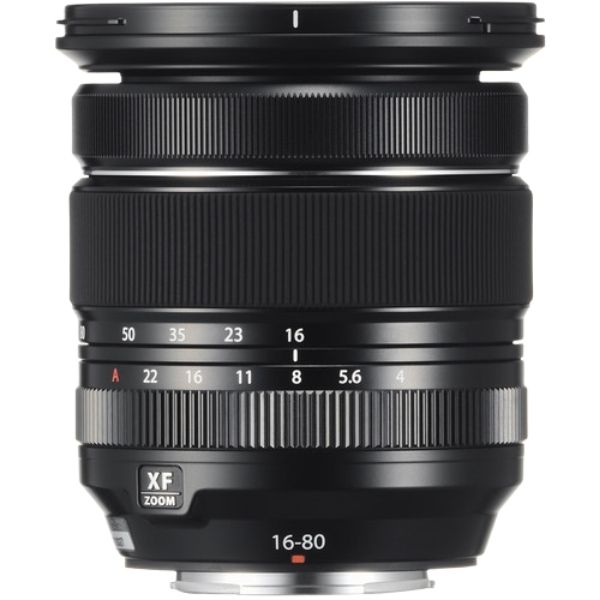
Announced in July 2019, the Fujinon XF 16-80mm f/4 R OIS WR is a versatile and versatile lens. With a focal length range equivalent to 24-122mm in full-frame, it is ideal for portrait and street photography, as well as video. In terms of size and weight, it falls between the XF 18-55mm f/2.8-4 R LM OIS and the XF 16-55mm f/2.8 R LM WR.
In terms of construction, the lens is made entirely of polycarbonate, making it reliable and durable. Its optical formula is based on 16 elements in 12 groups, including 3 aspherical elements and 1 aspherical ED element. Its optical stabilization and autofocus make it comfortable to use for both stills and video. In the center, sharpness is satisfactory throughout the entire focal range. At the edges, the consistency is optimal between 22mm and 50mm. The bokeh is pleasant, but limited by the f/4 aperture.
In conclusion, the XF 16-80mm f/4 R OIS WR is a perfect combination of performance, compactness and versatility. If you are looking for a lens for street photography, portraits and travel, this is a very solid option.
Fujifilm XF 50-140mm f/2.8 R LM OIS WR
| Features | Visual |
|---|---|
|

|
The Fujinon XF 50-140mm f/2.8 OIS WR, available since 2014, is the only longer telephoto zoom I recommend for portraits. Its focal length range is equivalent to 76-213mm in full-frame terms, which makes it more suitable for close-up portraits. One of its advantages is its constant aperture of f/2.8, which is ideal for isolating the subject from the background.
In terms of construction, this is a premium product, with an all-metal weather-sealed lens. Its optical formula incorporates 23 elements in 16 groups, including 5 ED elements and 1 Super ED element. In terms of performance, the sharpness is excellent from full aperture, with a sharp, even rendering. Defects such as chromatic aberrations and vignetting are well controlled. Distortion remains low and flare is controlled.
Finally, the Fujinon XF 50-140mm f/2.8 OIS WR offers high-quality rendering. Although it is rather expensive, its optical performance and stabilization make it easy to justify if you need this type of lens.
Below, you’ll find a sortable table summarizing the main characteristics of the eight lenses mentioned above.
| Fuji X standard lenses | Focallength | Max.Aperture | Weight | Dim. (Ø x L) | Min. FocusDist. | Approx.price | Best price | |||
|---|---|---|---|---|---|---|---|---|---|---|
| + | Fujifilm XF 16-55mm f/2.8 R LM WR II | 16-55mm | f/2.8 | 0.9 lb / 410g | 3.1 x 3.7" / 78 x 95 mm | 1' / 30 cm | $1 199 | B&H | More info + | |
|
||||||||||
| + | Fujifilm XF 16-80mm f/4 R OIS WR | 16-80mm | f/4 | 1 lb / 440g | 3.1 x 3.5" / 78 x 89 mm | 1.1' / 35 cm | $799 | Amazon B&H | More info + | |
|
||||||||||
| + | Fujifilm XF 23mm f/1.4 R LM WR | 23mm | f/1.4 | 13.23 oz / 375g | 2.6 x 3.1" / 67 x 78 mm | 7.5" / 19 cm | $899 | Amazon B&H | More info + | |
|
||||||||||
| + | Fujifilm XF 35mm f/2 R WR | 35mm | f/2 | 6 oz / 170g | 2.4 x 1.8" / 60 x 46 mm | 1.1' / 35 cm | $399 | Amazon B&H | More info + | |
|
||||||||||
| + | Fujifilm XF 50mm f/2 R WR | 50mm | f/2 | 7.05 oz / 200g | 2.4 x 2.3" / 60 x 59 mm | 1.3' / 39 cm | $449 | Amazon B&H | More info + | |
|
||||||||||
| + | Fujifilm XF 50-140mm f/2.8 R LM OIS WR X | 50-140mm | f/2.8 | 2.2 lb / 995g | 3.3 x 6.9" / 83 x 176 mm | 3.3' / 100 cm | $1 599 | Amazon B&H | More info + | |
|
||||||||||
| + | Fujifilm XF 56mm f/1.2 R WR | 56mm | f/1.2 | 1 lb / 445g | 3.1 x 3" / 79 x 76 mm | 1.6' / 50 cm | $999 | Amazon B&H | More info + | |
|
||||||||||
| + | Viltrox 75mm f/1.2 AF X | 75mm | f/1.2 | 1.5 lb / 670g | 3.4 x 4" / 87 x 101 mm | 2.9' / 88 cm | $499 | Amazon B&H | More info + | |
|
||||||||||
Standard alternatives for Fujifilm X
There are a large number of lenses that can be used as portrait and everyday alternatives, both from Fujifilm and from third-party brands, now that the mount is more open.
For alternative prime lenses, look no further:
| Alternatives - Prime lenses for portraits | Focallength | Max.Aperture | Weight | Dim. (Ø x L) | Min. FocusDist. | Approx.price | Best price | |||
|---|---|---|---|---|---|---|---|---|---|---|
| + | Fujifilm XF 18 mm f/1.4 R LM WR | 18mm | f/1.4 | 13.05 oz / 370g | 2.7 x 3" / 69 x 76 mm | 7.9" / 20 cm | $999 | Amazon B&H | More info + | |
|
||||||||||
| + | Fujifilm XF 18mm f/2 R | 18mm | f/2 | 4.09 oz / 116g | 2.5 x 1.6" / 65 x 41 mm | 7.1" / 18 cm | $599 | Amazon B&H | More info + | |
|
||||||||||
| + | Sigma 23mm f/1.4 DC DN Contemporary X | 23mm | f/1.4 | 11.99 oz / 340g | 2.6 x 3" / 66 x 77 mm | 9.8" / 25 cm | $549 | Amazon B&H | More info + | |
|
||||||||||
| + | Viltrox 27mm f/1.2 X | 27mm | f/1.2 | 1.2 lb / 560g | 3.2 x 3.6" / 82 x 92 mm | 11" / 28 cm | $499 | Amazon B&H | More info + | |
|
||||||||||
| + | Fujifilm XF 27mm f/2.8 R WR | 27mm | f/2.8 | 2.96 oz / 84g | 2.4 x 0.9" / 62 x 23 mm | 1.1' / 34 cm | $399 | Amazon B&H | More info + | |
|
||||||||||
| + | Sigma 30mm f/1.4 DC DN Contemporary X | 30mm | f/1.4 | 9.7 oz / 275g | 2.6 x 2.9" / 65 x 74 mm | 1' / 30 cm | $319 | Amazon B&H | More info + | |
|
||||||||||
| + | Fujifilm XF 33mm f/1.4 R LM WR | 33mm | f/1.4 | 12.7 oz / 360g | 2.6 x 2.9" / 67 x 74 mm | 1' / 30 cm | $799 | Amazon B&H | More info + | |
|
||||||||||
| + | Fujifilm XF 35mm f/1.4 R | 35mm | f/1.4 | 6.6 oz / 187g | 2.6 x 2.2" / 65 x 55 mm | 11" / 28 cm | $599 | Amazon B&H | More info + | |
|
||||||||||
| + | Viltrox AF 35mm f/1.7 XF | 35mm | f/1.7 | 6 oz / 170g | 2.5 x 2.2" / 64 x 55 mm | 1.1' / 33 cm | $179 | Amazon B&H | More info + | |
|
||||||||||
| + | Fujifilm XF 50mm f/1 R WR | 50mm | f/1 | 1.9 lb / 845g | 3.4 x 4.1" / 87 x 104 mm | 2.3' / 70 cm | $1 499 | Amazon B&H | More info + | |
|
||||||||||
There are some excellent, expensive lenses here, but also a few real gems at much fairer prices. It all depends on your needs and wishes!
When it comes to zooms, the choice is much more limited. Some of the lenses not mentioned here include:
| Alternatives - Zoom lenses for portraits | Focallength | Max.Aperture | Weight | Dim. (Ø x L) | Min. FocusDist. | Approx.price | Best price | |||
|---|---|---|---|---|---|---|---|---|---|---|
| + | Tamron 17-70mm f/2.8 Di III-A VC RXD X | 17-70mm | f/2.8 | 1.2 lb / 525g | 2.9 x 4.7" / 75 x 119 mm | 7.5" / 19 cm | $699 | Amazon B&H | More info + | |
|
||||||||||
| + | Sigma 18-50mm f/2.8 DC DN Contemporary X | 18-50mm | f/2.8 | 10.05 oz / 285g | 2.4 x 3" / 62 x 77 mm | 4.7" / 12 cm | $529 | Amazon B&H | More info + | |
|
||||||||||
| + | Fujifilm XF 18-120mm f/4 LM PZ WR | 18-120mm | f/4 | 1 lb / 470g | 3 x 4.9" / 77 x 124 mm | 2' / 60 cm | $899 | Amazon B&H | More info + | |
|
||||||||||
The best wide-angle lenses for APS-C Fujifilm
Wide-angle lenses let you capture a wide field of view to create a sense of scale or fit more into the frame in tight spaces: these are lenses often appreciated in landscape and architecture photography. They are therefore focal lengths below 24mm, so 16mm in APS-C.
The choice of Fujifilm wide-angle lenses used to be relatively limited, but manual-focus alternatives can become interesting because this kind of lens often requires less precision for focusing. Indeed, the depth of field is often so large that a shift of a few centimeters (or even a few meters for really large spaces) will be less noticeable.
- Fujifilm XF 8-16mm f/2.8 R LM WR
- Fujifilm XF 10-24mm f/4 R OIS WR
- Tamron 11-20mm f/2.8 Di III-A RXD X
- Fujifilm XF 14mm f/2.8 R
- Sigma 16mm f/1.4 DC DN Contemporary X
- Fujifilm XF 16mm f/1.4 R WR
- Fujifilm XF 16mm f/2.8 R WR
You will find all the lenses mentioned in this summary table, as with the standard lenses.
Fujifilm XF 8-16mm f/2.8 R LM WR
| Features | Visual |
|---|---|
|

|
The Fujifilm XF 8-16mm f/2.8 R LM WR is a professional ultra-wide-angle zoom designed for demanding landscape, architecture, and interior photography.
Its build quality is excellent, autofocus is fast and quiet, and image quality is very strong across much of the zoom range. It is large, heavy, and expensive for an APS-C lens, but if you need a bright ultra-wide zoom, it remains one of Fujifilm’s most capable options.
Fujifilm XF 10-24mm f/4 R OIS WR
| Features | Visual |
|---|---|
|
|
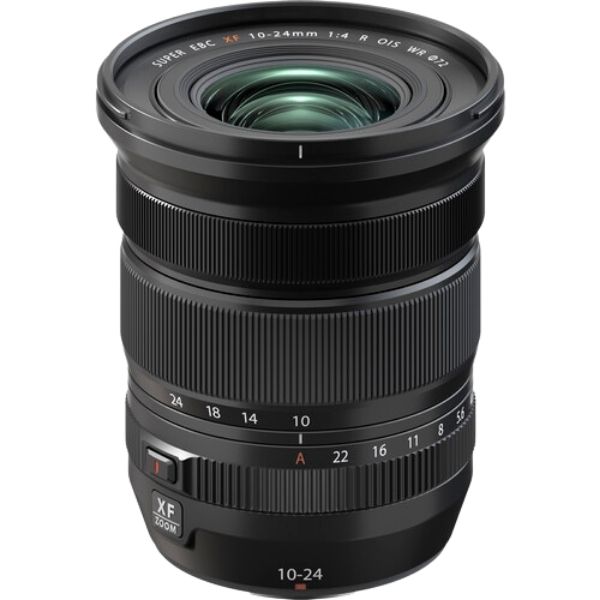
The Fujifilm XF 10-24mm f/4 R OIS WR is positioned as a new version of its predecessor, but with weather sealing and better stabilization.
Compared with the 8-16mm, which shows certain weaknesses at its shortest focal lengths, the 10-24mm struggles a little at its longest, especially at the edges. On the other hand, at its shortest focal lengths, the lens offers very good image quality at full aperture. The construction is perfect and the stabilization is effective and precise. Although its maximum aperture is more limited than that of the 16mm prime lenses, its focal range is versatile. Finally, the autofocus is fast and accurate.
In short, the Fujifilm XF 10-24mm f/4 R OIS WR is a solid and durable lens with effective stabilization. In my opinion, this lens should appeal to a wide range of photographers.
Tamron 11-20mm f/2.8 Di III-A RXD X
| Features | Visual |
|---|---|
|
|
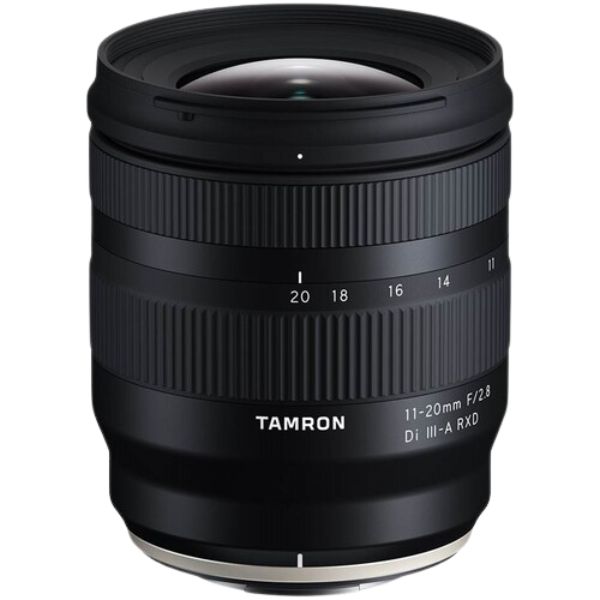
Available for the X-mount since 2023, the Tamron 11-20mm f/2.8 Di III-A RXD X is a high quality ultra-wide-angle zoom lens. Since its launch, this lens has become a strong alternative for Fuji users who want a bright, reasonably priced ultra-wide-angle lens. The other two options are the Fujinon XF 8-16mm f/2.8 R LM WR and the Fujinon XF 10-24mm f/4 R OIS WR, which are heavier and much more expensive.
In terms of construction, this Tamron is both compact and lightweight, making it easy to transport. It is also robust and weather-sealed. Its autofocus is quite satisfactory and quiet. It also offers a minimum focusing distance of 15 to 24 cm, depending on the focal length. The lens performs well. In fact, center sharpness is excellent even wide open, even if the edges are a little soft. Defects such as vignetting and distortion are visible, but they are well controlled.
In short, this lens is a very good alternative for Fuji cameras. It has a high-quality construction with excellent optical performance. What’s more, I think the price is more than reasonable. It is definitely worth considering.
Fujinon XF 14mm f/2.8 R
| Features | Visual |
|---|---|
|

|
The 14mm Fujinon is the prime lens with the shortest focal length in the range. It is equivalent to the field of view of a 21mm in full-frame, which is a very wide angle even if we could hope that Fuji will decide to release something even wider since we have access in full-frame to much shorter focal lengths.
Its quality is very good and uniform, which is not always easy to achieve on such short lenses. We can regret that this one is not weather-sealed, but it has a rather solid design, like all Fujifilm’s XF lenses. Another regret is its price, much higher than the 16mm f/2.8, we will then need to have a real use for these extra 2mm of width.
Sigma 16mm f/1.4 DC DN Contemporary X
| Features | Visual |
|---|---|
|
|
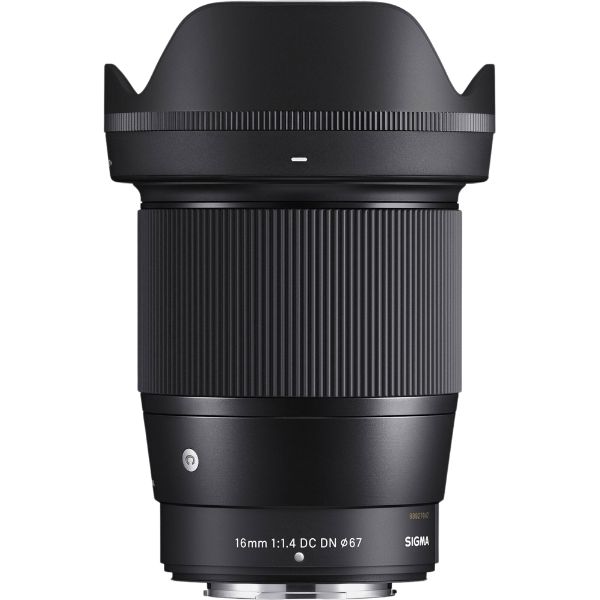
Since 2022, Sigma has offered several X-mount lenses, including the Sigma 16mm f/1.4 DC DN Contemporary X. This lens is an excellent option for Fujifilm users looking for an very bright wide-angle lens. Compared to its Fuji equivalent, this lens is newer and has more advanced features.
In terms of image quality, the lens is very good from f/2. Its build quality is good, but generally inferior to that of the Fuji lens. There is also no aperture ring. These compromises help explain why the Sigma costs much less than the Fujinon.
To put it simply, with this lens you will enjoy a 16mm that is admittedly quite heavy and bulky, but more accessible and with better image quality than the equivalent Fujinon version. It is definitely worth considering.
Fujinon XF 16mm f/1.4 R WR
| Features | Visual |
|---|---|
|

|
The f/1.4 version is again a bit behind the f/2.8 version, in my opinion, because of its only slightly better performance at small apertures and a slower AF.
Nevertheless, in low light situations like night photography and astrophotography, its much larger maximum aperture is a significant advantage – it gathers four times more light than the f/2.8. Obviously, the price, weight and size are all higher, but feedback from users is very positive.
Fujinon XF 16mm f/2.8 R WR
| Features | Visual |
|---|---|
|
|
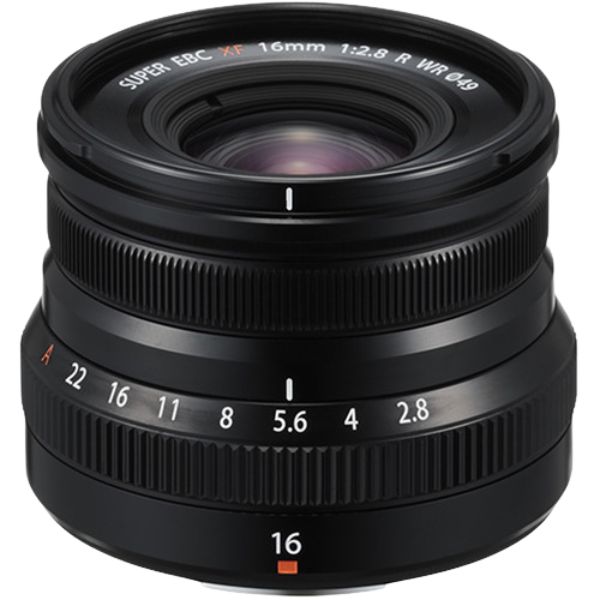
Fuji’s 16mm f/2.8 is also a very good wide-angle lens, and it remains useful for landscape and architecture work because it performs well at the smaller apertures often used to maximize depth of field.
Once again, its weather-sealed design, fast AF and compact size make it a portable ally in all circumstances, at a much lower price than the f/1.4 version or the zooms. For those who appreciate this particular focal length, it’s the ideal lens in many ways.
Below are the main characteristics of the 7 wide-angle lenses mentioned above.
| Fuji X wide-angle lenses | Focallength | Max.Aperture | Weight | Dim. (Ø x L) | Min. FocusDist. | Approx.price | Best price | |||
|---|---|---|---|---|---|---|---|---|---|---|
| + | Fujifilm XF 8-16mm f/2.8 R LM WR | 8-16mm | f/2.8 | 1.8 lb / 805g | 3.5 x 4.8" / 88 x 122 mm | 9.8" / 25 cm | $1 499 | Amazon B&H | More info + | |
|
||||||||||
| + | Fujifilm XF 10-24mm f/4 R OIS WR | 10-24mm | f/4 | 13.58 oz / 385g | 3.1 x 3.4" / 78 x 87 mm | 9.4" / 24 cm | $999 | Amazon B&H | More info + | |
|
||||||||||
| + | Tamron 11-20mm f/2.8 Di III-A RXD X | 11-20mm | f/2.8 | 11.82 oz / 335g | 2.9 x 3.4" / 73 x 86 mm | 5.9" / 15 cm | $699 | Amazon B&H | More info + | |
|
||||||||||
| + | Fujifilm XF 14mm f/2.8 R | 14mm | f/2.8 | 8.29 oz / 235g | 2.6 x 1.9" / 65 x 48 mm | 7.1" / 18 cm | $899 | Amazon B&H | More info + | |
|
||||||||||
| + | Sigma 16mm f/1.4 DC DN Contemporary X | 16mm | f/1.4 | 0.9 lb / 405g | 2.8 x 3.6" / 72 x 93 mm | 9.8" / 25 cm | $439 | Amazon B&H | More info + | |
|
||||||||||
| + | Fujifilm XF 16mm f/1.4 R WR | 16mm | f/1.4 | 13.23 oz / 375g | 2.9 x 2.9" / 73 x 73 mm | 5.9" / 15 cm | $999 | Amazon B&H | More info + | |
|
||||||||||
| + | Fujifilm XF 16mm f/2.8 R WR | 16mm | f/2.8 | 5.47 oz / 155g | 2.4 x 1.8" / 60 x 45 mm | 6.7" / 17 cm | $399 | Amazon B&H | More info + | |
|
||||||||||
Wide-angle alternatives at Fujifilm
Now that Fujifilm has opened up its mount to third-party manufacturers, you’ll find a whole range of other options that are worth looking at, often at much lower prices. Take a look at the following lenses, for example:
| Alternatives - Wide-angle X | Focallength | Max.Aperture | Weight | Dim. (Ø x L) | Min. FocusDist. | Approx.price | Best price | |||
|---|---|---|---|---|---|---|---|---|---|---|
| + | Fujifilm XF 8 mm f/3.5 WR | 8mm | f/3.5 | 7.58 oz / 215g | 2.7 x 2.1" / 68 x 53 mm | 7.1" / 18 cm | $799 | Amazon B&H | More info + | |
|
||||||||||
| + | Sigma 10-18mm f/2.8 DC DN Contemporary X | 10-18mm | f/2.8 | 8.82 oz / 250g | 2.8 x 2.5" / 72 x 64 mm | 4.7" / 12 cm | $599 | Amazon B&H | More info + | |
|
||||||||||
| + | Zeiss 12mm f/2.8 Touit X | 12mm | f/2.8 | 9.52 oz / 270g | 3.5 x 2.7" / 88 x 68 mm | 7.1" / 18 cm | $999 | Amazon B&H | More info + | |
|
||||||||||
| + | Samyang AF 12mm f/2 X | 12mm | f/2 | 7.51 oz / 213g | 2.8 x 2.3" / 70 x 59 mm | 7.5" / 19 cm | $499 | Amazon B&H | More info + | |
|
||||||||||
| + | Viltrox 13mm f/1.4 STM XF X | 13mm | f/1.4 | 0.9 lb / 420g | 2.9 x 3.5" / 74 x 90 mm | 8.7" / 22 cm | $419 | Amazon B&H | More info + | |
|
||||||||||
| + | Fujifilm XF 18 mm f/1.4 R LM WR | 18mm | f/1.4 | 13.05 oz / 370g | 2.7 x 3" / 69 x 76 mm | 7.9" / 20 cm | $999 | Amazon B&H | More info + | |
|
||||||||||
| + | Fujifilm XF 18mm f/2 R | 18mm | f/2 | 4.09 oz / 116g | 2.5 x 1.6" / 65 x 41 mm | 7.1" / 18 cm | $599 | Amazon B&H | More info + | |
|
||||||||||
We now have a full article detailing the best of today’s Fujifilm wide-angle lenses!
The best telephoto lenses for APS-C Fujifilm
The short telephoto lenses are the ones I consider to have focal lengths between 85 and 200mm in full-frame, or 50 and 140mm in APS-C. At Fuji, there is a relatively large choice in these focal lengths, the APS-C format being a rather well suited format for this type of lenses which are often less complicated to design to achieve high image quality and good consistency.
These lenses are often very popular for portraits (especially with prime lenses that have large apertures) and for sports, with zooms. Alternatives with manual focus are less interesting here because the shorter depth of field requires greater precision. They can sometimes do the job for fixed portraits, but we are here in a more specific field. Some might say that a telephoto lens can also be used for landscape or architecture, but here too, focusing will require a minimum of precision and in other situations the depth of field will always require less at wide-angle.
Here are the lenses I find most interesting in this focal length range:
- Fujifilm XF 55-200mm f/3.5-4.8 R LM OIS
- Fujifilm XF 70-300mm f/4-5.6 R LM OIS WR
- Sigma 100-400mm f/5-6.3 DG DN OS Contemporary X
- Fujifilm XF 100-400mm f/4.5-5.6 R LM OIS WR
- Tamron 150-500mm f/5-6.7 Di III VC VXD X
- Fujifilm XF 150-600mm f/5.6-8 R LM OIS WR
- Fujifilm XF 500mm f/5.6 R LM OIS WR
I haven’t included the Fujifilm XF 50-140mm f/2.8 R LM OIS WR X in this list (detailed in Telephoto Lenses) and the Fujifilm XF 56mm f/1.2 R WR (in Portrait Lenses), but both can be considered telephoto lenses, admittedly short for the Fujifilm XF 56mm f/1.2 R WR (but very bright), but very interesting and of very good quality for the 50-140mm.
Here is a summary table of the short telephoto lenses discussed in this chapter.
Fujifilm XF 55-200mm f/3.5-4.8 R LM OIS
| Features | Visual |
|---|---|
|
|
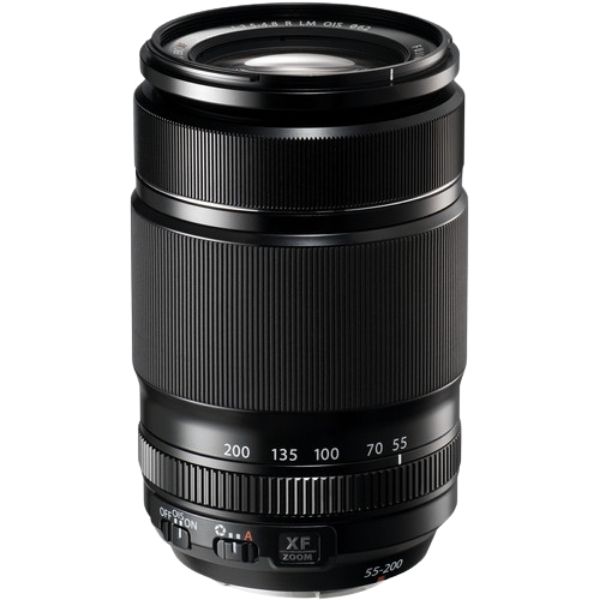
Announced in 2015, the Fujinon XF 55-200mm f/3.5-4.8 R LM OIS has been perfectly integrated into Fujifilm’s mirrorless cameras. It offers a focal length equivalent to 85-300mm in full-frame, which is suitable for wildlife and sports photography. Its dimensions and weight are quite reasonable for a lens of this type.
In terms of design, this telephoto lens has a nice metal finish. The zoom ring is both wide and rigid. As for the optical formula, there are 14 elements in 10 groups, including an aspherical lens and two ED lenses. Its maximum aperture, between f/3.5 and f/4.8, is limited but still sufficient in good light. It should be noted that the lens is stabilized but not weather sealed. Its optical performance is excellent, with very good sharpness. Its optical flaws, such as distortion and vignetting, are visible but can be corrected in post-production.
In conclusion, the Fujifilm XF 55-200mm f/3.5-4.8 R LM OIS is a very good option at an affordable price. It offers excellent performance with a satisfactory maximum aperture. If you go for it, you’re getting a good deal!
Fujifilm XF 70-300mm f/4-5.6 R LM OIS WR
| Features | Visual |
|---|---|
|

|
The Fujinon XF 70-300mm f/4-5.6 R LM OIS WR, launched in January 2021, is positioned as a versatile telephoto lens for wildlife, sports and travel photography. It offers a full-frame equivalent focal length range of 110-460mm. Its size and weight are quite reasonable: it is a more practical and less expensive telephoto lens than the 100-400mm.
It is largely made of plastic, which makes it light, strong and easy to handle. The telephoto lens has 17 elements in 12 groups, including one aspherical lens and two ED lenses. In terms of performance, the sharpness is remarkable, even if it tends to fade at the sides, especially at 300mm. Simply closing the aperture improves sharpness uniformity. Vignetting is under control at 70mm, while it is more visible at 300mm, but can be corrected in post-production.
In conclusion, this telephoto lens combines versatility and performance with excellent value for money. Even if it has certain limitations, such as the variable aperture, I recommend it!
Sigma 100-400mm f/5-6.3 DG DN OS Contemporary X
| Features | Visual |
|---|---|
|
|
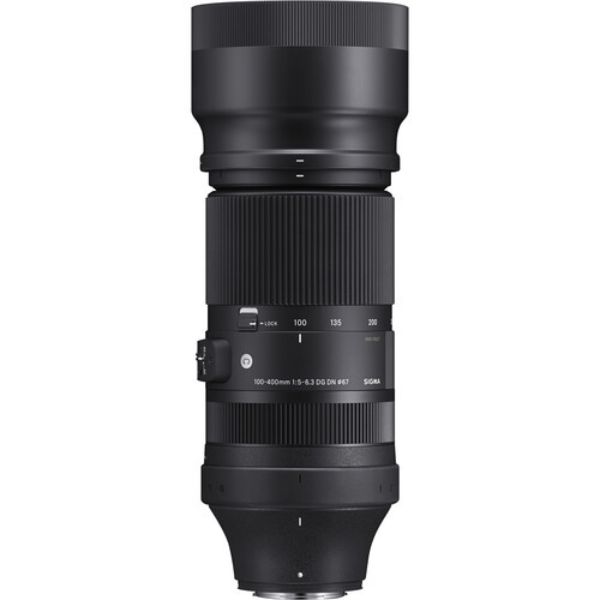
Available since 2023, the Sigma 100-400mm f/5-6.3 DG OS Contemporary is a good alternative to existing X-mount telephoto zooms. It offers a focal length range equivalent to a full-frame 150-600mm. Its size and weight make it the lightest and most compact telephoto lens in its range. It also competes directly with the Fujifilm XF 100-400mm and Tamron 150-500mm, offering a more affordable price and solid performance.
With a dust- and splash-resistant mount, this Sigma is solidly built and well finished. It has several buttons, such as the focus range limiter and the two optical stabilization modes. It has 22 elements in 16 groups, with a maximum aperture of f/5-6.3 and a minimum focusing distance of 1.12 m. In terms of performance, it is unsurprisingly very sharp, even on 40 megapixel sensors. It has to be said that even at its shortest focal length, the Sigma is a match for the Fujifilm XF 100-400mm.
In the end, the Sigma 100-400mm f/5-6.3 DG DN OS is an alternative with excellent autofocus and very good sharpness, while being more affordable than the Fuji. You should like it!
Fujifilm XF 100-400mm f/4.5-5.6 R LM OIS WR
| Features | Visual |
|---|---|
|
|
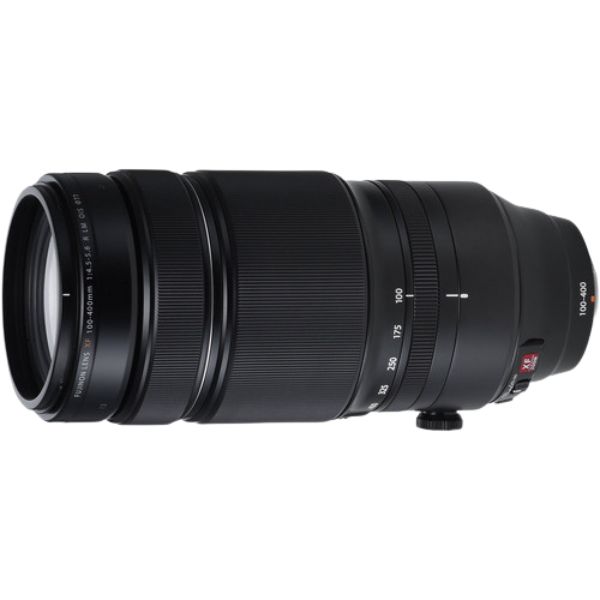
Available since February 2016, the Fujinon XF 100-400mm f/4.5-5.6 R LM OIS WR has quickly become a benchmark for the X-mount. Its focal length is equivalent to 600mm in full-frame, making it ideal for sports and wildlife photography. In terms of size and weight, it is inevitably heavier than the 70-300mm.
In terms of build quality (weather-sealed), it is made of metal and plastic. It is therefore of good quality and robust. Its optical formula is based on 21 elements divided into 14 groups, including five ED lenses and one Super ED lens. The lens also has a fast and silent autofocus. In addition, the optical stabilization allows a gain of five stops, ideal for long focal lengths. The lens offers very good center-to-center sharpness at full aperture. Finally, the bokeh is natural at close range, but a little nervous at longer distances.
In short, the Fujinon XF 100-400mm f/4.5-5.6 R LM OIS WR is still a very good choice, even with newer telephoto options now available. At a price of around €1000, the lens is remarkable for such a long focal length.
Tamron 150-500mm f/5-6.7 Di III VC VXD X
| Features | Visual |
|---|---|
|
|
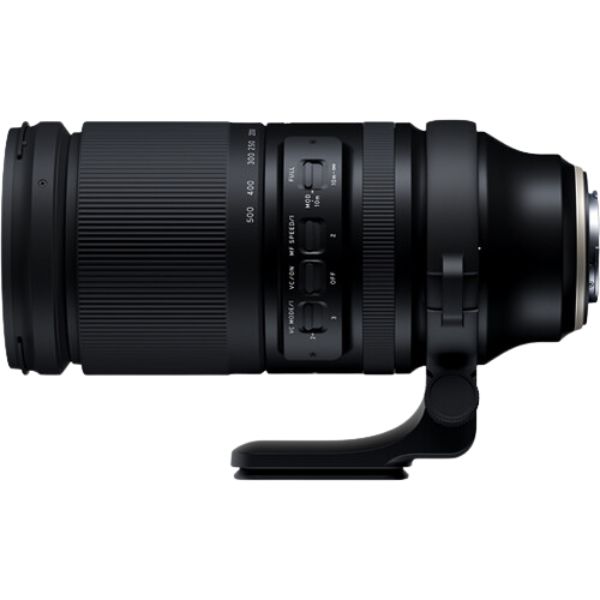
Available for Fujifilm X-mount since October 2022, the Tamron 150-500mm f/5-6.7 Di III VC VXD is positioned as an interesting alternative to Fuji’s telephoto lenses. To be honest, I bought it in Sony FE mount for my Sony A7 III and I’m really happy with it. It offers a full-frame equivalent focal length range of 225-750mm, ideal for wildlife and sports photography.
Unsurprisingly, it is very well built. The lens is equipped with 25 elements in 16 groups, including five LD elements and one XLD element to limit chromatic aberrations. Optical stabilization and autofocus are effective. The minimum focusing distance depends on the focal length: 0.6m at 150mm and 1.8m at 500mm, giving a magnification ratio of 0.32x. In terms of performance, the lens is on a par with the Fuji. Sharpness is very good in the center, while the edges are a little less sharp. Finally, the bokeh is smooth and effectively separates the subject from the background.
As you can see, this lens really can compete with the Fuji, even if it is slightly less sharp. For example, it is much more affordable than the Fujinon 150-600mm. In my opinion, it ticks a lot of boxes. You won’t be disappointed!
Fujifilm XF 150-600mm f/5.6-8 R LM OIS WR
| Features | Visual |
|---|---|
|

|
Released in January 2023, the Fujinon XF 150-600mm f/5.6-8 R LM OIS WR is the largest telephoto lens for the X-mount. In fact, its focal length is equivalent to 900mm at full-frame. With the 1.4x teleconverter, the equivalent focal length is 1350mm, and with the 2x teleconverter, 1828mm.
In terms of construction, the weather-sealed lens is made of magnesium. It is equipped with 24 elements in 17 groups, including three ED lenses and four Super ED lenses. It also has an efficient and silent autofocus system, accompanied by a 5-stop stabilization. Its sharpness is uniform from full aperture. Chromatic aberrations and distortion are well controlled.
In short, this Fujinon is an excellent choice if you are looking for a telephoto lens with a very long focal length. What’s more, opinions on this lens are unanimous, even if it’s not exactly cheap.
Fujifilm XF 500mm f/5.6 R LM OIS WR
| Features | Visual |
|---|---|
|

|
The Fujinon XF 500mm f/5.6 R LM OIS WR is currently the longest prime lens available for the Fuji X mount. Its focal length is equivalent to 760mm at full-frame. Its optical formula is based on 21 elements in 12 groups, including two ED lenses and five Super ED lenses.
In terms of build quality, the lens is weather-sealed and solid. You can use it in the most extreme conditions. It is also stabilized to 5.5 stops and has a fast and accurate autofocus. In terms of performance, sharpness is excellent from the middle of the aperture and offers good uniformity. Optical imperfections are generally well managed, while the bokeh is soft and natural.
In short, the Fujinon XF 500mm f/5.6 R LM OIS WR is designed for professionals/experienced amateurs for whom image quality is a priority, especially for wildlife and sports photography. We agree that the lens is not cheap, but its performance justifies the price.
Here is a summary of the 7 short telephoto lenses mentioned above.
| Fuji X telephoto lenses | Focallength | Max.Aperture | Weight | Dim. (Ø x L) | Min. FocusDist. | Approx.price | Best price | |||
|---|---|---|---|---|---|---|---|---|---|---|
| + | Fujifilm XF 55-200mm f/3.5-4.8 R LM OIS | 55-200mm | f/3.5-4.8 | 1.3 lb / 580g | 3 x 4.6" / 75 x 118 mm | 3.6' / 110 cm | $699 | Amazon B&H | More info + | |
|
||||||||||
| + | Fujifilm XF 70-300mm f/4-5.6 R LM OIS WR | 70-300mm | f/4-5.6 | 1.3 lb / 588g | 3 x 5.2" / 75 x 133 mm | 2.7' / 83 cm | $799 | Amazon B&H | More info + | |
|
||||||||||
| + | Sigma 100-400mm f/5-6.3 DG DN OS Contemporary X | 100-400mm | f/5-6.3 | 2.5 lb / 1135g | 3.4 x 7.8" / 86 x 197 mm | 3.6' / 110 cm | $789 | Amazon B&H | More info + | |
|
||||||||||
| + | Fujifilm XF 100-400mm f/4.5-5.6 R LR OIS WR | 100-400mm | f/4.5-5.6 | 3 lb / 1375g | 3.7 x 8.3" / 95 x 211 mm | 5.7' / 175 cm | $1 899 | Amazon B&H | More info + | |
|
||||||||||
| + | Tamron 150-500mm f/5-6.7 Di III VC VXD X | 150-500mm | f/5-6.7 | 3.8 lb / 1710g | 3.7 x 8.3" / 93 x 210 mm | 2' / 60 cm | $1 499 | Amazon B&H | More info + | |
|
||||||||||
| + | Fujifilm XF 150-600mm f/5.6-8 R LM OIS WR | 150-600mm | f/5.6-8 | 3.5 lb / 1605g | 3.9 x 12.4" / 99 x 315 mm | 7.9' / 240 cm | $1 999 | Amazon B&H | More info + | |
|
||||||||||
| + | Fujifilm XF 500mm f/5.6 R LM OIS WR | 500mm | f/5.6 | 2.9 lb / 1335g | 4.1 x 10.1" / 105 x 256 mm | 9' / 275 cm | $2 999 | Amazon B&H | More info + | |
|
||||||||||
The best macro for APS-C Fujifilm
Macro lenses are lenses with a very short focusing distance, which allows them to achieve a reproduction ratio of at least 1:1, so an object of 10mm will actually represent 10mm on the sensor. An APS-C has a 24x16mm sensor, the object will then cover a large part of the image.
Here are the macro lenses I’m talking about below:
- Fujifilm XF 30mm f/2.8 R LM W Macro
- Fujinon XF 80mm f/2.8 R LM OIS WR macro
- Laowa 65mm f/2.8 2x Ultra Macro
- Fujinon XF 60mm f/2.4 R macro
The characteristics of these three lenses are summarized below.
If you’re interested in macro photography, we’ve just published our full guide explaining all you need to know about Fujifilm X macro lenses (for APS-C cameras).
Fujifilm XF 30mm f/2.8 R LM W Macro
| Features | Visual |
|---|---|
|

|
Announced for early 2023, the Fujinilm XF 30mm f/2.8 R LM W Macro is the successor to two X-mount macro lenses: the famous Fujinon XF 80mm f/2.8 Macro and the Fujinon XF 60mm f/2.4. This is Fujifilm’s shortest focal length lens for macro photography. Its weight and dimensions make it a compact and lightweight lens.
Note that the lens is not stabilized, but this is not essential for macro photography and is well compensated if you use one of the latest Fujifilm cameras, such as the Fujifilm X-T5. Its optical construction is made up of 11 elements in nine groups, including three aspherical lenses and two ED lenses. Its 1:1 magnification ratio is one of its strengths. On the other hand, the minimum focusing distance remains very short: it will certainly be difficult to achieve the 1:1 ratio. In terms of performance, the sharpness in the center is remarkable, even if the edges are a little soft (but you often close the aperture for macro shots anyway). Finally, the bokeh is quite good, although it will be difficult to create a blurred background with such a short focal length.
In conclusion, this is the lens for you if you want a compact solution with good optical quality. Unlike the other two macro lenses mentioned, this lens is new and easy to transport.
Fujinon XF 80mm f/2.8 R LM OIS WR macro
| Features | Visual |
|---|---|
|

|
The Fujinon XF 80mm f/2.8 R LM OIS WR Macro was released at the end of 2017 and was an instant success. Prior to its release, the only macro lens available was the Fujinon XF 60mm f/2.4 R Macro with a 1:2 ratio. This new lens is the full-frame equivalent of a 130mm, with a 1:1 ratio.
The only downside is its size and weight, which make it rather bulky. Thanks to its focal length, this macro lens can also be used for portrait photography. The build quality of this lens is exceptional.
It has 16 elements in 12 groups, including an aspherical lens, three ED lenses and a Super ED lens. It also has a minimum focusing distance of 25 cm. At full aperture, the image quality of this lens is perfect, even if the edges are slightly behind at f/2.8. At f/8, the image becomes very uniform, which is perfect for macro photography. As far as flaws go, there is some vignetting at full aperture, but it is not very serious as you close the aperture for macro and it disappears from f/5.6.
In short, the Fujinon XF 80mm f/2.8 R LM OIS WR is positioned as a premium lens, ideal for macro photography. In my opinion, it is still the best Fuji lens. Even if it is not cheap, it is still a very good investment.
Laowa 65mm f/2.8 2x Ultra Macro
| Features | Visual |
|---|---|
|

|
Announced in January 2020, the Laowa 65mm f/2.8 2x Ultra Macro is introduced as a more affordable alternative to Fuji’s 80mm. Note that the focus is manual, although this is not really an issue in macro photography.
In terms of build quality, the lens is lightweight and made entirely of metal. Its strengths include a focusing distance of 16.5 cm and a magnification ratio of 2:1. Its performance is excellent, with very good image quality at full aperture and even better when you close the aperture to f/5.6, which is ideal for macro photography. It also has almost no optical flaws.
As you can see, this lens is a very good deal. What’s more, it’s very reasonably priced at around €500. Frankly, if you don’t mind manual focusing, I’m pretty sure you’ll be happy with this Laowa!
Fujinon XF 60mm f/2.4 R macro
| Features | Visual |
|---|---|
|

|
The famous first Fuji macro lens was released in 2012: the Fujinon XF 60mm f/2.4 R. It is also a small telephoto lens, equivalent to 90mm in full-frame format, which allows you to take portraits outdoors, even if there are better lenses for that. Although it is considered a macro lens, it only offers a 1:2 magnification ratio (which is more than enough in most cases). Its size and featherweight make it an ultra-light and compact lens.
Although the design is more than 10 years old, it is still at the top of its class. The optical formula is based on 10 elements in eight groups, including aspherical and ED elements. The focusing distance is quite long: 26.7 cm. However, it is neither stabilized nor weather-sealed. The autofocus is up to date, which may disappoint some. In terms of performance, the sharpness at full aperture is remarkable. You can easily close the aperture to f/3.2 or f/4 for a more uniform and better quality image. As far as flaws go, there is just a little vignetting and a few chromatic aberrations.
I agree, the lens is not exactly young, but it is still suitable for macro photography. You can even try your hand at proxy photography for a more than reasonable price (under €600). I’m willing to bet you’ll be satisfied without breaking the bank!
Here are the 4 macro lenses summarized below.
| Fuji X macro lenses | Focallength | Max.Aperture | Weight | Dim. (Ø x L) | Min. FocusDist. | Approx.price | Best price | |||
|---|---|---|---|---|---|---|---|---|---|---|
| + | Fujifilm XF 30mm f/2.8 R LM W Macro | 30mm | f/2.8 | 6.88 oz / 195g | 2.4 x 2.7" / 60 x 70 mm | 3.9" / 10 cm | $599 | Amazon B&H | More info + | |
|
||||||||||
| + | Fujifilm XF 60mm f/2.4 R Macro | 60mm | f/2.4 | 7.58 oz / 215g | 2.5 x 2.8" / 64 x 71 mm | 10.2" / 26 cm | $649 | Amazon B&H | More info + | |
|
||||||||||
| + | Laowa 65mm f/2.8 2x Ultra Macro APO X | 65mm | f/2.8 | 11.82 oz / 335g | 2.2 x 3.9" / 57 x 100 mm | 6.7" / 17 cm | $399 | Amazon B&H | More info + | |
|
||||||||||
| + | Fujifilm XF 80mm f/2.8 R LM OIS WR Macro | 80mm | f/2.8 | 1.7 lb / 750g | 3.1 x 5.1" / 80 x 130 mm | 9.8" / 25 cm | $1 199 | Amazon B&H | More info + | |
|
||||||||||
How to choose your Fujifilm lens - What to remember
First of all, even if I have already explained in detail how to choose a camera lens, I will here give you a little reminder of the essentials. You can simply click on the small magnifying glass below to understand all the elements to consider.
The sensor and its size
The size of the sensor determines the ability of your camera to go high in ISO without losing too much in image quality – the bigger the sensor, the better. It also influences the framing and depth of field for the same focal length. You will find on our website a more complete article to choose your camera sensor size.
If you chose a Fujifilm X-E, X-T or X-H, you will have an APS-C sensor with dimensions of about 24x16mm. These are sensors with a diagonal 1.5 times shorter than a full-frame, a volume 2 times smaller.
The focal length
The focal length represents the field of view you will see. There are prime lenses, having thus a single focal length like a 35mm, and zooms lenses with several focal lengths like a 16-80mm. To get the same field of view as in full-frame, you will have to take into account the shorter diagonal on an APS-C sensor: a 16mm will then compose like a 24mm in full-frame (16×1.5=24).
This is an important point because special focal lengths are often recommended for certain uses, such as a 35mm for street photography or an 85mm for portrait, but with an APS-C sensor, you will have to use a 23mm for street and a 50/56mm for portrait.
Maximum aperture and depth of field
Choosing a larger sensor allows to obtain shorter depths of field with the same framing, therefore more important blurs (the bokeh). But another element influences this depth of field in a more direct way: the aperture of the lens. The smaller the number f/ is (f/1.4 or f/2 for example), the shorter it will be. With a few exceptions, the apertures indicated on the lenses correspond to their maximum aperture. For example, a 35mm f/2 will allow you to open the diaphragm up to f/2. Some zooms have 2 maximum apertures indicated, such as f/2.8-4, which means that at its shortest focal length it will be able to open at f/2.8, but as you zoom in you won’t be able to open as wide.
A larger aperture also allows you to capture more light, which will be interesting in low-light situations to reduce the ISO increase or when you want to reduce the exposure time, for example for sports photography, which will allow you to keep more image quality or to better freeze the action.
If you want to obtain a depth of field that is close to the one you can get with a full-frame, you will also need to convert the aperture to know the equivalent. For example, if you have a 35mm f/2 on your APS-C, it will correspond to a 50mm f/2.8. If your main goal is to be able to reduce this depth of field, this means you will need lenses that open more than on a full-frame and that will quickly become then more expensive. To use the example of a 35mm, in full-frame: in many brands you can have a 50mm f/1.8 for about 200€, which would correspond to a 35mm f/1.2 in APS-C, but the 35mm f/1.4 from Fuji is already 3 times more expensive. Thus, as for the micro 4/3 sensor, the APS-C remains interesting in terms of price if you are not looking to get very bright lenses because, from a certain level of aperture, they become more expensive than their full-frame equivalents.
Choosing a stabilized lens or not?
From Fuji, the recent X-T4 has become the first X-T featuring sensor stabilization. Until then, only the X-H had one. The advantage of this stabilization is that all lenses, whether stabilized or not, can benefit from it. Stabilization allows you to shoot handheld pictures with longer exposure times without your movements affecting the image – the famous motion blur. However, some lenses have stabilization, especially long focal lengths that are more quickly impacted by the photographer’s movements.
Now that Fuji has integrated this stabilization on the X-T4, it is possible that it can be found on the lower end-of-the-range but it’s not the case for the moment. So, you will have to turn to stabilized lenses with cameras like the X-T100 or the X-T30 if you want to take advantage of this feature. In handheld situations with static subjects such as landscapes in the evening or architecture indoors, a stabilized lens may be more convenient than a large aperture because you can shoot with a large depth of field (so a large f/ number, like f/8) with long exposure times without the risk of ruining the shot because of a general blur caused by your movements. It will also be interesting in video and allows you to stabilize the viewfinder so that your movements are less visible also in the viewfinder and offer you an additional comfort.
The different products at Fujifilm
Fujifilm mainly offers 2 ranges, although the 2nd range can also be divided into 2. XC lenses, which are affordable entry-level lenses mainly consisting of sliding aperture zooms for beginners, and XF lenses, which constitute the majority and are better designed and more efficient. In this XF range, we can separate the mid-range lenses with large enough apertures but not yet oriented pro like the 23 and 50mm f/2 or the recent 16-80mm f/4, and the high-end lenses with large apertures like the 16mm f/1.4, the 56mm f/1.2 or the 16-55mm f/2.8.
Note that most high-end lenses are starting to become obsolete and many mid-range lenses sometimes benefit from a more sealed design. For example, the 23mm f/2 is weather-sealed while the 23mm f/1.4 is not. On performance as well, especially AF, mid-range lenses are often as good or even better than high-end lenses. No doubt that Fuji will eventually renew its high-end lenses to justify their price, but in the meantime, be aware that the most expensive lenses are often beaten by mid-range lenses, especially in prime lenses.
Using filters or not?
If you use screw-in filters, some lenses may not allow their use and require a special filter holder system such as 8-16mm f/2.8. For lenses with the possibility to use screw-in filters, pay attention to the filter diameter to use, which is generally indicated on the data sheets.
Third-party brands in X-mount
As mentioned above, there are few third-party brands that offer native X-mount lenses, and even fewer that offer autofocus. That’s why I won’t talk too much about them, except for the few Zeiss and Viltrox, and some interesting manual lenses.
I’m coming to the end of this article about the best Fujifilm lenses (for APS-C) you can currently find. I hope you liked this article, and if you know other references worthy of appearing in this ranking, feel free to share them in the comments.
I invite you to read the article on the best mirrorless cameras of the moment to find the body that will best suit your needs and will allow these lenses to give their full potential.
Enjoy the article, and see you soon,

Written by Sylvain PONS
I've been passionate about photography since 2010, learning as I went along. Today, I dedicate myself to guiding others in their choice of camera gear and sharing a variety of tips to improve their photography skills.
Despite our care, a mistake may have slipped into this article. If you find any, please don't hesitate to let us know so we can correct it as soon as possible and keep our information up-to-date!