Samyang AF 35mm f/1.8 FE Review
Last update: 06/27/2026
Our blog continues to grow thanks to you, our readers. This post may contain affiliate links, which means we can earn a small commission if you make a purchase through them, at no extra cost to you. This helps us to continue to bring you more and support our work!
Here we are again with a new lens review for my mirrorless camera. This time, we are switching brands and reviewing a lens we bought when we moved to mirrorless: the Samyang AF 35mm f/1.8 FE (also known as Rokinon in the U.S.). After taking a detailed look at the excellent Sony FE 20mm f/1.8 G, a premium wide-angle lens for full-frame cameras, we are now testing what could be considered a more standard focal length. For some time now, Samyang has been developing what it calls the “Tiny Series”: compact, lightweight lenses with good image quality. This 35mm is part of that lineup, alongside the Samyang AF 24mm f/1.8 FE, the AF 45mm f/1.8 FE, and the small telephoto lens everyone has been talking about, the AF 75mm f/1.8.
Indeed, for many photographers, 35mm remains a “do-it-all” focal length, and I have to admit there is some truth to that: landscapes, portraits, everyday details… you can shoot a bit of everything with it. Let’s say it is a fairly versatile lens. In this review, we will not go into ultra-technical details. I do not have a lab at home to test sharpness or chromatic aberration. Instead, I will share what I like to call a field test.
I should also point out that this is not a partnership with the Korean manufacturer Samyang and that I paid for this lens myself. The opinions and conclusions in this review are entirely my own. We have also published a complete page listing all lenses available for the Sony FE mount (full-frame).
All the images in this article come from RAW files, post-processed with DxO PhotoLab 5. When optical defects are not the subject of the image, I only enabled corrections for those defects. If you do not know the software yet, you can download it and try the free 30-day version.
First, I wanted to say a few personal words about why I chose this lens. I never owned a 35mm prime when I was shooting with a DSLR. I did have a wide-angle zoom, the Canon EF 16-35mm f/4 L IS, which covered this focal length, but I mainly used it at the wider end, between 16 and 20mm. When I switched to my Sony A7III, I chose a Tamron 20mm f/2.8 prime lens (linked above) and a Tamron 70-180mm f/2.8 telephoto lens. Between the 20mm of my wide-angle lens and the 70mm of my telephoto, I wanted to fill the gap somehow. After thinking it through, I went for this 35mm focal length, which I mainly use for portraits of my sons. There is a huge range of 35mm lenses available for Sony, at all prices and for all kinds of needs. Given my budget, and after doing a lot of research, I felt that the Samyang 35mm AF f/1.8 FE was the right choice for me. So here is my review of it.
Introducing the Lens
Let’s start with the basics.
| Features | Visual |
|---|---|
|

|
In October 2020, Samyang released this attractive 35mm AF f/1.8, supplied with a hard carrying case and lens hood, as part of the brand’s Tiny Series. Launched at a reasonable price under $400, it gives Sony camera owners a very appealing 35mm alternative. It sits between two existing 35mm lenses from the brand: the Samyang AF 35mm f/2.8 (pancake format) and the Samyang AF 35mm f/1.4, which remains heavy and lacks all-weather construction.

As mentioned above, the 35mm focal length offers a fairly standard angle of view and allows me to photograph many different subjects. I have to admit that I bought it mainly for environmental portraits. The advantage of a 35mm compared with a 50mm, and even more so with an 85mm, is that you tend to keep more context in the background because you do not need, or want, to move as far away from your subject. Since the focal length is shorter, even at full aperture, you still get a relatively blurred background while keeping some sense of the scene. In my opinion, it is a perfect lens for photographing my children in everyday life (at the beach, at home, in the garden, or in the forest). This focal length is also well suited to street and reportage photography, where you often want to highlight a subject, a person, or a detail while still showing its environment. If you are looking for a longer focal length for tighter shots, I also reviewed the Viltrox 56mm f/1.4 STM AF FE on my Sony A6000 (APS-C), a very nice lens for anyone looking for a portrait lens on a limited budget.
Speaking of backgrounds and bokeh, this lens offers a relatively large f/1.8 maximum aperture, which lets you make your subjects stand out nicely, whether you are photographing people, everyday objects, or something else. Of course, there are brighter lenses, such as the two Sigma options (f/1.4 and f/1.2 respectively) or the Sony 35mm f/1.4 GM, but they are not in the same category in terms of weight, size, and especially price! In practice, the available aperture already gives very good results. Generally speaking, you will often shoot wide open with a 35mm, although, as we will see below, stopping down by one stop can be useful to improve overall image quality. Finally, this wide aperture also makes the lens more comfortable in low light, even though you can already use relatively slow shutter speeds, around 1/15 to 1/20 sec, especially when paired with my A7III body and its in-body stabilization.
Ergonomics, Design, and Handling
Let’s now talk about the lens itself. In terms of features, it competes directly with the Sony FE 35mm f/1.8. First of all, the lens is very light and compact: 210g and only 6.3cm long. That is not much, and frankly, I think it is a real advantage compared with many other 35mm lenses. It makes the lens light, discreet, and easy to carry. This lens is not stabilized, but it does offer all-weather construction with four seals. The Samyang 35mm is built with 10 elements in 8 groups, including 2 aspherical lenses, 2 high-refractive-index lenses, and 9 aperture blades.
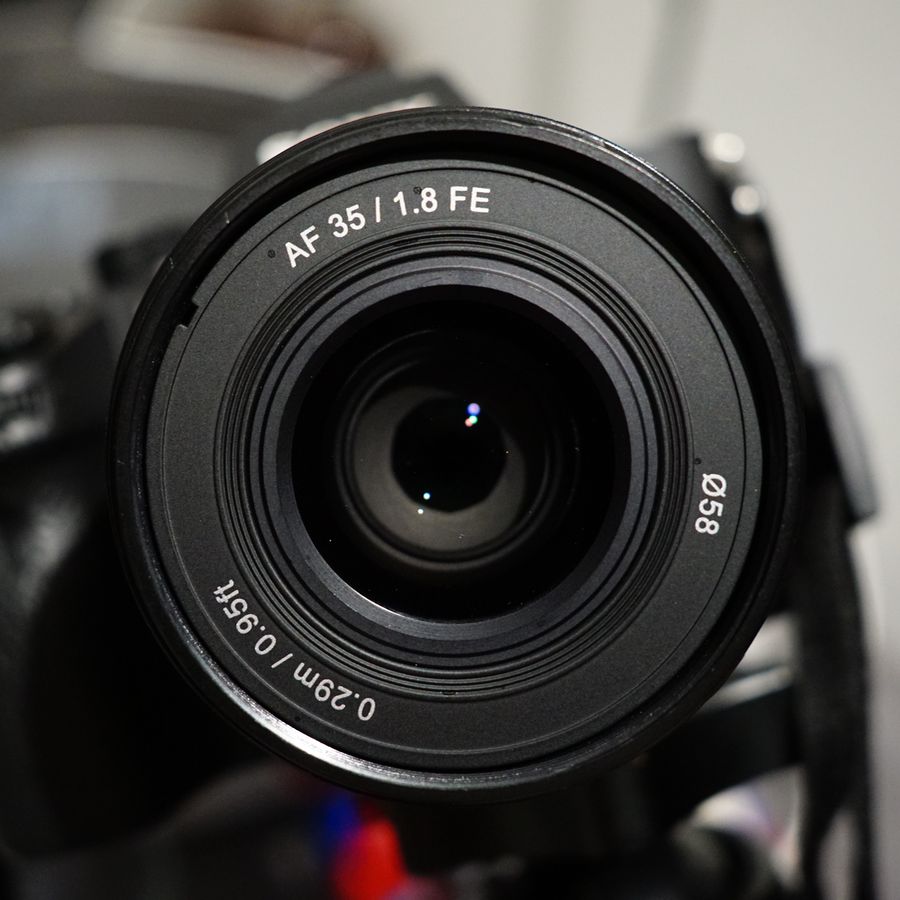


The lens essentially has a polycarbonate (plastic) barrel on a metal mount (with gasket) and uses a 58mm filter thread, which is still fairly common and, above all, inexpensive. The lens is black, with a red ring and a silver ring at the rear of the focus ring. However, the lens hood supplied with the lens feels a bit “cheap”, as it is made of lightweight plastic. The lens reference is also written on the barrel. The lens has a custom button that lets you configure the custom switch through Samyang’s Lens Station (not included – €60). By default, mode 1 sets the ring to focus (in MF), while mode 2 is dedicated to aperture control. With the Lens Station, you can, for example, configure the switch as an AF/MF button, which is very practical.
On the lens, there is only one ring, which works either as a focus ring or as an aperture ring. Personally, I find the ring very pleasant to use (much better than the one on my Tamron 20mm, for example). It is fairly wide and gives just enough room for your fingers. Aperture changes are a little quick for my taste, but you get used to it, and I now enjoy using this aperture ring instead of the dial on my camera. It is silent, which is ideal for changing settings during video, for example.
In conclusion, I find that this lens handles very well thanks to its compact and lightweight design. The design is simple and clean, and in my opinion the lens balances perfectly on my Sony A7III. Note that the minimum focusing distance of 29cm is still standard for a 35mm lens, but the magnification ratio is only x0.17, which is lower than the x0.24 offered by the Sony 35mm f/1.8, for example. All in all, Samyang offers a nice small lens here, perfectly suited to a compact body like my A7III, or even better, an A7C. Of course, you can also mount it on an APS-C body (such as an A6600), where it gives an equivalent focal length of about 52mm on full frame.
Autofocus
This Samyang AF 35mm f/1.8 FE uses Samyang’s classic linear autofocus motor (STM), as found on its other FE lenses. In my opinion, the autofocus is very good. It is fast, quiet, and works really well. I do not think I have had any real AF issues since I started using this lens. I mainly use it for portrait photography, especially photos of my children and my wife. I also use it for detail shots, street photography, and even the occasional landscape image, although I often find the focal length a bit too long for that use, and you do not really need strong AF performance for landscapes anyway. Compared with my Tamron 20mm f/2.8, the AF is clearly far superior.
For still photography, there is really no problem. The AF is fast, locks on well, and I have nothing to complain about. It also focuses on small subjects without any issue.
For moving subjects (with AF in AF-C mode), the lens works very well with eye tracking, both on my children and on animals (my cat, for example). Of course, you need to be relatively close to the subject to get eye detection (it is a 35mm!). If you are a little too far away, face detection takes over anyway. I once had a problem with the camera failing to detect my children’s eyes correctly, but the reason was simple: I had selected “animal” tracking instead of “human”. Once I corrected that, everything worked fine. In fact, without doing it on purpose, I realized that the AF was even tracking the eyes and faces in the photos hanging on my fridge. I also tested it on flowers in the wind and moving branches, again without any problem.
Finally, in manual focus (MF), even in low light, I did not encounter any particular issue. In my opinion, Samyang has produced a solid AF system that works well.
Image quality
Sharpness
Regarding image quality, I must say that I was very pleasantly surprised by the overall quality of the images produced by this Samyang AF 35mm f/1.8 FE. What I observed in my own tests is consistent with what I have read in technical and lab-based reviews. Sharpness is already very good in the center at full aperture, but weaker on the edges and in the extreme corners. Stopping down one stop to f/2.8 really improves the image across the frame (in the center, f/2.8 is already excellent, with no real need to stop down further). To improve the edges, and especially the extreme corners, you will need to stop down to f/4. Beyond that, image quality becomes very consistent across the frame. Overall, I found the lens slightly less sharp at short focusing distances.
Image quality starts to decrease from f/8, where diffraction begins to have an effect.
Here is a 100% crop from the center of an image, shot with my A7III at different apertures.

And here is the same comparison on the edges:
Here are a few images to illustrate the kind of photos you can get with this Samyang AF 35mm f/1.8 FE.




Bokeh
With its large constant f/1.8 aperture and the ability to focus as close as about 29cm from the subject, it is quite easy to create pleasant background blur. Overall, I find the bokeh very soft.
Here is an example showing how the bokeh changes.


Regarding bokeh balls, they are nicely rounded in the center of the image, although chromatic aberrations can be seen around them at full aperture (a problem that is easily fixed in post-processing). The 9-blade diaphragm helps keep the bokeh balls relatively round even when stopped down to f/2.8. From f/4 to f/5.6, the shape of the diaphragm begins to appear around the bokeh balls. Toward the edges, the bokeh balls take on a slight cat’s-eye shape.
Distortion
The lens shows very slight barrel distortion, which is easy to fix in any post-processing software. For those who shoot JPEG, the camera will correct it without any problem.


Chromatic aberrations
Chromatic aberrations are quite visible on this Samyang AF 35mm f/1.8 at full aperture, especially toward the edges of the image. As soon as you stop down to f/2.8, the green and purple fringing visible in some situations disappears. If you shoot RAW, this is easy to correct in post-processing, so no real concern here.


Vignetting
Vignetting is fairly pronounced at full aperture on this Samyang AF 35mm f/1.8, at around 2 stops. Stopping down to f/2.8 already improves things. Between us, in everyday use, this will probably not be a problem. Especially since, as we saw in the sharpness section, stopping down to f/2.8 is useful for improving sharpness and depth of field as well. If you shoot JPEG, you will not have to worry about it, as the camera corrects it automatically. In RAW, it is easily fixed in post-processing. No big deal here… and between us, tests show that it is already much better than the Sony 35mm f/1.8, which costs considerably more.
Sunstars
I did a few simple tests to see what the sunstars look like. It is still possible to get a nice star effect from f/11, but it lacks definition and the result is not particularly striking… Here is the same image shot at f/1.8 and f/11 to show the difference.


Flare and coma
I would say this is the weak point of the lens, even though in everyday use I did not really notice it until I deliberately tried to create flare. The results are still fairly average, and at full aperture, when shooting into the sun, flare and ghosting can appear quite easily. This leads to a strong loss of contrast, halo effects, and so on.

As for coma and astigmatism, the results are not especially impressive for now, and at full aperture the stars appear stretched.
To conclude this image quality section, the Samyang is not perfect, especially when it comes to chromatic aberrations and fairly average flare control. But for the announced price (under €400), it offers very good image quality.
Alternatives to the Samyang AF 35mm f/1.8 FE
As we have just seen, this Samyang remains a very good lens for anyone looking for a compact, lightweight 35mm with good image quality. However, there are other alternatives that may be more interesting depending on your needs and budget.
I would say there are three possible alternatives to this Samyang if you have a bigger budget and want a brighter, sharper, better-built lens with fewer optical defects. Compared with the three lenses below, this Samyang sits more in the entry-level, or let’s say mid-range, category.
- The Sony 35mm f/1.4 GM remains the best at the time of writing. It offers excellent build quality, a larger aperture, very good optical defect control, and image quality above the rest. Of course, the price is also very high-end, since for the same amount you could buy four Samyang 35mm AF f/1.8 FE lenses (the Sony is around €1700).
- The Sigma 35mm f/1.2 DG DN Art is a beautiful beast from Sigma, and the only lens here that opens to f/1.2. We are dealing with a very high-quality lens, but also a very heavy (1kg), long, and expensive one. Image quality is also outstanding, with very few optical defects to report. The price is softer than the Sony’s, although it is still close to €1200.
- The Sigma 35mm f/1.4 DG DN Art remains, in my opinion, one of the best, if not the best, alternative to the Samyang AF 35mm f/1.8 reviewed in this article. Released in May 2021, it also offers excellent image quality. The lens weighs about half as much as the f/1.2 version and comes in at a fairly reasonable €700/800. Yes, it is still well above the Samyang’s budget, but if you can afford the extra €300, I think it is a great choice!


On the other hand, if your budget is smaller and you are not especially interested in a large aperture, the Tamron 35mm f/2.8 Di III OSD M 1:2 is another possible alternative. Its image quality is below the lenses mentioned above (but still good), the AF is a little softer, but it offers macro possibilities with a 1:2 magnification ratio (the only 35mm mentioned here to do so).
Finally, for a slightly higher budget, positioned against the Sony 35mm f/1.8, Sigma also offers a 35mm f/2 with good image quality, carefully rendered bokeh, a high-end metal design, and an aperture ring.
Samyang FE 35mm f/1.8 in Brief
| Advantages | Disadvantages |
|---|---|
|
|
Conclusion
I am coming to the end of this Samyang FE 35mm f/1.8 review. In conclusion, I would say that, in my opinion, Samyang offers one of the best value-for-money 35mm lenses for Sony. The optical quality is there, the build is good, and the images delivered on a full-frame sensor are very good once stopped down to f/2.8. The f/1.8 maximum aperture lets you create nice background blur and helps avoid raising the ISO too much. Of course, there are better-built and brighter lenses, but you will need to spend a lot more. This lens remains really compact and light, and it is a genuine pleasure to shoot with.
Although I had never bought a 35mm prime when I was using a DSLR, I really do not regret this purchase, especially at a price that remains reasonable. I can genuinely recommend it. If you are a beginner and/or you do not want to break the bank when buying a 35mm, I think it is a very good choice.
As we often say now, if you enjoyed our field review, feel free to use the links in the article (or the ones below) when making your purchase. This way, you support our work and help make more articles like this possible. Of course, it will not cost you anything extra.
If you want to keep reading our reviews, you can also check out our review of the Tamron 24mm f/2.8 Di III OSD M1:2, an interesting and affordable lens, ideal for landscapes, architecture, and even environmental portraits.
See you soon,

Written by Sylvain PONS
I've been passionate about photography since 2010, learning as I went along. Today, I dedicate myself to guiding others in their choice of camera gear and sharing a variety of tips to improve their photography skills.
Despite our care, a mistake may have slipped into this article. If you find any, please don't hesitate to let us know so we can correct it as soon as possible and keep our information up-to-date!