Grand Cul-de-Sac Marin: a wonderful discovery
Last update: 07/09/2026
Our blog continues to grow thanks to you, our readers. This post may contain affiliate links, which means we can earn a small commission if you make a purchase through them, at no extra cost to you. This helps us to continue to bring you more and support our work!
As I write this, we’ve been living in these beautiful islands of Guadeloupe for about a year now. Still, because we live at the southern tip of Guadeloupe, we don’t yet know the whole island that well, especially the northern Basse-Terre area, which is about 1.5 hours from home. That might make someone living in mainland France smile, considering the distance is not that great. But I have to admit that since we’ve been living on islands (since 2009), we’re not used to driving that much anymore. We did have the chance to explore the coastline of northern Basse-Terre on the Littoral de Sainte-Rose trail, which starts at Plage des Amandiers and ends at Plage de Cluny. Today, let’s explore the Grand Cul-de-Sac Marin, the distinctive area that separates Basse-Terre and Grande-Terre. If you’re interested in finding out more about this beautiful area, I’ll tell you more at the end of the article. I did quite a bit of research, because it’s a fascinating area to explore, and we’ll definitely be back to discover more of it!
Whenever Mélanie’s family visits, it gives us the perfect excuse to explore places we’ve never been before. And honestly, that’s often how it goes. When you live somewhere, even on an island, you don’t always know everything around you, while at the same time you might travel to the other side of the world… So here we are. We set off by boat from the town of Sainte-Rose to discover the Grand Cul de Sac Marin. This is where most half-day and full-day boat trips leave from to explore this little tropical paradise.
To be honest, we didn’t really have much feedback on the companies offering these excursions (and there are plenty), since we don’t live in the area. Stéphanie, Mélanie’s sister, handled the booking a little randomly, although she did check the online reviews first. So we set off with Gwadaventure, and I’ll give you my personal opinion of the company a little further down, although I can already tell you that the outing itself and the scenery were really lovely.
When you think about it with Mélanie, it had been a while since we’d been on a proper boat trip. It probably went back to our time living in Polynesia, at least a year earlier. It has to be said that it’s less straightforward with children, and when they’re very young it’s not so easy to get them on a boat for a few hours or a whole day. But now that Louis is 6 and Téo 2, it’s possible without too much effort. When we were “free” in Mayotte (haha, meaning without kids), it was much easier. We spent our weekends on the lagoon in a boat.
Anyway, I’m taking you along for a tour of the area, hoping it gives you ideas for your stay in Guadeloupe. Over the course of an afternoon, you can swim, snorkel, discover white-sand islets, explore the mangroves, and get a glimpse of the local flora and fauna.
In fact, if you’re interested in a trip to discover the local flora and fauna, I invite you to read our full article in which we tried paddle-boarding in Guadeloupe, during an outing lasting a few hours from Babin beach, located far to the east, on the edge of the mangrove swamp, in the commune of Morne-à-l’Eau. Mélanie and I had a wonderful time!
Our excursion in Grand Cul-de-Sac Marin
Funnily enough, I wasn’t really used to taking half-day boat trips. But that seems to be the case here with most of the companies offering this trip in the lagoon. We meet at the Sainte-Rose quay at 1.30pm for a scheduled departure at 2pm. The program includes a 3- to 4-hour boat trip across the breathtaking lagoon.
After grabbing something to eat in the area, we arrived at the meeting point. It’s clear that this is one of Guadeloupe’s most popular tourist spots, given the number of service providers on site. Most of them offer half-day trips on the lagoon. Others offer kayak or canoe hire (water activities), which might be fun to try out. I have the impression (though you will have to check) that the prices are almost the same for all of them. If this isn’t the case, you’ll still need to check that the program is the same, as different prices often mean different programs or services…

When we arrived, we were greeted warmly. Looking back, I found it a little odd that we were asked to pay before the trip. That wasn’t how we were used to doing things in Mayotte. We booked, went on the trip and paid at the end of the day. But I’m sure that’s the way it is here, so it’s no big deal.
We started late because of another group. The sky was threatening on the land side and there were even a few drops of rain. I’m keeping my fingers crossed for better weather, because lagoon cruises on tropical islands are much (much) better when done in the sun. Although I’m the first to say that there’s nothing you can do about the weather. It’s just that the colors come out so much better and the turquoise blue of the water is really at its best in the sun (and polarized sunglasses, of course).
There were 12 people on board, which wasn’t bad at all, and the boat was big enough for everyone, so all is well. We meet Bruno, the captain, who seems quite nice at first glance. A few safety instructions before departure and we are quietly on our way from the quay to the sea. The weather opens up on the seaward side and we’re treated to some really beautiful sunshine. It’s great.
First stop: the wreck and seabed
A short 15-minute crossing took us to the first site of the afternoon, the famous wreck, also known as the “wreck of îlet Caret”. I’ll tell you more about it at the end of the article when I share my opinion, but it was a shame not to get more explanations from Bruno, our guide. You really had to ask if you wanted to know more about the things you saw or visited throughout the afternoon (or most of it). Yes, you’ll tell me, we’re here to have a good time on the lagoon, soak up the sun and see some beautiful scenery, but Mélanie and I think it’s always interesting (especially for us, who were with tourists who know nothing about the place) to find out more about things and explain things a bit.
That said, it didn’t take anything away from the magnificent panorama when we arrived. The wreck is there, right in front of us, or rather just below the water, which at this point is really turquoise blue. It’s magnificent. A few boats had already been there, but there wasn’t much of a rush. I think it’s the first time we’ve seen a wreck so close to the water, as it’s about 2 or 3 metres below the surface and you can see the whole thing perfectly well, although the light breeze tended to reduce visibility. We learn that the wreck is actually an old work boat. It was used to remove sand. It was apparently deliberately sunk to encourage marine life to develop. Apparently there is a second wreck in the area (to be seen next time?). Anyway, it was difficult to get Téo here, so after a few safety instructions we took turns with Mélanie in the water. There’s still a bit of current, enough to make it difficult to carry a little one in your arms. Apparently it’s not like this all the time, and when the wind isn’t blowing, the area can look like a lake!


This little underwater world is really fun to explore with a mask and snorkel. It’s always impressive to dive on a wreck, even if you’re only wearing fins, mask and snorkel. In the end, we only saw a few wrecks in this way, much more often by scuba diving in the Mediterranean, Mayotte or Tahiti. Visibility is still good, the wreck is still in ‘good condition’ and there is a lot of life that has developed on it anyway. There are many species of algae and the classic tropical fish of the region. The flora and fauna have really settled in here and the boat is a refuge for many underwater species. We were not allowed to dive inside the wreck because it is still dangerous and there are also fire corals (but our arms and legs still remember Mayotte!). In short, we spent half an hour at the site, the sun shining down on the hull of the wreck. A really good time.
Second stop: starfish
We continued our outing not far from the wreck, just 5 minutes away, to stop again at another famous site in the area. In fact, there is a large concentration of starfish at the level of a large seagrass bed. You can see them very well from the boat as they are much darker in color. I don’t really know what family they belong to, but they remind me of the ones we’ve seen in Mayotte and other places. They come in a wide range of colors, from yellow and orange to red. There’s still quite a bit of current in the area today, and you need to be at least a little comfortable to snorkel here. It’s a beautiful place, though. The sun is still out and we’re having a great time. Apparently there’s a chance of seeing barracudas and turtles. But they weren’t there when we went. Once again we would have liked to know more about the seagrass beds, why they are there, how they work, and so on.


Third stop: îlet Caret
Sadly famous in recent years because it is gradually disappearing, we nevertheless stopped at this small islet. It has a magnificent white sandy beach all around, as if it were resting on the coral reef. About ten years ago (not that long ago!) the island was very different, with coconut palms and huts, but unfortunately, as with many places, the visitor numbers have gradually taken their toll. There’s not much left, apart from the remains of a carbet and a few tables…
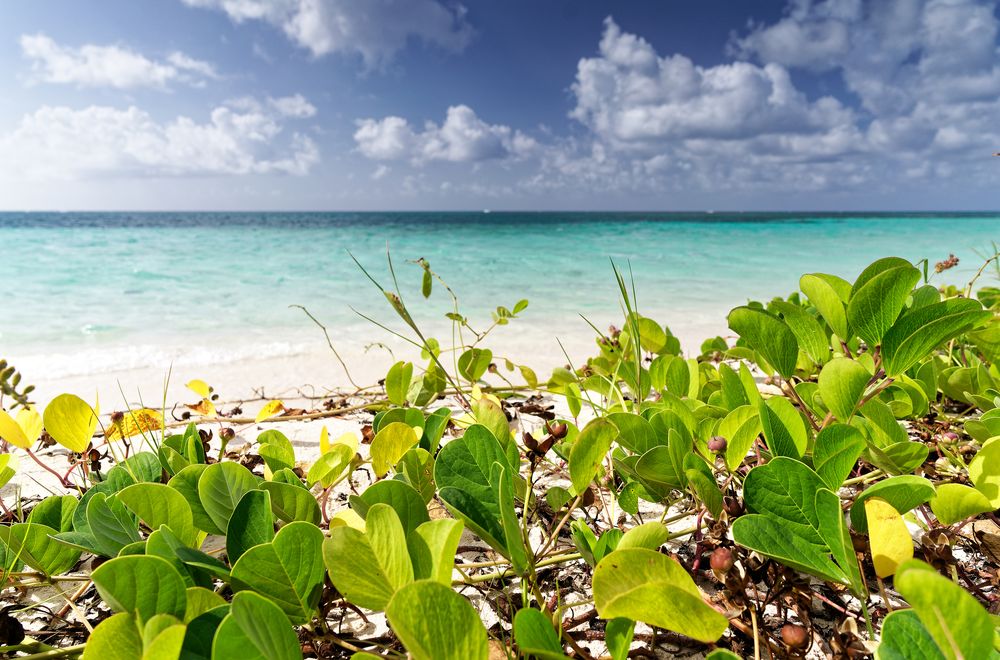
The island is still very beautiful. We arrived in glorious sunshine. The water around the islet was truly magnificent, a beautiful tropical blue.
There did not seem to be much to see underwater around the islet, apart from a few seagrass beds that can be seen from the surface. There are a couple of boats already here and a few people lazing around, although it looks like things could be a lot worse. While writing this article, I saw photos of îlet Caret packed with people and more than a dozen boats around. And then people act surprised that the islet is disappearing… At the time of writing, Tropical Storm Fiona has also passed through in September 2022 and the state of the islet looked frightening. I’m not sure whether operators still stop there now.


In this beautiful setting that makes you dream, we rest here for an hour. We’re used to these little white sand islands you find more or less on every tropical island we’ve visited, but it’s still nice and Melanie’s sister and her family are enjoying this beautiful paradise. Everyone was using the sandbank for swimming and snorkeling.
As for me, with my feet in the water and on the sand, I took some photos of the picturesque place. Not bad, right?
Fourth stop: swimming in the turquoise waters of the mangroves
After our hour of relaxation at îlet Caret, we took the boat to another place. I think it was the most beautiful place we saw that afternoon. It’s actually an area of mangroves, but set in turquoise waters just as beautiful as those of îlet Caret. It was a rare sight indeed. We’d been to several mangrove areas in the islands, with the mangroves and their characteristic roots, but we’d never been to a mangrove with such beautiful water.
I don’t know if the place has a name. And as I didn’t have my GPS with me, I don’t know exactly where we were in the lagoon. Looking back, I think it was the mangrove area just north of îlet de la Biche. Nevertheless, the site is really great in my opinion. You have the postcard aspect with the color of the water and the natural aspect with the mangrove and its beautiful trees. We got a few brief explanations about the mangrove here, so those who are not familiar with it can learn a little more about how it works and why it’s important. Although I would have liked to understand why there was white sand and mangroves in this particular spot, something I’d never seen before.


There is only one other boat, not counting the second Gwadaventure, which has been following us more or less all afternoon. Taking in the area and enjoying this little paradise was a real pleasure. We were almost alone here, with the island of Guadeloupe in the background. There are even some large threatening clouds in the landward background, which makes for better pictures. Finally, we can enjoy a leisurely snorkeling session to observe the local underwater flora and fauna. There are plenty of small fish. We also saw the famous mangrove oysters, some baby boxfish, baby barracudas and sea cucumbers. Seahorses and small rays also seem to be around!
We spent some time here, soaking up the sun and enjoying the idyllic setting. Then it was time for an aperitif. Thanks to an inflatable buoy floating on the turquoise water, we enjoyed a glass (well, two actually…) of punch. It’s fun and everyone enjoys it!
Fifth stop: the îlets Carénage
If I’m not mistaken, this was the last stop before leaving this little corner of paradise. It was right on the way back to Sainte-Rose. These are the classic mangrove islands that I was much more used to seeing in Mayotte, for example. Bruno gives us a good explanation of this ecosystem, which is essential to the life of the islands! Another 15 minutes here and we’re off to our last stop, the îlet aux oiseaux.


Last stop: îlet aux oiseaux
On the way back, we made a quick stop at this island. It’s another mangrove island where hundreds (thousands?) of birds nest! Nothing spectacular to see, though. Bruno gave us a few explanations about the different species (sorry, I didn’t catch everything).
We finished our maritime excursion at 17.30 and returned to the quay.

Our opinion of the Grand Cul-de-Sac Marin cruise
To be honest, we loved going out in this beautiful setting. I was worried about the weather, but in the end we were spoiled. The places we visited were really lovely. But if you’re a regular visitor to the tropics, you won’t discover much that you haven’t already seen. Personally, I loved La Biche’s mangrove islands, those in the turquoise water. It was a truly beautiful spot.
I may not have mentioned it at the beginning of the article (and if I did, I’ll say it again), but this was not a partnership with the company we booked with. We all had a great afternoon. There was nothing to complain about when it came to the places visited or the trip itself. We were a little less convinced by the provider. In our opinion it could have been better. There’s a real lack of explanation for many of the things we see and encounter and we would have liked a bit more than just “white sand and beautiful scenery”. All in all, I thought Bruno was a nice guy throughout the afternoon, even if we didn’t really appreciate some rather dry remarks to the children, who certainly didn’t really listen to the instructions, but at the same time, they’re still children and there are ways to say things… Handing out cards to leave a review on TripAdvisor when you haven’t even got off the boat is also very average in the way it was done, we thought. It’s not the end of the world, but it’s someone who’s been doing this for a long time, maybe a little weary of doing the same stuff again and again, and it’s coming across a little, I think.
So much for the critical side, as this is our blog and we have the right to write and express our opinions! However, whichever service you choose, you’re sure to have an excellent afternoon in a beautiful setting!
Find out more about Grand Cul-de-Sac Marin
I’ve been talking about Grand Cul-de-Sac Marin since the beginning of this article, but I really wanted to share a little more about the place. The Grand Cul-de-Sac Marin is a vast protected lagoon covering more than 15,000 hectares. It stretches along the north of the island of Basse-Terre and part of the west coast of Grande-Terre. The area stretches from around Sainte-Rose in the west toward Port-Louis in the east. On land, the Grand Cul-de-Sac Marin area is mainly made up of mangroves, swamps, and wetlands. On the seaward side, it is sheltered by a reef barrier that runs along much of the bay. The only real pass that cuts through this barrier reef is the Passe à Colas. In fact, right next to the islet of the same name, there is also the Passe à Carêt. The “S” shape of the Passe Colas (like the Passe en “S” in Mayotte) reminded me of an old river channel, when the sea level was much lower. I did some digging and found this interesting IRD publication on the subject. So it’s just as I thought, the Caret Pass is the outlet of the Grande Rivière à Goyaves! Anyway, I got lost, but I like digging things up.
To see that this is actually a vast, shallow lagoon, just look at the satellite photo below from the Géoportail website. This lagoon is dotted with small islands. To mention just a few of the most famous: îlet Macou, îlet Colas, îlet Fajou, îlet Caret (which is sinking), îlet La Biche and the îlets Carénage (where we stopped!).
You can also see another, smaller area called “Petit Cul-de-Sac Marin”, which is the area between Petit-Bourg and Pointe-à-Pitre.
Grand Cul-de-Sac Marin has been protected since 1987. It has been managed by the Guadeloupe National Park since 1990. In 1993, the Grand Cul-de-Sac marin was declared a “Ramsar site”, that is to say, a wetland of international importance in need of protection.
Its mangroves and wetlands form one of the largest coastal wetland areas in the Lesser Antilles. For those who like numbers, the bay is home to 261 species of fish and 5 species of sea turtle.
So now you know more about this famous Grand Cul-de-Sac Marin!
How to visit Grand Cul-de-Sac Marin
That’s not an easy question to answer simply. There are so many options. It all depends on what areas you want to visit, what you want to see and do, and how you want to do it. Basically, you have plenty of options.
In detail, here’s what that looks like:
- A classic half or full day trip to the lagoon from Sainte-Rose. This is what we did and is the most classic, if you can call it that. All the operators use more or less the same spots that I mentioned in the article, although it is also possible to go to îlet Fajou or pass by îlet blanc. As I said, we enjoyed our trip, but there are many operators who offer this trip from Sainte-Rose. I’ll leave you to judge the others! And don’t hesitate to give us your feedback!
- You can also go boating from Le Gosier to the Grand Cul-de-Sac Marin. I’ve had very good feedback from Vou & Mwen Excursions, who offer a day trip via Rivière Salée (the bay between Grande-Terre and Basse-Terre). In fact, we’ve put together a complete guide to exploring the islet of Gosier if you’re in the area!
- Several operators also offer half-day snorkeling trips to discover the flora and fauna of the Grand Cul-de-Sac Marin. Seatour has an excellent reputation and departs from the Aquarium. It’s a half-day trip, and from the feedback I’ve had, it’s really top class!
- I’ll look into it, but apparently there are several companies offering catamaran trips around this little paradise,
- You can also choose to explore only part of Grand Cul-de-Sac Marin, particularly the mangrove swamps on Grande-Terre’s west coast. The only thing to bear in mind about these two excursions is that they don’t allow you to discover the classic tourist sites that boat trips offer. But between you and me, these two options are quieter and more environmentally friendly. Two possible options:
- We tried it ourselves (the link is above), a few hours of paddling from Babin beach, in Morne-à-l’Eau. It’s really great, a change of scenery, quiet and not to mention cheap. In my opinion, it’s an excellent outing that I would definitely recommend. Here’s the one we did!
- You could also consider sea kayaking in the same area, which we haven’t tried yet.

A few tips for visiting Grand Cul-de-Sac Marin
Just a quick note here, but I think it’s important to know if you’re coming to Guadeloupe on vacation. I just wanted to give you a few tips:
- Don’t forget your sunglasses, and if you can, polarized ones, which really bring out the colors of the lagoon. We’ve been using Maui Jim for over 10 years now and I think it’s the best brand to buy if you’re going to live in the islands.
- If you’re coming with children or if you’re afraid of the sun, we really recommend that you take an anti-UV t-shirt, which gives really good protection from the sun,
- If you want to bring back some great memories of your lagoon, kayaking or canoeing trip (and you don’t want to risk dropping your hybrid / SLR in the water like I almost did) then I recommend you look at a rugged waterproof camera. We have the Olympus TG6 and love it. See details on Amazon.
Visiting Grand Cul-de-Sac Marin: practical information
As has become my habit on the blog for some time now, I like to end my articles with the practical information you need.
How to get to Grand Cul-de-Sac Marin
Sometimes it’s easy to answer the question “Where do I go? But in this case it’s quite complicated. And why is that? Simply because it’s not a specific area. It’s a very large area, and depending on what you want to see and do, you won’t stay in the same place.
First, you’ll obviously need to get to Guadeloupe. I’ve written a full article explaining everything you need to know about getting to Guadeloupe. I talk about airlines, fares, flights and so on. If you’re flexible, you can find flights from Paris for under €400.
Once you’re there, you’ll need to hire a car to be as independent as possible. This is the easiest thing to do and what I recommend for anyone visiting Guadeloupe.
Once you’re there, it all depends on what you want to do. But overall, my impression is that leaving the lagoon from the commune of Sainte-Rose is still the most classic and well-known way to visit the Grand Cul-de-Sac Marin. The commune is located to the north of the island of Basse-Terre, so depending on where you’re coming from, it can be quite a distance. For example, you should allow about 1.5 hours from the south of Basse-Terre.
Where to stay in the area
There’s something to suit every taste and budget. A few ideas around Sainte-Rose with an excellent reputation:
- La Villa Diakok: a double room with breakfast for the budget traveler, just a stone’s throw from the beach!
- L’îlet Blanc: a very spacious 3-bedroom gîte in the centre of Sainte-Rose,
- Villas Ti Créole Nogent: for those on a larger budget and those who want to spoil themselves. A superb 200m2 house with a swimming pool and views!
There are of course many other options. You can check out all the accommodation in Sainte-Rose or Morne-à-l’Eau (if you decide to go kayaking/paddling) here.
What to do in the area
Again, I can’t really tell you what you’ll see here, because where you stand will determine what you see. If you’re in the Sainte-Rose area, there are plenty of things to do nearby:
- You can go hiking. There are lots of walks. In fact, I’ve decided to dedicate an entire page to hiking in Guadeloupe. You’ll find all the articles I’ve written about the walks we do here every day. There are lots of explanations and photos to give you an idea of the places! Lovers of lush tropical vegetation, waterfalls and nature will be in their element on the land side. In the area, you’ll find the famous Saut des Trois Cornes hike (at the Sofia Sulphur Spring) and the Bois Banane waterfall (article coming soon). If you prefer to walk by the sea, there’s a lovely, easy walk that starts at Plage des Amandiers and ends at Plage de Clugny. It’s also known as the Sainte-Rose coastal walk (article and photos coming soon),
- If you’re more of a beach lover, you’ll find what you’re looking for in the north of the island. Basse-Terre has some equally beautiful beaches. To name just one that I love: Plage des Amandiers (Sainte-Rose), Plage de Clugny, Anse de la Perle and Plage de Grande Anse, all three in Deshaies,
- You can also take advantage of being in the area to visit the Deshaies Botanical Gardens. We’ve been there several times and always love to go back!
I’ll stop here with this (very long) article on the Grand Cul-de-Sac marin. It’s a really beautiful area to explore. I’m sure we’ll come back to visit other parts of it. In my opinion, if you’re going to Guadeloupe, this is definitely an area to visit! See you soon for a Guadeloupe article and and here’s to discovering this beautiful Caribbean island.
In the meantime, I invite you to consider microlighting in Guadeloupe if you’d like to discover another great activity. Mélanie was lucky enough to fly over Pointe des Châteaux, Désirade and the islands of Petite Terre. It was breathtaking!
See you soon.

Written by Sylvain PONS
Since 2021, I've been living in the Guadeloupe archipelago with Mélanie and our two children. We are exploring these beautiful islands and discovering the treasures that we are happy to share with you!
Despite our care, a mistake may have slipped into this article. If you find any, please don't hesitate to let us know so we can correct it as soon as possible and keep our information up-to-date!