We tried paddleboarding in Guadeloupe (Morne-à-L’Eau)
Last update: 06/23/2026
Our blog continues to grow thanks to you, our readers. This post may contain affiliate links, which means we can earn a small commission if you make a purchase through them, at no extra cost to you. This helps us to continue to bring you more and support our work!
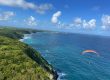
This week, I’m continuing with an activity Mélanie and I tried during our stay on Grande-Terre, here in Guadeloupe. When our parents arrived, we decided to spend a morning doing something new: stand-up paddleboarding. A few days earlier, we—or rather Mélanie, the lucky one—had flown in a microlight over Pointe des Châteaux, La Désirade, and the Petite-Terre islands. It was a wonderful microlight flight over Guadeloupe, and Mélanie still has fond memories of it.
I have to admit that, since we live at the other end of Grande-Terre, we do not come here very often. This was therefore a good opportunity to try an activity we had heard a lot about. Mélanie and I knew that kayaking was possible in several places around Guadeloupe, particularly through the mangroves, so we were excited to give it a try.
As always, this article was written in collaboration with the online activity platform Manawa and Get Up – Stand Up, a company specializing in stand-up paddleboarding in Guadeloupe. We left the children at the house we had rented in Saint-François for the week and headed to Morne-à-L’Eau to enjoy our morning.
This was the first time I had really tried stand-up paddleboarding. I had given it a go once before in French Polynesia, out at sea, but only very briefly. Mélanie was not exactly an expert either: her only previous experience had been during a yoga class. This was clearly going to be different.
We were not quite sure what to expect, but we set off in good spirits. Unfortunately, the sky was still gray and rather threatening. We would just have to see how things turned out.
Before we get into the details, a visit to the Musée du Cacao de Guadeloupe is also worth considering. Located in Pointe-Noire on the west coast, it is a lovely place to visit during a stay here.
In partnership with Manawa, we also had the opportunity to take a wonderful sailing trip to Les Saintes. It is a relaxing way to discover the islands, so take a look at our account of the few hours we spent there.
My first stand-up paddleboarding experience in Guadeloupe
Arrival and briefing
An hour after leaving Saint-François, we arrived at our destination. To give you an idea of how little I knew Grande-Terre at the time, I had never even heard of the village of Vieux-Bourg. It lies at the western end of the commune of Morne-à-L’Eau. After driving a few more kilometers west, we finally reached Babin Beach, roughly opposite Macou Island, in the area known as the Grand Cul-de-Sac Marin. It felt completely off the beaten path, far from the usual tourist routes followed by visitors exploring Guadeloupe. And I have to admit, the less touristy a place is, the more I tend to like it.
We met Matt, our stand-up paddleboarding instructor, who was waiting for us. We took a look around, and the setting was beautiful despite the overcast sky. It was a shame for the outing, but it did not spoil the fun ahead. A little sunshine would simply have helped me dry off faster after falling in, haha.
Babin Beach is also well known locally for the clay found in the sea, which is said to help relieve rheumatism, osteoarthritis, and joint pain while leaving the skin soft. When we arrived, we saw plenty of locals covered in the grayish clay.


Matt showed us the equipment we would be using: inflatable boards that were surprisingly rigid, along with our paddles. Before setting off, he outlined the day’s route: paddling to Macou Island, making our way through tunnels of red mangroves, stopping at a small deserted beach, and learning more about the mangrove ecosystem—its role, structure, and more.
Matt also gave us a briefing about the area before we left. It was very interesting, even though we were already familiar with some of the basics.
He explained that the Grand Cul-de-Sac Marin is sheltered by the longest coral reef in the Lesser Antilles. From where we stood, we could see Fajou Islet, the largest islet in the Grand Cul-de-Sac Marin, as well as Caret Islet farther west, known locally for its turquoise waters and popular with both visitors and residents. He also reminded us of the contrast between Basse-Terre and Grande-Terre: the former is volcanic, while the latter is limestone. Geologically, the two islands are very different, and their vegetation and weather differ as well.
Basse-Terre is volcanic and far more mountainous. It is home to La Soufrière, the highest point in the Lesser Antilles at 1,467 meters. Rainfall is heavier and more prolonged there. It falls on clay-rich soil, which tends to absorb and retain moisture. The result is greener, denser vegetation—something Mélanie and I have come to know well through our weekend hikes since moving to Guadeloupe. At Bassin Bleu, for example, you can experience this lush scenery without too much effort.
Once you cross the Rivière Salée, Grande-Terre feels very different: rainfall is lower, the vegetation is drier, and the limestone soil does not retain water in the same way. I am not going to give you a geology lesson here—I still do not know enough about Guadeloupe—but from what I have read, Grande-Terre is essentially made up of layers of sediment deposited millions of years ago. The present-day arc of the Lesser Antilles was shaped by the Atlantic plate subducting beneath the Caribbean plate, and tectonic movement gradually brought these sediments above sea level. In practical terms, when you walk across Grande-Terre—or Marie-Galante or La Désirade—you are walking on ancient coral formations.
That was the end of Matt’s introductory briefing. It was especially interesting for anyone unfamiliar with the way tropical volcanic and sedimentary islands are formed.
Our paddleboarding excursion in Morne-à-L’Eau
At 10:00 a.m., we set off on our paddleboarding excursion, beginning in a seated position. Matt gave us the essential tips for handling the board and standing up. As usual, I was not exactly a natural when it came to coordinating my arms and legs, haha. I have always struggled with anything involving a paddle, kayaking included. In fact, every time Mélanie and I go kayaking, I feel as though we are on the verge of breaking up. We often wonder how many couples end up arguing in a kayak!
We began by sitting on our boards and paddling along the coast to our right. Before long, we had lovely views of the mangrove and its red mangrove forest. The weather was not ideal, but the water was still clear and beautiful. Under a sunny sky, it must be even more striking. Matt had us stand up and explained the techniques we needed to steer the boards. Meanwhile, I spent a while wrestling with my Sony A7III because one of the memory cards was acting up. Fortunately, I had a second card and could use the camera’s other slot. We could also see many white patches on the bottom, which were actually jellyfish resting there. For safety, we were wearing life jackets throughout the excursion.


Given how steady I was on the board—or rather, how unsteady—I did not want to risk taking out my camera while standing. Sure enough, five minutes later, I lost my balance and fell into the water. Nothing serious, but I was completely soaked. At least Mélanie found it funny. She had already found her balance and was standing comfortably on her board.
We continued through the mangrove forest, and what struck us most was the calm and the atmosphere of the place. Being just the three of us made the experience even better. It was so quiet, and I was genuinely glad we had not come here to try jet skiing or water skiing. I understand why some people enjoy those activities, but gliding peacefully through the mangroves with only the sound of the paddle cutting through the water felt almost magical. We even spotted a beautiful stingray, clearly visible from the surface. Luckily, she was not making much noise either!
We then passed Rat Islet on our right and made a short crossing toward Macou Island. I say “short crossing,” but we could clearly feel the stronger current to the right, and it took some concentration to maintain our balance and direction. Once we reached the island, we paddled around it before arriving at what I considered the highlight of the outing: heading into the island itself, or rather through it. Macou is crisscrossed by narrow channels that allow you to paddle from one side to the other. Mélanie went first, with me just behind her. The red mangroves hung very low, and the vegetation made it impossible to remain standing, so we had to sit or kneel. It felt as though we were about to disappear into a dark tunnel of vegetation.
I had visited mangroves before while living in Mayotte, but those trips had taken place on broad waterways, usually by motorboat. This was a completely different experience. We entered slowly and quietly, taking care to stay in the deepest part of the channel and avoid touching the mangrove roots. The setting felt magical. Mélanie was just as happy to be there, and I have to admit that I had never experienced anything quite like it.
We moved at a snail’s pace through a maze of channels, each one more beautiful than the last. The mangroves closed over our heads, creating a low canopy of vegetation. It was a wonderful setting. I followed Mélanie, who led the way along this section. The channels were extremely shallow, and I had to keep paddling to stay moving because the board repeatedly scraped the bottom. Unless, of course, that was simply because I had put on a little weight recently, haha.


Inside the mangroves, we spotted a few birds flying overhead, along with orange and purple sponges clinging underwater to the roots. It made for a beautiful scene. We spent about 20 minutes in this unusual environment before emerging on the other side of the island. The light opened up again, and we paddled around the island toward a small deserted beach. As we approached, we could see numerous orange starfish, their color standing out clearly despite the dull weather.
We landed and sat down on the lovely little “beachette,” as I like to call it. Matt served us some homemade juice, which we enjoyed while listening to his explanation of how mangroves work. He told us that an ordinary tree would struggle to grow there because the ground is so muddy. Mangroves can thrive in these conditions because of their specialized root systems. They grow in salt water and have several ways of dealing with the salt. When water enters the roots, much of the salt remains outside, which affects the roots’ color. The tree filters out most of what remains, while the rest is stored in the leaves. Yellow leaves are often saturated with salt.
Since much of the vegetation around the Grand Cul-de-Sac Marin consists of red mangroves, we also learned more about the three main roles of the mangrove:
- Nursery habitat: young fish shelter among the mangrove roots, where they are protected from predators and can find food. Once they are fully grown, they return to the lagoon. This nursery role helps sustain fish populations in the lagoon,
- Filtration: before reaching the lagoon, runoff passes through the mangrove, which filters sediment, leaves, and other material as effectively as possible. Cleaner water supports nearby coral growth. Matt also explained coral growth and its symbiotic relationship with zooxanthellae, single-celled algae that absorb the carbon dioxide released by coral and, in return, provide nutrients to their host, the polyp,
- Protection from storms and cyclones: mangroves help protect the land during heavy swells by trapping sediment and reducing the impact of waves and wind.


After this explanation, we returned to our boards and took a different channel across Macou Island. We were still delighted to be there, and the peace and quiet remained just as enjoyable. The return journey went smoothly. After around two and a half to three hours of paddling through the mangroves, we reached our starting point and put away the equipment. We had thoroughly enjoyed the experience.
What we thought of the paddleboarding experience
As I mentioned, we were already fairly familiar with mangroves and how they work, but we had never had the chance to explore one so closely—or so quietly. That was what excited me most. In the end, it was the stillness and atmosphere that appealed to us. The activity is ideal for anyone who enjoys nature, exploration, and water sports at a slow, peaceful, and environmentally respectful pace.
I can now understand why some people enjoy long canoe or kayak trips across a large lake. It is a simple, unhurried way to discover an ecosystem, far removed from the speed of an activity such as surfing, haha. You are not rushing. You have time to notice all the details that shape the landscape around you. In a way, it is similar to “slow travel”: traveling at a gentler pace and, in my opinion, gaining a deeper understanding of a place. I could drive across the United States in a couple of days and say I had done it—but would it really be worthwhile? Would I feel that I had truly seen and experienced the country? I am not so sure.
For a very different perspective, you can also discover Guadeloupe from the air with a seaplane flight over the Petit Cul-de-Sac Marin.
Activities with Get Up Stand Up Paddle

I’ll end this article by telling you about the other paddleboarding options available. We chose the excursion from Babin Beach, which was described as easy. It lasted around two and a half hours, and the sea was very calm—I did not spend the whole time on my knees, haha. Departure times may vary depending on demand, with outings generally offered in the morning, early afternoon, or late afternoon. The excursion we took was also presented as suitable for children aged four and over when sharing a board with an adult.
There are two other options:
- The excursion from Petit-Canal to Port-Louis: a more athletic three-hour route along the leeward coast toward a river and a beautiful mangrove forest.
- The excursion from Morne-Rouge to Sainte-Rose: a demanding three-hour trip, with two possible routes depending on the wind.
- Stand-up paddleboards may also be available to rent by the half day, full day, or week.
That brings me to the end of this article. I hope you enjoyed following our paddleboarding adventure. I may be repeating myself, but if you enjoy nature, peaceful surroundings, and beautiful scenery, this activity should appeal to you. We loved it, and if I lived nearby, I would probably buy a paddleboard and explore these islands after work. We are not experienced paddlers yet, haha! Morne-à-L’Eau is particularly well suited to paddleboarding thanks to its calm, flat water. I have also heard of people practicing yoga and fitness on paddleboards; their balance must be excellent, and the sea would certainly need to be calm.
See you soon for another activity or water-sports adventure. In the meantime, come and dive with me at La Désirade if you love the sea!
Hope to see you again soon.

Written by Sylvain PONS
Since 2021, I've been living in the Guadeloupe archipelago with Mélanie and our two children. We are exploring these beautiful islands and discovering the treasures that we are happy to share with you!
Despite our care, a mistake may have slipped into this article. If you find any, please don't hesitate to let us know so we can correct it as soon as possible and keep our information up-to-date!