Our microlight flight experience in Guadeloupe
Last update: 06/23/2026
Our blog continues to grow thanks to you, our readers. This post may contain affiliate links, which means we can earn a small commission if you make a purchase through them, at no extra cost to you. This helps us to continue to bring you more and support our work!
Since arriving in Guadeloupe in August 2021, we have been trying to explore as much of this beautiful region as possible. I have to say, I have been thoroughly impressed by everything we have seen so far. Oh, and I almost forgot: today, it is me, Mélanie, taking over the keyboard to tell you about the wonderful aerial experience I enjoyed in April 2022—a microlight flight in Guadeloupe with ULM Archipel, over Petite-Terre, Pointe des Châteaux, and the island of La Désirade.
We made the most of the grandparents’ twenty-day visit by planning a few activities. One of them was this wonderful microlight flight from Saint-François. It was also a chance to explore more of Grande-Terre, an island that is actually within fairly easy reach of us since we live at the southern end of Basse-Terre.
As always, we want to be transparent: this experience was organized in partnership with Manawa and ULM Archipel. Since Manawa is a reliable platform offering a wide variety of excursions, we have been featuring more and more of its activities. That said, our opinions are honest, and everything expressed in this article is entirely our own.
I had never flown in a microlight before, so this was a real first for me—and quite a challenge. Sylvain had already flown over Mayotte when we lived there between 2011 and 2015, and he had always told me how much he enjoyed it. He later repeated the experience over Bora Bora in French Polynesia. Admittedly, the two flights were very different, but the appeal was the same: gaining some altitude and seeing the coastline and islands from the air.
Anyway, enough background—let me tell you about the flight itself and share my impressions. I took the yellow route with Pascal, which included Pointe des Châteaux, La Désirade, and the Petite-Terre islands. I will go into more detail below, but several other flight routes were also available.
If you like the idea of flying over a beautiful lagoon and ilets, I invite you to read about our experience of flying over the Petit-Cul-de-Sac-Marin in a seaplane in Guadeloupe.
Speaking of Manawa, we hope to arrange more partnerships with them and try several activities so that we can share our honest impressions of the many things to do in Guadeloupe, from snorkeling to scuba diving and beyond.
If you’re in the area, I invite you to read our full article on Pointe des Châteaux.
We’ve also published a story about our sailing trip to Les Saintes. It was great!
My first microlight flight over Guadeloupe
Before takeoff
As I mentioned in the introduction, this was a major first for me, and Sylvain was kind enough—although I am not sure I gave him much choice—to let me take the flight. Why should he get to enjoy all the fun aerial adventures?
Sylvain and I arrived at the ULM Archipel flight school in Saint-François at 8:15 a.m. Pascal, a genuine Harley-Davidson enthusiast, showed us around the nicely decorated premises, and we got to know him over a complimentary coffee. It is a simple, welcoming place, with a shaded seating area and a small bar where you can chat over coffee while watching the other microlights land. Sylvain would be able to relax there during the hour or so I spent in the air.

After coffee, Pascal gave me a short safety briefing and explained the main things I needed to know for the flight. A few instructions later, I put on my flight gear—which was really just a vest—and was ready for takeoff. I have to admit that I was eager and excited to begin this flight over the surrounding lagoons, but also curious to find out what it would feel like.
We left Sylvain sitting comfortably on the shaded bench and climbed into the aircraft. It was a gyrocopter, classified in France as an ultralight motorized aircraft, or ULM. I will explain a little more about that at the end of the article. We learned plenty of interesting things, particularly about the differences between gyrocopters and the other types of “small aircraft” that also fall into the microlight category. I was delighted to be flying in this machine because its open design seemed ideal for both photography and the overall sensation of flight. Put simply, it looks a little like a small helicopter, with two blades above it forming the rotor.


With Pascal guiding me, I looked around the aircraft and cockpit before takeoff. Once seated, I had expected the setup to feel rather basic, but it was actually quite comfortable—being small probably helped. I fastened my safety harness and checked my camera gear. Pascal reminded me not to leave anything loose or keep anything unsecured in my pockets. The tension began to build, helped along by Sylvain, who had given me a thorough briefing to make sure I did not miss the photos during the flight. In other words, he had put me under a little pressure! I even received a quick photography lesson before heading up. For the record, I took two cameras with me: my current waterproof camera, the Nikon Coolpix W300, and my Sony A6000 with the Tamron 70-180 mm lens. The plan was to use the Nikon compact for wide-angle shots and the mirrorless camera for zoomed-in images. We would soon see how that worked out.
Pascal helped me position the microphone and explained that I needed to keep it close to my mouth so the wind would not interfere with it. I would also have to stay quiet whenever he spoke over the radio. No problem—I was happy to sit back and enjoy the scenery and the adventure!
Time to take off
Once we were ready, we taxied along the runway while the engine warmed up and waited for clearance to take off. We then accelerated, skimmed low over the ground, and suddenly began to gain altitude. The sensation was strange—a mixture of fear, excitement, and that unmistakable “wow” moment when you lift off and become aware of the landscape around you. It felt nothing like turbulence in a commercial plane; the movement was much gentler.
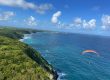
Within the first few minutes, my fear gave way to wonder. The aircraft moved around a little, which was slightly unsettling at first, but the view quickly took over. As soon as we were airborne, I realized how fortunate I was to be up there enjoying this experience with a professional flight school. Just after takeoff, I had a remarkable view of Saint-François, the area’s white-sand beaches, the vivid colors of the lagoon, the coral reef, and the salt flats near Pointe des Châteaux. It was extraordinary. Throughout the flight, Pascal helped me get my bearings and explained what I was seeing in real time, which I really appreciated.


We then headed east toward the famous Pointe des Châteaux. The air was almost completely still and the sun was shining. It was an incredibly peaceful moment, giving me plenty of time to admire the view and savor the experience—carpe diem, as they say. I tried to remember the settings that Sylvain had told me so that I wouldn’t be scolded at the finish! Pascal even treated me to his famous simulated engine failure, cutting the engine briefly in midair above Pointe des Châteaux. I gripped my seat, expecting the sensation of dropping through a hole in the sky, but instead I felt almost weightless, as though we were simply floating. I loved it. It lasted only a few seconds, although it was hard to judge time in the moment.
We then made a smooth, gentle 360-degree turn before heading toward the tip of the peninsula and its famous cross, which is particularly striking from the air. The view was beautiful. We then began our first open-water crossing, heading toward the beautiful island of La Désirade, which I had explored for four full days less than a month earlier. We’ve written a full guide to visiting La Désirade. Conditions changed noticeably during the crossing. The wind became much more apparent and the aircraft moved around more. There was little to see between Pointe des Châteaux and La Désirade apart from endless blue—as divers like to say—but we still kept an eye out for whales, just in case. After a few minutes, we reached the island.


The first thing that caught my eye was the island’s cliffs—and this was only the beginning of the aerial experience. We flew over the village of Beauséjour, which unfortunately looked rather different from when we had visited. Sargassum covered parts of the shoreline—the familiar brown seaweed that drifts ashore and decomposes on beaches across many Caribbean islands. We began by flying over the plateau that forms the northern part of La Désirade, then followed the coastal cliffs, with wonderful views of small natural coves. I realized that this perspective was only truly accessible from the air. From the ground, it’s almost impossible to get to this side of the island. Sylvain, however, managed to get there via a footpath, which you’ll read about in the article. At one point, Pascal told me about a spot once associated with pirates. Ships would anchor there, then cut their ropes and set off to attack as soon as an enemy appeared. As a result, several anchors have been found at the bottom of the water. He also shows me a bay where the local fishermen gather once a year for a big feast of sea cicadas and lobsters!
We continued toward the wind turbines, and the views remained just as beautiful. I could not get enough of them. In fact, La Désirade looked much greener from the air than it had from the ground. It certainly makes a difference to see the panoramas from so high up! I’m more aware of the island’s unique relief. We headed to the eastern tip of the island to fly over the old weather station, the lighthouse and the local nature reserve. This is the only part of the island that is volcanic and you can see it clearly from the air. It’s also easy to see the old leper colony and the beautiful local beach, although sargassum has taken over.


We left La Désirade and headed toward the Petite-Terre Islands —which Pascal jokingly renamed the “Pascal Islands.” They are administratively part of La Désirade. This new crossing was even more scenic. You can see beautiful shades of blue between the two islands. It is even possible to see the two islands from a considerable distance away: Terre-de-Haut and Terre-de-Bas, not to be confused with the archipelago of Les Saintes, just in front of us, off the commune of Trois-Rivières. The arrival on the island is also impressive. The landscape was very different from La Désirade: Petite-Terre consists of two small, low-lying coral islands separated by a shallow turquoise channel. Terre-de-Haut, the smaller island, is closed to visitors and boats to protect local wildlife, including turtles and nesting seabirds such as the little tern. Both islands have formed part of a nature reserve since 1998, while regulated excursions are permitted on Terre-de-Bas. From the feedback I’ve been able to get, the sites (on land) are magnificent, but the excessive number of tourists in recent years has clearly damaged the place… However, Pascal (private pilot) told us that the underwater world is still excellent for snorkelling and even diving in the surrounding areas. We’ll have to try that one day.
Pascal explained that staff involved in studying and protecting the local flora and fauna stay near the lighthouse on the main island. Their work includes conservation and monitoring the reserve. In any case, each view over the Petite-Terre islands seemed more impressive than the last. I’ll have to ask Sylvain about the origin of these two islands, as it almost sounds like an atoll (or part of one). I was surprised to see that there weren’t many boats (but it was a bit early, I have to say). In the distance on Terre-de-Bas there’s a beautiful beach where you can see a few tourists and boats. The water is translucent and makes you want to come and explore (and of course do snorkelling)!


The south coast of Terre-de-Bas felt less dramatic because it has fewer white-sand beaches, although the reef remains visible along the shoreline. At the western tip of Terre-de-Bas we fly over several salt pans. The brown color of the pans is very noticeable. On the largest of these, you can see the pontoons that serve as nesting boxes for the birds that come here to lay their eggs. The color of the lake and the appearance of a beach inside the saltworks are a real contrast. Pascal then made a wide turn above the islands, giving me an even better angle on the scenery. We even caught a glimpse of a small turtle. It was a feast for the eyes.
We headed back towards Grande-Terre as the flight drew to a close. The crossing between the islands of Petite-Terre and Pointe des Châteaux is fairly quick. There’s not much to see on the way back. I’ll have a good look to see if I can spot any whales, because a month earlier, during our weekend in La Désirade, we saw some whales blowing. Nothing this time. I came back with the sun at my back, which is much better for photos and not too many reflections. In my opinion, the flight over Pointe des Châteaux (airspace) on the way back was much nicer than on the way out. We return to the skies, once again flying over the beautiful sandy beaches and the thousand shades of blue of the lagoon.

At last, we returned to the Saint-François airfield, where we had taken off more than an hour earlier. The descent was very smooth, with no sudden movements or pressure in my ears. The landing was just as gentle; without seeing the ground beneath us, I might barely have noticed that we had touched down. We go back to the office to pick up Sylvain, who’s waiting for us on his bench! Pascal and I have a quick debrief on the trip and we have a quiet chat with Cédric, a certificated microlight pilot who works with Pascal (flight instructor). We’re going to learn a lot from him (the command-pilot).
What I thought of the microlight flight
So, what can I say about this passenger flight? It is difficult to find enough words to describe how I felt, and the views were remarkable. No matter how hard I try to explain it, the experience was genuinely memorable. The sense of calm in the air, the peaceful atmosphere, and the chance to admire everything from above felt almost magical.
I felt like a child, staring wide-eyed at one panorama after another. I also think this would make an original gift for a birthday, Christmas, a wedding, or another special occasion.
As for the route, as I said, I did the yellow loop. I think it’s the best choice. I think the others are a bit too short. After that, the Grande-Terre tour should also be sublime, with a greater variety of landscapes to discover (lagoon, mangrove swamps, sandy beaches, coastal cliffs, fields, windmills, etc.). I’ll tell you all about it below.
By the way, if you’re looking for something completely different on your trip to Guadeloupe, I suggest you visit the Cocoa Museum in Pointe-Noire. It’s really fun.
When I took the flight in April 2022, the yellow route cost €170. That may sound expensive, but I felt it was reasonable for an hour in the air and such a memorable experience.
ULM Archipel: other microlight flights over Guadeloupe
As I mentioned, this was my first microlight flight. The routes currently advertised through Manawa from the Saint-François airfield include:
- The Tarare circuit: a 12-minute introductory route toward the rocky point and beach north of Pointe des Châteaux. It provides a brief aerial overview of the area, although I personally would have found such a short flight a little frustrating,
- The Pointe des Châteaux route: an 18-minute flight offering an aerial view of the peninsula, its white-sand beaches, cliffs, and salt flats,
- The Pointe des Châteaux and Petite-Terre route: a 30-minute flight that continues beyond the peninsula to the Petite-Terre nature reserve,
- The Pointe des Châteaux, Petite-Terre, and La Désirade route: currently advertised as a 45-minute flight. This is the closest equivalent to the route I took, and it covers three very different parts of Guadeloupe with a varied range of landscapes, particularly around the distinctive relief of La Désirade,
- Finally, a premium flight over Grande-Terre is currently advertised at around 1.5 hours, offering a broader overview of the island and the diversity of its landscapes.
If you’re wondering how to get to ULM Archipel, it’s very easy. All you have to do is go to the Saint-François airport and drive all the way to the end. You can park in front of it, there’s plenty of space. It’s just opposite Gwada Fly, a free-fall simulator.
The current Manawa listings indicate a minimum age of 7 for these flights. I can already picture Louis in one of those microlights—he would love it!
For those who are wondering (like us), there is currently no opportunity to take a first flight in Basse-Terre. It’s a shame, but it’s simply down to the weather conditions, which are much more complicated around the volcano.


A few extra details
I hope this has given you a sense of what this activity is like in Guadeloupe. As I come to the end of the article, I wanted to share a few more things I learned from Pascal during the flight. It is always interesting to understand a little more about how these aircraft work.
- In French, ULM stands for “ultra-léger motorisé,” meaning an ultralight motorized aircraft. It is essentially a very light powered aircraft, generally carrying no more than one pilot and one passenger. There are several classes of ultralights, including paragliders, hang gliders, multi-axis ultralights (a small plane with fixed wings), ultralight gyrocopters (the one I took), aerostats and ultralight helicopters. In short, I didn’t know that there were many different types of microlight. I also learned that international flights in a French microlight are subject to the regulations and authorization requirements of the countries concerned. Speaking of that, I invite you to read our article about our paragliding experience in Le Moule.
- For sightseeing, a gyrocopter like the one I tried can feel very stable. Its rotor—the two blades above the aircraft—turns through the airflow. Take-off and landing are really smooth! Another advantage of an autogyro is that you have a better field of vision (as you have no wings). By comparison, a fixed-wing, multi-axis microlight may feel somewhat different in the air. It all depends on what you’re after. You’ll get more thrills in a multi-axis plane than in a gyroplane. However, you can choose the microlight you want to fly and the price remains the same,
- Another difference I had not appreciated was that Sylvain’s seaplane flight in Bora Bora belonged to a very different regulatory and operational framework from this microlight experience. Commercial seaplane operations involve specific operator approvals, maintenance requirements, documentation, and appropriately qualified pilots.
- I also learnt that on our flight we flew at an average of 300/400m and that you can fly at around 600m over the island of La Désirade (which is higher),
- You can also arrange a flight as a couple, with each person traveling in a separate microlight while the two aircraft follow one another for the duration of the route. It can be a fun way to take photos of each other in the air.
- Pascal also offers introductory flying lessons for people interested in learning to pilot a microlight. He is a certified flight instructor and can guide students through their training.
That is it for the extra details—and for my review of the flight, which had nothing to do with a simulator! I hope you enjoyed following this microlight adventure. I may be repeating myself, but it was a truly memorable aerial experience for me.
We also took advantage of our week in the Grande-Terre to try another activity: stand-up paddling in the sea at Morne-à-l’Eau. Speaking of which, we spent half a day exploring the Grand Cul-de-sac marin, north of Basse-Terre.
We’ll also be trying some activities closer to home in Guadeloupe, including climbing La Soufrière with a guide and canyoning. In the meantime, if you’re looking for a bit of peace and quiet in our neck of the woods, check out our article on our weekend in Terre-de-Bas, in the Saintes archipelago.
See you soon for another article from Guadeloupe.
Written by Sylvain PONS
Since 2021, I've been living in the Guadeloupe archipelago with Mélanie and our two children. We are exploring these beautiful islands and discovering the treasures that we are happy to share with you!
Despite our care, a mistake may have slipped into this article. If you find any, please don't hesitate to let us know so we can correct it as soon as possible and keep our information up-to-date!