Discovering Anse Castalia
Last update: 06/24/2026
Our blog continues to grow thanks to you, our readers. This post may contain affiliate links, which means we can earn a small commission if you make a purchase through them, at no extra cost to you. This helps us to continue to bring you more and support our work!
It has been more than two years since we left French Polynesia for Guadeloupe, and we still feel just as at home here. Living at the southern end of Basse-Terre, we still have plenty to discover, especially on Grande-Terre. Contrary to what you might think, Guadeloupe is not a single island but an archipelago made up of the two main islands, Basse-Terre and Grande-Terre, along with La Désirade, Marie-Galante, and the Saintes archipelago (Terre-de-Haut and Terre-de-Bas).
We decided to make the most of the long November 1 weekend by exploring northern Grande-Terre, particularly the area around the town of Le Moule. We do not know this part of the island very well, and it is almost a two-hour drive from our home. As we have been doing more and more lately, we wanted to share our visit to a place we had known by name for a long time: Anse Castalia, in the commune of Anse-Bertrand.
We spent four full days around Le Moule, exploring the surrounding area, its beaches, and other activities. One of our goals is to write an article about what to see and do in Le Moule.

Discover Anse Castalia
Unless you live here, you may never have heard of Anse Castalia. It is not one of Guadeloupe’s best-known beaches. In fact, it is more accurate to call it Anse Castalia than Plage de Castalia: the beach is extremely difficult to reach, and both access to the site and swimming are prohibited by municipal order. Only the most adventurous travelers, or those hoping to see something beyond the classic beaches of Sainte-Anne and Saint-François, tend to venture this way.
I will not explain exactly how to reach Anse Castalia here, as the current access restrictions are covered in the practical information section.


As I mentioned, several people had recommended this place to us, and we were spending four days in northern Guadeloupe. We therefore set off early in the morning from Le Moule, where we had spent the night. About 40 minutes later, we reached the site, northeast of the town of Anse-Bertrand, along the scenic road leading to Guadeloupe’s northernmost point, Pointe de la Grande Vigie.
We parked beside the road, close to what we believed was the starting point of the trail. To be clear from the outset, this is not really a hike in the strict sense. It is more of a 10- to 15-minute family walk, perhaps a little longer when, like us, you have young children and need to take extra care…

It was a Monday morning, and there was only one car ahead of us, so the area was very quiet. We had heard that it could get much busier on weekends, which must take away some of its charm…
We entered the forest beside an information board. The trail is actually part of a longer hike that begins at Anse Laborde and ends at Pointe de la Grande Vigie. It led us through xerophilous forest, typical of the dry limestone plateaus of northern Guadeloupe. The damp path, which had apparently held more water two days earlier, was pleasant and easy to follow. There was little chance of getting lost: we simply followed the natural trail and the yellow markings on the trees.
After about ten minutes, we reached a fork and turned left, still following the yellow markers. This was the most difficult part of the walk. The descent was steep and as slippery as an ice rink, which reminded me of the Saut de la Lézarde in Petit-Bourg.


Fortunately, there was a rope on the right to hold on to. I went down first to keep Louis safe as he followed me, with Mélanie and Téo behind us. Everything went smoothly. We took our time and descended carefully until we reached the flatter ground below and could finally let go of the rope. Louis loved it, but three-year-old Téo was much less enthusiastic…
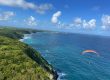
After a few minutes of brisk walking along a dry gully, the sea finally came into view. We could already see the beautiful blue horizon and the huge limestone rocks that seemed to float on the water. The last obstacle stood directly ahead: one final rope descent to reach the rocks below. Again, it was not especially difficult, just slippery, so take care, particularly with children.
We were delighted when we finally reached this striking spot. A cove carved into the limestone, boulders scattered all around, a broad limestone platform, and turquoise water that reminded us of the lagoons of Polynesia. Just before the cove, there was a lovely shallow pool where the children could splash around. It gave them somewhere to play while the adults got their bearings. Mélanie had a little trouble with her drone, which refused to take off at first, but we eventually got it working, haha. Here is what came out of our little expedition.


While Mélanie took photos and videos from the air, I walked across the rocks to explore the area. Waves crashed hard against the rocks in front of us, leaving a layer of fine foam that the children enjoyed playing in. I should point out that we visited on a beautiful day with relatively little swell, which made it possible for them to remain in the pool without too much concern. Even so, a couple of unexpectedly large waves swept into the pool while they were playing. I would not recommend entering it when sea conditions change, as it can quickly become dangerous.

To the left, you can see the well-known hollow carved into the limestone. Drone photos of it had circulated some time before our visit, and the setting really was impressive. Erosion has also formed a small bay, with a beach at the foot of the cliffs. Reaching it, however, is extremely difficult: you have to jump from the rocks and swim across. I will say it again: swimming is prohibited, and the site itself is closed to the public, so this should not be attempted. With heavy swell, the area can be extremely dangerous. We stayed on the rocks, which suited us perfectly.
We ended up spending a good hour there as a family, feeling completely alone in the world. Despite the constant crash of waves against the shoreline, it was a wonderfully peaceful place. We returned along the same path and found the climb easier than the descent.
That concludes our short excursion to Anse Castalia. I hope the photos give you a sense of the place.
Anse Castalia: practical information
As usual, here is the practical information to know about Anse Castalia. Please note that the site is currently closed to the public by municipal order.
How to get there
First, of course, you need to get to Guadeloupe. You can read our article, which covers the main options and everything you need to know about visiting this beautiful archipelago. Once there, renting a car is the easiest way to travel independently. We often recommend comparing prices on a rental car comparison site such as DiscoverCars.
Anse Castalia lies northeast of the town of Anse-Bertrand, roughly a five-minute drive north. Here is the route shown in our original account. However, access to the site has been prohibited by municipal order since June 17, 2019, because of the risk of falls and rockslides. The route is therefore provided only to locate the area, not as an invitation to enter it.
Two different trails are sometimes shown as leading toward Anse Castalia. See the map below for geographical context, but respect the current closure.
Can you visit with a child or baby?
Although Mélanie and I do not always agree on whether certain trails are suitable for babies or young children, the current answer here is clear: Anse Castalia is not an appropriate family outing because access to the site is prohibited. The steep, slippery descents and exposure to waves also make the area particularly hazardous for children.
Where to stay nearby
We chose to stay in the commune of Le Moule, which is fairly central for exploring Grande-Terre. We also wrote a short article about the accommodation where we spent four days, Ti Cocoon. Overall, we enjoyed our stay and felt it offered good value for money. It is a pleasant, clean 40 m² apartment with enough room for four people, within walking distance of the beach, the seafront, and the center of Le Moule.
To stay closer to the Anse Castalia area, you can look for accommodations in Anse-Bertrand.
We had already researched several places to stay nearby because we were originally due to visit the previous week, but had to cancel because of Hurricane Tammy. These were some of the accommodations on our shortlist. We may return to them when we explore the far north of the island for a future article:
- La Villa du Soleil: a lovely two-bedroom gîte with an excellent reputation.
- La Kaz à Clémence: this is the accommodation we canceled because of the hurricane, but we would still like to stay there after hearing such positive feedback.
- Ti Coin Paradis: a charming place with a swimming pool that looks right up our alley.
- Gîtes Les Bienheureux: we have also heard very good things about this accommodation in Anse-Bertrand.
What to do in the area
There is plenty to do in the area, depending on your interests, budget, and available time. Here are a few ideas:
- Explore Anse Laborde beach, just to the south, and Trou Madame Louis, which we particularly enjoyed.
- Swim at Anse de la Chapelle beach in Anse-Bertrand.
- Walk along the island’s northern tip at Pointe de la Grande Vigie.
- Explore the cliffs of the east coast, including the area around Trou du Souffleur, from Porte d’Enfer.
Where to eat in the area
We ended our morning at Le Coucher d’Soleil in Anse-Bertrand, where we enjoyed both the meal and the panoramic view. The welcome was simple and friendly, just the way we like it, and the Creole dishes were generous and delicious. We had a very good time there.
Chez Tof Table d’hôtes, Le Rayon de Soleil, L’Océane, and Restaurant Le Zion are other well-known restaurants in the area that we would like to try on a future visit.
While you are on Grande-Terre, take the opportunity to discover Pointe des Châteaux.
See you soon!

Written by Sylvain PONS
Since 2021, I've been living in the Guadeloupe archipelago with Mélanie and our two children. We are exploring these beautiful islands and discovering the treasures that we are happy to share with you!
Despite our care, a mistake may have slipped into this article. If you find any, please don't hesitate to let us know so we can correct it as soon as possible and keep our information up-to-date!