Visit Désirade island: our full guide
Last update: 07/09/2026
Our blog continues to grow thanks to you, our readers. This post may contain affiliate links, which means we can earn a small commission if you make a purchase through them, at no extra cost to you. This helps us to continue to bring you more and support our work!
Ah, Désirade island — doesn’t the name alone make you dream a little? I had heard about it before, mostly while looking at maps. And as a geographer, I already knew it was one of Guadeloupe’s dependencies before moving here last year. Since arriving in August 2021, we’ve had the chance to explore several of Guadeloupe’s islands, especially Terre de Bas island, in the Saintes archipelago, just across the water from where we live.
Among Guadeloupe’s dependencies, the island of Désirade had really caught our eye, and we’d heard only good things from people who had been there. Naturally, we wanted to discover this small limestone island for ourselves. We made the most of a four-day long weekend to head over, enjoy the island, and simply spend some quality time together as a family. More and more, that’s what we’re looking for: time with the four of us in small places that we see, quite rightly I think, as little tropical paradises.
We also used this long weekend to set up two partnerships: one with our accommodation, Hotel Oasis, and the other with the island’s only diving club. I’ll tell you more about both later in the article. This guide is probably going to be a long one, but I’ll do my best to make you want to discover this beautiful little island. There is so much to see and do, and one thing is certain: our four days there were anything but boring!
In this article, I’ll tell you about our arrival on the island, everything we had the chance to discover, and then give you a complete guide to exploring Désirade. As usual, you’ll find all the practical details at the end. So let’s keep exploring this island of the Lesser Antilles.
In the meantime, I’d also like to invite you to read our full article about the week we spent on Marie-Galante, or “la galette,” as it is known locally.
About Désirade island: what you need to know
Before getting into our weekend on Désirade, I thought I’d share a few useful facts about the island:
- Désirade is a small limestone island, like Marie-Galante, and an uplifted atoll. It is about 11 km long and 2 km wide, covering 22 km². Seen from the air, and even once you’re there, it looks like a broad plateau rising to 275 m. The easternmost part of the island is volcanic, and the black color of the rocks is clearly visible on site,
- Since 2011, a nature reserve has protected the eastern end of the island, especially for its geological, botanical, and wildlife features. It covers 62 hectares,
- There are no permanent rivers on the island. In 1991, a pipeline was laid to supply Désirade with drinking water. It was destroyed in 1999 when Hurricane Lenny passed through,
- The island has a tropical climate, but it is relatively dry compared with the rest of Guadeloupe, especially Basse-Terre.


Arriving on Désirade island
Since we live on the opposite side of Guadeloupe from the boat departure point in Saint-François, we decided to spend the night before in an Airbnb nearby, just to avoid getting up too early. We left Saint-François with Comadile, the only boat company currently serving the island as far as I know, early in the morning at 8:00 am. We settled on deck in full sunshine. The crossing is smooth enough while you are sheltered by Pointe des Châteaux, but as soon as you pass the point, the sea gets much rougher. It really starts to move! Good thing the crossing isn’t too long, otherwise Mélanie would definitely have been seasick.

You can, of course, see Désirade from a distance, but arriving near the island feels like a dream coming true. It looks like a “big mountain,” flat on top, with a beautiful lagoon below. The vegetation is different here, much drier than the lush tropical forest we’re used to around home. The sun is shining brightly and, honestly, it feels great to be here. We unloaded our luggage, and while Mélanie took the kids to Hotel Oasis, I picked up the rental car for our four-day stay. I’ll tell you more about that in the practical section below, but let’s just say we were going to be just fine on Désirade.
Discovering Désirade island
In this article, I’ve decided to include everything we managed to do during our stay, not necessarily in chronological order. If you’re wondering whether you should come just for the day or spend a few days here, I’ll let you read on and make up your own mind.
Below is a map of all the places I mention, which should help you get your bearings.
The old cotton mill
Heading east across the island, just before you reach the lighthouse and the old weather station, you’ll find the ruins of an old cotton mill on your right. Take a moment to stop here. The setting is really pleasant, although I’d recommend coming early in the morning because it can get hot very quickly and there is no shade. From the cotton mill, you get a lovely view over the lagoon. The mill was only in operation for four years, between 1918 and 1922. Make the most of the information panels below, on the sea side, to learn more about Désirade and its geological formation. On the way to the eastern tip of the island, it’s a nice little stop. Also worth seeing nearby: the marine cemetery and the beautiful beach beside it. And don’t miss the photo opportunity with the road sign that says “Slow down Iguana.”


Lighthouse and former weather station at Pointe Doublé
Once you’ve visited the cotton mill, you can continue towards the eastern tip of the island. The road leading to the lighthouse and the end of the island (on this side) is really beautiful, characteristic of a very dry area. There are few, if any, trees, just a few cacti left and right, and pebbles and sand as far as the eye can see.
The lighthouse inside the Désirade National Nature Reserve, created in 2011, is well worth a stop. Although I’m not especially into lighthouses or architecture, I find this one quite remarkable, and Mélanie and I had fun photographing it from different angles. Its red hexagonal lantern stands out beautifully against the white base. It was probably built between 1935 and 1945 and was automated in 1972. It’s a dry, open spot, but the views of the sea and surrounding landscape are beautiful.


We continued toward the end of the road and the famous old weather station. Like the Pointe Doublé lighthouse, the station has been listed as a historical monument since 2008. The abandoned white building is genuinely impressive. It was built between 1935 and 1945 and has been unused since 1987. You can even step inside in a few places. If you enjoy architecture photography, this is a must. The station overlooks all of Pointe Doublé and the surrounding area, with a magnificent view all around. This is also where we started the Montana hike, which I’ll tell you about below.
Walking in Montana and exploring the eastern tip
Désirade doesn’t have a huge number of hiking trails, but there is still enough to keep you busy. We tried a couple of short walks, including the famous “Sentier Montana,” named after the ship Montana, which ran aground off the coast near the lighthouse. The trail is marked on the map at the top of this article to help you find your way around.
It’s a path (in a loop) that stretches across the whole of the south-eastern tip of the island. It actually starts in the ‘town center’ of the village of Baie Mahault, goes past the lighthouse, then the weather station, crosses the geological reserve and returns via the ‘Grande Savane’. I’m not sure there’s much point in starting the walk from the center of Baie Mahault, even though you can do it by car all the way to the weather station. That’s what we did. There’s no shade at all, and with the heat we couldn’t imagine walking with the kids (and carrying Téo).
So we tried to follow in the footsteps of those who had gone before us, starting from the station. Nothing is really well signposted, but you get the idea. We are walking through a rather lunar, basaltic landscape that has clearly been washed by the spray of the Atlantic Ocean, in contrast to the rest of the island, which is of limestone origin. All the family will have a great time in these landscapes, meeting sheep, iguanas, goats and passerines. There are few, if any, trees. However, we have come across some agaves, grey maples that are exposed to the wind, and some magnificent cacti (Tête à l’Anglais) that are typical of the island. Our next stop is Carbet, where there is plenty of shade for a rest. Allow about 1.5 hours for the walk if you take your time and enjoy the scenery. In my opinion, this is a must when you discover Désirade. You’ll see. Make up your own mind!


The great north trail
On the map given to me by the tourist office (in the center of Beauséjour), this is one of the only walks that is signposted to take you to the other side of the island (on foot). It seems there are other, lesser-known paths from the plateau down to the other side, but you’ll have to find out about them.
I started this walk before the hairpin bends that lead to the Chapelle Notre Dame de Calvaire, taking advantage of Téo’s nap (and admittedly Mélanie’s laziness, haha). Beyond the chapel, with a small hired car, it gets exciting. If you want to reach it, you’ll have to park just before the entrance to the path on the left at the intersection with the Chemin du Latanier (the unpaved path leading to Pointe des Colibris, on the west side of the island). The sign at the entrance indicates a 3 km walk that takes around 3 hours to complete. The walk is entirely in the shade, in the woods, in fairly dry vegetation. This is very pleasant, especially if, like me, you have the idea of going for a walk at 2 o’clock in the afternoon. After five-minutes of walking along a fairly flat path, the slope ahead of me began to drop off sharply and I could already feel that it was going to be difficult to climb back to the start. I even had to brake to avoid going down too fast (which is saying something). Nothing too complicated, and if you’re wondering, you can walk with children or babies. It takes just over half an hour to reach the first viewpoint over the sea, on the other side of the island.


I walked down to the pebble beach, watching the sea break against the cliffs. I was completely alone here, without a person — or even an animal — in sight. The coast is really beautiful, and so is the color of the water. This part of the shoreline has no protection from a coral reef, and I have a feeling it would not be much fun to be on this beach in bad weather. The trail then follows the west-facing coast. It’s an easy walk along the seafront, but looking at the cliffs behind me, I didn’t particularly feel like lingering. I quietly climbed back up the hillside, although there isn’t a huge reason to go farther. For now, I think you can walk down to the start of the trail, follow the coastal section, and turn back. That way, you don’t have to take the Latanier track on the return. It’s a matter of taste.
In any case, it’s a beautiful walk, and the shaded slope is very pleasant. On the other hand, the descent and climb are hard on the legs, and it’s worth knowing that before you go. I checked the IGN map: about 150 m of elevation change over barely 1 km downhill. That’s steep.
Sunset at Pointe des Galets
Heading west now. I have to say, we loved this part of the island, shaped by wind and sea spray. Getting there is easy: just drive to the end of the road on the western side and take the dirt track leading up to rocky Pointe des Galets.
We’ll be coming back here a few times in the evening to admire the coastline rugged by erosion and the elements, but also to spend some quality time with the family, have an aperitif (which we’ve brought with us) and above all to enjoy the sunsets. I suggest you come around 5pm. You can enjoy the beautiful light and let your mind wander as you watch the waves crash against the shore.
Apart from admiring the scenery, there’s nothing special to do here. There’s even a large cross, which is very nice and well placed for taking great photos in the golden evening light. Anyway, this is the place I recommend for sunsets, and we’d often come for a walk to take photos and pose for long (you know me by now, haha). A little extra tip: to admire the colors of the island’s slopes, find a spot on the eastern side of the point, above Anse d’Échelle.


The Lataniers track and the plateau road
Here, everyone will have to decide what feels doable. You’ll need to rent a 4×4 to access this route properly. Is it worth it? Considering the small price difference I paid compared with a standard small car, I’d say yes. It lets you discover some beautiful viewpoints over the lagoon below and see the two wind turbine areas up close.
There are three options for access to this trail, either from the west (4×4 required), or via the road to the chapelle Notre Dame de Calvaire (from the center of the village of Beauséjour), or via the center of the other village to the east, Baie Mahault. With a normal car you can do the last two options. So you can do it one way or the other. We did it twice, in both directions.


There’s nothing really special about the route itself. There are very few viewpoints on either side of the island, but I thought it was a fun drive. Starting from the west, the road is quite rough on this side and the 4×4 is clearly not overkill. The road passes the chapel (mentioned below) and continues along the plateau. Don’t miss the path that turns right at the old windmills on your right. Park at the building and walk down to the viewpoint, which offers an exceptional panorama of the southern lagoon of the island, as far as the weather station in the east. We spent a quarter of an hour here, admiring the beauty of the view.
We continue along the path to the other wind turbines to the east, without much of a view. That’s the way it is.
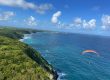
When you’re on the plateau, you get the impression that it’s relatively dry, but recently Mélanie had the opportunity to fly over the island of La Désirade from Saint-François in a microlight. There will be a full article on this great activity soon. Mélanie told me — and I believe her, looking at the photos — that it was one of the most beautiful things she had ever seen. She also said that the island looks surprisingly green from the air!
The chapel of Notre-Dame du Calvaire
As I mentioned earlier, one of the highlights of a stay on Désirade island is visiting the chapel. You’ll notice (if you’ve got eagle eyes) that the chapel (painted blue and white) is visible when you arrive by boat. It’s also visible from many places on the island. It can be reached by a small car from the center of Beauséjour. You can park next to it.
The chapel stands at an altitude of 200 m and was built in 1905 by a priest, Abbé Ruillier. It offers an exceptional view of the west of the island and its lagoon. It’s best to come early in the morning to get the sun at your back if you want to take pictures. In the late afternoon, the sun is in your face and depending on the situation, the light is not as good.


Take a moment to admire the scenery and, above all, the beautiful orientation table showing the surrounding landmarks. A must-see.
The desert botanical garden
A visit to the desert botanical garden is a must. Located just outside the village of Beauséjour, on a hillside, this place turned out to be a wonderful experience for us. Even though we’re not exactly cactus fanatics (haha), it’s definitely worth a visit. We spent almost two hours with the owner, Aline, who is truly passionate and shared so much about the garden, its history, and, of course, the cacti.
The walk is uphill, in a landscaped area, past hundreds, if not thousands, of cacti and succulents, each crazier than the last: very big, small, flowering or not, more or less prickly, etc.


It felt like a real exchange, and we had a great time. The cherry on top? At the very top, near the last terraces, you can access a lovely terrace for a drink or a bite to eat, by reservation only. The setting is beautiful, and the sunset views during our visit were magnificent. We really recommend it. Don’t hesitate to call ahead to arrange a visit. Here’s the Facebook page for the place.
Activities on La Désirade
I hesitated to include the botanical garden in this list of things to do on the island, because that’s exactly what it is, after all. In the end, I decided to focus here on two sportier activities.
First, scuba diving. As part of a partnership with Manawa, an activity booking website, and the only diving club (L’îlot plongée Désirade), I was lucky enough to dive on the island, off Pointe des Colibris. I’ll tell you all about it in our dedicated article, but I have some excellent memories of the dive, with some really interesting, rich and original seabed features (mini canyon, caves) and the 3 anchors from that era still visible underwater. If you have time, it’s a great activity and Olivier is really cool!
Another activity that seems like a good idea for sporty types is mountain biking around the island. Unfortunately, I didn’t have the time to do it. But I think if you spend a few days on the island, it’s a very nice and environmentally friendly way to discover the island. It allows you to visit at a slower pace, in peace and quiet. You can choose between a simple mountain bike or a bike with electric assistance (VAE). I think it’s worth trying!
We didn’t take the time to go snorkeling and explore the seabed and coral reefs with fins and masks. But given what I saw underwater, it could definitely be worth it.
The beaches of Désirade island
Alongside my personal impressions, I wanted to add a few useful details about the island’s beautiful beaches. When we were there, there was no sargasso, but I know that the island can be affected by it… My only hope is that when you are there it will be as beautiful as it was for us! The island has some beautiful beaches, and although I haven’t seen all the white beaches on Grande-Terre, Plage du Souffleur is the best I’ve seen since arriving in Guadeloupe. From west to east, here’s some information about the beaches of Désirade.
Galets beach / Anse d’Échelle
It is not far from Pointe des Colibris. We only came close to it when we were having a drink in the area. The beach is deserted but very nice. The only drawback is that it’s less swimmable than other beaches on the island, as it’s less sheltered. But it’s heavenly at sunset. You can get there directly from the Pointe. Or you can take a path that bends to the left before the end of the road. It is signposted.
Fan Fan beach
It is very close to the village of Beauséjour. This large beach has facilities, including huts where you can find shade when the sun is strong. Set in a beautiful coconut grove, the surroundings are very pleasant too!


Fifi beach
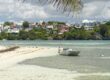
This is the village beach, less than a five-minute walk from Hotel Oasis, where we stayed for four days. The beach is also very nice with great views of the mountains. We came several times, if not every evening, to admire the beautiful lights and to play with the children. A big advantage is that you have access to several snack bars on the beach where you can eat in or take away and eat in the carbet on the beach. A perfect little spot for the evening.

Souffleur beach
This is the most beautiful sandy beach on the island, stretching for about 1 km. The beach is lined with coconut palms and is truly sublime. As is often the case, you’ll find several caravans to choose from, especially right next to the restaurant la Roulotte. The shades of blue are beautiful, and swimming in the turquoise water is a real treat. Another bonus is that you have access to several restaurants in the area. We tried 2 of them and we’ll tell you more about them later.
Petite Rivière beach
After Plage du Souffleur you’ll find this little beach. We spent two hours here as a family, enjoying the sea and the beach. It’s also a very nice place, far from the crowds, at least by La Désirade standards, I must admit. Note the evidence of dead coral on the rocks at the back of the beach (on the left as you arrive). A great place for children to explore and not bad for swimming either.

Local crafts
Finally, you should know that there are also some local handicrafts. Although we didn’t have the time or opportunity to visit the shops, I know there are a few little places where you can find local creations.
- At the Indigo Shop, you can discover how plants are used to create color. I hear it’s very interesting,
Desijaspe is a small shop where you can find and buy beautiful cut and engraved stones from the island of Désirade, - There are also a number of shops on the island where you can buy honey made on the island,
- Finally, there is also a soap factory that uses traditional methods to make local soap.
That’s the end of this little travel story. If you’re interested in the Guadeloupe islands, I invite you to discover the sublime Terre-de-Haut island, in the Saintes archipelago. We spent a long weekend there and really enjoyed it.
La Désirade: practical information
Below, as usual in my travel articles, I’m sharing everything you need to know for a stay on La Désirade.
How do you get to Désirade?
To get to the island of Désirade, you’ll need to travel to Guadeloupe first. I’ve been using the Skyscanner travel comparator for about ten years now. It makes it easy to compare flights in a smart way. If you’re planning your trip, I suggest you look at the dates in detail and compare them, ideally being a little more flexible.
Depending on the season and airline, you can sometimes find flights from Paris for around €350 to €400. There are even direct flights from the provinces. In fact, we’ve written a whole article on how to get to Guadeloupe for less.
Once you’re there, you’ll have no choice but to rent a car. In my opinion, visiting Guadeloupe without a means of transport is too complicated, as the island is far too big to get around on foot and public transport is not really reliable. It also gives you more independence.
A long time ago I got into the habit of checking prices on a car rental comparison site, DiscoverCars. If you look carefully and are flexible with your dates, you can find some great bargains.
As for the island of Désirade, you should know that it’s impossible to get there by plane. Although there is an airport on the island, there are no airlines offering this service. Like us, you’ll have no choice but to take a boat from Saint-François on Grande-Terre. As far as I know, there is only one company that flies to Désirade: Comadile. I strongly advise you to check the exact timetable in case things change, but when we left there were two departures a day from Saint-François: the first at 8:00 am on weekdays, or 8:15 am on weekends, and the second at 5:00 pm. To make the most of the day, we left at 8am in the morning. It takes less than an hour to cross to reach Désirade. Depending on the time of year, the sea can be quite rough, especially once you pass the Pointe des Châteaux (which was our case). If, like Mélanie, you get seasick, a little Mer Calme won’t hurt. However, as we skirt the Pointe des Châteaux for a long time, the crossing is still very pleasant. The link above will tell you what there is to see and do in the area.
You can also take a service provider from Saint-François and make a day trip to the island of Désirade at the same time as the islands of Petite-Terre. As far as I’m concerned, it’s not worth it and you’re bound to end up messing it up. My father-in-law, who came here on vacation, spent only two hours on Désirade on such a trip. As a result, apart from saying that he had set foot on the island, he hadn’t really seen anything at all… A matter of taste, that’s just my opinion.
As far as fares are concerned, count €39 return per adult and €25 for children.


Where to stay on Désirade island
There are several places to stay on Désirade island, although I should say from the start that there are no luxury hotels here. As part of a partnership, we stayed at the Hotel Oasis for 4 nights. We found the value for money very good and the hotel is perfectly located for the town center and the beach, which is less than a five-minute walk away. We opted for half board with dinner and breakfast and frankly we were not disappointed. The Lagranlag restaurant is really good and we enjoyed it every night.
If you’d like to read more about how we felt and our stay at the hotel in detail, please read our full hotel review. There are other places to stay on the island, including a number of gîtes and guesthouses.
Where to eat on the island
When you’re on vacation, eating well matters, doesn’t it? During our four days on the island, we ate every evening at the restaurant that runs the Oasis Hotel’s half board service: Lagranlag. It is located in the center of the village of Beauséjour. We were never disappointed and everything was very good. I definitely recommend it if you want a reliable place to eat well.
We also ate at La Roulotte restaurant. The location is exceptional and the view over the lagoon is breathtaking, right on the sandy beach of Le Souffleur. However, I didn’t find the food particularly exceptional and thought the prices were rather high for something so simple. But the setting and the swimming were first-rate.
A little further on, we also went to eat at the Rose-Ita restaurant. All in all, I liked eating there much more than I liked eating at Restaurant de la Roulotte. The view over the lagoon is also exceptional and the food was quite decent for an acceptable price.
There are other restaurants with a good reputation that we didn’t try, such as Les Pieds dans le Sable and Restaurant la Payotte. A special mention goes to Pilipili, the little food truck in front of Fifi beach in Beauséjour, which serves good grilled meats with rice in the evening. Big portions and very good rice, much better than the two restaurants we tried.
If you want to cook for yourself, there are a few small shops around the island that sell all the essentials, so don’t worry.
How to get around the island
Here, it really depends on you. We are now a family of 4. It was essential for us to rent a car, especially as Téo is still very young. We hired a Duster from Ideal Location (05.90.20.08.45) for 40 euros a day. The cars aren’t new, but I was told it was, and I quote, “one of the least bad on the island,” haha. I’m sure there are other car rental companies in town like Villeneuve Location and Carib Location.
You can rent baby seats on site — don’t look too closely at the condition, eh! — as well as small cars (€30) and scooters (€15 per day). You can also hire quads for around €20 a day, although I don’t have all the details. Please note that there is only one petrol station on the island, at the jetty (closed on Sunday mornings when we were there).
I know that Dési-rando offers local excursions for those who prefer to hire a guide. I haven’t tried it myself, but I’ve heard good things.

How many days do you need to visit Désirade?
I’m coming to the end of this very long article, and I hope you’ve enjoyed it. How long you should stay is a very personal question, and that’s true. We all travel differently, at our own pace, with or without children. Some people like to take their time, others prefer to visit one place at a time, while others spend their days on the beach. It’s a matter of taste, not judgment.
Personally, as far as we’re concerned, there are four of us and a baby who is almost two at the time of writing. He still needs a nap and anyway we’re travelling slowly, at our own pace. If we’d listened to people before we left, we’d only have gone for 1 or 2 days, which would have been more than enough. In the end, we went our own way and stayed on the island for 4 full days. The verdict? It was perfect, not too long and not too short.
As you can see, there’s still a lot to see and do, and if you want to take your time, you can spend four days without worrying. Personally, I’d have stayed a week without a care in the world.
I’ll stop here! I sincerely hope I’ve inspired you to visit this beautiful island of Désirade. It really is a little haven of peace, exactly the kind of place we love, and in some ways it reminded me of the remote islands of French Polynesia. There aren’t many people around (although there are tourists) and quite a few locals come to spend the weekend on the island. It’s quiet, relaxing, and honestly as beautiful as you could hope for. If you’re planning a trip to Guadeloupe in the near future, this is definitely a place to visit.
I invite you to discover the Sentier de la Grande Pointe if you like quiet places and you’re in the Trois-Rivières area.
In a different style, the archipelago of Les Saintes, in the south of Guadeloupe, is a little marvel to discover!
See you soon.

Written by Sylvain PONS
Since 2021, I've been living in the Guadeloupe archipelago with Mélanie and our two children. We are exploring these beautiful islands and discovering the treasures that we are happy to share with you!
Despite our care, a mistake may have slipped into this article. If you find any, please don't hesitate to let us know so we can correct it as soon as possible and keep our information up-to-date!