Diving on La Désirade
Last update: 06/23/2026
Our blog continues to grow thanks to you, our readers. This post may contain affiliate links, which means we can earn a small commission if you make a purchase through them, at no extra cost to you. This helps us to continue to bring you more and support our work!
Here I am again, writing about Guadeloupe—more specifically, one of its islands: La Désirade. At the time of writing, we had been living in this beautiful part of the world for eight months. After exploring Terre-de-Bas in Les Saintes, it was time to discover the wonderful island of La Désirade. We took advantage of a four-day weekend around the mid-Lent holiday to visit this peaceful place, which we had heard nothing but good things about since arriving.
Naturally, you can find our complete guide to what to see and do on La Désirade. In our opinion, diving on La Désirade is one of the island’s highlights. I had the chance to dive there through a partnership with L’Îlot Plongée Désirade and Manawa. Manawa is a reliable platform for booking outdoor activities, and it is one we have used on several occasions.
Come along as I explore the local marine life at a dive site just off the island. Whether you are a beginner or an experienced diver, the setting has plenty to offer. Here is my account of a dive with Olivier, who runs the operation.
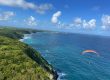
I invite you to read about Mélanie’s microlight flight if you’re looking for another way to explore the island. She spent over an hour and a half in the air. She flew over the beautiful island of La Désirade!
Diving on La Désirade
Let us be honest: diving may not be the first thing that comes to mind when you picture La Désirade. Unless you live in Guadeloupe or have visited before, you may never even have heard of this small tropical island off Pointe des Châteaux. Still, as someone who spends a lot of time looking at maps and satellite images, I was excited by the idea of exploring its underwater landscape. The reefs visible around the island from above certainly looked promising.
I met Olivier at 8:30 a.m. at the island’s only gas station. We got to know each other that morning while I collected my diving gear—BCD, fins, mask, and snorkel—before boarding his Zodiac. The weather was fairly good. During the outing, he explained that tourism in Guadeloupe, and especially on a small island like La Désirade, had been hit hard since the beginning of the Covid pandemic. At the time of my visit, he was therefore running the business from home rather than from a conventional dive center. He had installed a container containing everything he needed, which also kept the equipment protected during cyclones—a very real concern in the French West Indies and across the Caribbean.
There were only two of us on the boat, which made the outing feel particularly special. Olivier confirmed that he would still head out even when only one diver had booked. It is best to reserve in advance, as this allows him to organize each outing around the weather and sea conditions. A former fisherman, Olivier had been diving for more than 20 years and had lived on the island for 25 years at the time, so he knew the area extremely well. He was also a volunteer firefighter. We left the harbor at around 9:00 a.m. for a boat ride of roughly half an hour. The ride became a little bumpy as we left the harbor and entered the main channel, where the trade winds often make the sea choppier at that time of year.
We headed toward the southwest of the island, roughly off Pointe des Colibris—a beautiful spot that we later revisited by car to watch the sun set behind Pointe des Châteaux. Once there, we began searching for a mooring buoy Olivier had installed to mark the dive site known as Les Tuyaux, or “the pipes.” The name may not sound especially glamorous, but it refers to an old utility line that once connected La Désirade to Guadeloupe and supplied the island with water, electricity, and telecommunications. The line was damaged when Hurricane Lenny struck Guadeloupe and its islands in November 1999, and the replacement was later installed farther away.

Unable to locate the buoy, we eventually dropped anchor in roughly 20 meterseters of water. The weather was pleasant and the water looked clear enough for a good dive. Olivier prepared the safety equipment, including a spare cylinder underwater and a buoy at the stern where we could secure our tanks and BCDs before climbing back aboard. After a short briefing, we entered the water and set off to explore the site.
We descended slowly along the anchor line to a depth of between 15 and 20 meterseters. Visibility was very good at the start of the dive. As I write this, I am reminded how difficult it is to put a great dive into words. Diving is something you really have to experience for yourself, but I will do my best to describe it. Once we reached the bottom, I allowed a gentle current to carry me along as I followed Olivier. Although I hold a French Level 4 diving qualification, I did not know the site, whereas Olivier knew it inside out and was the ideal guide.


Aside from the water feeling relatively cool at 25°C, the first thing that struck me was the abundance of underwater life. We passed through an area of hard and soft corals that appeared to be in very good condition. Numerous medium-sized sea fans swayed with the current, while the soft corals moved around us. Weaving between them was a real pleasure. The site was home to the familiar tropical marine life of the Caribbean. Large schools of fish followed us and circled nearby. Several groups of sergeant majors, easily recognized by their five dark vertical stripes, stayed close to us. We also spotted Caesar grunts, a French angelfish, schools of damselfish, a group locally known as manioc fish, and many other colorful species. It would have been a wonderful opportunity for underwater photography with a GoPro. We did not see any of the larger animals, such as sharks, manta rays, whales, or dolphins, but we were lucky enough to hear cetaceans during much of the dive, which was a memorable experience in itself.
I especially enjoyed how the scenery changed throughout the dive. We crossed sandy areas where we came close to two beautiful stingrays, then explored rockier sections filled with crevices, small caves, and arch-like formations. It is difficult to describe the feeling of swimming beneath one of these natural arches. Everywhere I looked, another detail of the underwater world appeared. I followed a few meters behind or beside Olivier, taking in this small marine universe. I no longer dive as often as I did when Mélanie and I lived in Mayotte, before we had children, but being underwater is still a real pleasure.


For several minutes, we followed the old pipe, which had been colonized by marine life at an impressive rate. Over roughly two decades, nature had almost completely covered this man-made structure. We also passed three anchors believed to date from the 19th century. They, too, were covered in marine growth, although their shapes remained clearly visible.
Toward the end of the dive, the water became slightly murkier and the current picked up, but neither was particularly troublesome and there was still plenty to see. We never tired of watching the two stingrays glide over the sand. After 55 minutes underwater and a maximum depth of 18 meters, it had been a very enjoyable dive. I was beginning to feel the cold, but I had managed reasonably well in 25°C water, which was close to its seasonal low at that time of year.


We made our way back as the swell began to build offshore and even inside the lagoon. I had thoroughly enjoyed both the site and the overall experience. The seabed was rich in marine life and offered plenty to look at throughout the dive. We chatted over a drink that Olivier kindly offered me, and I promised to return the favor on my next visit. One advantage of living in Guadeloupe was that I now had every reason to return to La Désirade for another long weekend. Olivier offered introductory dives for beginners, generally in the lagoon, as well as guided dives for qualified divers. Other local sites included the Kachakou wreck at 17 meters, Kaye a Man Armide at 15 meters, Les Cathédrales at 20 meterseters, and Pointe Monbin at 30 meters.
I invite you to read our report on diving in the Cousteau Reserve on the west coast of Guadeloupe. It was also a great discovery and excursion!

Olivier also told me about a viewpoint in the hills that we had missed the previous day. Near the old windmills, there is a beautiful view across Souffleur Beach toward the far end of the island. I will share more about it in our complete guide to visiting La Désirade. Based on my experience, Olivier’s operation was a very good choice for exploring the island’s underwater world, and the equipment provided was in good condition.
By the way, for another peaceful water-based activity, we also tried paddleboarding through the mangroves of Morne-à-l’Eau.
See you soon for another article on Guadeloupe. In the meantime, I invite you to read our article on all you need to know about coming to Guadeloupe. We explain the different options available.
See you soon.
Written by Sylvain PONS
Since 2021, I've been living in the Guadeloupe archipelago with Mélanie and our two children. We are exploring these beautiful islands and discovering the treasures that we are happy to share with you!
Despite our care, a mistake may have slipped into this article. If you find any, please don't hesitate to let us know so we can correct it as soon as possible and keep our information up-to-date!