Fujifilm X telephoto lens guide
Last update: 06/16/2026
Our blog continues to grow thanks to you, our readers. This post may contain affiliate links, which means we can earn a small commission if you make a purchase through them, at no extra cost to you. This helps us to continue to bring you more and support our work!
I know it’s been a while since I last wrote about camera gear. As the year draws to a close, I’ve decided to get back into it with this full guide to Fujifilm X telephoto lenses. If you haven’t heard already, we’ve made some major changes to the photography section of the blog over the past few months. We’ve added all the key features to help you choose the right lens: weight, dimensions, minimum focusing distance, optical construction, and more. In short, it was a huge project that took months of teamwork!
Speaking of lenses, I suggest taking a look at our page on all X-mount lenses. It will give you a good overview of what’s available. Back to this article: I’ll mainly focus on the longest focal lengths for X-mount, including both Fujifilm and third-party options. I’ll cover both zooms and prime lenses above 100mm.
On this page, I won’t cover focal lengths between 56mm and 90mm, which are generally better suited to close-up portraits. I’m planning a separate article on that subject. Here, I’ll focus on the other telephoto lenses that are better suited to wildlife, sports, and any situation where you need more reach than classic standard zooms such as the 16-80mm or 16-55mm. You can also read our comprehensive article on Fujifilm zoom lenses.
Best X-mount telephoto lenses
Telephoto zoom lenses for X-mount
Below is a summary table to help you visualize and compare the main characteristics of all the lenses mentioned in this article. You’ll also find the price, dimensions, weight, and minimum focusing distance. You can even sort the lenses by the specifications that matter most to you by clicking on the column headings. I hope it helps you narrow down your choice.
| Zoom telephoto lenses X | Focallength | Max.Aperture | Weight | Dim. (Ø x L) | Min. FocusDist. | Approx.price | Best price | |||
|---|---|---|---|---|---|---|---|---|---|---|
| + | Fujifilm XF 50-140mm f/2.8 R LM OIS WR X | 50-140mm | f/2.8 | 2.2 lb / 995g | 3.3 x 6.9" / 83 x 176 mm | 3.3' / 100 cm | $1 599 | Amazon B&H | More info + | |
|
||||||||||
| + | Fujifilm XC 50-230mm f/4.5-6.7 OIS II | 50-230mm | f/4.5-6.7 | 13.23 oz / 375g | 2.7 x 4.4" / 70 x 111 mm | 3.6' / 110 cm | $399 | Amazon B&H | More info + | |
|
||||||||||
| + | Fujifilm XF 55-200mm f/3.5-4.8 R LM OIS | 55-200mm | f/3.5-4.8 | 1.3 lb / 580g | 3 x 4.6" / 75 x 118 mm | 3.6' / 110 cm | $699 | Amazon B&H | More info + | |
|
||||||||||
| + | Fujifilm XF 70-300mm f/4-5.6 R LM OIS WR | 70-300mm | f/4-5.6 | 1.3 lb / 588g | 3 x 5.2" / 75 x 133 mm | 2.7' / 83 cm | $799 | Amazon B&H | More info + | |
|
||||||||||
| + | Sigma 100-400mm f/5-6.3 DG DN OS Contemporary X | 100-400mm | f/5-6.3 | 2.5 lb / 1135g | 3.4 x 7.8" / 86 x 197 mm | 3.6' / 110 cm | $789 | Amazon B&H | More info + | |
|
||||||||||
| + | Fujifilm XF 100-400mm f/4.5-5.6 R LR OIS WR | 100-400mm | f/4.5-5.6 | 3 lb / 1375g | 3.7 x 8.3" / 95 x 211 mm | 5.7' / 175 cm | $1 899 | Amazon B&H | More info + | |
|
||||||||||
| + | Tamron 150-500mm f/5-6.7 Di III VC VXD X | 150-500mm | f/5-6.7 | 3.8 lb / 1710g | 3.7 x 8.3" / 93 x 210 mm | 2' / 60 cm | $1 499 | Amazon B&H | More info + | |
|
||||||||||
| + | Fujifilm XF 150-600mm f/5.6-8 R LM OIS WR | 150-600mm | f/5.6-8 | 3.5 lb / 1605g | 3.9 x 12.4" / 99 x 315 mm | 7.9' / 240 cm | $1 999 | Amazon B&H | More info + | |
|
||||||||||
This is the current list of telephoto zoom lenses for X-mount. As you’d expect, most are Fujifilm lenses, but a few third-party brands, especially Tamron and Sigma, also offer some very solid alternatives. Here’s the detailed list:
Fujifilm XF 50-140mm f/2.8 R LM OIS WR X
| Features | Visual |
|---|---|
|

|
The Fujifilm XF 50-140mm f/2.8 OIS WR, released in 2014 (yes, it’s been a while!), remains a key lens in Fujifilm’s APS-C mirrorless lineup. It is a professional-style telephoto zoom with a bright f/2.8 aperture and a full-frame equivalent range of about 76-213mm. Given its reach and aperture, it remains a relatively compact and practical telephoto lens.
In terms of construction, this is a high-end lens with an aluminum body and weather-sealing. Optically, it features 23 elements in 16 groups, including five ED elements and one Super ED element. The zoom and focus rings feel excellent in use. The lens is stabilized, uses a triple linear motor for high-quality autofocus, and takes 72mm filters.
In terms of performance, sharpness is very good from the center to the edges throughout the zoom range. Optical flaws are very well controlled: chromatic aberration and distortion are virtually nonexistent. Vignetting is visible at full aperture, but it is easy to correct in post-processing. If you’re looking for a telephoto lens for portraits or for images where the subject really stands out, such as wildlife close-ups, this Fuji is also known for its excellent bokeh.
In conclusion, the Fujinon XF 50-140mm f/2.8 OIS WR offers excellent image quality and high-end construction. You’ll need to stretch your budget to afford it, but I still think it’s a solid investment, and the price remains fair for this level of performance.
We also mention this lens in our article on the best Fujifilm X APS-C lenses for portrait photography.
Fujifilm XF 55-200mm f/3.5-4.8 R LM OIS
| Features | Visual |
|---|---|
|
|
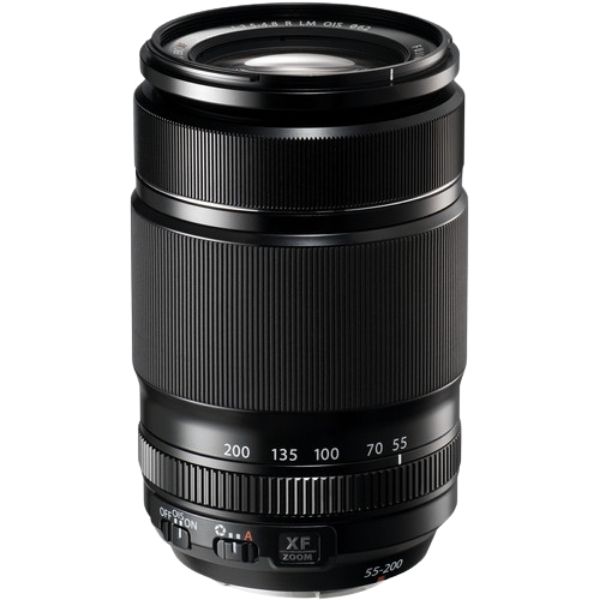
The Fujinon XF 55-200mm f/3.5-4.8 R LM OIS was released in 2013 to complete Fujifilm’s mirrorless lens lineup. It is a versatile zoom and a natural companion to the Fujinon XF 18-55mm f/2.8-4. Its focal range is equivalent to about 84-305mm in full frame, which makes it well suited to wildlife or sports photography in good light. Its dimensions remain reasonable, and it weighs just 580g.
In terms of design and construction, this telephoto lens has an attractive metal finish. The barrel is comfortable to hold, and the metal mount feels reassuring. The lens also has a wide, firm zoom ring. Optically, it includes 14 elements in 10 groups, with one aspherical element and two ED elements to minimize chromatic aberration. The f/3.5-4.8 maximum aperture is not especially bright, but it works well in good light. It has a minimum focusing distance of 110cm and a 62mm filter thread. The lens is stabilized, but not weather-sealed.
The optical performance of the XF 55-200mm is very good for a lens in this range. Sharpness is excellent, even at full aperture, and remains fairly consistent from the center to the edges. Chromatic aberrations are well controlled. Distortion is negligible, while vignetting remains moderate and can be reduced by stopping down or corrected in post-processing. The lens also uses Fujifilm’s Super EBC coating, which helps limit flare and reflections.
All in all, this is a very good telephoto lens at a reasonable price, with a decent maximum aperture and solid optical performance. If you’re looking for a capable telephoto lens without breaking the bank, the Fujinon XF 55-200mm f/3.5-4.8 R LM OIS could be exactly what you need.
Fujifilm XF 70-300mm f/4-5.6 R LM OIS WR
| Features | Visual |
|---|---|
|

|
Introduced in January 2021, the Fujinon XF 70-300mm f/4-5.6 R LM OIS WR is a versatile lens with a full-frame equivalent range of approximately 107-457mm, making it ideal for wildlife, sports, and everyday travel photography. With its manageable size and weight, it is a very good, more compact, and less expensive alternative to the 100-400mm.
In terms of construction, this telephoto lens has a fairly plastic body, but it still feels sturdy and comfortable to hold. It is also dust- and moisture-resistant thanks to its weather seals. The lens has a non-click-stop aperture ring, which may matter to videographers. It contains 17 elements in 12 groups, including one aspherical element and two ED elements, which help limit chromatic aberration and distortion. The optical stabilization is effective, and the lens is compatible with Fujifilm XF 1.4x and 2x teleconverters, giving it even more reach.
In terms of performance, sharpness is excellent, especially in the center of the frame at full aperture. It drops slightly toward the edges, particularly at 300mm, but the difference remains limited. By stopping down to f/7.1 or f/8, you can easily achieve more even sharpness. Vignetting is well controlled at 70mm but more visible at 300mm, although it can be corrected in post-processing. Distortion is well controlled.
In conclusion, the Fujinon XF 70-300mm f/4-5.6 R LM OIS WR is a versatile, high-performance telephoto lens that, in my opinion, offers excellent value for money. Although its variable aperture can limit its use in low light, it offers effective stabilization and very solid image quality. Considering the price and weight difference compared with the Fujifilm XF 55-200mm f/3.5-4.8 R LM OIS, I personally prefer this 70-300mm, which also gives you more reach.
Fujifilm XF 100-400mm f/4.5-5.6 R LM OIS WR
| Features | Visual |
|---|---|
|
|
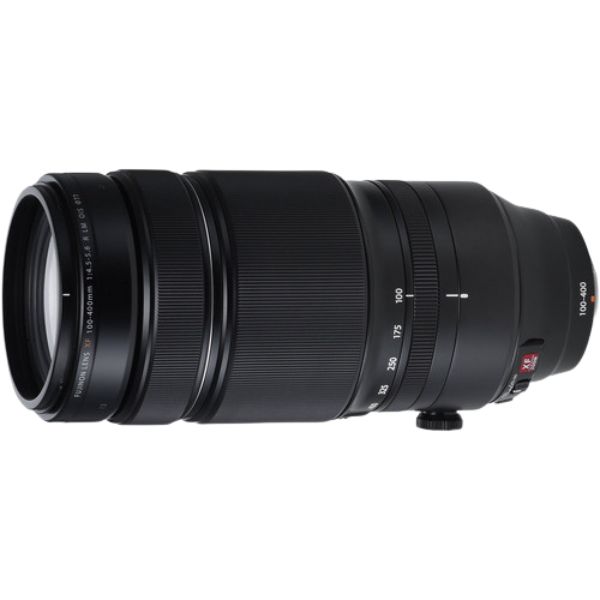
Since its release in February 2016, the Fujinon XF 100-400mm f/4.5-5.6 R LM OIS WR has established itself as one of the benchmark telephoto lenses for X-mount. With a full-frame equivalent reach of about 152-609mm, it is ideal for sports and wildlife photography. In terms of size and weight, it is obviously heavier and more imposing than the 70-300mm, but still reasonable for its category.
The construction of this Fuji lens is very good, with a mix of metal and plastic, although newer designs feel more refined. It also has 13 weather seals. The lens uses 21 elements in 14 groups, including five ED elements and one Super ED element, which helps minimize chromatic aberration. Autofocus is fast and quiet thanks to two linear motors (LM). Finally, optical image stabilization (OIS) is rated at 5 stops, which remains useful at long focal lengths.
In terms of optical performance, the Fujinon XF 100-400mm offers excellent central sharpness from full aperture. There is good consistency throughout the focal range, although at 400mm the edges lose a little sharpness. Vignetting is visible at full zoom but can be corrected easily in post-processing. Reflections and flare are kept to a minimum thanks to the effective lens coating. Chromatic aberrations are practically nonexistent. Overall, the bokeh is very good: rather creamy at close range and a little more nervous at longer distances.
All in all, the Fujinon XF 100-400mm f/4.5-5.6 R LM OIS WR remains an excellent choice for X-mount, even after the release of the newer XF 150-600mm, which is more expensive and even more imposing. It still costs more than €1,000, but it remains a very good lens if you’re looking for a long focal length.
Fujifilm XF 150-600mm f/5.6-8 R LM OIS WR
| Features | Visual |
|---|---|
|

|
Introduced in May 2022, the Fujinon XF 150-600mm f/5.6-8 R LM OIS WR is the longest telephoto zoom in the X-mount range, with a full-frame equivalent range of 229-914mm. Its reach can even be extended to a 1,371mm equivalent with the 1.4x teleconverter and a 1,828mm equivalent with the 2x teleconverter. This telephoto lens complements the XF 100-400mm with a modern internal-zoom design, improved ergonomics, and a much longer focal range.
The weather-sealed lens has a magnesium-alloy barrel, 19 seals, and a fluorine coating on the front element. It uses 24 elements in 17 groups, including three ED elements and four Super ED elements to minimize chromatic aberration. The lens also features a click-stop aperture ring, a responsive zoom ring, and a focus preset system. Autofocus is fast and quiet, and optical stabilization is rated at 5 stops.
In terms of optical performance, the Fujinon XF 150-600mm offers very consistent image quality, even at full aperture. Center sharpness is excellent at f/5.6, while the edges are a little softer. Vignetting is present but barely noticeable and can be corrected easily if needed. Chromatic aberrations are practically nonexistent, and distortion is very well controlled.
In short, the Fujinon XF 150-600mm f/5.6-8 R LM OIS WR is an excellent choice for wildlife or sports photographers looking for a modern telephoto lens with serious reach. Feedback on this model has been excellent, even though it remains one of Fuji’s most expensive zoom lenses.
Fujifilm only opened up its mount relatively recently, so very few third-party manufacturers offer very long focal lengths, whether zooms or primes. As I mentioned earlier in the article, Tamron and Sigma are currently the main alternatives to Fuji in this range.
Tamron 150-500mm f/5-6.7 Di III VC VXD X
| Features | Visual |
|---|---|
|
|
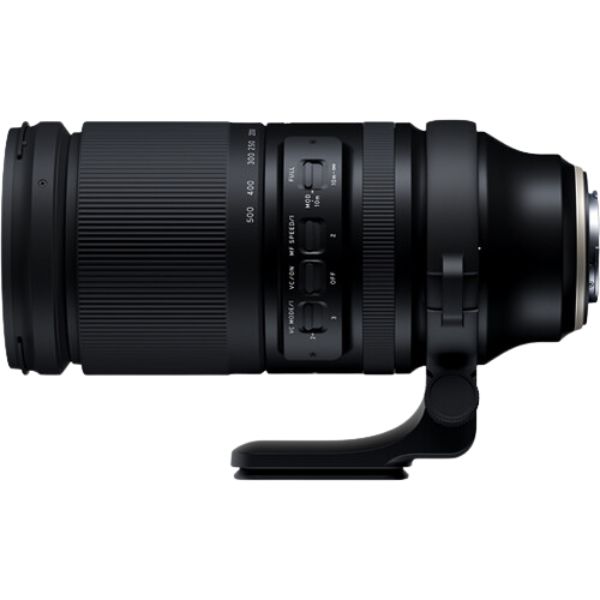
The Tamron 150-500mm F5-6.7 Di III VC VXD for Fujifilm X is a very good first alternative to Fuji telephoto lenses, especially the Fujinon XF 100-400mm f/4.5-5.6 and XF 150-600mm f/5.6-8. I even bought the Sony FE version for my Sony A7 III, and I can tell you I’m really pleased with it! This lens was originally designed for Sony full-frame cameras before being adapted to APS-C mounts. On Fujifilm X, it offers a full-frame equivalent range of 225-750mm, making it an excellent choice for wildlife and sports photography. In terms of weight (1,710g) and dimensions, it sits between Fuji’s two main telephoto zooms. Its price also remains relatively reasonable.
The build quality of this Tamron is good, with composite materials and a magnesium-alloy body. It uses 25 elements in 16 groups, including five LD elements and one XLD element to reduce chromatic aberration as much as possible. The VC stabilization system offers three modes: standard stabilization, panning mode, and framing priority mode. Autofocus is quiet and fast thanks to a VXD linear motor. The minimum focusing distance varies by focal length: 0.6m at 150mm and 1.8m at 500mm, giving a useful 0.32x maximum magnification ratio. I often use it to capture details of plants in the forest, for example.
In terms of performance, the Tamron 150-500mm holds up very well against the Fuji lenses. At 150mm, sharpness is good in the center and fades slightly toward the edges. Stopping down a little helps get the best image quality. At 500mm, there is a slight drop in contrast and sharpness, especially at the edges, but it remains perfectly acceptable. Vignetting and distortion are practically nonexistent. Flare is also well controlled thanks to the BBAR-G2 coatings. On top of all that, the bokeh is soft and makes it easy to isolate your subject in almost any environment. When light is scarce, though, you’ll need to raise the ISO a little.
In conclusion, this lens is an excellent alternative to Fuji’s own options, even if it is a little less sharp. It is also much cheaper than the Fuji 150-600mm. In my opinion, it offers very good quality and works perfectly for wildlife, sports, and even long-distance landscape photography. It remains excellent value for money, as is often the case with Tamron lenses.
Sigma 100-400mm f/5-6.3 DG DN OS Contemporary X
| Features | Visual |
|---|---|
|
|
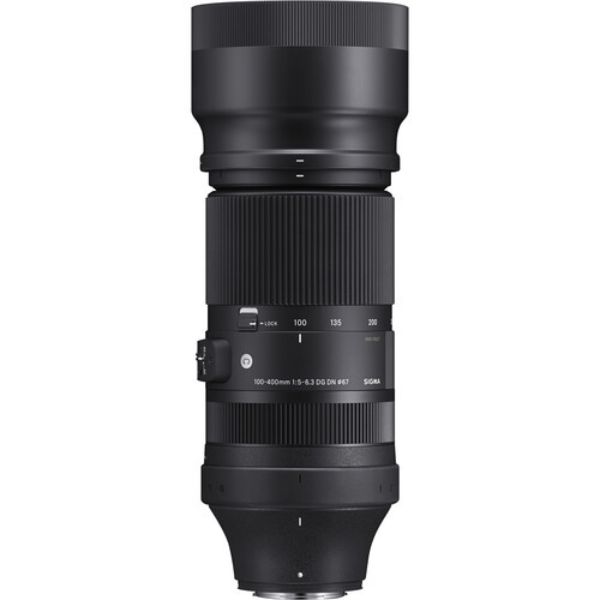
Introduced for Fujifilm X-mount in 2023, the Sigma 100-400mm f/5-6.3 DG DN OS Contemporary is positioned as a more affordable and portable alternative to other X-mount telephoto lenses. Its focal length is equivalent to 150-600mm in full frame. Its weight and length make it one of the lightest and most compact telephoto lenses in this category. Priced under €1,000, it is a serious competitor to the Fujifilm XF 100-400mm in particular, as well as the Tamron 150-500mm, while offering solid performance.
The construction of the Sigma 100-400mm is quite neat. The lens uses an external zoom with a smooth mechanism. It also includes several controls, including a focus range limiter, two optical stabilization (OS) modes, and an AF-L button for locking autofocus. The optical formula includes 22 elements in 16 groups, with a maximum aperture of f/5 to f/6.3 and a minimum focusing distance of 1.12m, giving a 0.24x magnification ratio. The lens is also weather-sealed.
In terms of performance, the Sigma delivers excellent sharpness, even on 40MP sensors such as the Fujifilm X-H2. At shorter focal lengths (100-200mm), this telephoto zoom can rival the Fujifilm XF 100-400mm. That said, the Fujifilm still offers better overall image quality at 400mm. The Sigma makes up for this partly with very accurate autofocus. Its bokeh is pleasing, although a little busier than the Fujifilm’s. Optical flaws are well controlled: vignetting is almost nonexistent, chromatic aberrations are minimal, and pincushion distortion remains low.
Finally, the Sigma 100-400mm f/5-6.3 DG DN OS is an excellent alternative if you’re looking for long reach, good autofocus, and strong sharpness at a more affordable price than the Fuji. It is also a very interesting alternative to the Fujifilm XF 70-300mm f/4-5.6 R LM OIS WR, although a little more expensive, while offering more reach.
If you’d like to know more about Sigma’s X-mount lenses, check out our article on the subject.
For smaller budgets
Beginners looking for affordable, lightweight lenses should take a look at Fujifilm’s XC range. In general, these lenses offer compact designs and good image quality for the price. They are clearly good options if you want to take your first steps into photography without breaking the bank.
Fujifilm XC 50-230mm f/4.5-6.7 OIS II
| Features | Visual |
|---|---|
|
|
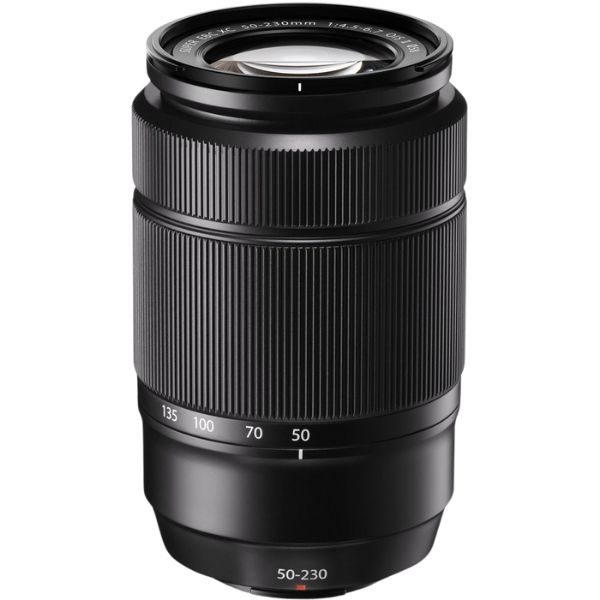
The Fujifilm XC 50-230mm f/4.5-6.7 OIS II is an affordable telephoto lens for Fujifilm X-mount. It offers a full-frame equivalent range of approximately 76-350mm. Compact and lightweight, it weighs just 375g and is only 111mm long. With a price of around €400, it’s the most affordable option if you want to try a longer focal length.
Unsurprisingly, it is made entirely of plastic. The handling may not feel ideal to everyone, but the advantage is its light weight. Unlike XF models, there is no aperture ring. Once in use, the zoom extends significantly, but the mechanism remains smooth. The lens is stabilized (OIS), which helps compensate for the limited f/4.5-6.7 aperture. It is made up of 10 elements in 7 groups, with an EBC anti-reflective coating that helps reduce flare. The minimum focusing distance is 1.10m, giving a maximum magnification of 0.2x.
In terms of optical performance, sharpness is decent for this price range. At 100mm and 200mm, the center of the image is acceptably sharp, but the edges are much softer, especially at full aperture. At 230mm, quality drops: sharpness is less precise and contrast is lower. Optical flaws are well managed overall: vignetting is minimal, chromatic aberrations are controlled, and pincushion distortion remains low.
In short, the Fujifilm XC 50-230mm f/4.5-6.7 OIS II is clearly an affordable lens for beginners or anyone on a budget. Although its optical performance does not match the XF range, it remains a good option to take with you on a trip, for example.
X-mount prime telephoto lenses
Apart from shorter focal lengths such as 85mm and 90mm (there is a very good 90mm macro lens for X-mount — see our macro article), there are currently only two prime telephoto lenses for X-mount. Both come at a very high price and are aimed at wealthy enthusiasts, professionals, or anyone who wants to treat themselves and can afford it!
As usual, here’s a summary table showing all the lens characteristics.
| X-mount prime telephoto lenses | Focallength | Max.Aperture | Weight | Dim. (Ø x L) | Min. FocusDist. | Approx.price | Best price | |||
|---|---|---|---|---|---|---|---|---|---|---|
| + | Fujifilm XF 200mm f/2 OIS WR | 200mm | f/2 | 5 lb / 2265g | 4.8 x 8.1" / 122 x 206 mm | 5.9' / 180 cm | $4 999 | Amazon B&H | More info + | |
|
||||||||||
| + | Fujifilm XF 500mm f/5.6 R LM OIS WR | 500mm | f/5.6 | 2.9 lb / 1335g | 4.1 x 10.1" / 105 x 256 mm | 9' / 275 cm | $2 999 | Amazon B&H | More info + | |
|
||||||||||
Here are the two lenses in detail:
Fujifilm XF 200mm f/2 OIS WR
| Features | Visual |
|---|---|
|

|
Released in December 2018, the Fujinon XF 200mm f/2 R LM OIS WR is Fujifilm’s first X-mount prime telephoto lens. With a full-frame equivalent focal length of about 305mm and a bright f/2 aperture, it is perfect for wildlife, sports, and even long-distance portraits. Weighing 2,265g, the lens body is made from a solid magnesium alloy. Despite its weight, it remains ergonomic and well thought out, with a classic aperture ring, a focus range selector, and all the necessary AF buttons. Stabilization is rated at up to 5 stops.
The optical quality of this telephoto lens is excellent. Sharpness is already excellent at f/2, chromatic aberrations are perfectly controlled, and bokeh is soft and creamy. Even with the 1.4x converter, performance remains very strong. Autofocus is fast, quiet, and accurate, which is ideal for capturing moving subjects. The price is high, but it still feels justified.
Fujifilm XF 500mm f/5.6 R LM OIS WR
| Features | Visual |
|---|---|
|

|
The Fujinon XF 500mm f/5.6 R LM OIS WR is the longest prime lens in the Fujifilm X lineup. With a full-frame equivalent focal length of about 762mm, it features 21 elements in 14 groups, including ED and Super ED glass. Its rugged, weather-sealed design, with 20 seals, makes it a strong ally for shooting in harsh conditions. Weighing just 1,335g, it is impressively light for a 500mm lens. The lens is stabilized up to 5.5 stops, and its autofocus is said to be very fast.
The lens is also compatible with Fuji’s teleconverters, reaching up to a 1,524mm equivalent with the 2x teleconverter. The optical performance of the Fujinon XF 500mm is remarkable. Center sharpness is excellent from f/5.6, with excellent consistency all the way to the edges. Optical aberrations are very well controlled, with virtually no chromatic aberration, very little vignetting, and hardly any visible flare. Bokeh is smooth and harmonious thanks to the 9-blade rounded diaphragm. In short, the Fujinon XF 500mm f/5.6 R LM OIS WR is aimed primarily at professionals or photographers looking for exceptional image quality. This telephoto lens offers impressive optical performance. Admittedly, it is not cheap, but if you’re a professional photographer or enjoy sports and wildlife photography, it should make you very happy!
So which one should I choose?
As you’d expect, choosing a telephoto lens for your Fujifilm camera depends on several factors, especially your budget. There is no universal answer to the question “Which X-mount telephoto lens should I choose?”, but here are a few recommendations to guide you:
- First, I’m going to exclude the two prime lenses, the 200mm and 500mm, because they are outside the budget of 99.9% of users. They are also very specific lenses, primarily aimed at wealthy enthusiasts or professionals specializing in sports or wildlife photography.
- There are several options when it comes to zoom lenses. If your budget is comfortable, I recommend the Fujifilm XF 150-600mm f/5.6-8 R LM OIS WR or the Tamron 150-500mm f/5-6.7 Di III VC VXD (an excellent choice, which I own in E-mount). For a medium budget, I think the Fujifilm XF 70-300mm f/4-5.6 R LM OIS WR is the best option, offering a good compromise between quality, focal length and price.
- Finally, for those on a tighter budget who want to try long focal lengths, I would recommend the Fujifilm XC 50-230mm f/4.5-6.7 OIS II.
- For users looking for a versatile lens that can also handle portraits and isolate subjects thanks to its wide aperture, the Fujifilm XF 50-140mm f/2.8 R LM OIS WR is ideal. Its f/2.8 aperture allows for excellent background blur while maintaining excellent image quality.
That’s the end of my guide to Fujifilm X telephoto lenses. I hope it helps you make your choice! Once again, don’t hesitate to use the tables to rank the lenses according to the features that matter most to you. And feel free to share your feedback in the comments!
If you’d like to know more about the Fujifilm X mount, I suggest reading our article on the best Fuji X wide-angle lenses.
See you soon!

Written by Sylvain PONS
I've been passionate about photography since 2010, learning as I went along. Today, I dedicate myself to guiding others in their choice of camera gear and sharing a variety of tips to improve their photography skills.
Despite our care, a mistake may have slipped into this article. If you find any, please don't hesitate to let us know so we can correct it as soon as possible and keep our information up-to-date!