Parc de la Source in Bouillante
Last update: 06/23/2026
Our blog continues to grow thanks to you, our readers. This post may contain affiliate links, which means we can earn a small commission if you make a purchase through them, at no extra cost to you. This helps us to continue to bring you more and support our work!
Ever since we lived in Polynesia—and even more so now that we’re in Guadeloupe—we’ve always enjoyed trying new activities. As I mentioned recently in my article about discovering sailing in Les Saintes, Mélanie and I are currently working on a major project that is taking up all our time and attention. We’ll be talking about it again on the blog soon. Today, though, I’d like to share another experience with you: our visit to the Parc de la Source in Bouillante.
This well-known park, located in the commune of Bouillante, opened in July 2022. We had heard about it several times and received plenty of feedback, but we had never visited it ourselves. If you’ve been following me for a while, you’ll know that we increasingly recommend a website specializing in online bookings for outdoor activities: Manawa. It gives us the opportunity to try activities for ourselves and share our honest opinion in articles like this one. Recently, we were lucky enough to go paddleboarding in the Morne à l’Eau mangroves with them, and Mélanie even had the chance to fly over Pointe des Châteaux in a microlight.
As we always explain at the beginning of these articles to avoid any confusion, we visited the Parc de la Source in partnership with Manawa. Mélanie and I had already stopped by once without the children, simply to have a drink on the beautiful wooden terrace overlooking the îlets Pigeon. The opinion shared in this article is entirely sincere, and we are committed to giving you honest information.
Come along—I’ll show you around this new place.
A few words about Parc de la Source
As I mentioned earlier, the park was inaugurated on July 14, 2022. It is officially described as a large agroforestry and recreational park. Put simply, it is a 10-hectare nature park devoted to recreation and the surrounding forest. Inside, you’ll find the beautiful Queue de Cheval waterfall, the park’s main attraction.
The park has a network of mostly gravel paths, along with two hiking trails that let you explore the mesophilic forest typical of this area. This type of forest is found on Basse-Terre at elevations between 300 and 500 meters. It grows on rich, well-drained volcanic soil and is characterized by tall trees that can reach up to 30 meters. What sets it apart from hygrophilous forest is the smaller number of epiphytes—those plants that grow on trees and use them for support.
Another highlight is the chance to picnic in one of the 14 carbets located throughout the park. They can, of course, be reserved in advance. You will find all the practical information you need at the end of this article.
The park also offers a range of additional services and activities, including yoga, Creole classes, wellness days, domino tournaments, and orienteering races.
Our visit to the Parc de la Source
As I mentioned earlier, Mélanie and I had already stopped by once for a drink. I have to admit that what we had heard beforehand had left us a little skeptical. In particular, we found it strange to pay to walk through a forest when there are so many places to do that freely in Guadeloupe. Still, we agreed that we needed to see it for ourselves before writing about it and sharing our opinion.
So, on a Sunday morning, we left home and headed to Parc de la Source in Bouillante. The park is about an hour’s drive from Vieux-Fort. The weather was beautiful and everything went well. We arrived right when the park opened at 9:30 a.m. After checking in at reception, we waited for the guide who would introduce us to vanilla cultivation. The reception area is very pleasant: a large wooden space with an attractive exposed frame and a wide selection of local products, including decorative items, jams, pralines, paintings, books, sewing, and more. Some items are well worth a look, although availability varies. In our opinion, though, a few products are a little overpriced.


One advantage is that this area is open to everyone without paying the park entrance fee, which is what Mélanie and I did on our first visit. It is especially worth stopping here if you’re nearby and would like a drink on the terrace with a lovely view of Guadeloupe’s west coast. The wooden terrace looks out over the surrounding landscape. We tried the café liégeois, which was very good—much better than the fresh fruit juices, which tasted too watered down for us.


We set off with another pair of visitors to explore the park. As soon as we arrived at reception, we were offered a guided tour of the vanilla plantation. Although we were already familiar with vanilla cultivation after spending six years in Tahiti, we joined the short tour. The guide walked us through the basics of growing vanilla, including its introduction, development, pollination, and more. The explanation was engaging and nicely condensed. Naturally, it was less detailed than the explanations we were used to hearing in Polynesia, but honestly, that did not bother me. The guide then took us into the vanilla plantation for a few more explanations. It is well laid out, full of flowers, and very pleasant to walk through. After the roughly 30-minute visit, we were free to explore the park at our own pace.


We followed the standard route using the map we had picked up at reception. If you live here, bear in mind that this is not rainforest in the same sense as what you might find at the foot of La Soufrière or in the lower reaches of the national park. Overall, the forest looks much drier. That said, we visited during the drier season, with the rains still a few months away. We continued along the path laid out through the park. Birdsong drifted in from the distance, and the atmosphere was peaceful and pleasant. There were very few people around, which made the walk even more enjoyable.
I have to admit that we were a little skeptical about some of the landscaping. We’re used to trails that are slippery, muddy, and sometimes a little risky, haha. Still, it is important to put things into context: that is not what this park is designed to offer. What’s more, when we arrived at reception, we were told that a small buggy could pick visitors up anywhere in the park if they became tired. That helps explain why wide gravel paths run throughout the grounds. I understand the reasoning, although I do think it takes away a little from the natural feel of the place.


That said, we enjoyed the walk and the descent to the waterfall. On the way down, we passed the park’s carbets. They are spacious and well equipped, with a storage locker and barbecue facilities available (more on that later…).
It takes about 25 minutes of downhill walking to get close to the riverbank. You can hear the waterfall in the distance, with birds still singing all around. We followed the path to the famous “Horse Tail” waterfall. It is a beautiful spot, and the access has been thoughtfully landscaped. The final descent follows a wooden structure overlooking the river, and it has been very well done. The last few meters to the waterfall involve a narrow ladder, so you need to watch your footing, especially with young children. When we finally reached the waterfall, I have to say it was one of the most beautiful we had ever seen. There were around ten people there when we arrived, which took away from the experience a little, although that was hardly their fault, haha. About 15 minutes later, they left, and we were able to enjoy the beautiful natural setting all to ourselves.


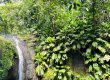
The waterfall is about 20 meters high and tumbles down a striking rock face. At the bottom is a lovely natural swimming hole. Louis and Téo happily changed into their swimsuits and jumped into the water. Mélanie followed, and I decided to join them. Honestly, it was a real treat. For us, this is the park’s main attraction. We spent about half an hour there enjoying the setting before heading back up to find a picnic spot. Although the picnic areas can be reserved, you may use one if it is available.
After a pleasant family picnic, we decided to head back. We walked along the Bourceau River, which feeds the waterfall upstream. There is another swimming spot, but the water level was too low to enjoy it when we passed by. We therefore headed back up one of the two trails leading to reception. The trails are clearly marked: the Source Trail and the Café Trail. We chose the Source Trail, which heads deep into the woods and begins with a fairly steep climb. It is not very long, but it is steeper than the map might suggest. It was nothing unusual compared with the hikes we are used to here, but it is still worth mentioning. The Café Trail looks easier on the map.


Eventually, we reached the spring that gives the park its name. It was once an important water source for people living in Bouillante. After the steep climb, it was the perfect place to cool off and dip our heads in the water. The final section is fairly easy and winds gently along the mountainside. We finished the loop by rejoining the gravel path that led back to reception. All in all, we had spent about four hours in the park. The kids were tired, and it was time to head home. Before leaving, we enjoyed ice cream and fresh juice on the lovely terrace.
That brings our little exploration of Parc de la Source to an end. I hope you enjoyed coming along and that the photos make you want to visit.
So, what’s our final verdict on Parc de la Source?
As I explained at the beginning, this is our personal opinion, based on our own visit and experience of the park. Mélanie and I wanted to be honest and share our own perspective rather than rely on rumors. So the real question is: is Parc de la Source worth visiting?
Mélanie and I discussed it at length, and we largely agree. We certainly would not advise against visiting Parc de la Source. It is a very pleasant park, with an introduction to vanilla cultivation at the start, a beautiful waterfall where you can swim, and appealing picnic areas for a family day out. It is clearly an enjoyable outing if you are vacationing in Guadeloupe.
However, a few things bothered us during our visit. First, although we understand the reasoning behind the extensive gravel paths, they do little to enhance the setting. It feels a little unfortunate to walk on coarse gravel in the middle of such a natural environment. Again, this is not criticism for its own sake: we understand that the paths make it easier for people who rarely walk to discover a nature park and waterfall. For those visitors, the layout makes perfect sense.
The second issue for us was the price of the various services. We can understand why the entrance fee is relatively high when you consider the facilities built on-site and the maintenance involved. However, in our opinion, the admission price still feels high for a walk through a fully landscaped park and access to a waterfall. That is simply our personal view, and everyone will make up their own mind.

While we are on the subject of prices, it is also worth mentioning the cost of reserving a carbet. The current reserved Carbet Pass costs €200, while the non-reserved Carbet Pass costs €150. I can see the appeal of reserving one for a birthday or another occasion with a group of around ten people, but it makes far less sense for a group of only two or four. There are plenty of places in Guadeloupe where you can use carbets in settings that are just as beautiful, if not more so, free of charge. For example, you can stop at several spots along the Route des Mamelles, including the Corossol area that Mélanie and I recently discovered.
The value of a carbet now depends on the pass you choose and the size of your group, so it is worth checking the latest terms directly before booking. You may also find an unoccupied carbet during your visit, as we did, although availability is never guaranteed.
Barbecue rental and charcoal are now offered separately, subject to availability. Personally, I still find it disappointing that these extras are not included in an already substantial price.
After discussing it with people around us and sharing our experience on Instagram and other social networks, we realized that many locals broadly shared our view: the experience felt a little expensive for what it offered.
The aim of this article is not to discourage you from visiting. On the contrary, reviews on TripAdvisor show that many tourists have found the park genuinely interesting. I can completely understand why. I am simply saying that, in my view, many locals may hesitate to rent a carbet at the current price.
Again, this is only our opinion!
Visiting Parc de la Source in Bouillante: practical information
Here you’ll find the practical information you need to plan your visit to Parc de la Source.
Parc de la Source: useful information
Here’s everything you need to know before your visit. This information has been updated, but I still recommend checking the park’s official website before you go in case anything changes.
Prices
Current prices are:
- Adults aged 18 and over: €17.50
- Teenagers aged 13 to 17: €14
- Children aged 6 to 12: €10
- Children under 6: free
The reserved Carbet Pass costs €200, while the non-reserved Carbet Pass costs €150. The park asks visitors to contact them at least 24 hours in advance to confirm a reservation and payment. Small barbecues can be rented separately, subject to availability, and visitors may bring charcoal or buy an 8-liter bag on-site.
A family pass is also available at special rates.
An annual pass is also available; check the official website for the current rate.
If you have difficulty walking or simply feel tired, you can use the call points around the park to request the service buggy. Check with reception for the current terms.
Opening hours
The park is open Wednesday through Sunday from 9:30 a.m. to 6 p.m. The last entry is at 4:30 p.m. for the upper section and 4 p.m. for the lower section. The park is closed every January 1.

How to get there
I won’t repeat all the details covered in my article titled “How to get to Guadeloupe“. You can refer to it for information on reaching Guadeloupe from France, Canada, or elsewhere abroad.
The main point to keep in mind is that you will need to rent a car to get around during your stay in Guadeloupe. We recommend that you compare prices on the Discover Cars website. We have found some very good deals there in recent years.
The route to Parc de la Source will depend on where you are coming from. The park is located in the commune of Bouillante, on the west coast of Basse-Terre. Below is one route from Pointe-à-Pitre and another from the town of Basse-Terre.
What to do in the area
There are, of course, many ways to explore Guadeloupe’s beautiful leeward coast. Here are a few ideas for filling a day or even a full week:
- Set out on the Route des Mamelles: there are a number of activities you can do along this route:
- Visit the zoo and botanical gardens: although we’re not big zoo fans, we’ll be writing a short article on the subject,
- Enjoy some of the short hikes, such as Mamelle de Pigeon (article coming soon) or Mamelle de Petit-Bourg,
- Further afield, discover the famous Cascade des écrevisses, where you can admire a small waterfall by the side of the road without getting tired,
- Don’t forget the Maison de la Forêt, where two discovery trails allow you to explore the rainforest without too much difficulty.
- To the north, enjoy a swim at Saut d’Acomat,
- Don’t miss the magnificent beach of Anse Caraïbes in Pointe Noire or the beaches of Deshaies further north.
In short, there is no shortage of things to do.
Where to stay nearby
Here are a few suggestions if you decide to stay in the area.
Budget
- Les gîtes du domaine de Petite-Anse: A pleasant place to stay with everything you need on-site. The hosts are friendly and attentive, and the quiet, beautifully decorated gîtes are close to the beach.
- Le Bananier: A warm welcome and spotless accommodations. The hosts are available, helpful, and attentive, with a welcome snack and high-quality breakfasts.
Mid-range
- Gîte Rêve Caraïbes – Le Petit Havre: A genuine Caribbean retreat, with a charming setting, beautiful views, memorable sunsets, an infinity pool, and comfortable rooms.
- Ti Kaz a Annick: A very warm welcome from Annick, along with a clean, functional, and well-equipped house. The hosts are generous and attentive, with a welcome snack and delicious meals.
- Gîtes Hôtel Couleur Caraïbes: A quiet, pleasant property with friendly and helpful staff, a beautiful view, and comfortable bungalows. A good option for a peaceful stay in Guadeloupe.
Higher budget
- Les Galets Rouges Lodges & Spa: A property offering a relaxing stay, beautiful views, attentive staff, and high-quality facilities.
- Gîtes Marlyse: This welcoming, fully equipped property has everything you need, along with a beautiful sea view.
That brings our walk through Parc de la Source in Bouillante to an end. I hope you enjoyed the article and appreciated our honest take on the experience. As I said, it is only our opinion. It is still a very pleasant place to discover, especially for visitors or anyone looking to reserve a carbet for a birthday, for example. The setting is lovely, the terrace is inviting, and the waterfall is especially appealing to children who want to swim.
For another lovely place nearby, head to Saut d’Acomat in the commune of Pointe-Noire.
See you soon.

Written by Sylvain PONS
Since 2021, I've been living in the Guadeloupe archipelago with Mélanie and our two children. We are exploring these beautiful islands and discovering the treasures that we are happy to share with you!
Despite our care, a mistake may have slipped into this article. If you find any, please don't hesitate to let us know so we can correct it as soon as possible and keep our information up-to-date!