Sony's best zoom lenses
Last update: 06/27/2026
Our blog continues to grow thanks to you, our readers. This post may contain affiliate links, which means we can earn a small commission if you make a purchase through them, at no extra cost to you. This helps us to continue to bring you more and support our work!
I have to admit, it has been a while since I last wrote about Sony lenses. So here I am again with a complete guide to help you choose your standard Sony zoom lens. I have already covered quite a few Sony lenses on the blog, but not this specific topic yet. You can also check out my guides to the best Sony wide-angle lenses or the best Sony macro lenses.
Standard zooms are among the most versatile lenses for photographers. They can be used for landscapes, street photography, weddings, portraits and, to a lesser extent, wildlife photography.
Here, I’m talking roughly about lenses with focal lengths between 20 and 70mm. For full-frame cameras, the classic standard zoom range is 24-70mm, while on APS-C bodies it is closer to 18-50mm because of the 1.5x crop factor.
In this article on Sony standard zooms, I won’t cover wider zooms, such as wide-angle and ultra-wide-angle lenses like 16-35mm, or classic telephoto zooms such as 70-200mm and beyond. I have also put together a separate guide to the best options if you are looking for a Sony telephoto lens.
Quick summary: choosing a Sony standard zoom
I thought it would be useful to start with a quick summary of my opinion on the subject, in case you don’t have time to read all the detailed lens sections.
For full-frame cameras, the Sony 24-70mm f/2.8 GM II remains, in my opinion, the best choice if you want a classic high-end 24-70mm f/2.8 standard zoom. However, it is also one of the most expensive options, so it won’t be for everyone. Sony has since gone even further with the FE 28-70mm f/2 GM, but that is a much more specialized, heavier and more expensive lens. For a tighter budget, I would recommend the Sigma 24-70mm f/2.8 DG DN II Art or the slightly cheaper Tamron 28-75mm f/2.8 Di III VXD G2. Both are very strong alternatives for the price. The Tamron 35-150mm f/2-2.8 Di III VXD (not cheap) and the Sony 24-105mm f/4 G OSS are the best choices if you want something more versatile with a longer reach. Finally, the Tamron 20-40mm f/2.8 Di III VXD is still a very good option for the price if you prefer a shorter focal range with strong image quality.
For Sony APS-C bodies, I would definitely go for the excellent-value Sigma 18-50mm f/2.8 DC DN Contemporary. If you want a slightly longer range and have a little more budget, the Tamron 17-70mm f/2.8 Di III-A VC RXD is also a very good choice.
Sony zoom lenses for full-frame cameras
Below is the list of all the standard zoom lenses suitable for Sony full-frame cameras that I cover in detail below.
They are listed in order, and you can click on each lens name to jump directly to the detailed section.
The main features of the Sony zooms mentioned above are compared in the table below.
By the way, we also have a comprehensive page, updated daily, listing all full-frame Sony FE lenses, including Sony’s own lenses as well as third-party autofocus and manual-focus options.
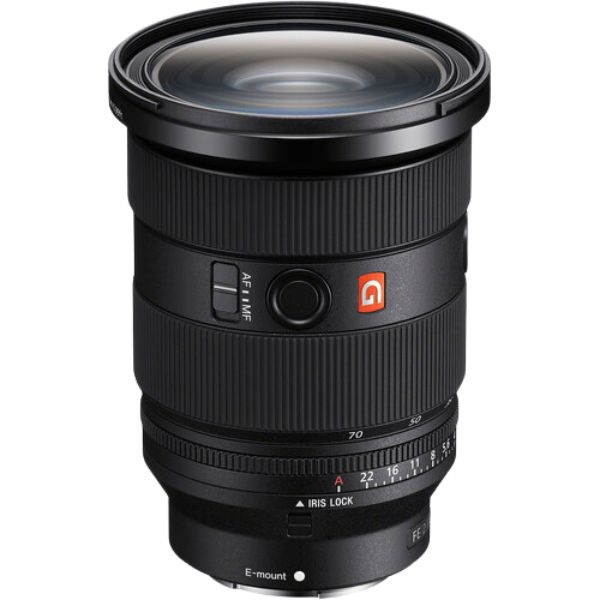
Sony 24-70mm f/2.8 GM II
| Features | Visual |
|---|---|
|
|
Announced in April 2022, the Sony 24-70mm f/2.8 GM II sits at the top of Sony’s GM (Gold Master) range for classic standard zooms. It is a major improvement over the Mark I, especially in terms of weight (around 200g lighter), length (1.6cm shorter) and overall volume (almost 20% smaller). With its versatile 24-70mm focal range and constant f/2.8 aperture, this Mark II version belongs to one of the most sought-after categories of full-frame standard zooms. It is still Sony’s lightest 24-70mm f/2.8 lens.
The optical formula is more complex, with 20 elements in 15 groups, including XA (Extreme Aspherical), Super ED and ED glass elements. Build quality is excellent. Weather sealing, 14 internal seals and a fluorine coating on the front element all contribute to its durability. For fast and accurate focusing, the autofocus system uses four XD linear motors. The lens also includes an aperture ring, an iris lock switch, focus hold buttons and a zoom tension switch. In short, it is a very complete, high-quality lens.
With an 82mm filter thread, the 24-70mm GM II delivers excellent optical quality. Sharpness is already impressive at full aperture, with excellent detail in the center, at the edges and in the corners. This quality remains consistent throughout the zoom range, with very little variation between focal lengths. Stopping down slightly improves sharpness even further. Around f/5.6, sharpness reaches a very high level. Optical flaws such as vignetting, distortion and chromatic aberrations remain limited.
In conclusion, the Sony 24-70mm f/2.8 GM II is an excellent lens, offering a strong balance of compactness, optical performance and advanced features. Its high price is justified by its robust build quality, responsive autofocus and outstanding image quality. It is the current benchmark for demanding photographers and professionals looking for a versatile, high-quality standard zoom.
Sony 24-105mm f/4 G OSS
| Features | Visual |
|---|---|
|

|
Announced in October 2017, the Sony FE 24-105mm f/4 G OSS remains an excellent choice if you want a versatile 24-105mm focal range with a constant f/4 aperture. It works very well for landscapes, portraits, street photography and even as a small telephoto lens. It is a true Swiss army knife at a relatively reasonable price, ideal for travel, for example, all in a lightweight (<700g) and fairly short (around 11cm) lens.
Build quality is very good, with an optical construction that was already quite advanced for its time: 17 elements in 14 groups, including special AA and ED elements. The front element has a fluorine coating, and the lens is weather-sealed. Autofocus is accurate, quiet and fast, with very good real-world performance. The lens has a 77mm filter thread and a minimum focusing distance of 38cm. On the barrel, you get an AF/MF switch, an OSS switch and a customizable button. Another nice point is that the zoom ring has a fairly firm feel.
In terms of image quality, this Sony zoom remains very strong in its category. Sharpness is already very good in the center, although the edges are a little weaker. Center sharpness remains very good throughout the zoom range, even if the extreme edges are always a bit less convincing, especially at the longest focal lengths. Stopping down to f/5.6 improves sharpness and overall contrast. Overall, this lens delivers a very good level of sharpness across its focal range, which is what matters most. Yes, there are better lenses, but at this price it is still a very solid choice. Optical flaws such as vignetting and distortion are present, but they are easy to correct in post-production with the right software. If you shoot JPEG, in-camera corrections will do the job.
In conclusion, the Sony FE 24-105mm f/4 G OSS is a versatile and well-built lens. Despite the lack of a focus distance scale and the more limited depth-of-field effects at f/4, it offers very good optical performance and a wide focal range, making it an easy recommendation for photographers looking for an all-in-one solution. In my opinion, it remains good value for money for this type of lens.
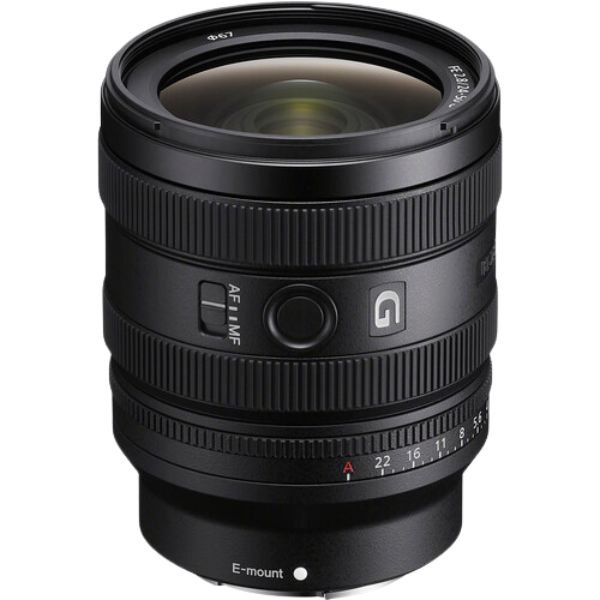
Sony FE 24-50mm f/2.8 G
| Features | Visual |
|---|---|
|
|
Released in 2024, the Sony FE 24-50mm f/2.8 G is a recent and clever standard zoom from Sony. I have already seen plenty of reviews praising this lens. In my opinion, it is clearly aimed at photographers looking for a bright, high-quality standard zoom without spending as much as they would on a professional 24-70mm. As you can see, the focal range is shorter than the usual 70mm on the long end, so it sits somewhere between the Sony FE 20-70mm f/4 G and the Tamron 20-40mm f/2.8 Di III VXD. At just 440g and 9.2cm long, this Sony zoom is light and compact.
The Sony FE 24-50mm f/2.8 G is very well built. It has a complex optical formula with 16 elements in 13 groups, including two ED elements and four aspherical elements, and the front element has a fluorine coating. On the barrel, you get a focus hold button, an AF/MF switch, an aperture ring with a click/de-click switch, plus the usual zoom and focus rings. Autofocus should be very good thanks to the dual XD linear motor system. The lens extends slightly, by around 3cm, when zooming, and it is weather-sealed. Minimum focusing distance ranges from 19 to 30cm, and the filter diameter is 67mm.
Optical performance is almost excellent, with excellent sharpness in the center at full aperture and only slightly weaker edges, if you really want to nitpick. Stopping down to f/4 improves things even more, giving you a sharp image across the whole frame. As for optical flaws, vignetting and distortion are quite pronounced, although they remain manageable in post-production. Flare resistance is good, and chromatic aberrations are well controlled.
In conclusion, the Sony FE 24-50mm f/2.8 G is an interesting option if you want a lightweight, compact standard zoom, although it is worth considering the even more compact and much cheaper Tamron 20-40mm. Still, it remains a serious, high-quality and very appealing option.
Sigma 24-70mm f/2.8 DG DN II Art
| Features | Visual |
|---|---|
|
|
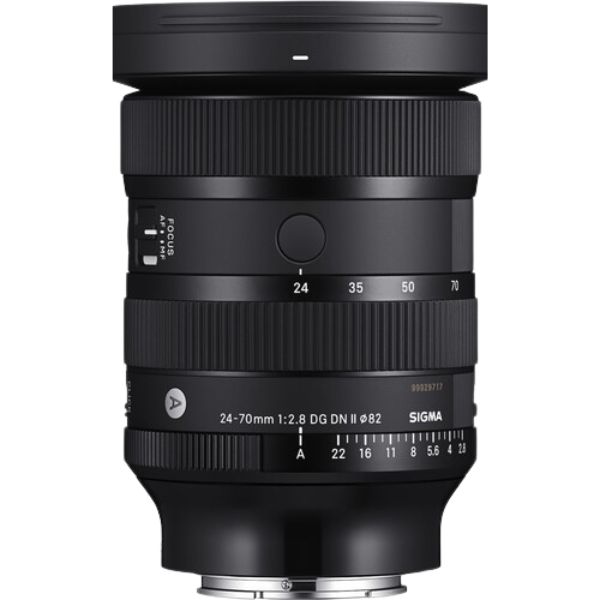
Released in May 2024, the Sigma 24-70mm f/2.8 DG DN II Art replaces the first DG DN version and now stands as one of the strongest alternatives to Sony’s 24-70mm f/2.8 GM II. It keeps the same classic 24-70mm range and constant f/2.8 aperture, but Sigma has improved the formula across several important points: optical performance, autofocus, handling and portability. It is still not a cheap lens, but compared with the Sony GM II, it remains a more accessible high-end option.
Build quality is excellent, with a more complete feature set than the previous version. The lens now includes an aperture ring, an aperture ring lock, a de-click switch, two AFL buttons, an AF/MF switch and a zoom lock. It is dust- and splash-resistant, with a water- and oil-repellent coating on the front element. The lens is also slightly smaller and lighter than the original model, weighing around 735g in Sony E-mount, while keeping an 82mm filter thread and an 11-blade rounded diaphragm. Autofocus is handled by Sigma’s HLA motor, which is designed to be much faster and more responsive than the motor used in the first version.
Optically, the Sigma 24-70mm f/2.8 DG DN II Art is a serious step up. The lens uses 19 elements in 15 groups, including 6 FLD, 2 SLD and 5 aspherical elements. Sharpness is excellent from full aperture and remains strong throughout the zoom range, including on high-resolution sensors. It also improves close-up performance, with a minimum focusing distance of 17cm at the wide end and a maximum magnification ratio of 1:2.7. Vignetting and distortion are still part of the game with this type of zoom, but they can be corrected easily, and flare, ghosting and chromatic aberrations are very well controlled.
In conclusion, the Sigma 24-70mm f/2.8 DG DN II Art is now the most logical alternative to Sony’s 24-70mm f/2.8 GM II if you want a high-end standard zoom without paying Sony’s full price. It is sharper, faster, more complete and more pleasant to use than the first DG DN version, while staying more affordable than the Sony. For many photographers, it is probably the best balance between optical quality, build quality, autofocus performance and price.
Sigma 28-70mm f/2.8 DG DN Contemporary
| Features | Visual |
|---|---|
|
|
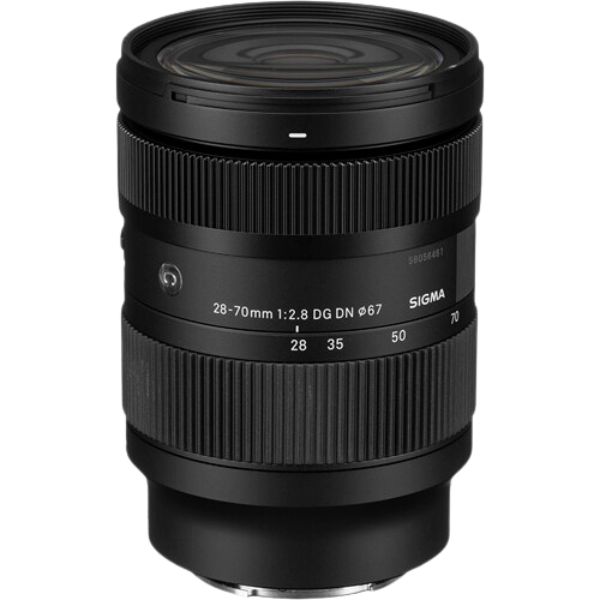
Released in March 2021, Sigma surprised many photographers with this ultra-compact standard zoom, measuring around 10 to 13cm depending on the zoom position and weighing only 470g. It arrived shortly after the Sigma 24-70mm f/2.8 DG DN. Compared with that lens, it “loses” 4mm at the wide end and a few comfort features, but the price is more attractive at around €850. Overall, it sits between the Sigma 24-70mm f/2.8 DG DN II Art and the Sigma 16-28mm f/2.8 DG DN Contemporary, both of which are more expensive. It competes directly with the Tamron 28-75mm f/2.8 Di III VXD G2.
Build quality is very good, with 16 elements in 12 groups, including FLD, SLD and aspherical elements. Compared with its bigger brother, the 24-70mm, it only has an AF/MF switch and more limited weather sealing, with a single seal around the mount. The lens is also not stabilized. Autofocus is handled by an STM motor, described as quiet, fast and accurate, and it works well in low light. The lens uses a 67mm filter thread and offers a variable minimum focusing distance from 19 to 38cm.
The lens performs very well overall, according to the reviews. Center sharpness is very good from full aperture at all focal lengths. The corners and edges are a little behind, so you will need to stop down to f/4 and then f/5.6 to get perfect homogeneity across the frame. As for optical flaws, vignetting and distortion are visible, although they remain reasonable and can be corrected in post-production software, or through in-camera corrections if you shoot JPEG. Chromatic aberrations and flare are also well controlled.
In conclusion, this Sigma 28-70mm is a very attractive package: light, discreet, compact and optically very good. Yes, you lose a little at the wide end, but otherwise Sigma offers excellent value for money here.
Tamron 28-75mm f/2.8 Di III VXD G2
| Features | Visual |
|---|---|
|

|
The first version of this Tamron standard zoom already had a very good reputation. Three years later, the brand launched a second generation: the Tamron 28-75mm f/2.8 Di III VXD G2. It competes directly with the Sigma 28-70mm f/2.8 DG DN Contemporary mentioned above, but also with the more expensive Sigma 24-70mm f/2.8 and Sony 24-70mm f/2.8 GM II. Compared with the V1, the main changes are the new VXD autofocus motor, the revised optical construction, a slight improvement in magnification and better ergonomics. Weight (540g) and length (11.8cm) remain almost identical to the first version.
Build quality is very good for this Tamron zoom, which is weather-sealed but not stabilized. The lens uses 17 elements in 15 groups, including LD and GM elements. Overall quality is much better than on the first version, and the lens feels more solid. The zoom and focus rings have also been improved. There is a USB-C port for firmware updates and customization through Tamron Lens Utility software. The lens still uses a 67mm filter thread, and minimum focusing distance ranges from 18 to 38cm depending on the focal length. There is still no AF/MF switch, as on the V1, but there is now a customizable button on the barrel. The major improvement is the VXD autofocus system, similar to the one on my 70-180mm, which is much more responsive.
In terms of optical performance, this Tamron is one of the best in its category, offering excellent image quality from full aperture and very even sharpness across the frame. Homogeneity is excellent, even at the edges and corners, which remain very good. Optical flaws such as distortion and vignetting are present, but they can largely be corrected. Chromatic aberrations are not a real issue.
In conclusion, the Tamron 28-75mm f/2.8 Di III VXD G2 is a very attractive lens, with very good build quality, excellent optical performance and strong value for money. Compared with the Sigma 28-70mm mentioned above, I would still give it the advantage overall. It is a great choice if you want a high-quality all-round zoom without spending a fortune.
Tamron 35-150mm f/2-2.8 Di III VXD
| Features | Visual |
|---|---|
|

|
Introduced in 2021, this lens is positioned as a highly versatile high-end zoom, giving Sony photographers a bright, high-quality lens with an unusual focal range that works in many situations. At around €1,800, it is close to ideal, and it can even replace both a 28-75mm f/2.8 and a 70-180mm f/2.8, which I own. Its unusually bright aperture for this type of zoom will appeal to many photographers.
In terms of build quality, Tamron clearly moved up a level compared with what it used to offer. The lens is very well built and remains resistant to dust and moisture. There is a smooth zoom ring and a very good focus ring, which can be customized into an aperture ring through Tamron Lens Utility. Thanks to the USB-C port, you can also update the lens firmware. The lens uses 21 elements in 15 groups. Several aspherical and low-dispersion elements are used to minimize chromatic aberrations. Autofocus, powered by the VXD system, is said to be excellent. The 82mm filter diameter is also worth noting.
In terms of optical performance, this is a very high-end lens. Sharpness is excellent in the center at full aperture, although it improves as you stop down, especially at the edges. As for optical flaws, there is strong vignetting at full aperture, classic distortion for this type of zoom (strong barrel distortion at 35mm and strong pincushion distortion at 150mm) and relatively low chromatic aberration. All of this can be easily corrected in post-production using lens profiles.
In conclusion, Tamron offers a very fine, versatile and well-built lens with excellent sharpness. It is perfectly suited to a wide range of photography, including weddings, portraits, events and low-light situations. You really cannot go too far wrong with this lens.
Tamron 20-40mm f/2.8 Di III VXD
| Features | Visual |
|---|---|
|

|
Released in October 2022, this was a very interesting new lens from Tamron. Instead of following the usual 24-70mm standard zoom formula, Tamron chose a completely different range: wider at the short end, but shorter at the long end, with the Tamron 20-40mm f/2.8 Di III VXD. The result is a very light and compact lens, weighing only 365g and measuring 6.6cm long. It is exactly the kind of compact lens that will appeal to many photographers, myself included, for travel.
The lens uses 12 elements in 11 groups and also includes coatings designed to limit chromatic aberrations. It is a well-made lens, with durable materials and a very good finish. However, it has very few controls on the barrel: only a focus ring and a zoom ring. There is no AF/MF switch and no customizable button. The overall feel is solid, though not quite as sturdy as Sigma or Sony lenses. The lens also has a USB-C port, so it can be updated through Tamron Lens Utility. Autofocus uses a high-quality VXD system that provides fast and quiet focusing.
In terms of optical quality, this remains a high-level lens, with very good center sharpness at full aperture. Image quality is a little weaker at the edges, but it improves significantly at f/4, producing a sharp and homogeneous image. As for optical flaws, there is barrel distortion at 20mm and pincushion distortion at 40mm, which is typical for this type of zoom. Flare and chromatic aberrations did not cause any particular problems and remained well controlled. Although this is not a lens designed primarily for bokeh, the rendering is still quite pleasant.
In conclusion, the Tamron 20-40mm f/2.8 Di III VXD is a great choice if you want a lightweight, compact standard zoom that works particularly well for travel. The value for money remains excellent, especially when you compare its qualities with other high-end lenses that cost far more without necessarily doing much better.
Sony 20-70mm f/4 G
| Features | Visual |
|---|---|
|
|
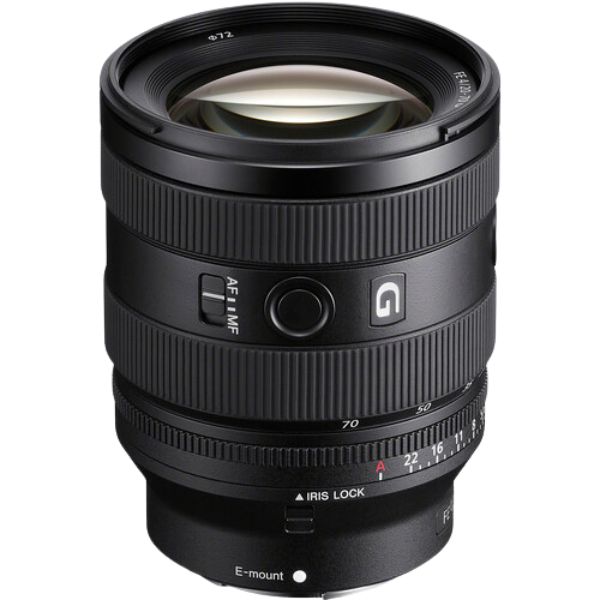
Announced in January 2023, this standard zoom brought something genuinely different to Sony FE-mount cameras. More compact and lighter than many competitors, it weighs just 488g and measures 99mm long, making it very easy to use. Of course, its main feature is the unusual 20mm starting point. That is much wider than conventional zooms, which usually start at 24mm, and it makes the lens very useful for wider scenes such as landscapes and architecture.
In terms of construction, the lens has a very solid build. It is particularly appealing for video thanks to its de-clickable aperture ring, which allows smoother exposure control. The lens also has an AF/MF switch, a focus hold button and an autofocus system using XD linear motors, making AF fast and accurate. With a minimum focusing distance of 25cm, the lens also makes close-up shots easy. It is weather-sealed, with 14 seals, and uses a 72mm filter thread.
In terms of optical performance, the 20-70mm f/4 shows excellent sharpness at full aperture at 20mm, especially in the center and at the edges, although the extreme corners can be a bit softer. Sharpness improves significantly as you stop down, with very consistent quality around f/8. As for optical flaws, the lens shows little vignetting or distortion overall, although there is some barrel distortion at 20mm, which is easy to correct in post-production. Thanks to the quality of the lens coatings, chromatic aberrations are minimal.
In conclusion, I would recommend the Sony FE 20-70mm f/4 G if you want a versatile lens that can cover your wide-angle needs, especially for landscapes, while still reaching into short-telephoto territory for everyday scenes. At around €1,100, it still feels a bit expensive.
The table below compares the main features of the different full-frame standard zoom lenses mentioned above.
| Standard zoom lenses for Sony E | Focallength | Max.Aperture | Weight | Dim. (Ø x L) | Min. FocusDist. | Approx.price | Best price | |||
|---|---|---|---|---|---|---|---|---|---|---|
| + | Tamron 20-40mm f/2.8 Di III VXD | 20-40mm | f/2.8 | 12.88 oz / 365g | 2.9 x 3.4" / 74 x 87 mm | 6.7" / 17 cm | $699 | Amazon B&H | More info + | |
|
||||||||||
| + | Sony 20-70mm f/4 G | 20-70mm | f/4 | 1.1 lb / 488g | 3.1 x 3.9" / 79 x 99 mm | 9.8" / 25 cm | $1 099 | Amazon B&H | More info + | |
|
||||||||||
| + | Sony 24-50mm f/2.8 G | 24-50mm | f/2.8 | 1 lb / 440g | 2.9 x 3.6" / 75 x 92 mm | 7.1" / 18 cm | $1 099 | Amazon B&H | More info + | |
|
||||||||||
| + | Sony 24-70mm f/2.8 GM II | 24-70mm | f/2.8 | 1.5 lb / 695g | 3.5 x 4.7" / 88 x 120 mm | 8.3" / 21 cm | $2 299 | Amazon B&H | More info + | |
|
||||||||||
| + | Sigma 24-70mm f/2.8 DG DN II Art | 24-70mm | f/2.8 | 1.6 lb / 735g | 3.5 x 4.8" / 88 x 122 mm | 6.7" / 17 cm | $1 179 | Amazon B&H | More info + | |
|
||||||||||
| + | Sony 24-105mm f/4 G OSS | 24-105mm | f/4 | 1.5 lb / 663g | 3.3 x 4.5" / 83 x 113 mm | 1.2' / 38 cm | $1 299 | Amazon B&H | More info + | |
|
||||||||||
| + | Sigma 28-70mm f/2.8 DG DN Art Contemp. | 28-70mm | f/2.8 | 1 lb / 470g | 2.8 x 4" / 72 x 102 mm | 7.5" / 19 cm | $729 | Amazon B&H | More info + | |
|
||||||||||
| + | Tamron 28-75mm f/2.8 Di III VXD G2 | 28-75mm | f/2.8 | 1.2 lb / 540g | 3 x 4.6" / 76 x 118 mm | 7.1" / 18 cm | $899 | Amazon B&H | More info + | |
|
||||||||||
| + | Tamron 35-150mm f/2-2.8 Di III VXD | 35-150mm | f/2-2.8 | 2.6 lb / 1165g | 3.5 x 6.2" / 89 x 158 mm | 1.1' / 33 cm | $1 799 | Amazon B&H | More info + | |
|
||||||||||
Sony APS-C zoom lenses
If you have a Sony APS-C camera, here is the list of Sony zooms I recommend:
The main features of these lenses are compared in the table below.
We also have a dedicated page for Sony E lenses for APS-C cameras, updated daily, if you want to explore other options.
Sigma 18-50mm f/2.8 DC DN Contemporary
| Features | Visual |
|---|---|
|
|
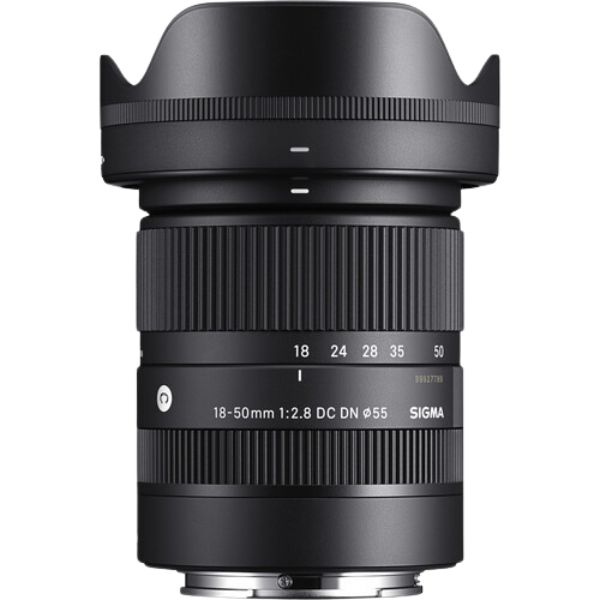
Designed specifically for Sony E-mount APS-C cameras, this lens was released in 2021, alongside the L-mount version, and then arrived for Fujifilm X-mount in December 2023. This standard zoom has very appealing dimensions: at 7.7cm long and only 285g, it is a very light and compact lens. There are only a few comparable options, apart from the Tamron 17-70mm f/2.8 VC RXD, which is more expensive, and the Sony E 16-55mm f/2.8 G, which is older and much more expensive. Sigma offers the cheapest and lightest option in its category, with a very useful focal range for APS-C.
Build quality is relatively good, although it is not on the same level as the Tamron and Sony lenses mentioned above. The lens is not fully weather-sealed, but it does have a seal around the mount. The Sigma is not optically stabilized and does not have an aperture ring. On the barrel, you only get the zoom ring, which feels good, while the focus ring is quite thin. Autofocus is handled by a conventional STM motor, which remains accurate and fast. The lens accepts 55mm filters and has a minimum focusing distance that varies from 12 to 18cm depending on the focal length. The maximum magnification is a very interesting 0.36x.
Optically, sharpness is impressive at full aperture in the center and across most of the image, with only a slight drop at the edges. When you stop down, the image becomes even more even, especially around f/5.6. There are some optical flaws, including noticeable barrel distortion at 18mm and pronounced vignetting, but they can largely be corrected in post-production. Chromatic aberrations are low and well controlled.
In conclusion, the Sigma 18-50mm f/2.8 DC DN offers excellent value for money and stands out as a very good choice for photographers looking for an affordable, versatile and compact zoom lens. Despite a few compromises, its very good image quality and compact size make it an ideal candidate for travel, street and everyday photography.
Tamron 17-70mm f/2.8 Di III-A VC RXD
| Features | Visual |
|---|---|
|

|
Released at the beginning of 2021, this is the kind of lens that can make many Sony APS-C photographers happy. It feels like a breath of fresh air, with a very versatile zoom range and a relatively bright f/2.8 aperture. Compared with the Sigma 18-50mm f/2.8 DC DN, it offers a little more range, but it is also more expensive. This zoom weighs 525g and is 12cm long, which still makes it fairly compact and a strong alternative, especially compared with Sony’s more expensive APS-C zooms.
The lens is made up of 16 elements in 12 groups, including low-distortion aspherical elements designed to manage chromatic aberrations as effectively as possible. Build quality is good, with a satin finish. However, there are no switches on the lens barrel, which some photographers may miss, including an AF/MF switch or a stabilization switch. The lens uses a 67mm filter thread, and minimum focusing distance varies from 19 to 39cm depending on the focal length.
In terms of performance, the Tamron 17-70mm f/2.8 delivers excellent sharpness in the center at full aperture, although image homogeneity improves when you stop down. Compared with the price of the Sony E 16-55mm f/2.8 G, it has nothing to be ashamed of, especially when you factor in the price difference. There is some classic distortion for this type of zoom, along with some vignetting, but the overall effect is reasonable and easy enough to manage in post-production. Chromatic aberrations are generally not an issue, and the lens remains very resistant to flare.
In conclusion, this Tamron is an excellent choice if you use a Sony APS-C body. The lens is extremely versatile, still reasonably compact, and offers good optical performance. Like the Sigma, it is well suited to travel, street and everyday photography, as well as landscapes and portraits. For an APS-C body, it is certainly one of the best choices without breaking the bank.
Sony E 16-55mm f/2.8 G
| Features | Visual |
|---|---|
|

|
Announced in August 2019, the Sony 16-55mm f/2.8 G remains the higher-end APS-C standard zoom in this selection. Its main competitor today is the much cheaper Tamron 17-70mm f/2.8 Di III-A VC RXD. The Sony is slightly more compact and lighter, weighing 496g and measuring 10cm long, all with a constant f/2.8 aperture. Despite its excellent quality, the price remains quite high, especially for an APS-C zoom. Still, it remains an excellent, versatile and high-quality lens.
In terms of construction, this is clearly the most premium option here, with build quality far superior to the Sigma and Tamron zooms mentioned above. The barrel includes an AF/MF switch and a focus hold button. The lens uses 16 elements in 12 groups, including special elements designed to reduce chromatic aberrations. It is also dust- and moisture-resistant. Autofocus is excellent thanks to Sony’s XD linear motor, known for its speed and quiet operation. The lens uses a standard 67mm filter thread and has a fixed minimum focusing distance of 33cm.
Optical performance is impressive at full aperture and improves even more when you stop down slightly. The edges and corners are almost as good as the center of the image, which shows the high level of sharpness. As for optical flaws, there is very pronounced distortion at the shortest focal length and some vignetting, but both are manageable in post-production. Chromatic aberrations are quite low, and flare is well controlled, although some competing lenses do even better in this area.
In conclusion, the Sony 16-55mm f/2.8 G remains an excellent choice if you want a professional Sony zoom for your APS-C body without the size and weight of full-frame zooms. However, I still can’t help thinking that the Tamron may be the better choice when you look at the price/performance ratio. But if you want the best optical quality and build quality in this APS-C category, you cannot go wrong with this lens.
Sony E PZ 18-105mm f/4 G OSS
| Features | Visual |
|---|---|
|

|
Here is a lens that is clearly starting to show its age, since it was released in 2013. The Sony PZ E 18-105mm f/4 G OSS is a versatile lens designed for Sony’s A6000-series APS-C bodies. Its very wide focal range makes it useful for many different types of photography. It weighs only 427g and measures 110mm long, which is still reasonable for a lens with this range.
In terms of construction, even though it is no longer new, the lens is still well built, with a metal design that feels reassuring. There are two classic rings on the barrel, one for zoom and one for focus. There is also a switch to control the zoom electronically, since this is a power zoom lens, hence the “PZ” name. Unlike what I sometimes see written about it, this lens does include Optical SteadyShot stabilization. It is not weather-sealed. Minimum focusing distance varies from 45 to 95cm from the shortest to the longest focal length.
Optical performance is very good, especially for an APS-C zoom. Sharpness is already very good at full aperture, although the corners remain a little weaker. Stopping down improves things significantly and gives a very homogeneous image, especially between f/5.6 and f/8. As for optical flaws, there is not much to criticize. Distortion and vignetting are present, but they can largely be corrected in post-production. Chromatic aberrations and flare are fairly well controlled.
All in all, the Sony PZ E 18-105mm f/4 G OSS is a very good choice if you are a Sony APS-C photographer looking for a versatile lens that works for both stills and video, thanks to its motorized zoom. At its current price (€500-600), I think it offers very good value for money.
Here is a summary of the different lenses mentioned above.
| Standard zoom lenses for Sony E | Focallength | Max.Aperture | Weight | Dim. (Ø x L) | Min. FocusDist. | Approx.price | Best price | |||
|---|---|---|---|---|---|---|---|---|---|---|
| + | Sony E 16-55mm f/2.8 G | 16-55mm | f/2.8 | 1.1 lb / 494g | 2.9 x 3.9" / 73 x 100 mm | 1.1' / 33 cm | $1 399 | Amazon B&H | More info + | |
|
||||||||||
| + | Tamron 17-70mm f/2.8 Di III-A VC RXD | 17-70mm | f/2.8 | 1.2 lb / 525g | 20.7 x 2.9" / 525 x 75 mm | 7.5" / 19 cm | $699 | Amazon B&H | More info + | |
|
||||||||||
| + | Sigma 18-50mm f/2.8 DC DN Contemp. | 18-50mm | f/2.8 | 10.23 oz / 290g | 2.5 x 2.9" / 65 x 75 mm | 4.7" / 12 cm | $539 | Amazon B&H | More info + | |
|
||||||||||
| + | Sony E 18-105mm f/4 G | 18-105mm | f/4 | 0.9 lb / 427g | 3.1 x 4.3" / 78 x 110 mm | 1.5' / 45 cm | $649 | Amazon B&H | More info + | |
|
||||||||||
That brings us to the end of this article on Sony’s best zoom lenses, both for APS-C bodies and the brand’s full-frame cameras. There is plenty to choose from, and plenty to enjoy, even if you don’t have a huge budget. In any case, I hope this article and my research will help you choose the lens that suits you best.
If budget is not an issue, then of course, treat yourself. But you will also find excellent alternatives from third-party manufacturers at much lower prices, so it is always worth comparing your options.
See you soon for another Sony article. In the meantime, be sure to check out our full guide to the best Sony 35mm lenses for environmental portraits.

Written by Sylvain PONS
I've been passionate about photography since 2010, learning as I went along. Today, I dedicate myself to guiding others in their choice of camera gear and sharing a variety of tips to improve their photography skills.
Despite our care, a mistake may have slipped into this article. If you find any, please don't hesitate to let us know so we can correct it as soon as possible and keep our information up-to-date!