Discovering the Valombreuse botanical garden
Last update: 07/09/2026
Our blog continues to grow thanks to you, our readers. This post may contain affiliate links, which means we can earn a small commission if you make a purchase through them, at no extra cost to you. This helps us to continue to bring you more and support our work!
It took a visit from Mélanie’s sister and her family for me to finally sit down and write an article about the famous Valombreuse botanical garden. I had already visited the garden with her mother in early 2022, but I really hadn’t had time to write down what I saw or share how I felt about the place. We’ve been living in Guadeloupe for a year now as I write this article, and I’ve (finally) decided to shift gears and write more and more about Guadeloupe and its islands. I have to admit, I’m far behind on articles, especially all the walks we’ve done in Guadeloupe. The link above will take you to the articles about all the walks we’ve done since moving here.
In short, if you’re planning a vacation in Guadeloupe, there’s a very good chance that a visit to one or more botanical gardens will make it onto your itinerary. Guadeloupe has plenty of small places worth visiting, but to keep things simple, there are really two main botanical gardens: the Deshaies Botanical Garden and the famous Valombreuse Garden, which I’ll tell you about in this article.
You’ll probably have to choose between the two botanical gardens if you’re short on time during your vacation in Guadeloupe. I’ll give you my opinion on that, although it’s far from an easy choice, because I think the two botanical gardens are very different. As I mentioned in the introduction, our family visit to this garden came before an evening visit to Lézarde beers in Petit-Bourg. I’m not going to write an article about that place (haha, that might be a little too beer-focused, I think), but it’s definitely somewhere I would recommend. I’ll tell you more about it below.
In this article, I’m taking you on a tour of this picturesque garden, which in my opinion is a must on any trip here. For once, I’m not going to write a whole loaf of an article, as the saying goes, but instead try to inspire you with photos. You’ll find all the practical information you need to visit the garden at the end of the article. Come on, let’s get going! I’m taking you around this beautiful 5-hectare tropical garden. For the record, after Hurricane Hugo destroyed the entire farm in 1989, Madame Magguy Chaulet decided to open this magnificent garden to show visitors the local vegetation, remarkable trees, and a huge variety of flowers.
Visit Guadeloupe's flower park, the Valombreuse botanical garden
As is often the case in botanical gardens, the Valombreuse botanical garden is divided into themed areas. I’ll walk you through what there is to see here. You’ll be able to find each area and follow the route on the map you receive at the entrance. Between you and me, there’s only one way around, so there’s no chance of getting lost (lucky you, right?). We already know this beautiful place, but Stéphanie and her little family are delighted to be here and discover the tropical flora and fauna.


One unique feature of the Valombreuse botanical garden is its small electric train, which offers a 10-minute ride through the garden and its history. It gives you a quick overview of the different areas. After that, you can explore them on foot at your own pace. Along the way, you’ll also hear a few interesting facts about the garden’s history and development, as well as a reminder that no pesticides are used anywhere in the garden. It gives you a good idea of what to expect next, keeping in mind that the electric train doesn’t go everywhere.


After our little touristy ride (can I say that?), we set off on foot to rediscover this beautiful garden, which I love just as much as the one in Deshaies. It’s smaller, but I like it just as much because it has its own personality. The visit starts by following the little train path.
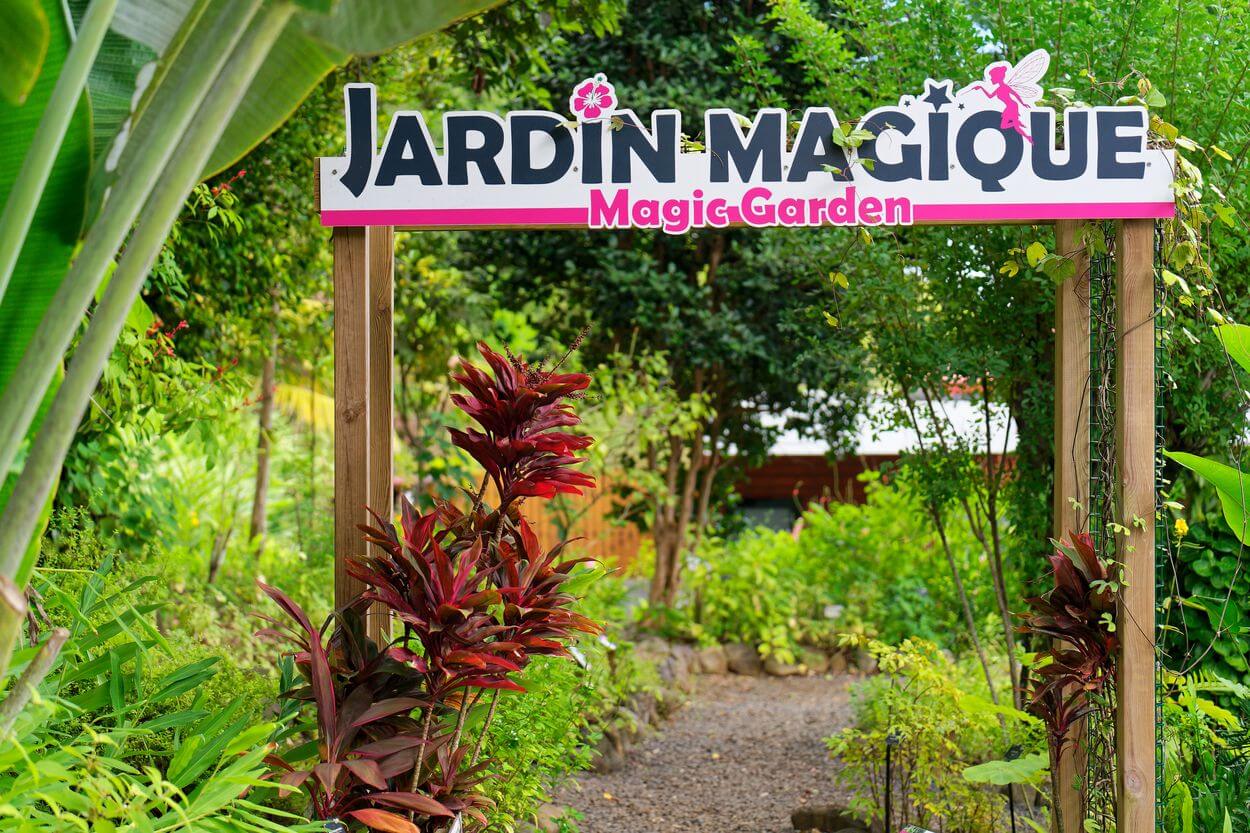
On your right, you’ll see a huge kapok tree, such a distinctive tree with enormous aerial roots that you can spot it in many corners of Guadeloupe. A little farther on, you can visit the Magic Garden, where many of the medicinal plants used locally are displayed. The walking route then continues to the Exotic Garden, where you’ll see a large number of plants and trees, each one beautiful in its own way. For anyone who has never been before, it’s a lovely sight and a pleasure to discover all its beauty.


After crossing the little railway line, you come to what I like to call the “hanging garden” and a series of water basins. Here, countless plants seem to hang in midair, suspended above the open space. On the ground, you’ll also see a wide variety of cacti, each with its own wild shapes and spikes. It reminds me a little of the magnificent botanical garden on Désirade Island. This corner is quite nice if you enjoy taking photos. There’s also a small photo spot. You’ll also find a statue by Luigi Art Design.


The walking route continues toward the biodiversity area. In a small house, you’ll find information about local biodiversity and the history of the Valombreuse garden. If you have time, there’s even a film that explains it all. Follow the path to the famous Creole hut, known as the seminar room. In front of it, you’ll see large ponds where plenty of koi carp bask. For a small €0.50 coin, you can feed the fish, much to the children’s delight. Don’t miss the huge hummingbird statue beside the pond. (Just between us, if you miss it, you may need to see an eye doctor!) Take a few minutes to visit this small hut filled with artifacts from the past, including kerosene lamps, dry toilets, and a sewing machine.


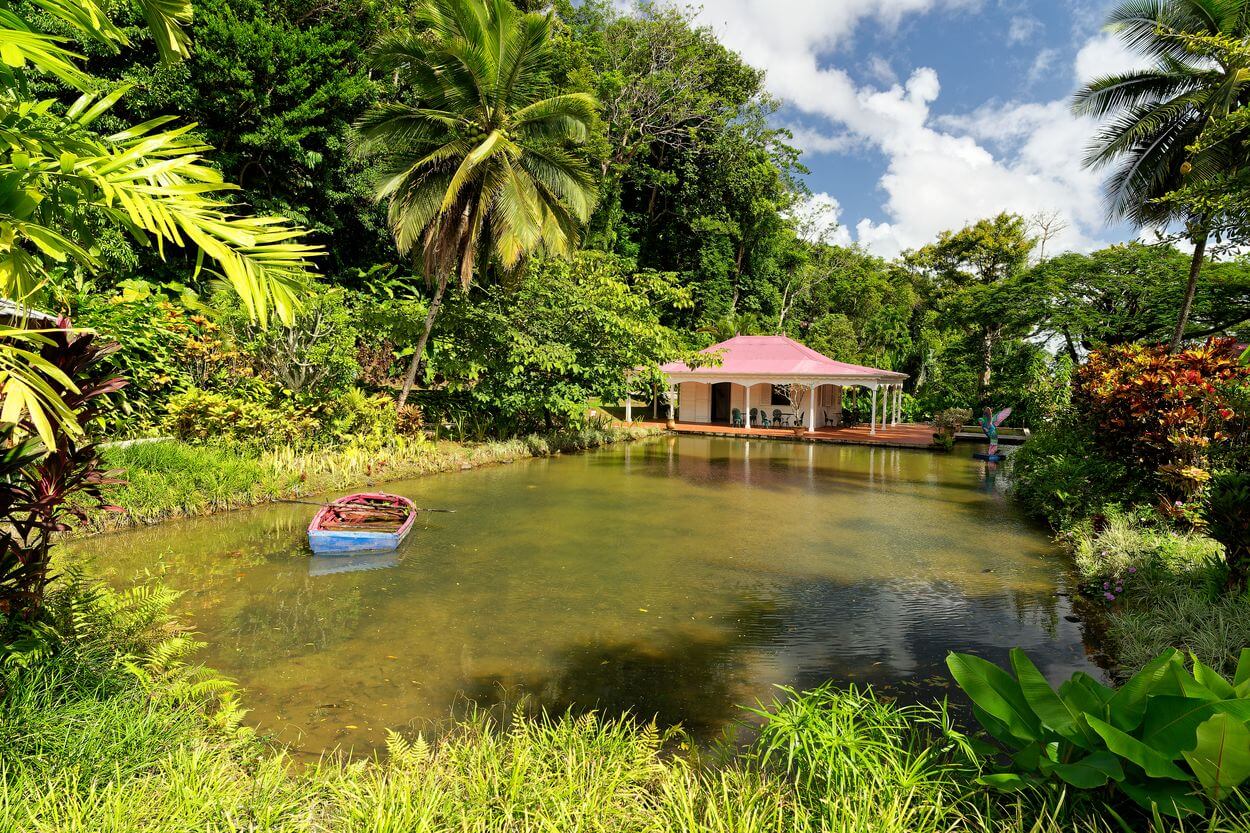
Walk past Magguy’s house and continue your tour of the garden. On your left, you’ll see a beautiful pond with a boat floating on the water. It’s quite photogenic. The path climbs back up to a carbet, which offers a small viewpoint over the surrounding area (beautiful scenery) and reminds us how far away the surrounding islands are. Nothing too wild. You can then stroll gently back down toward the playground. There’s also a playground at the end of the Deshaies garden, and it’s one of the special features of this garden too. Here, you’ll find slides, swings (outdoors), and a full playroom. The latter is covered, which is a great idea when the weather turns bad.
Inside, there’s a high-ropes course with nets for children aged 3 to 12. Children can also enjoy a loop-shaped pedal car track. The only problem, as you can imagine, is that the kids never want to leave. I even have to get cross to get Louis to move on… I have to admit that at his age, going around in pedal cars is still more fun than looking at porcelain roses… Anyway…

We continue downhill to see some of the local wildlife. It’s a really pleasant spot, with plenty of ponds filled with water lilies. You can see several kinds of parrots (macaws) in cages (unfortunately, there isn’t much choice at the moment…), and farther along the walk, there’s also an aviary with flamingos and ibises. It’s a peaceful place (very tranquil), although I have to admit I’d still rather see these birds in their natural habitat, surrounded by magnificent plants…


We continue our walk toward a pond with lotus flowers, passing a beautiful baobab and a ylang-ylang, both of which remind us of our former life in Mayotte (back when we didn’t have children yet, haha). The path continues toward the far end of the garden, giving you the chance to see many species of tropical plants and trees, especially in a small palm grove. Notice the huge palm trees on the right. Porcelain roses — red, pink, and even the rare white ones — fill the rest of the garden. Keep an eye out for hummingbirds pecking at the flowers. I was lucky enough to get a close-up of one. I’m pretty happy with the result!


Finally, we crossed back over the little railway line to finish our walk in the honey plant area. It’s known for the large number of bees that come here to gather nectar from the local flowers.
On our first visit, it was possible to walk to a small waterfall in the middle of the rainforest, but access was closed this time. I don’t know whether that’s because of the rainy season or not. I’ll find out.


The walk ends by crossing two aviaries where you can get close to lorikeets, the same ones as in the Deshaies garden! Since the walk forms a loop, you can then retrace your steps. There’s also a souvenir shop for anyone who wants to buy a little something.
So much for this short walk. To be honest, the Valombreuse Garden is well worth a visit and is a great way to discover the local flora and fauna if you want to explore a botanical garden in a peaceful setting. Admittedly, it’s a little smaller (I think) than the Deshaies garden, but it’s just as beautiful.
If you’re looking for another nice place to visit during your trip to Guadeloupe, don’t hesitate to head to the Maison du Cacao.
The Valombreuse garden: practical details
Here is all the information you’ll need to visit the garden.
Prices and opening hours
The Jardin de Valombreuse is open all year round from 9 am to 6 pm, with last admission at 4:30 pm.
Prices:
- Adult ticket: €16.50
- Children’s ticket: €11 (ages 3 to 12)
- Group rates for 10 or more people
Note that for residents like us who visit several times a year when family or friends come over, there is an attractive annual pass. The price is €30 for 1 year for adults and €20 for children, from the date of purchase.


Finally, for tourists and anyone planning to visit several places in Guadeloupe, there is also one interesting combined ticket:
- The Garden + Zoo Pack: this gives you access to the Jardin de Valombreuse and the Guadeloupe Zoo — €28.90 per adult and €19.55 per child.
Between you and me, I wouldn’t really recommend the old Nature Pass if it includes the Guadeloupe Aquarium, as the aquarium seems more than ordinary to me and not especially interesting. I wouldn’t even write an article about it, haha.
We also wrote a comprehensive article to show you what the Guadeloupe Zoo is like!
The services
Just a few words about the visit and what to expect at the garden, because as far as I know, it doesn’t really offer many additional services. There is, however, a restaurant on site, although I don’t really have an opinion on it since I haven’t tried it! If you have, feel free to leave a comment at the end of the article.
How do I get to the Valombreuse garden?
The first place to go is here, of course. In fact, I’ve written a whole article on the Guadeloupe travel route, with all the options. For the sake of simplicity and flexibility, you can find tickets from Paris for about €400 on a direct flight.
Once you’re here, renting a car is a must for a vacation in Guadeloupe. Honestly, it’s the best way to stay independent.
Access to the Valombreuse garden is fairly straightforward, although it does depend on where you’re coming from. The botanical garden is located in the commune of Petit-Bourg on the east coast of Basse-Terre Island. It’s about a half-hour drive from Pointe-à-Pitre. The road there isn’t the easiest, as you have to head quite far inland, but it is well signposted.


What to do in the area?
The area is known for several lovely places. Here are just a few of the classics:
- A short walk to a beautiful (admittedly crowded) waterfall, Saut de la Lézarde. And don’t miss a stop at the famous Lézarde craft beers right next door, a great experience in a beautiful green setting,
- Close by, we did the lovely walk to the Canyon Moustique, a water walk that takes you into a gorge deep in the forest,
- If you take the cross-island road, you can stop at the Maison de la Forêt and take a look at the overly touristy Cascade des écrevisses, which isn’t especially interesting. Between you and me, there are other very beautiful waterfalls with far fewer people.
Having “almost just arrived” here in Guadeloupe (a year ago at the time of writing), I haven’t yet had the chance to discover everything in the area, but I will!
Where to stay in the area?
There are lots of places to recommend that we’ve heard more or less about since moving here. I invite you to take a look at the accommodation in Petit-Bourg to get an idea. But here are a few recommendations right next to the botanical garden:
- La Vallée de Diane: a gorgeous vacation home with beautiful views of the surrounding area,
- L’Ylang Ylang: another gîte known for its beautiful blue colors,
- Villa Bois Rose: a beautiful one-bedroom villa for a family vacation, with a lovely outdoor pool.
I’ve reached the end of this article about Guadeloupe. I hope you’ve enjoyed this stroll through the Valombreuse garden and that it makes you want to explore the area during your vacation here! I think it’s a beautiful place. It’s well worth a visit!
You can also take a walk around Bassin Bleu on Basse-Terre Island in Guadeloupe to discover another beautiful spot.
See you soon.

Written by Sylvain PONS
Since 2021, I've been living in the Guadeloupe archipelago with Mélanie and our two children. We are exploring these beautiful islands and discovering the treasures that we are happy to share with you!
Despite our care, a mistake may have slipped into this article. If you find any, please don't hesitate to let us know so we can correct it as soon as possible and keep our information up-to-date!