Sony Telephoto Lenses – Complete Guide
Last update: 06/26/2026
Our blog continues to grow thanks to you, our readers. This post may contain affiliate links, which means we can earn a small commission if you make a purchase through them, at no extra cost to you. This helps us to continue to bring you more and support our work!
I’m continuing my Sony E-mount guides for the brand’s mirrorless cameras. Today, I’m focusing on the best telephoto lenses for a Sony camera, with an emphasis on full-frame lenses. We’ve also written a full article on Sony mirrorless cameras, and I think we’re finally coming to the end!
More recently, we covered the best Sigma lenses, as well as the best Tamron and Samyang lenses for Sony E-mount. We also wrapped up this Sony overview with a broader guide to the best Sony lenses, bringing together what you’ll find in our articles on 24mm, 35mm, 50mm and 85mm lenses, as well as macro and portrait lenses.
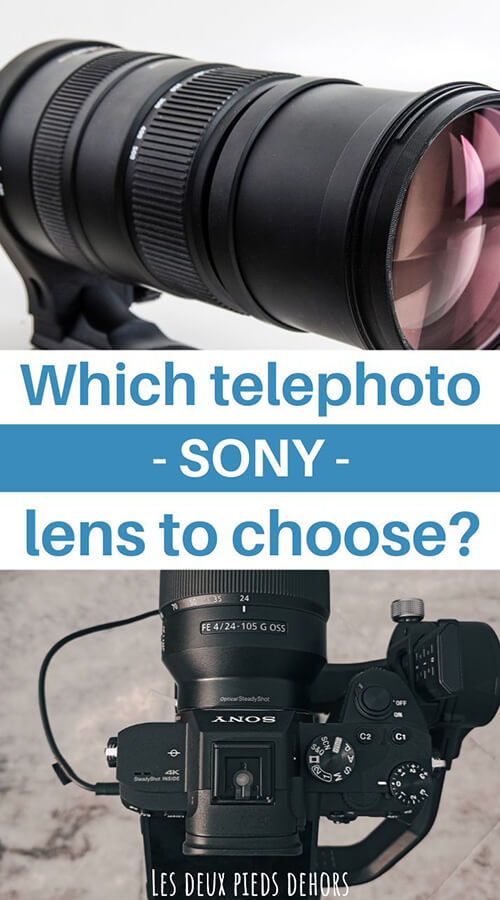


In this article, I’ll go through what I consider the best options if you’re looking to buy a Sony telephoto lens. If you’re interested in a longer focal length, you’re probably thinking about wildlife, sports, outdoor portraits, or a mix of all three. I’ll cover all of that below.
If you want to see every lens available for Sony, I recommend visiting our dedicated pages, which are updated regularly. Keeping track of all the lenses released by every brand takes a lot of work. Here are all the lenses for Sony FE (full-frame) and for Sony E (APS-C).
You’ll also find comparison tables to help you weigh telephoto lenses against one another and make a better choice based on the criteria that matter to you, and of course, your budget.
If you want to understand the main criteria to consider before choosing a Sony telephoto lens, I’ll go over them again at the end of the article.
June 26, 2026
- English polish and factual update of the main Sony E-mount telephoto options released since the previous version, including the Tamron 70-180mm f/2.8 G2, the Sony 85mm f/1.4 GM II, the Sigma 70-200mm f/2.8 DG DN OS Sports, the Sony 300mm f/2.8 GM OSS, the Sony 400-800mm f/6.3-8 G OSS, the Sigma 500mm f/5.6 DG DN OS Sports, and several updated alternatives.
Best Sony telephoto lenses (70 to 200mm)
Let’s start with Sony telephoto lenses between 70 and 200mm. If you want to compare them quickly, you’ll find a summary table below with the main features of the lenses mentioned in this section.
Sony prime lenses
I’ve arranged these lenses from the shortest focal length (85mm) to the longest (135mm). Here is a summary table with what I consider the key points to remember for each telephoto prime lens between 70 and 200mm.
- Best value 85mm
- Very compact
- Excellent image quality
- Very large aperture
- Good build quality
- Very good AF
- Useful handling features
- Sharpness below some alternatives

- Also ideal for macro
- Excellent construction
- Stabilized lens
- Very few optical defects
- Best for macro
- Excellent construction
- Weather-sealed lens
- Ideal for outdoor portraits
- Excellent image quality
- Excellent construction
- Useful handling features
- Average value for money
1. Sigma 85mm f/1.4 DG DN Art
| Features | Visual |
|---|---|
|
|
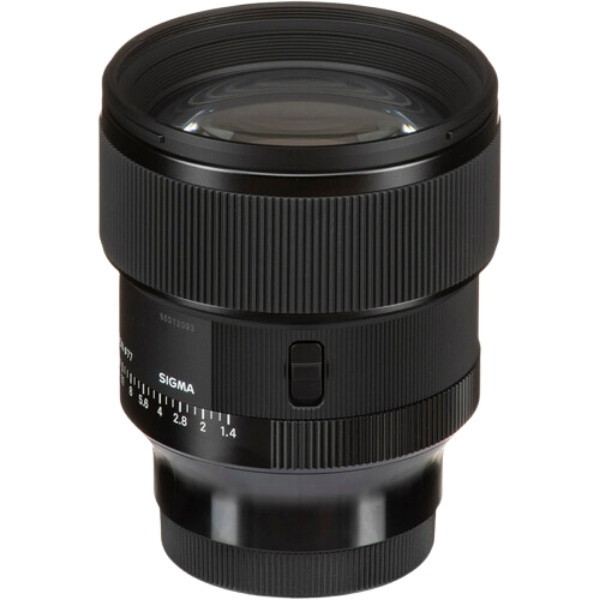
For anyone looking for an 85mm lens with a very large aperture, this Sigma remains, in my opinion, one of the best options for a full-frame camera. It is the mirrorless successor to the older Sigma 85mm f/1.4 DG HSM Art, with impressive compactness for this type of lens (626g and 96mm long). I also prefer it to the Sony 85mm f/1.4 GM, which I find less convincing and almost twice as expensive.
The build quality is excellent, as you would expect from Sigma’s high-end Art line. You get a clickable aperture ring, a classic manual focus ring, an AF/MF switch, a button for locking the aperture ring, and a customizable focus-hold button. With 11 aperture blades, the bokeh remains excellent, even stopped down. Many users also consider the autofocus excellent, even better than Sony’s. Its very large f/1.4 aperture will help you capture and isolate your subject beautifully in low light.
2. Sony FE 85mm f/1.4 GM II
| Features | Visual |
|---|---|
|
|
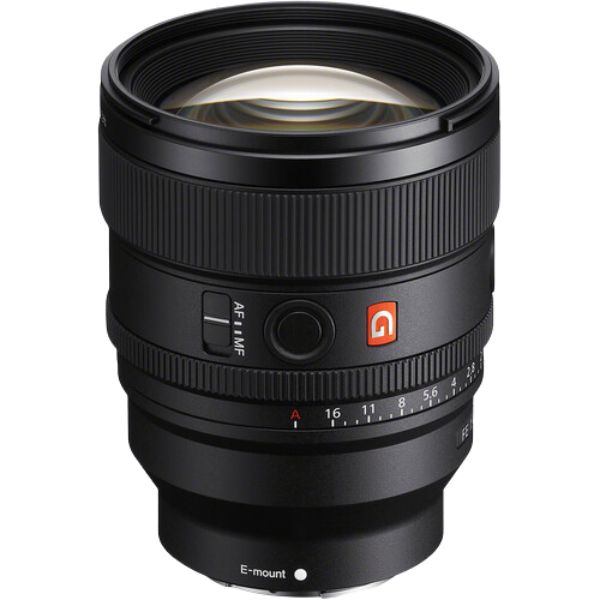
Sony has now updated its premium 85mm f/1.4 with this GM II version, and it clearly deserves a place in the main selection. It is aimed at photographers who want a native Sony portrait lens with very high optical performance, excellent autofocus, and the full comfort of the G Master line.
Compared with the older Sony 85mm f/1.4 GM, this second version is more modern in every way: better autofocus, a more compact body, improved handling, and image quality designed for today’s high-resolution Sony cameras. It is also a strong option for video, thanks to its quieter AF and better control of focus breathing.
That said, it remains an expensive lens. If your priority is value for money, the Sigma 85mm f/1.4 DG DN Art still makes a lot of sense. But if you want the best native Sony 85mm for portraits, with the most complete AF and handling package, the Sony 85mm f/1.4 GM II is now the obvious premium choice.
3. Sony FE 85mm f/1.8
| Features | Visual |
|---|---|
|
|
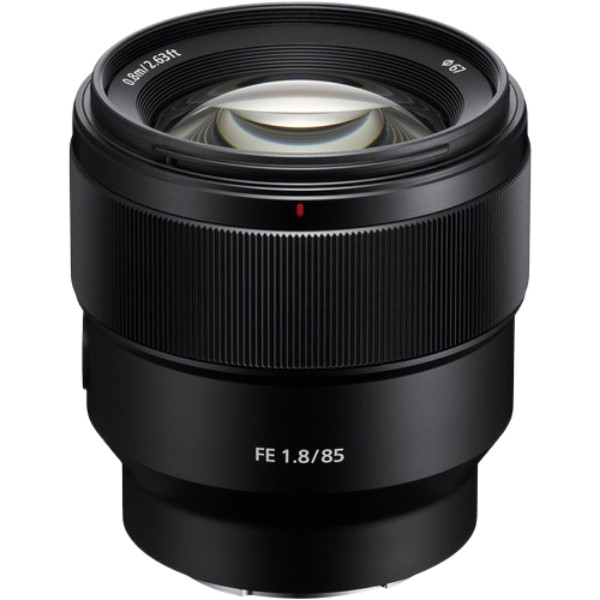
For a long time, this was considered the best value for money for anyone looking for an 85mm. Things have changed a little with the two Samyang lenses mentioned as alternatives, and with the arrival of options such as the Viltrox 85mm. Still, this Sony has good build quality, a compact design, and several useful features, including an AF/MF switch and a focus-hold button. Its autofocus also has a very good reputation.
Image quality is very good from the maximum aperture, although sharpness appears to sit below the Sigma and Samyang options mentioned above. Optical defects are fairly well controlled, with nothing major to report, apart from flare resistance that is often described as average.
In the end, this lens is still worth considering if you prefer to stay with a Sony lens rather than choosing a third-party brand like Sigma or Samyang. It remains a very good choice, but it is slightly more expensive than the Samyang f/1.4 mentioned above, which would still be my first recommendation.
4. Sony 90mm f/2.8 Macro G OSS
| Features | Visual |
|---|---|
|
|
Even though this is a dedicated macro lens, I still wanted to say a few quick words about it. This Sony 90mm f/2.8 has very good build quality, weather sealing, optical stabilization (OSS), and excellent autofocus.
This lens is primarily designed for macro photographers, but it can also work very well for outdoor portraits. Image quality is excellent from the maximum aperture, and optical defects are very well controlled. If you’re looking for a macro lens that can also serve as a portrait lens, this Sony 90mm remains an excellent choice.
5. Sigma 105mm f/2.8 DG DN MACRO Art
| Features | Visual |
|---|---|
|
|
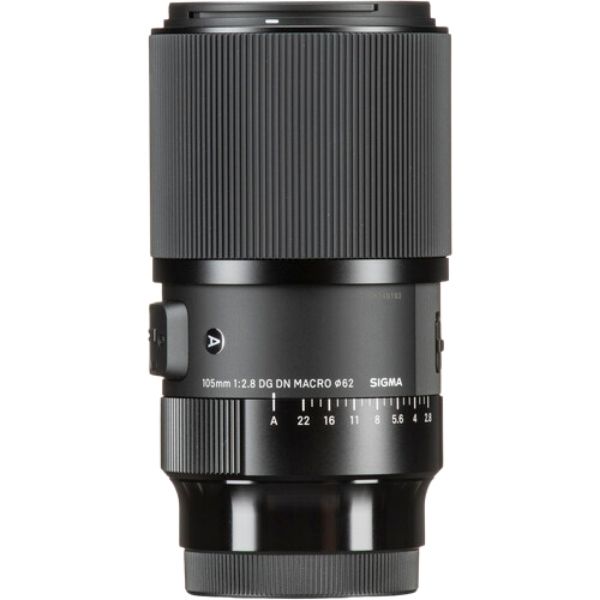
I’m staying for a moment in the world of lenses designed primarily for macro photography. This TIPA award-winning lens offers excellent build quality, almost flawless optical performance, and very good autofocus, although not quite at the level of the Sony 90mm. It does, however, lack stabilization.
For macro photographers, this lens delivers some of the best image quality in this category. The 105mm focal length also works very well for outdoor portraits, and the lens benefits from weather sealing.
If you’re looking for a high-quality macro lens that can also produce pleasant background blur for portraits, this 105mm remains an excellent choice.
6. Sony 135mm f/1.8 GM
| Features | Visual |
|---|---|
|
|
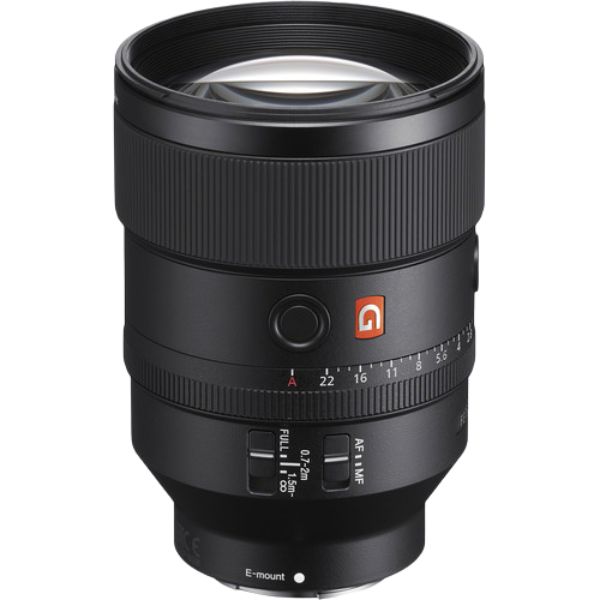
Here, we’re getting into the best of what Sony can offer at this type of focal length. This Sony 135mm f/1.8 remains a reference lens for serious portrait photographers. DSLR photographers used to rely, and probably still do, on the excellent Nikon 135mm f/2 DC and the famous Canon EF 135mm f/2L.
This lens delivers outstanding image quality from the maximum aperture, both in the center and toward the edges. Build quality is flawless, with all the practical features you expect from the GM line: AF/MF switch, clickable aperture ring, focus limiter, and more.
Its only real drawback, if we can call it that, is the price. Even if you are getting one of the best lenses in this focal length range, you need to be sure you will really use it, mainly for outdoor portrait work. The Zeiss Batis 135mm f/2.8 is still cheaper, but overall not as strong. If you’re looking for one of the best full-frame portrait lenses available for Sony, this is it.
7. Samyang AF 135mm f/1.8 FE
| Features | Visual |
|---|---|
|

|
At the beginning of 2022, Samyang released an excellent 135mm f/1.8, a modern autofocus successor to the old manual-focus DSLR-style 135mm lenses. It is a very strong alternative to the Sony 135mm GM, which remains excellent but expensive. This Samyang includes the handling features needed for portrait photography while delivering remarkable image quality.
For under €1,000, it is clearly one of the most interesting choices if you want a 135mm. Even if the autofocus is generally considered a little less responsive than Sony’s, you may not notice much difference in standard use. A real favorite.
Here is a summary table of the six lenses mentioned above, along with the three alternatives listed below.
| Sony telephoto prime lenses | Focallength | Max.Aperture | Weight | Dim. (Ø x L) | Min. FocusDist. | Approx.price | Best price | |||
|---|---|---|---|---|---|---|---|---|---|---|
| + | Samyang 75mm f/1.8 FE AF | 75mm | f/1.8 | 8.11 oz / 230g | 2.6 x 2.7" / 65 x 69 mm | 2.3' / 69 cm | $349 | Amazon B&H | More info + | |
|
||||||||||
| + | Sony 85mm f/1.8 | 85mm | f/1.8 | 13.09 oz / 371g | 3.1 x 3.2" / 78 x 82 mm | 2.6' / 80 cm | $599 | Amazon B&H | More info + | |
|
||||||||||
| + | Sony FE 85mm f/1.4 GM II | 85mm | f/1.4 | 1.4 lb / 642g | 3.3 x 4.2" / 85 x 107 mm | 2.6' / 80 cm | $1 799 | Amazon B&H | More info + | |
|
||||||||||
| + | Sigma 85mm f/1.4 DG DN Art | 85mm | f/1.4 | 1.4 lb / 625g | 3.3 x 3.8" / 83 x 96 mm | 2.8' / 85 cm | $1 000 | Amazon B&H | More info + | |
|
||||||||||
| + | Samyang 85mm f/1.4 FE AF | 85mm | f/1.4 | 1.3 lb / 568g | 3.5 x 3.9" / 88 x 100 mm | 3' / 90 cm | $599 | Amazon B&H | More info + | |
|
||||||||||
| + | Sigma 90mm f/2.8 DG DN Contemp. I L | 90mm | f/2.8 | 10.41 oz / 295g | 2.5 x 2.4" / 64 x 60 mm | 1.6' / 50 cm | $620 | Amazon B&H | More info + | |
|
||||||||||
| + | Sony 90mm f/2.8 Macro G OSS | 90mm | f/2.8 | 1.3 lb / 602g | 3.1 x 5.1" / 79 x 131 mm | 11" / 28 cm | $1 099 | Amazon B&H | More info + | |
|
||||||||||
| + | Sigma 105mm f/2.8 DG DN MACRO Art | 105mm | f/2.8 | 1.6 lb / 710g | 2.9 x 5.3" / 74 x 136 mm | 11.4" / 29 cm | $709 | Amazon B&H | More info + | |
|
||||||||||
| + | Sony 135mm f/1.8 GM | 135mm | f/1.8 | 2.1 lb / 950g | 3.5 x 5" / 90 x 127 mm | 2.3' / 70 cm | $2 099 | Amazon B&H | More info + | |
|
||||||||||
| + | Samyang 135mm f/1.8 FE AF | 135mm | f/1.8 | 1.7 lb / 772g | 3.7 x 5.1" / 93 x 130 mm | 2.3' / 69 cm | $459 | Amazon B&H | More info + | |
|
||||||||||
Prime alternatives
Beyond the seven lenses mentioned above, which I consider some of the best short telephoto options for Sony, I also wanted to briefly mention a few alternatives that are well worth considering.


The Samyang 85mm f/1.4 FE AF is also a remarkable lens. You get something lighter than the Sigma f/1.4, with equally solid build quality. It has fewer features than the Sigma, and according to reviews, the autofocus could be better. Image quality is very good, even if you need to stop down to f/2 and then f/2.8 to get the best results. Its sharpness is better than the Sony 85mm f/1.4 GM, which is already a strong point. Some flare issues have been reported, but vignetting and distortion are fairly well controlled and can be corrected in post-processing. In the end, at around €700, this Samyang is a wonderful alternative if you don’t have the budget for the Sigma f/1.4, which costs about €400 more.
Samyang also offers a cheaper alternative, the Samyang 75mm f/1.8 FE AF. With excellent compactness (230g and 69mm long) and a customizable switch using the brand’s “Lens Station“, this Samyang “Tiny Series” lens delivers impressive image quality, even if you’ll need to stop down to f/2.8 for a perfectly even image across the frame. For under €400, it is hard not to consider if you’re on a smaller budget and want a light but high-quality lens, especially for outdoor portraits. It will also be useful in low light.
Finally, Sigma released the Sigma 90mm f/2.8 DG DN I C, a lens from its well-known “I” series. The result is a compact, relatively light lens that works very well for portrait photography. Build quality is excellent, as usual with this Sigma line. In my opinion, however, the price still feels a bit high (around €600), especially compared with the Samyang 85mm f/1.4, the Samyang 75mm f/1.8, and the Sony 85mm f/1.8. Since this article was first written, Sigma has also introduced an even more specialized 135mm f/1.4 DG Art for Sony E-mount, but given its size, weight and price, I would place it more as a niche portrait option than a general recommendation. If you want something even more specialized, the Sigma 200mm f/2 DG OS Sports is also worth mentioning. It is clearly not a general-purpose recommendation, but for portraits with strong compression, indoor sports, stage photography, or low-light action, it is a very serious professional alternative.
Best Sony zoom lenses
When it comes to telephoto zoom lenses under 200mm, I would still focus mainly on a few strong options rather than listing every possible lens. Below is a summary table of the three main lenses mentioned, along with alternatives.
The table below highlights the key features to remember about the Sony telephoto zooms covered in this section.
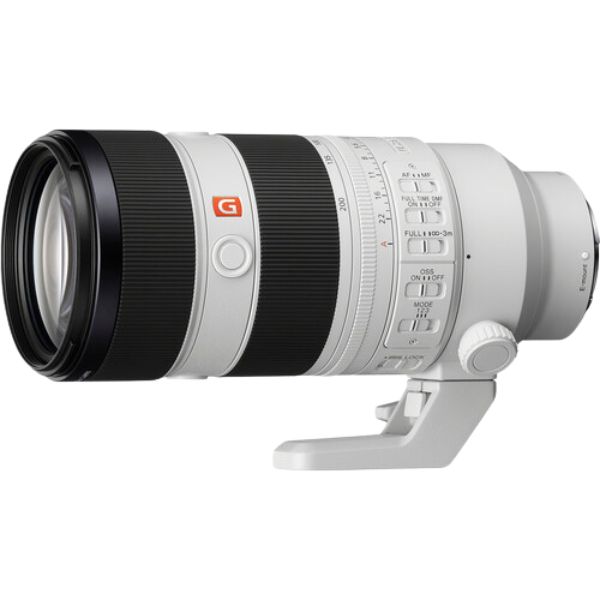
- Best 70-200mm f/2.8
- Outstanding image quality
- Useful handling features
- High price
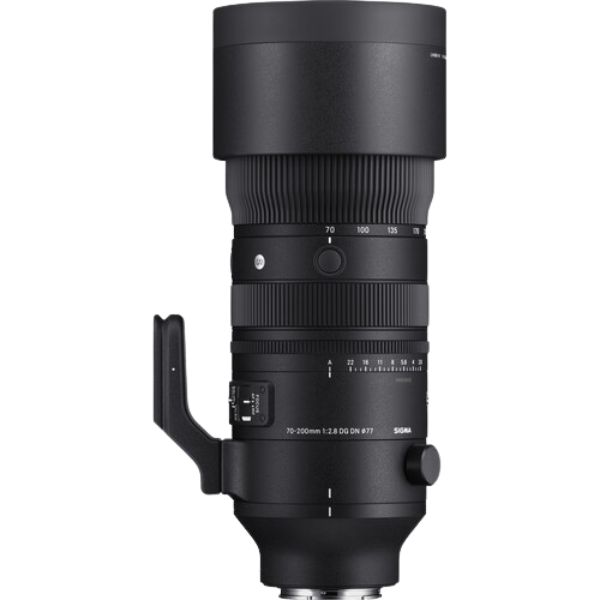
- Excellent f/2.8 alternative
- Sports construction
- Stabilized lens
- Good value for money
1. Sony 70-200mm f/2.8 GM II
| Features | Visual |
|---|---|
|
|
At the end of 2021, Sony finally released a Mark II version of its first 70-200mm f/2.8, which was starting to feel old and, frankly, had been overtaken by the competition, especially by my Tamron 70-180mm mentioned below.
With the 70-200mm f/2.8 GM II, Sony caught up and improved on the first version in almost every way. This Mark II delivers excellent image quality from the maximum aperture, and stopping down does not change much across the zoom range. The lens is also around 500g lighter than the Mark I. Otherwise, you get all the classic GM comforts: AF/MF switch, focus limiter, three stabilization modes, and, for the first time on a Sony zoom, an aperture ring.
Of course, the roughly €3,000 price tag is hard to ignore, but this is still one of the best 70-200mm lenses available. If you have a smaller budget and still want a high-quality lens, the Sigma and Tamron options below are worth a serious look.
2. Sigma 70-200mm f/2.8 DG DN OS Sports
| Features | Visual |
|---|---|
|
|
Sigma’s 70-200mm f/2.8 DG DN OS Sports is now one of the most serious alternatives to Sony’s 70-200mm f/2.8 GM II. It is a professional-oriented lens with optical stabilization, strong build quality, internal zooming, and the kind of handling expected from Sigma’s Sports line.
Compared with the Tamron 70-180mm G2, the Sigma is more complete and more traditional: it gives you the full 70-200mm range, a sturdier construction, and more physical controls. Compared with the Sony GM II, it remains more affordable while still offering a very convincing feature set for portraits, sports, events, and reportage.
It is not the lightest option, and the Sony still keeps the edge if you want the very best native AF performance. But for many photographers, this Sigma offers one of the best compromises in the 70-200mm f/2.8 category.
3. Tamron 70-180mm f/2.8 Di III VC VXD G2
| Features | Visual |
|---|---|
|

|
Not everyone will have the budget for the Mark II version of Sony’s 70-200mm f/2.8. Tamron really hit the mark with its 70-180mm, and the first version was actually the first zoom lens I bought when I switched to mirrorless. After several months of use, I was not disappointed.
The current G2 version is even more relevant today. Build quality remains very good, although naturally not at GM level, autofocus is responsive, and the size is still one of its biggest strengths. Tamron kept the 180mm maximum focal length to reduce weight and maintain the same 67mm filter diameter used across many of its other zooms and primes. The major update is that the G2 version now adds VC stabilization, while improving close-focus performance and overall handling.
Image quality is very good from the maximum aperture. The first version was already sharper than Sony’s original 70-200mm f/2.8 and even the older f/4 version according to many reviews, and the G2 version makes the lens even more competitive. As before, performance is a little less perfect at the long end, with some pincushion distortion, but this is easy to correct in practice.
Usually sold for much less than the Sony GM II, this remains one of the most serious options if you want a versatile, fast-aperture telephoto zoom for reportage, outdoor portraits, and even some wildlife photography when animals are relatively close.
Here is a summary table of the three lenses above, along with possible alternatives.
| Sony telephoto zoom lenses | Focallength | Max.Aperture | Weight | Dim. (Ø x L) | Min. FocusDist. | Approx.price | Best price | |||
|---|---|---|---|---|---|---|---|---|---|---|
| + | Tamron 70-180mm f/2.8 Di III VC VXD G2 | 70-180mm | f/2.8 | 1.9 lb / 855g | 3.3 x 6.2" / 83 x 157 mm | 1' / 30 cm | $1 299 | Amazon B&H | More info + | |
|
||||||||||
| + | Sony 70-200mm f/2.8 GM OSS II | 70-200mm | f/2.8 | 2.3 lb / 1045g | 3.5 x 7.9" / 88 x 200 mm | 1.3' / 40 cm | $2 799 | Amazon B&H | More info + | |
|
||||||||||
| + | Sigma 70-200mm f/2.8 DG DN OS Sports | 70-200mm | f/2.8 | 2.9 lb / 1335g | 3.6 x 4.2" / 91 x 107 mm | 2.1' / 65 cm | $1 469 | Amazon B&H | More info + | |
|
||||||||||
Sony zooms alternatives
If you’re looking for a smaller telephoto lens under 200mm for your Sony camera, the choice is still fairly limited. I won’t go into every option in detail, but I would mention:
- The Mark I version of the 70-200mm f/2.8 is no longer very interesting in my opinion, as it sits well below the Mark II and also behind the Tamron 70-180mm.
- Sony also offers the Sony FE 70-200mm f/4 Macro G OSS II. It is much more attractive than the original version, especially thanks to its improved close-focus capabilities, but the Tamron 70-180mm f/2.8 G2 still looks like the better value if you want the f/2.8 aperture.
- Sigma now also offers a 70-200mm f/2.8 DG DN OS Sports for Sony E-mount. It is a serious alternative if you want a third-party 70-200mm f/2.8 with optical stabilization and professional handling, although it is larger and heavier than the Tamron.
- There is also another possible alternative from Sony, the Sony FE 70-300 mm f/4.5-5.6 G OSS. Even though it offers stabilization and a longer focal length, its price is higher than Tamron’s alternatives, and the aperture is not very exciting in my opinion. If you need more reach, it may be better to look at the super telephoto lenses mentioned below.
- For smaller budgets, Tamron also offers the 70-300mm f/4.5-6.3 Di III RXD. The big advantage is that it costs clearly less than Sony’s 70-300mm.
- Tamron has also released the 50-300mm f/4.5-6.3 Di III VC VXD, which is a very interesting newer option if you want more flexibility at the wide end than a classic 70-300mm while keeping a compact, stabilized lens.
- The Sony FE 50-150mm f/2 GM is a much more specialized premium alternative. It is not a classic 70-200mm, but its constant f/2 aperture makes it very attractive for portraits, weddings, indoor sports, and events if your budget allows it.
- Finally, for Sony APS-C camera owners, Sony offers the entry-level Sony E 55-210mm f/4.5-6.3 OSS, a decent starter telephoto lens. There is also the Sony E 70-350mm f/4.5-6.3 G OSS, which has a good reputation, although I still find it fairly expensive.
Best Sony super telephoto lenses (beyond 200mm)
Here, I’ll cover what I consider the best super telephoto lenses beyond 200mm. The choice used to be fairly limited on Sony, but the range is now much richer, with several strong zooms and a few very expensive prime lenses aimed mainly at professionals and well-funded enthusiasts.
Here is a summary table of the super telephoto zoom lenses below, comparing the main specifications of each lens.
Sony super telephoto zoom lenses
The table below lists the key features to remember for each super telephoto zoom lens.
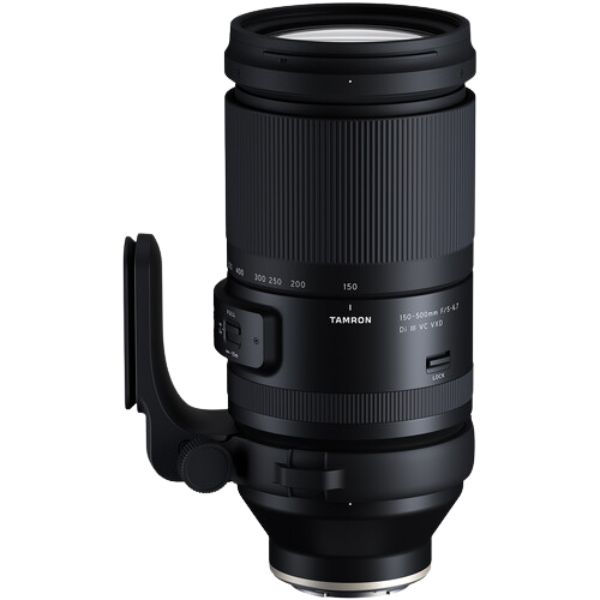
- Very compact lens
- Very good image quality
- Bokeh slightly behind
- Shorter focal length

- Longer focal length
- Excellent image quality
- Very good construction
- Very good AF
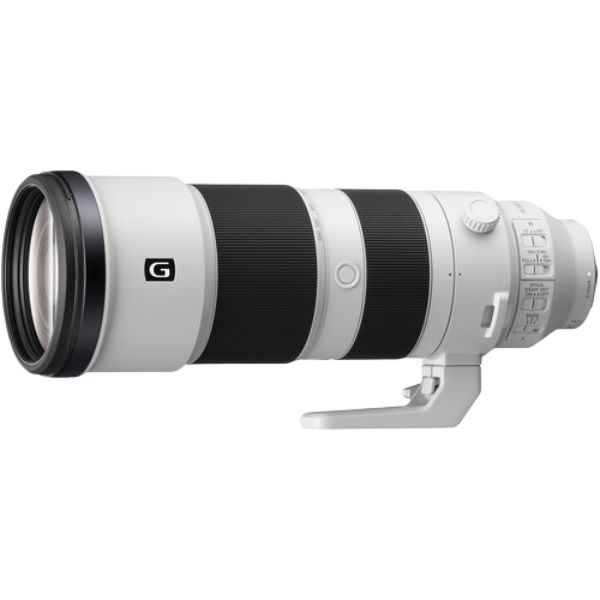
- Internal zoom
- Excellent image quality
- Teleconverter compatible
- Still bulky

- Compact/lightweight lens
- Very good construction
- Very good value for money
- Excellent image quality
- Superb build quality
- Very good value for money
- Compact/lightweight lens
- Some optical defects
- Very good image quality
1. Tamron 150-500mm f/5-6.7 Di III VC VXD
| Features | Visual |
|---|---|
|
|
Tamron was one of the first manufacturers to offer a serious alternative to Sony’s classic telephoto lenses with this 150-500mm. It is the most compact lens in the “150-600mm” family, even though it stops at 500mm. Its maximum aperture at the long end is also a little less bright (f/6.7, although only at 500mm; at other focal lengths, Tamron remains very close to the others, or even slightly brighter depending on the setting). In terms of size, it is not far from Sigma’s 100-400mm.
It is also worth noting that the Tamron has only 7 aperture blades, which can have a slight impact on the quality of background blur. Combined with its shorter focal length compared with its main competitors, the bokeh is a little less pronounced. If your background is far enough away, however, you probably won’t see much difference.
Image quality is excellent and often described as being on the same level as the Sigma 150-600mm or the Sony 200-600mm, except on high-resolution sensors where the Sony still has an advantage. In the end, image quality is not the main difference here. The real strength of this Tamron is its compactness and the fact that it fits more easily into a camera bag.
Overall, this Tamron remains an excellent telephoto lens for a full-frame Sony camera. Image quality is very strong, even if optical defect control is often considered a little less impressive than on the Sigma 150-600mm. When prices are similar, I would still lean toward the Sigma for its longer focal length, brighter long-end aperture, and stronger build quality. But the Tamron has one major advantage: it is noticeably more compact. So what do you think?
2. Sigma 150-600mm f/5-6.3 DG DN S OS
| Features | Visual |
|---|---|
|
|
Competing directly with the Tamron 150-500mm, Sigma released an excellent 150-600mm, a mirrorless version inspired by the DSLR 150-600mm that already had a very good reputation. This telephoto lens is lighter than the old DSLR version, even though it still weighs around 2kg. It also has 9 aperture blades, which, combined with the 600mm focal length, helps produce pleasant background blur.
Build quality is excellent, and stronger than Tamron’s in my opinion. You also get a solid set of controls: AF/MF switch, three stabilization modes, a switch to adjust zoom ring resistance, and a customizable AF button. Autofocus is considered very good, although still below Sony’s 100-400mm and 200-600mm. In terms of image quality, it is very close to the Tamron and the Sony 200-600mm.
In the end, Sigma has produced a very convincing telephoto lens for Sony photographers. It is a high-quality lens, capable of excellent images, with very good AF and a price that feels fair for this category. At a price similar to the Tamron 150-500mm, I would tend to recommend the Sigma, although photographers who want something equally good but more compact may prefer the Tamron. The real question is whether the extra 100mm of reach matters for the way you shoot.
3. Sony 200-600mm f/5.6-6.3 G OSS
| Features | Visual |
|---|---|
|
|
This Sony 200-600mm is still one of Sony’s major super telephoto zooms, and it has a constant physical length. In other words, the lens does not extend when zooming, unlike the Tamron and Sigma mentioned above. The downside is that it is bulkier, heavier, and longer (about 2.1kg and 32cm long), so carrying it around is not exactly effortless.
Build quality is worthy of Sony’s higher-end lenses, and you get all the classic features for this type of lens: AF/MF switch, customizable AF button, focus limiter, and three stabilization modes. Image quality is excellent, of course, but not dramatically better than the Sigma or Tamron. Reviews usually mention better sharpness mainly in the center on high-resolution sensors.
The price remains higher than the Sigma and Tamron options mentioned above, and I’m not sure it will always be worth the extra cost. Still, it keeps an important advantage: it is compatible with Sony teleconverters, which can matter a lot for wildlife photographers. Sony has also since released the FE 400-800mm f/6.3-8 G OSS, which offers even more reach for distant subjects, but it is a more specialized lens with a slower aperture.
4. Sony 400-800mm f/6.3-8 G OSS
| Features | Visual |
|---|---|
|

|
The Sony 400-800mm f/6.3-8 G OSS is now the longest native Sony telephoto zoom, and it clearly deserves its own place in this guide. It is a more specialized lens than the 200-600mm, but it offers a level of reach that will be very appealing for birds, distant wildlife, and subjects you simply cannot approach.
The aperture is slower, especially at the long end, so this is not the most versatile lens in poor light. However, the internal zoom, optical stabilization, and compatibility with Sony teleconverters make it a very serious option if reach matters more than brightness.
For many photographers, the 200-600mm will still be easier to recommend because it is brighter and already very long. But if you often crop heavily or regularly find yourself wanting more than 600mm, the Sony 400-800mm becomes a very logical choice.
5. Sigma 100-400mm f/5-6.3 DG DN OS Contemporary
| Features | Visual |
|---|---|
|
|
I’m stepping away from the classic trio for a moment to introduce the Sigma 100-400mm, which remains a real gem. Build quality is almost as good as Sony’s. It does have a slightly smaller aperture than its Sony competitor, the 100-400mm GM, which I’ve placed as an alternative. The Sigma is also lighter (about 1.1kg compared with 1.5kg for the Sony with its tripod collar).
You get almost the same controls on the Sigma as on the Sony, except for the customizable AF button, which the Sigma does not include. Image quality is excellent and very close to Sony’s. The difference is mostly visible at 400mm and on very high-resolution sensors. Its autofocus also has a strong reputation.
In short, this Sigma 100-400mm competes directly with Sony’s equivalent. Unless you absolutely want to use a teleconverter with your 100-400mm, I see little reason not to consider the Sigma, especially since the Sony costs more than twice as much.
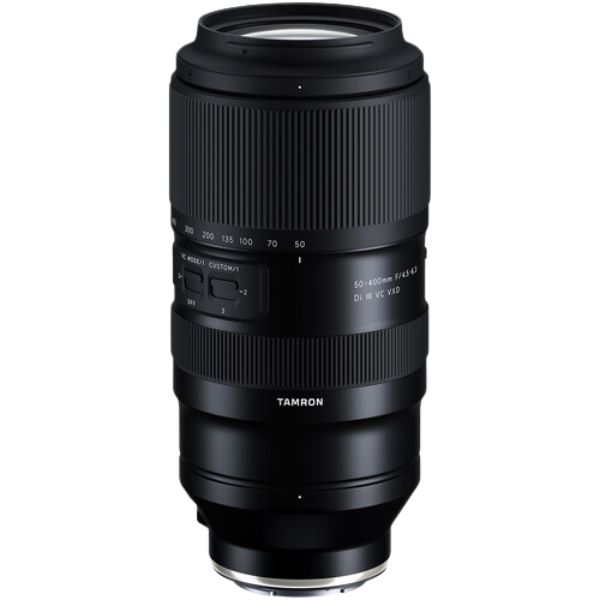
6. TAMRON 50-400mm f/4.5-6.3 Di III VC VXD
| Features | Visual |
|---|---|
|
|
Even though Tamron already had the 150-500mm, the brand released a 50-400mm f/4.5-6.3 in December 2022. This lighter and more compact lens competes directly with Sigma’s 100-400mm, while offering a wider starting focal length. Sigma later followed with the 60-600mm, which is more versatile and reaches farther, but is also much heavier and more expensive.
Image quality is considered excellent, even at the maximum aperture. Reviews generally place it above the Sigma 100-400mm in image quality, although the Sigma remains cheaper. It is also fairly close to the Tamron 150-500mm. Compared with Sony’s 100-400mm, the Tamron is much cheaper, but unfortunately heavier. Sony’s autofocus is still usually considered better. As for optical defects, the weak points are vignetting and significant distortion, both of which can be corrected well in post-processing. Chromatic aberrations are well controlled.
In conclusion, this 50-400mm is a very versatile lens from Tamron, letting you shoot a little wider than with a classic 100-400mm. It remains relatively compact and light, and it also offers a 1:2 magnification ratio at 50mm, making close-up photography possible at that focal length. It is just a pity that the tripod collar is not included.
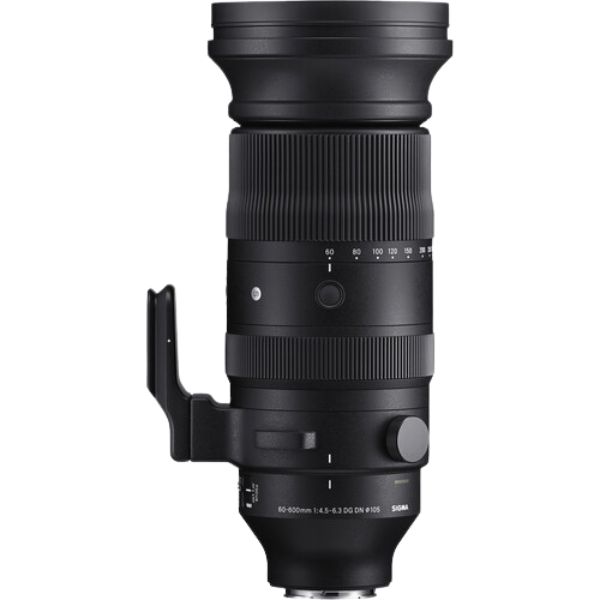
7. Sigma DG DN 60-600mm f/4.5-6.3 S OS
| Features | Visual |
|---|---|
|
|
In January 2023, a few months after releasing the 150-600mm Sports for mirrorless cameras, Sigma launched another lens that already existed in DSLR form: the 60-600mm f/4.5-6.3, often nicknamed the “Bigma.” This version brings several improvements compared with the 150-600mm.
First, while lenses with a wider zoom range often tend to be weaker optically, that does not seem to be the case here. This 60-600mm appears to perform better than the 150-600mm and several other telephoto zooms, even Sony’s 200-600mm in some situations. It also uses Sigma’s newer autofocus technology, making it more responsive and closer to Sony G and GM performance. Stabilization has also improved, reaching up to 7 stops instead of about 5 on the 150-600mm. Flare resistance is not its strongest point, but that is not unusual for this type of zoom, and in real-world images, it will rarely be a major issue. Chromatic aberrations are well controlled and, at worst, easy to correct.
Compared with the 150-600mm, the main drawbacks are weight and price. If you can handle the extra weight, the price difference is the real question. Still, it is an excellent choice if you want maximum versatility for wildlife photography in particular. Since then, Sigma has gone even further with options like the 500mm f/5.6 DG DN OS and the much more specialized 300-600mm f/4 DG OS, but those lenses are aimed at photographers with very different needs and budgets.
The table below summarizes the main characteristics of super telephoto lenses available for Sony E-mount.
| Sony super telephoto zoom lenses | Focallength | Max.Aperture | Weight | Dim. (Ø x L) | Min. FocusDist. | Approx.price | Best price | |||
|---|---|---|---|---|---|---|---|---|---|---|
| + | Tamron 50-400mm f/4.5-6.3 Di III VC VXD | 50-400mm | f/4.5-6.3 | 2.5 lb / 1150g | 3.5 x 7.2" / 89 x 183 mm | 9.8" / 25 cm | $1 299 | Amazon B&H | More info + | |
|
||||||||||
| + | Sigma 60-600mm f/4.5-6.3 DG DN OS Sports | 60-600mm | f/4.5-6.3 | 5.5 lb / 2500g | 4.7 x 11" / 119 x 279 mm | 1.5' / 45 cm | $1 949 | Amazon B&H | More info + | |
|
||||||||||
| + | Sigma 100-400mm f/5-6.3 DG DN OS Contemporary | 100-400mm | f/5-6.3 | 2.5 lb / 1135g | 3.4 x 7.8" / 86 x 197 mm | 3.6' / 110 cm | $839 | Amazon B&H | More info + | |
|
||||||||||
| + | Tamron 150-500mm f/5-6.7 Di III VC VXD | 150-500mm | f/5-6.7 | 4.1 lb / 1880g | 3.7 x 8.3" / 93 x 210 mm | 2' / 60 cm | $1 399 | Amazon B&H | More info + | |
|
||||||||||
| + | Sigma 150-600mm f/5-6.3 DG DN OS Sport | 150-600mm | f/5-6.3 | 4 lb / 1830g | 4.1 x 10.2" / 105 x 260 mm | 9.2' / 280 cm | $1 299 | Amazon B&H | More info + | |
|
||||||||||
| + | Sony 200-600mm f/5.6-6.3 G OSS | 200-600mm | f/5.6-6.3 | 4.7 lb / 2115g | 4.4 x 12.5" / 112 x 318 mm | 7.9' / 240 cm | $1 999 | Amazon B&H | More info + | |
|
||||||||||
| + | Sony 400-800mm f/6.3-8 G OSS | 400-800mm | f/6.3-8 | 5.4 lb / 2470g | 4.7 x 13.6" / 120 x 346 mm | 5.6' / 170 cm | $2 900 | Amazon B&H | More info + | |
|
||||||||||
Sony zoom alternatives
Here, I would keep things simple by mentioning one real alternative: the Sony FE 100-400 mm f/4.5-5.6 GM OSS. As mentioned above, it is an excellent lens, no doubt about it, but in my opinion its price is hard to justify compared with the Sigma 100-400mm, which is much cheaper. The Sony does keep the advantage if you want native teleconverter compatibility and the full GM experience.
Sony super telephoto lenses
The table below summarizes the prime super telephoto lenses for Sony cameras.
- Lightweight for a 300mm
- Excellent AF
- High-end construction
- Very high price

- 3 stabilization modes
- Superb image quality
- High-end construction
- High-level AF
- Reach and portability
- Excellent image quality
- Sports construction
- More realistic than big primes
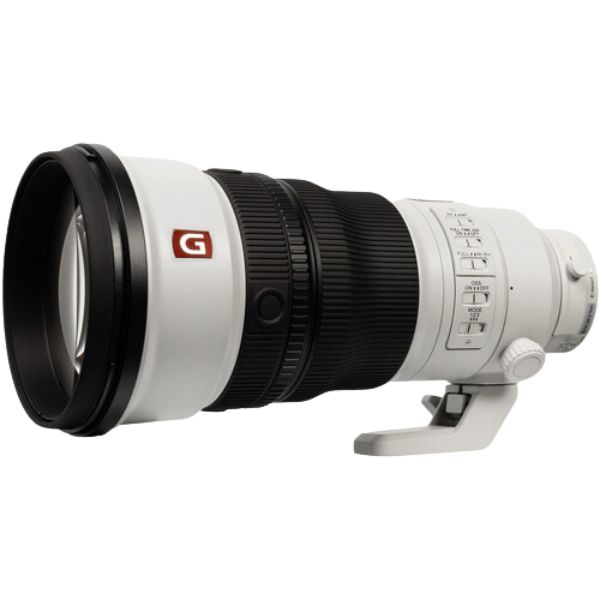
1. Sony 300mm f/2.8 GM OSS
| Features | Visual |
|---|---|
|
|
The Sony 300mm f/2.8 GM OSS is one of the most important recent additions to Sony’s professional telephoto range. It is still a very expensive lens, of course, but it is far easier to handle than a 400mm f/2.8 or a 600mm f/4, and that makes it much more realistic for some photographers.
This focal length is very useful for sports, wildlife at moderate distances, indoor action, and even some compressed portraits. Its main strength is the combination of a bright f/2.8 aperture, high-end autofocus, optical stabilization, and a relatively light design for this category.
It is not an affordable recommendation, but if you need a professional prime lens that remains mobile and usable for long shooting sessions, this 300mm GM is now one of the most interesting options in the Sony system.
2. Sony 400mm f/2.8 GM OSS
| Features | Visual |
|---|---|
|
|
Sony offers this excellent lens for photographers looking for a telephoto lens for wildlife and/or sports photography. As with all GM lenses, it includes the classic high-end features: three stabilization modes, several customizable buttons, and the usual MF/AF switch. Autofocus is at a very high level and can fully keep up with Sony’s best cameras, such as the A9/A9II and the A1.
As you can imagine, this beast comes at a price that only professionals or very wealthy amateurs will seriously consider.
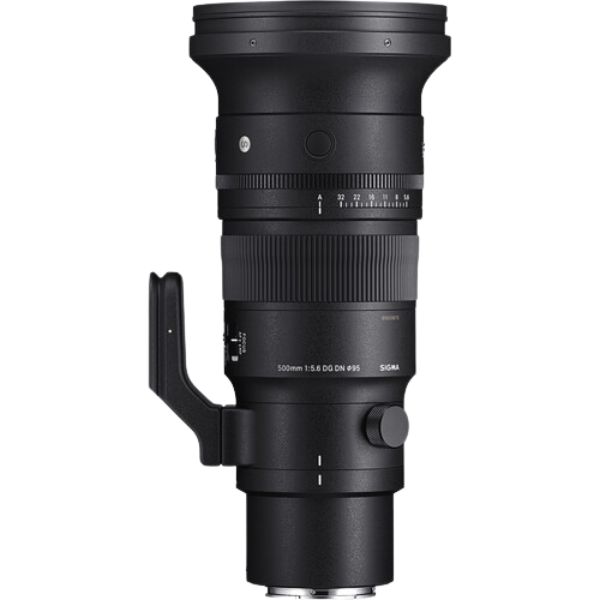
3. Sigma 500mm f/5.6 DG DN OS Sports
| Features | Visual |
|---|---|
|
|
The Sigma 500mm f/5.6 DG DN OS Sports is an especially interesting lens because it offers a long fixed focal length without reaching the size, weight, and price level of Sony’s 400mm f/2.8 or 600mm f/4. It is still a serious investment, but it feels much more realistic for passionate wildlife photographers.
Its main appeal is simple: you get 500mm, optical stabilization, strong image quality, and a professional construction in a relatively portable package for this type of lens. It will be particularly relevant for wildlife, birds, and outdoor sports when you want the rendering and discipline of a prime lens without carrying a huge super telephoto.
Of course, a zoom will remain more flexible, and f/5.6 is not as bright as Sony’s exotic primes. But if you know you want a long prime for Sony E-mount, this Sigma is now one of the most convincing options on the market.
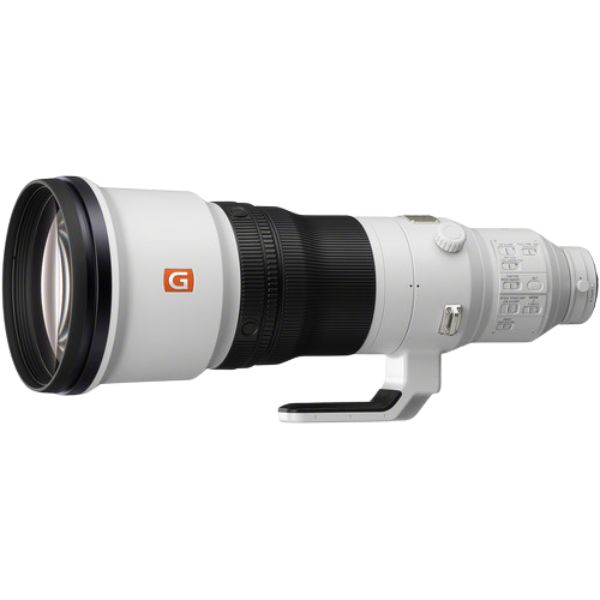
4. Sony 600mm f/4 GM OSS
| Features | Visual |
|---|---|
|
|
Sony released this 600mm f/4 alongside the 400mm f/2.8 mentioned above. As you can imagine, it delivers extraordinary image quality at every aperture. You get the same type of features as on the 400mm, but at an even higher price.
Reminder – How to choose a telephoto lens
As I mentioned in the introduction, there are several criteria to keep in mind when choosing a telephoto lens. Beyond budget, which is not really a technical criterion in itself, I would recommend considering the following points.
Choosing a zoom or a prime lens?
In my opinion, this is one of the most important factors to consider before buying. You’ll need to choose between a prime lens and a zoom lens. Everyone will have their own preferences here, and it is largely a matter of use. Here are a few points worth keeping in mind:
- If I exclude the very expensive professional prime lenses (300mm, 400mm, 500mm and 600mm), there still aren’t many affordable primes beyond the Sony 135mm f/1.8 GM, which is already quite expensive. So if you need a long focal length beyond 135mm, for wildlife or sports photography for example, you will usually have to choose a zoom lens, either from Sony or from a third-party brand like Sigma or Tamron. The main case where I find a telephoto prime especially interesting is portrait photography, mainly outdoors. In that situation, you have several relatively accessible options, especially in the 85mm to 105mm range. The only zooms covering these focal lengths are the classic 70-200mm lenses.
- The maximum aperture of your lens is another important factor. On most zoom lenses, f/2.8 is as bright as it gets, while prime lenses can offer f/1.8 (Sony 85mm and 135mm) or f/1.4 (Samyang and Sigma 85mm, and now some more specialized options). However, these prime focal lengths will often be best suited to outdoor portraits, because you need some working distance. If that fits your use, a prime lens can be a better and often cheaper choice than a 70-200mm zoom, which will generally be more expensive and less bright.
- Compactness also matters. An f/1.4 prime lens usually weighs around 500 to 600g, while even a relatively light zoom like the Tamron 70-180mm already weighs more. The Sony FE 70-200mm f/2.8 GM OSS II weighs about 1kg.
In conclusion, I would say that for wildlife or sports, a zoom lens will usually be more suitable, and sometimes the only realistic option depending on the sport. For portraits, I would often recommend taking a fixed 85mm and moving your feet. You will often get better results for less money.
Which maximum aperture to choose?
Here again, things are not always simple. Very long zoom lenses beyond 200mm usually offer maximum apertures of f/5.6, f/6.3, or even f/6.7. Unless you are considering very expensive professional prime lenses, you won’t have many alternatives in this focal length range.
If you need a shorter focal length, between 70 and 200mm, the question of a larger aperture becomes more relevant. And a larger aperture often means switching to a prime lens. As a reminder, a larger aperture allows you to:
- Create more pronounced foreground or background blur than with a zoom lens at f/5.6, because your depth of field will be shallower.
- Use a faster shutter speed. If your aperture lets in twice as much light, for example from f/4 to f/2.8, you can double your shutter speed.
- If you know the famous exposure triangle, you also know that instead of shooting faster, you can lower your ISO thanks to the larger aperture. This is especially useful when the light starts to drop.
For example, if you are shooting at “f/4, 1/500th, ISO 1000”, with a maximum aperture of f/2.8, you can choose:
- f/2.8, 1/1000th, ISO 1000, to shoot faster
- f/2.8, 1/500th, ISO 500, to reduce ISO by half
Which use?
Of course, the right Sony telephoto lens depends on how you plan to use it. For portraits or reportage, I would say that a large-aperture prime lens can be ideal, unless you prefer the flexibility of a 70-200mm zoom, which will generally be heavier, more expensive, and less bright. For landscapes, a zoom will often be more useful because it is more versatile.
For wildlife, you will usually want something like a 100-400mm, 150-600mm, 200-600mm, or even a newer long-range option such as Sony’s 400-800mm, depending on how much reach you need. These lenses can work for domestic animals, wild animals, safari-style photography, and even insects such as dragonflies.
For sports photography, a lens with a large aperture helps freeze action more easily and blur the background. Ideally, a 400mm or 600mm prime would be great, but unless you are a professional or a very wealthy amateur, few photographers can justify that kind of purchase. For relatively close indoor sports, such as handball or boxing, I would recommend a 70-200mm f/2.8 rather than a super telephoto lens.
Should you choose a stabilized lens?
Most 70-200mm lenses are stabilized, and the newer Tamron 70-180mm G2 now includes stabilization too. Super telephoto lenses such as 100-400mm, 150-600mm, 200-600mm, and similar options are also stabilized.
The question mainly applies to smaller telephoto lenses under 200mm. Many of these primes are not stabilized. For portrait photography, stabilization is not always essential because the subject is usually fairly static, and most Sony cameras already include in-body stabilization.
Weight and size?
This depends on you and the way you shoot. For some photographers, saving 100 or 200g makes a real difference. For others, it barely matters. As mentioned above, zoom lenses will generally be heavier and longer than prime lenses.
Should you choose a weather-sealed lens?
Most of the lenses mentioned in this article are weather-sealed. Here, everything depends on the conditions in which you shoot. If you often work in tropical areas, in humid environments, or in rain, it is worth considering a lens with weather-resistant construction. If you mostly shoot in normal conditions, it is far from essential.
Should you choose a Sony lens or a third-party lens?
Everyone will have their own opinion on this, but the days when Sigma and Tamron were just third-party brands where you had to hope for a “good copy” are over. Today, several third-party brands, mainly Sigma and Tamron, and to a slightly lesser extent Samyang, offer lenses that can be just as good as Sony’s, often for much less money. Everyone will have their own view, of course.
That’s it, we’ve reached the end of this very long article. I think I’ve given you the key information you need to choose among the best Sony telephoto lenses. You should now be able to make a more informed decision. Most of these lenses are very high quality, and if you choose one from this list, it is hard to make a truly bad choice.
If you want to go further, I invite you to read how to shoot with a long focal length!
See you soon,
Did you like the post? Follow us!

Written by Sylvain PONS
I've been passionate about photography since 2010, learning as I went along. Today, I dedicate myself to guiding others in their choice of camera gear and sharing a variety of tips to improve their photography skills.
Despite our care, a mistake may have slipped into this article. If you find any, please don't hesitate to let us know so we can correct it as soon as possible and keep our information up-to-date!