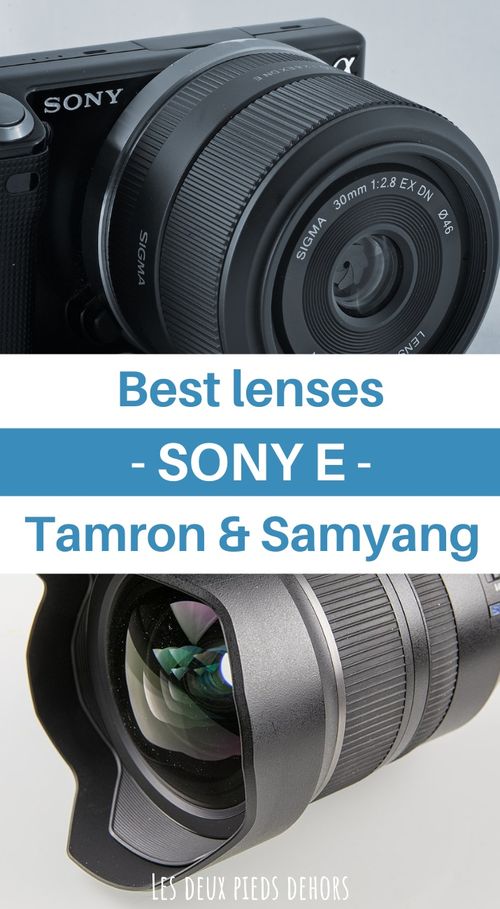
Best Tamron and Samyang lenses for Sony E mount
Last update: 06/26/2026
Our blog continues to grow thanks to you, our readers. This post may contain affiliate links, which means we can earn a small commission if you make a purchase through them, at no extra cost to you. This helps us to continue to bring you more and support our work!
After our guide to the best Sigma lenses for Sony cameras, I wanted to take a closer look at the best Tamron and Samyang lenses for Sony E-mount. These two brands used to have smaller lineups than Sigma, but they have grown a lot in recent years and now offer several genuinely interesting alternatives for Sony shooters.
Like Sigma, Samyang and Tamron are far from newcomers in the photography world: Samyang was founded in 1972, while Tamron dates back to 1950! For a long time, Tamron, like Sigma, was seen as a more affordable alternative to the big camera brands, while Samyang was mostly known for low-cost manual focus lenses. Things have changed quite a bit. Tamron has improved both its optical quality and build quality, while Samyang has used the mirrorless boom to develop a much broader autofocus lineup, even if many of its AF lenses still use a lighter, more plastic-oriented construction than its older all-metal manual lenses.
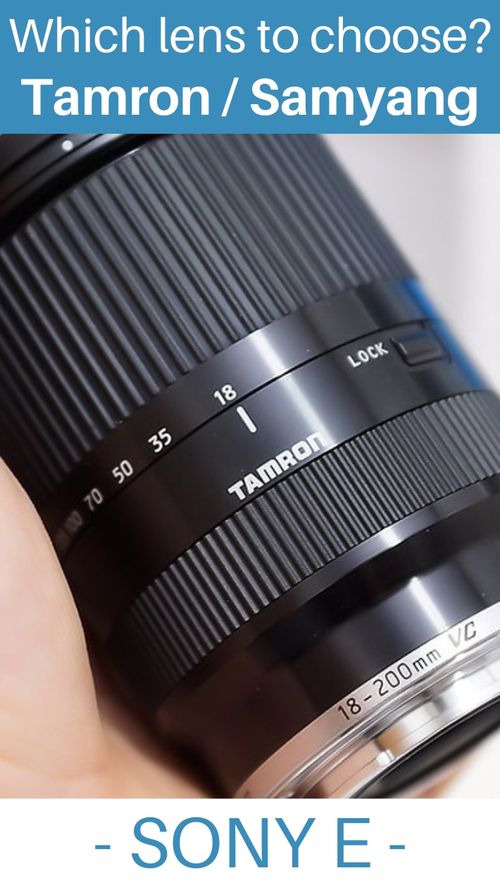
Tamron first made a name for itself on Sony E-mount with compact zooms, often with a constant f/2.8 aperture and a 67mm filter thread, which made them much easier to carry than older DSLR equivalents. Samyang, on the other hand, started mostly with prime lenses, but its lineup has expanded a lot and now includes more ambitious f/1.4 primes, compact “Prima” lenses and even f/2.8 zooms. The two brands no longer play exactly the same role, but that is precisely what makes them interesting: Tamron remains very strong for travel and everyday zooms, while Samyang offers some excellent value primes and, more recently, a few serious zoom alternatives.
Another important update: these lenses are no longer limited to Sony E-mount in the strict sense. Sony E remains one of the most complete mounts for both brands, but Tamron now offers several mirrorless lenses for Nikon Z, Fujifilm X and Canon RF/RF-S too, while Samyang has also started expanding some recent lenses beyond Sony. By the way, we also have a full guide summarizing all the best current Sony lenses.
You might wonder why I’m talking about these two brands in particular. When I switched to a mirrorless camera, I started looking closely at everything available for Sony E-mount. I quickly realized that Tamron and Samyang offered some very good lenses at much lower prices than many native Sony options. If you’re wondering where I would start today, I would still look first at two Tamron lenses and one Samyang:
We’ve also included several of the lenses mentioned here in our guide to help you choose the best Sony zoom lens for your needs.
Best Samyang and Tamron lenses for Sony APS-C cameras
Once again, APS-C remains the less spoiled format compared with full frame. Tamron does offer several useful APS-C options for Sony E-mount, including the 11-20mm f/2.8, the 17-70mm f/2.8 VC and the 18-300mm travel zoom, while Samyang’s autofocus APS-C lineup remains much more limited. Still, when you combine Tamron zooms with Sigma’s APS-C primes, you can build a pretty solid Sony APS-C kit, even if Fujifilm remains the benchmark in my opinion if you want to stay fully committed to APS-C.
If you want to go further, I invite you to have a look at our complete page summarizing all available lenses for Sony APS-C cameras (Sony and all third-party brands).
Here are the three lenses detailed below:
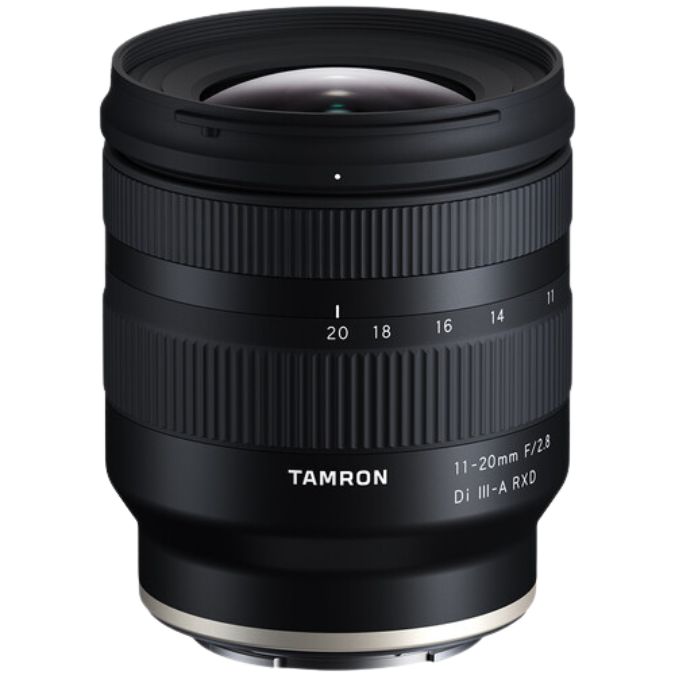
1 - TAMRON 11-20mm f/2.8 Di III-A RXD
| Features | Visual |
|---|---|
|
|
Tamron’s 11-20mm is a wide-angle zoom that can replace Sony’s aging 10-18mm, while offering a brighter constant aperture. For APS-C landscape, architecture, travel or interior photography, it remains one of the strongest choices in this category, and it can even compete with some prime lenses in the same focal range.
Build quality is quite good and close in spirit to Tamron’s full-frame mirrorless lenses, with a clean barrel and very few external controls to keep the price and size under control. Optical quality is very good, especially after stopping down slightly, although the edges lag a little behind at full aperture. Vignetting and distortion are more visible at 11mm, but they become more discreet as you zoom in. Flare can still show up quite clearly, which is not unusual for this type of ultra-wide lens. Autofocus is fast and reliable, even if it is not Tamron’s most advanced AF system.
In short, this is still a very good choice. It is not exactly cheap, but it can compete with the best APS-C lenses of this type, especially around f/5.6, which is often where you will use it for landscape or architecture photography.
2 - TAMRON 17-70mm f/2.8 Di III-A VC RXD
| Features | Visual |
|---|---|
|

|
Here again, Tamron offers an alternative to the Sony 16-55mm f/2.8 and other similar zooms, such as the Sony 18-105mm f/4 or the Sony Zeiss 16-70mm f/4.
The construction follows the same philosophy as other Tamron zooms for Sony E-mount: good quality, but not overloaded with buttons or advanced controls. Optical quality is excellent for this type of zoom and very close to the Sony 16-55mm, with even better results once you stop down slightly. The 70mm end is not perfect, especially wide open, but Sony’s 16-55mm simply does not reach that focal length, so this remains a real advantage for Tamron. The main optical flaws are distortion at the wide end and vignetting at full aperture, both of which can be corrected in post-processing. The 9-blade aperture also helps produce more pleasant bokeh than you might expect from a standard APS-C zoom. Autofocus is fast and precise.
It remains a very strong option. It is not cheap, but it is still generally less expensive than Sony’s 16-55mm f/2.8 and offers a more versatile zoom range with stabilization. Let’s hope Tamron continues to expand its APS-C range, because it still has room to grow.
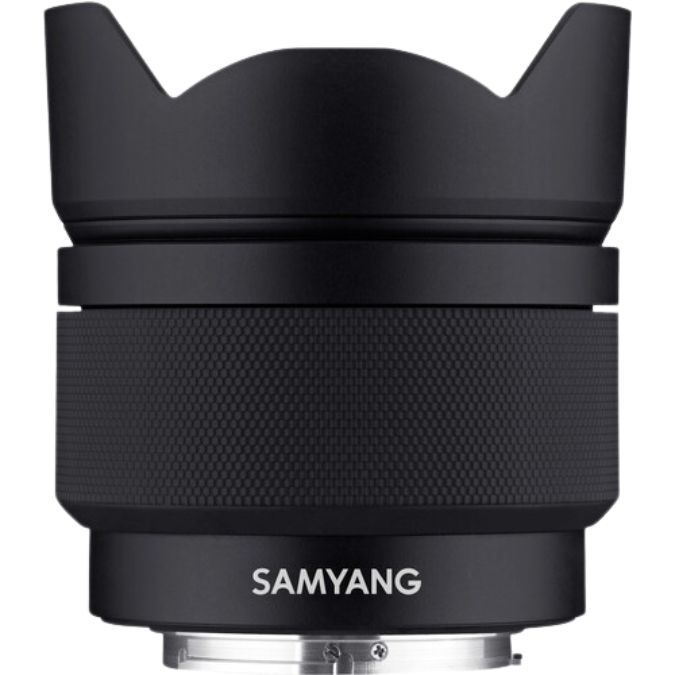
3 - SAMYANG AF 12mm f/2
| Features | Visual |
|---|---|
|
|
This remains Samyang’s main autofocus APS-C lens for Sony E-mount. The brand chose to focus on an ultra-wide-angle prime, which makes sense given Samyang’s long-standing expertise with wide-angle lenses, including its full-frame 18mm.
The construction is very good, and so is the optical quality in the center, but the edges are far behind at large apertures. The optical defects are more annoying, because although distortion and vignetting are okay, chromatic aberrations and flare are significant. On the other hand, it does well with coma and can therefore be used in astrophotography.
If you prefer fixed focal lengths or find Tamron’s 11-20mm too expensive, this 12mm can be found at the very affordable price of 400€, less than half the price of the Tamron or the 12mm f/2.8 Zeiss Touit.
Other lenses
Tamron also offers the 18-300mm f/3.5-6.3 Di III-A VC VXD for Sony APS-C. It is not in the same category as the two f/2.8 zooms above, but it is much more relevant today than the older 18-200mm if you want one travel lens that covers almost everything. Image quality and aperture are inevitably more compromised than with the 11-20mm or 17-70mm, but for travel, family trips or simple everyday use, it is worth mentioning.
Best Tamron and Samyang lenses for full frame Sony cameras
As with the Sigma list, here I’ll discuss the lenses that I consider to be the most interesting, starting with the zooms and then the primes from Tamron and Samyang. I also invite you to have a look at our complete and regularly updated page dedicated to all Sony FE lenses for full-frame cameras.
Here are the lenses detailed below:
- Tamron 16-30mm f/2.8 Di III VXD G2
- Tamron 20mm f/2.8 Di III OSD M1:2
- Tamron 28-75mm f/2.8 Di III VXD G2
- Tamron 35-150mm f/2-2.8 Di III VXD
- Tamron 50-400mm f/4.5-6.3 Di III VC VXD
- Tamron 70-180mm f/2.8 Di III VC VXD G2
- Tamron 150-500mm f/5-6.7 Di III VC VXD
- Tamron 90mm f/2.8 Di III Macro VXD
- Samyang AF 24mm f/1.8 FE
- Samyang AF 35mm f/1.8 FE
- Samyang AF 35mm f/1.4 FE II
- Samyang AF 45mm f/1.8 FE
- Samyang AF 50mm f/1.4 II FE
- Samyang AF 75mm f/1.8 FE
- Samyang AF 85mm f/1.4 FE II
- Samyang AF 135mm f/1.8 FE
1 - TAMRON 16-30mm f/2.8 Di III VXD G2
| Features | Visual |
|---|---|
|

|
The Tamron 16-30mm f/2.8 Di III VXD G2 is now the wide-angle zoom I would put forward first in this range. It keeps the compact, travel-friendly spirit that made Tamron’s earlier ultra-wide zooms so appealing, but it brings a more useful 16-30mm range, a modern VXD autofocus motor and the refinements of Tamron’s G2 generation.
In practice, this is exactly the kind of lens that makes sense for Sony full-frame users who want a bright ultra-wide zoom without going straight to a larger and more expensive Sony 16-35mm f/2.8. Build quality is good, the lens remains easy to carry, and the constant f/2.8 aperture makes it useful for landscape, architecture, travel, events and even night scenes. As always with this type of zoom, distortion and vignetting will be more visible at the wide end, but they are easy to manage with lens corrections and do not take away from the overall value of the lens.
The main point is simple: if you are updating this guide today, this 16-30mm f/2.8 Di III VXD G2 should replace the older wide-angle recommendation. It is the more current Tamron option, and it fits perfectly alongside the 28-75mm G2 and 70-180mm G2 to build a coherent, compact f/2.8 zoom kit for Sony full frame.
2 - TAMRON 20mm f/2.8 Di III OSD M1:2
| Features | Visual |
|---|---|
|

|
Announced alongside the 24mm and 35mm f/2.8, this Tamron 20mm belongs to a small, light and affordable trio of compact primes. It gives you a true wide-angle focal length in a very easy-to-carry format, with a close-focusing ability that makes it more versatile than it may first appear.
Build quality is in line with Tamron’s compact Sony E-mount lenses. Optical quality is good, especially if you stop down one or two stops, with very good results around f/5.6. Autofocus is the weak point: the OSD motor can feel a little slow and noisy, and it may hesitate in certain situations. Distortion is strong, but other optical flaws are generally well controlled. The 1:2 magnification ratio is a real bonus, especially for close-ups and wide-angle detail shots with a more creative perspective.
For a little less than 350€, this is still a good lens, even if some photographers will not need it if they already own a 16-30mm, 20-40mm or another Tamron wide-angle zoom. Its small size, light weight and 1:2 ratio remain very useful advantages. I personally chose this wide-angle lens when I switched to Sony. Check out my full review of this lens!
Want to know about other wide-angle lens options besides the 20mm and 16-30mm? We wrote a full article on the best wide-angle lenses for Sony.
3 - TAMRON 28-75mm f/2.8 Di III VXD G2
| Features | Visual |
|---|---|
|

|
The first version of this lens played a huge role in making third-party standard zooms so attractive on Sony full frame, and it even pushed Sigma to release its own 28-70mm Contemporary. The current G2 version is better in several important areas. Tamron kept the same general concept, but refined an already successful lens into a more complete and modern standard zoom.
Size and weight remain almost the same, but the G2 version now uses a VXD autofocus motor, which is clearly more convincing than the first generation. Tamron also added a customizable button, although there is still no dedicated AF/MF switch, which some users may miss. The USB-C port is another useful addition, as it allows firmware updates and customization through Tamron Lens Utility.
Sharpness is very good and better than on the first version, even at full aperture. Vignetting wide open and distortion at the long end remain visible, but they are not surprising for this type of lens. For around 1000€, this remains a very strong alternative to Sony’s more expensive standard zooms, especially if you want high image quality without paying for every professional feature.
4 - Tamron 35-150mm f/2-2.8 Di III VXD
| Features | Visual |
|---|---|
|

|
Tamron had already explored this idea on DSLRs with a very good 35-150mm f/2.8-4, designed to keep size and weight under control. At the end of 2021, the brand brought the concept to Sony full frame, but with a much brighter and more ambitious f/2-2.8 aperture.
This is a heavy and imposing lens, weighing more than 1kg. The idea is clearly to replace a classic 24-70mm + 70-200mm f/2.8 duo, or even Tamron’s own 28-75mm + 70-180mm combination, for photographers who prefer one fast zoom instead of two. Image quality is excellent from full aperture, and stopping down a little makes it even better.
Autofocus is fast and precise thanks to the VXD motor, even if this lens remains more demanding to handle because of its size and weight. It is also expensive, but if you compare it with the price of a two-lens f/2.8 setup, the positioning becomes easier to understand.
5 - TAMRON 50-400mm f/4.5-6.3 Di III VC VXD
| Features | Visual |
|---|---|
|
|
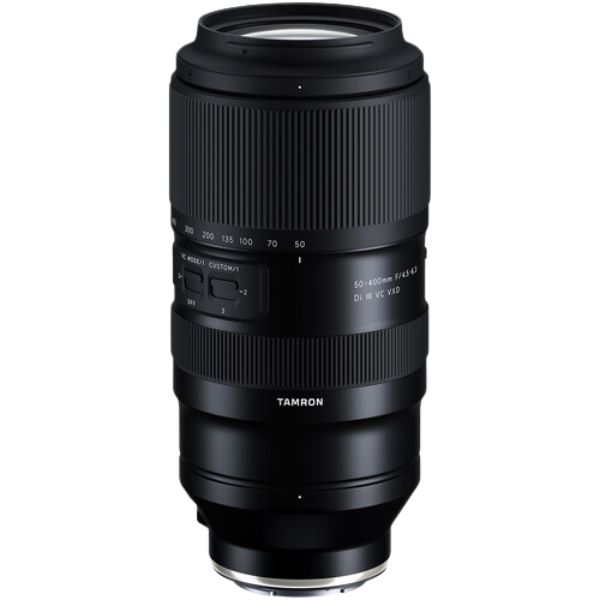
In 2022, Tamron released the 50-400mm f/4.5-6.3 to offer a lighter alternative to its 150-500mm and a more versatile competitor to Sigma’s 100-400mm. The range is unusual but very practical, especially for travel, wildlife, landscape details and outdoor photography when you want to avoid changing lenses too often.
Optical performance is good. It remains more convincing than the cheaper Sigma 100-400mm and comes fairly close to Tamron’s own 150-500mm, while staying lighter and more flexible at the wide end. The Sony 100-400mm GM is still better built and more reliable for demanding action, but it is also much more expensive. Autofocus performs well overall, although like many third-party telezooms, it can struggle a little more with unpredictable subjects. Chromatic aberrations are well controlled, while distortion and vignetting are more visible but can be corrected in post-processing.
In the end, Tamron offers a lightweight and good-quality lens for this type of focal range. Just keep in mind that the tripod collar is not included, so you may need to budget extra if you want one.
6 - TAMRON 70-180mm f/2.8 Di III VC VXD G2
| Features | Visual |
|---|---|
|

|
The first Tamron 70-180mm f/2.8 was already one of the most convincing alternatives to a classic 70-200mm f/2.8 for Sony full frame. Tamron chose to stop at 180mm to keep the lens lighter, more compact and compatible with the brand’s usual 67mm filter diameter. With the G2 version, the concept is still the same, but the lens is now more complete.
The big update is stabilization: the Tamron 70-180mm f/2.8 Di III VC VXD G2 now includes VC, which makes it much more reassuring for handheld shooting. The optical design has also been reworked, close-up performance is better, and autofocus remains fast and reliable thanks to the VXD motor. Image quality is excellent for this type of lens, with strong sharpness and few optical defects in everyday use.
It is still not a true 70-200mm and it does not offer exactly the same handling as Sony’s professional GM lenses, but the balance between price, size, weight and image quality is hard to ignore. If you still mention the first version in your article or product database, this is the version I would update to today.
7 - TAMRON 150-500mm f/5-6.7 Di III VC VXD
| Features | Visual |
|---|---|
|
|
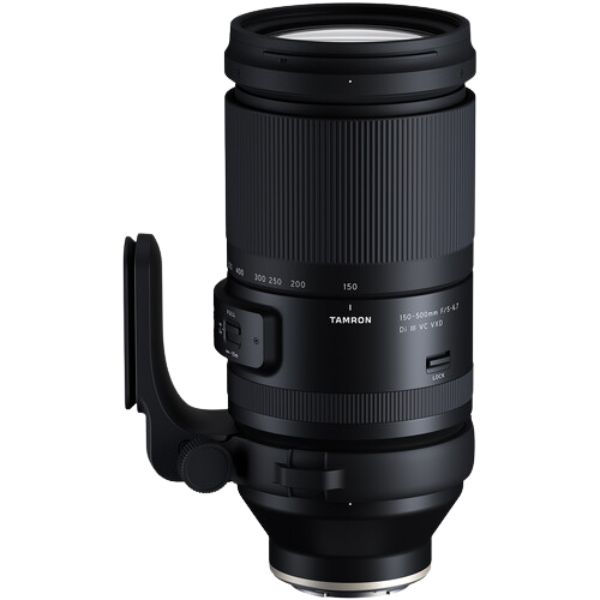
While Sigma chose to offer both a simple 100-400mm and a more ambitious 150-600mm, Tamron split the difference with a 150-500mm. Compared with the brand’s DSLR 150-600mm, the lens is shorter at the long end and a little darker, but it is also easier to carry on a mirrorless setup.
The construction is more advanced than on Tamron’s smaller zooms, with controls that are essential on this kind of lens, including an AF/MF switch and a distance limiter. Stabilization is also included, which is very important at these focal lengths. Autofocus is very good overall, although it can still be less consistent with unpredictable subjects than Sony’s 200-600mm. Image quality is very good and close to Sigma’s alternatives, though it falls a little behind Sony at the longest focal lengths. Optical flaws remain moderate, but bokeh is not the most harmonious in this group, partly because of the 7-blade diaphragm.
It is not the cheapest option, but it is lighter and more compact than many competing super-telephoto zooms, while still delivering a solid level of performance.
8 - TAMRON 90mm f/2.8 Di III Macro VXD
| Features | Visual |
|---|---|
|
|
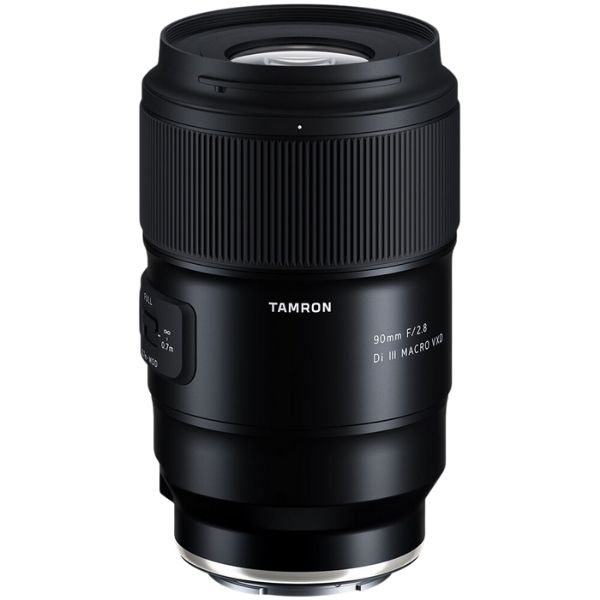
Tamron’s 90mm macro lenses have a long reputation, so it makes sense to mention the modern mirrorless version here. The Tamron 90mm f/2.8 Di III Macro VXD brings that classic macro focal length to Sony E-mount, with autofocus, a 1:1 reproduction ratio and a compact full-frame design.
The focal length is very comfortable for macro work because it gives you more working distance than shorter 50mm or 60mm options, while still staying useful for portraits and detail photography. The VXD autofocus motor is also a real advantage compared with many older macro lenses, especially if you want a lens that can handle more than strictly static subjects. As with most macro lenses, stabilization is not essential if you often work on a tripod, but it would still have been a nice addition for handheld use.
In short, this is one of the Tamron lenses that now deserves a proper place in a Sony E-mount guide. If you are interested in macro photography and want an alternative to Sony’s own macro lenses, the Tamron 90mm f/2.8 Di III Macro VXD is clearly worth considering.
9 - SAMYANG AF 24mm f/1.8
| Features | Visual |
|---|---|
|
|
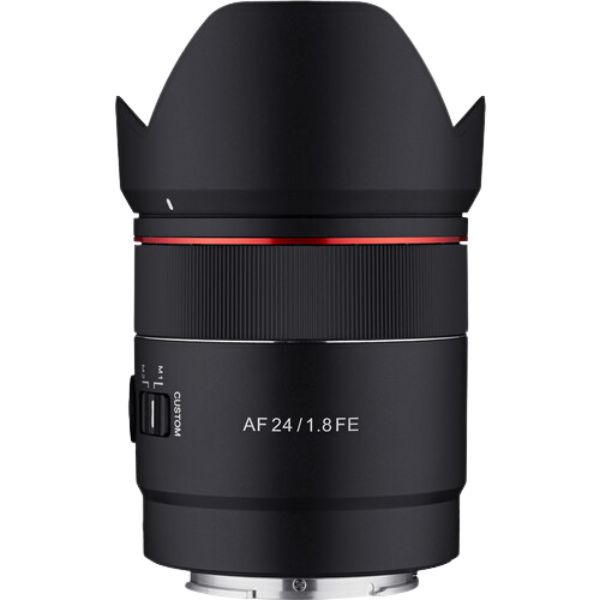
The Samyang f/1.8 range remains, in my opinion, one of the brand’s most interesting lines. These lenses are light, compact and bright enough for travel, everyday photography and low-light work. The 24mm is especially interesting because it includes a specific astrophotography-oriented feature.
The construction is good, with a switch to change the focus ring to an aperture ring and a button to set the focus to infinity, useful for astrophotography, and you can customize it through the brand’s USB dock. The optical quality is good to excellent, and at first sight is better for distant subjects than close ones, which is typical for a non-macro lens. The optical defects are globally well-managed, with a little distortion. AF is very good.
This is a very well-balanced 24mm: brighter than the Tamron 24mm f/2.8, still compact and reasonably priced. For less than 500€, it remains one of the most attractive 24mm options in the Sony E-mount ecosystem.
10 - SAMYANG AF 35mm f/1.8
| Features | Visual |
|---|---|
|

|
Sony E-mount is certainly not lacking 35mm options, but this Samyang 35mm f/1.8 remains one of the most balanced choices in my opinion. It is compact, bright enough, affordable and very pleasant to use. There’s a reason I included it in this list!
The construction is good, in the same line as the 24mm, again with a switch to convert the focus ring into an aperture ring. The AF is very fast and reliable. The optical quality is already very good at full aperture, and becomes excellent from f/2.8 on. It has few flaws, except for chromatic aberrations and visible vignetting at full aperture, as well as moderate distortion. The bokeh is smoother than the Sony f/1.8.
For less than 400€, there is very little to complain about with this Samyang 35mm. A Sony lens with this level of balance would almost certainly cost much more. If you want something brighter and more ambitious, the 35mm f/1.4 FE II below is the logical step up, but this f/1.8 remains the easiest one to carry. If you want to know more about this lens, don’t hesitate to check out my full review!
11 - SAMYANG AF 35mm f/1.4 FE II
| Features | Visual |
|---|---|
|

|
If you like the 35mm focal length but want a brighter lens than the compact f/1.8, the Samyang AF 35mm f/1.4 FE II is the version I would mention today. It is a second-generation lens, more modern than the original 35mm f/1.4, and it offers a very attractive alternative to the more expensive Sony and Sigma options.
Of course, this is not the same type of lens as the 35mm f/1.8. It is larger and heavier, but the f/1.4 aperture gives you more creative flexibility for portraits, weddings, low-light scenes and any situation where subject separation matters. Build quality is good, autofocus is more convincing than on the oldest Samyang AF lenses, and the handling is more complete, with useful controls for both photo and video work.
In my opinion, this lens should not replace the Samyang 35mm f/1.8 in the article, because the two lenses do not target exactly the same users. The f/1.8 remains the compact, affordable and easy-to-carry option, while this 35mm f/1.4 FE II is the better choice if you want a brighter, more ambitious prime while still keeping the price below many premium alternatives.
If you are interested in a 35mm, we also wrote a complete article on the best 35mm for Sony cameras!
12 - SAMYANG AF 45mm f/1.8
| Features | Visual |
|---|---|
|

|
This is another f/1.8 Samyang lens that I find very appealing. Instead of choosing the usual 50mm focal length, Samyang went for 45mm, which gives it a slightly different feel.
The construction is good, but this time the lens doesn’t have weather-resistant protection and doesn’t let you change the focus ring into an aperture ring. Optical quality is good at full aperture, and becomes very good to excellent from f/2.8, with overall very moderate optical defects, a remarkable performance considering the lens size. The AF is fast and reliable, but you’ll want to make sure you have the latest version of the integrated firmware, as it seems to perform better with the Sony Eye-AF.
For about 350€, it is an excellent option if you want a standard focal length that feels a little different from the usual 35mm or 50mm. Some photographers may need time to get used to it, but it is a very versatile lens.
13 - Samyang AF 50mm F1.4 FE II
| Features | Visual |
|---|---|
|

|
In 2021, Samyang updated its original 50mm f/1.4 AF FE. The first version was not a bad lens, but it was not quite at the level of the best modern 50mm lenses. This second version is a clear improvement and comes much closer to the Sony Zeiss 50mm.
Center sharpness is already excellent and improves further when you stop down. The edges remain a little behind, but they are still good. Optical defects are more visible than on Sony’s more expensive options, but the price difference makes that much easier to accept.
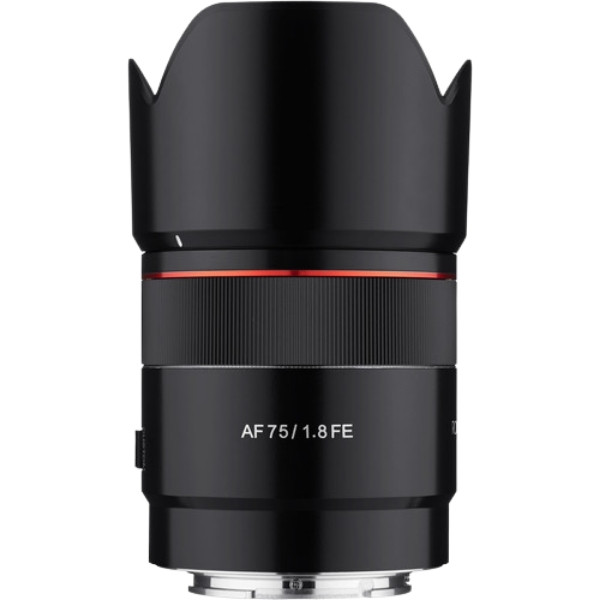
14 - SAMYANG AF 75mm f/1.8
| Features | Visual |
|---|---|
|
|
Here Samyang chose a 75mm focal length instead of the classic 85mm, which probably helped keep the lens smaller and maintain a 58mm filter thread.
The construction is again good, though like the 45mm, it doesn’t have weather-resistant protection. The AF is fast and reliable, and it does have the switch to convert the focus ring into an aperture ring. Although the edges are still a bit behind the center, we get excellent image quality from f/2.8, with optical defects once again moderate.
Also sold at around 350€, it is hard to find better if you want an affordable portrait lens. Unless you absolutely need the extra 10mm of a classic 85mm, this 75mm makes a lot of sense. Samyang’s f/1.8 range is remarkable: for roughly the price of one Sony Zeiss 50mm f/1.4, you can build a set with the 24, 35, 45 and 75mm f/1.8 lenses.
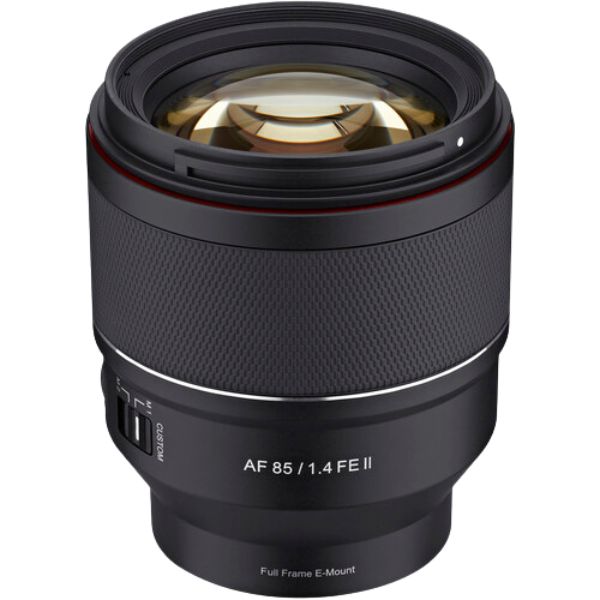
15 - SAMYANG AF 85mm f/1.4 FE II
| Features | Visual |
|---|---|
|
|
The Samyang AF 85mm f/1.4 FE II is the version I would now use in this guide instead of the first generation. The original lens was already interesting for the price, but this second version is more modern, better finished and more convincing overall, especially for portrait photographers looking for a bright 85mm without paying Sony GM prices.
Build quality is very good, and the lens gains useful controls such as a custom switch and a focus hold button. Image quality is already strong wide open and becomes excellent when you stop down slightly. Optical defects remain moderate, even if flare resistance is not perfect. Autofocus is faster, quieter and more reliable than on older Samyang AF lenses, which makes this version easier to recommend for portraits, weddings and everyday people photography.
It is no longer quite as cheap as the first version was at launch, but it remains very competitive compared with Sony and Sigma alternatives. If your article or product shortcode still points to the first version, this is clearly the right moment to update it to the Samyang AF 85mm f/1.4 FE II.
Don’t hesitate to read our complete article on the best 85mm lenses for Sony cameras. This Samyang clearly deserves to be included there.
16 - Samyang AF 135mm f/1.8
| Features | Visual |
|---|---|
|

|
Announced at the beginning of 2022, the Samyang AF 135mm f/1.8 FE gave portrait photographers a very serious alternative to the excellent, but much more expensive, Sony 135mm GM. The 135mm focal length is a classic for outdoor portraits, tight framing and strong subject separation.
Build quality is very good, even better than on many of Samyang’s smaller f/1.8 lenses and close in spirit to what Sigma offers in its Art range. You get a switch that can turn the focus ring into an aperture ring, as well as a distance limiter and an assignable button, like on Sony G and GM lenses. Samyang’s older manual 135mm f/2 was already optically excellent, but this autofocus f/1.8 version is much easier to recommend for modern Sony bodies. Image quality is very close to the Sony 135mm f/1.8 GM, while the price is much lower.
For around 950€, this is one of the most attractive 135mm lenses for Sony. Autofocus is not quite as reactive as Sony’s GM in every situation, but the lens costs less, weighs a little less and delivers excellent image quality. The older Sigma Art adapted from DSLR design is heavier, while the Zeiss Batis is more expensive and only opens to f/2.8, even if it is lighter.
If you are interested in longer lenses, please check out our article on the best Sony telephoto lenses.
Other lenses
Tamron and Samyang offer several other lenses worth mentioning, even if I would not necessarily give all of them a full detailed section in this article without updating the product database first. In particular, I’m thinking of:
- The Tamron 28-200mm f/2.8-5.6 Di III RXD, which offers a very practical focal range and a more attractive maximum aperture than most superzooms. I still generally prefer more specialized lenses, but this 28-200mm is clearly more convincing than Sony’s 24-240mm for many travel photographers.
- The Tamron 28-300mm f/4-7.1 Di III VC VXD, a newer all-in-one full-frame zoom that goes further than the 28-200mm. It is not a replacement for a high-end zoom, but it is very relevant for travelers who want maximum versatility with one lens.
- The Tamron 35-100mm f/2.8 Di III VXD, a compact portrait and travel zoom released after the 35-150mm. It does not replace the 35-150mm if you want the brightest and most versatile option, but it is much lighter and easier to carry.
- The Tamron 70-300mm f/4.5-6.3 Di III RXD, which remains interesting compared with Sony’s alternative because of its lower price. It is a good option if you do not need longer focal lengths, a brighter aperture or more advanced autofocus.
- The Tamron 24mm and 35mm f/2.8 Di III OSD M1:2, which remain very affordable and optically good. Their f/2.8 aperture is less appealing than Samyang’s f/1.8 lenses, which are also light, but the Tamron 24mm is still an excellent small-budget option. By the way, we reviewed the Tamron 24mm f/2.8 extensively here on our blog.
- Samyang’s newer zooms, including the AF 14-24mm f/2.8 FE, AF 24-60mm f/2.8 FE, AF 60-180mm f/2.8 FE and AF 35-150mm f/2-2.8 FE. These are important because Samyang is no longer only a prime-lens brand, but I would add full sections only once you have product IDs and links ready.
- The newer Samyang Prima lenses, including the AF 16mm f/2.8 P FE, AF 35mm f/1.8 P FE and AF 85mm f/1.8 P FE. They are worth monitoring, but I would not replace the existing f/1.8 recommendations automatically until you decide whether the “P” series deserves separate entries on the site.


Conclusion
With these Tamron and Samyang lenses for Sony cameras, we now have many serious alternatives to native Sony lenses, which are often more expensive and not always better unless you move into the high-end G or GM ranges. Alongside Sigma, Tamron and Samyang make it possible to build a very capable Sony full-frame kit for much less money, without giving up too much image quality. Sony APS-C users benefit too, even if the choice is still more limited.
The biggest change is that this article now needs to be kept more actively updated. Tamron has already moved several key lenses to newer generations, especially the 16-30mm G2, the 28-75mm G2 and the 70-180mm G2. The brand has also brought back its famous 90mm macro for mirrorless, while Samyang now has stronger second-generation primes such as the 35mm f/1.4 FE II and 85mm f/1.4 FE II.
I hope this article will help you choose lenses for Sony E-mount and encourage you to give these brands a chance. You do not always need to spend a fortune on Sony’s highest-end lenses to make beautiful images. To go further into the details of these lenses, I invite you to check out our complete article on the best 24mm lenses for Sony cameras.
See you soon,

Written by Sylvain PONS
I've been passionate about photography since 2010, learning as I went along. Today, I dedicate myself to guiding others in their choice of camera gear and sharing a variety of tips to improve their photography skills.
Despite our care, a mistake may have slipped into this article. If you find any, please don't hesitate to let us know so we can correct it as soon as possible and keep our information up-to-date!