The best mirrorless cameras under $1,000
Last update: 06/17/2026
Our blog continues to grow thanks to you, our readers. This post may contain affiliate links, which means we can earn a small commission if you make a purchase through them, at no extra cost to you. This helps us to continue to bring you more and support our work!
As I mentioned in my article on the best mirrorless cameras under $500, we’ve been doing a lot of work on the photography section of the blog lately. We’ve updated several photography articles and even created two large databases covering the latest lenses and cameras. We’re talking about more than 4,000 lenses, just to give you an idea of the work involved!
Updating our articles and building these databases means we can now publish more guides and, above all, keep them updated more regularly. That way, you won’t miss the latest releases.
So today, I’m going to walk you through the best mirrorless cameras under $1,000. Between you and me, that’s already a pretty comfortable budget to get started with. And if you want to take your research further, I also recommend checking out our complete guide to the best mirrorless cameras. You’ll find all the information you need to choose the right camera for you.
Of course, I’m not going to cover cameras priced between $0 and $500 here, as I’ve already done that in the dedicated article mentioned above. If your budget is tighter, that guide should be a better starting point.
As always, I had to make a few choices, because it wouldn’t be possible to include every camera available in this price range. So I’ve put together a selection of what I consider to be the best mirrorless cameras between $500 and $1,000.
The best mirrorless cameras under $1,000
Here’s my selection of what I think are the best cameras under $1,000. To get straight to the point, you can click directly on the camera you’re interested in to learn more:
Fujifilm X-M5
The Fujifilm X-M5 is a compact mirrorless camera that works very well for photography enthusiasts and creators. Its 26.1 MP sensor and X-Processor 5 deliver high-quality results, while its autofocus system is precise enough to track moving subjects effectively. For video and vlogging, it can record in 6.2K at 30p or 4K at 60p.
In terms of design, it keeps a compact body with Fujifilm’s retro styling. It is small enough to carry easily, and the fully articulating touchscreen is convenient for varied shooting angles, especially for vlogging. On the downside, the camera has no electronic viewfinder and no in-body sensor stabilization.

In use, this camera is ideal for street photography, portraits, travel, and lightweight content creation. It clearly lives up to the Fujifilm name and produces attractive images straight out of camera, especially thanks to the brand’s film simulations and good high-ISO behavior.
In short, the Fujifilm X-M5 is aimed at beginners and photography enthusiasts who want a compact, versatile, high-quality camera. The lack of stabilization and viewfinder may put some people off, which I completely understand, but overall it offers strong performance and, above all, excellent value for money.
Fujifilm X-T30 II
Introduced in September 2021, the Fujifilm X-T30 II is the updated version of the popular X-T30. It keeps the same compact spirit and excellent image quality, built around a 26.1 MP APS-C sensor. Its ISO range runs from 160 to 12,800, with extended values available, and it can record DCI 4K video as well as Full HD at up to 240 frames per second.
The camera does not have in-body stabilization or weather sealing, which may limit its use in some situations. Still, the electronic viewfinder is pleasant to use, and the customizable controls make it easy to handle for both stills and video.
| Features | Visual |
|---|---|
|

The Fujifilm X-T30 II is aimed at amateur and more advanced photographers looking for a compact, versatile, and capable camera. Its light weight makes it easy to carry for street photography or travel. For video, its features are still very solid for creating content. Fujifilm’s film simulations, such as Velvia and Classic Chrome, also let you get creative results straight out of camera.
In short, although this Fujifilm model has a few limitations, it offers excellent value for money. Whether you’re just starting out or looking to improve your skills, it is a camera that remains well worth considering.
If you’re considering one of these cameras, I’d recommend checking out our guide to Fujifilm APS-C lenses.
Sony ZV-E10 II
Available from July 2024, the Sony ZV-E10 II is a solid update to Sony’s APS-C camera designed for vlogging. Its 26 MP sensor and 4K 60p video capabilities are very convincing. It also features a fully articulating touchscreen and remains capable for still photography. With its compact size and reasonable weight, it is easy and practical to use.
In terms of features, the ZV-E10 II does not include mechanical in-body stabilization, but its electronic Active SteadyShot mode is useful for handheld video. On the other hand, it has neither an electronic viewfinder nor a mechanical shutter, which may disappoint some photographers. Still, it offers several creative video features, including S-Cinetone, customizable LUTs, and Cinematic Vlog mode.

Simply put, this camera is designed for vloggers and content creators who want to produce high-quality video. It also offers several shooting aids, including automatic subject detection. Its directional microphone is another plus for recording cleaner sound without immediately needing an external mic.
As you can see, the Sony ZV-E10 II is a major improvement over its predecessor. It offers excellent video features, even if the lack of mechanical stabilization remains a limitation. In my opinion, it is still a very good choice thanks to its strong price/performance ratio. A solid model without breaking the bank, haha!
Sony A6400
Introduced in 2019, the Sony A6400 is a high-performance APS-C camera that remains a strong option if you want something versatile. It features a 24.2 MP APS-C CMOS sensor paired with the Bionz X processor, delivering very good image quality. Its autofocus is still one of its main strengths, with effective subject tracking, even when the subject is moving. You also get burst shooting up to 11 frames per second and a 2.36-million-dot electronic viewfinder.
For video, the camera offers 4K UHD at 30p, along with HLG, S-Log2, and S-Log3 profiles. For slow motion, the Full HD 120 fps mode is useful. On the downside, there is no in-body stabilization. The 180° tilting touchscreen is convenient for video, although the overall handling is not perfect for vlogging.

Although it is neither weather-sealed nor stabilized, the A6400’s compact size (403 g with battery and card) and advanced features still make it a very appealing choice. It can suit both serious amateurs and more experienced photographers looking for a lightweight, high-performance camera. However, Sony’s older menus are not especially intuitive, even though they offer plenty of options.
In short, the Sony A6400 remains an excellent alternative to newer Sony models such as the A6700. It still offers very good performance and a strong feature set. I’m pretty sure you’ll be happy with it.
To continue with this brand, check out our full article on Sony E APS-C lenses.
Canon R10
Released in May 2022, the Canon EOS R10 is a mirrorless camera aimed mainly at enthusiasts and newcomers to photography. It has a 24 MP sensor and can shoot at up to 23 fps with the electronic shutter. For video, it records 4K at 30 fps and can go up to 60 fps with a 1.56x crop. The camera is flexible and easy to use thanks to its vari-angle touchscreen and electronic viewfinder.
In terms of size, it is compact and fairly light (426 g), so it is easy to carry around. However, it does not have in-body image stabilization, which can limit handheld shooting in low light. Its efficient autofocus provides good subject tracking, and standard battery life is around 350 shots.

The R10 is easy to use, with accessible controls and a joystick for selecting autofocus points. It is a very good camera for portraits, family photography, travel, or capturing fast-moving scenes thanks to its burst mode.
In short, I’d recommend considering the Canon EOS R10 if you’re looking for a versatile, compact, high-performance camera to discover photography or improve your skills. You’ll be able to take it almost anywhere. If it fits your budget, it is a very solid investment.
And if you’re looking for a lens, check out our guide. With all the features, it can be hard to find your way around, but our guide to Canon APS-C lenses is here to help!
Nikon Z fc
Announced in June 2021, the Nikon Z fc immediately stands out thanks to its retro design inspired by the famous Nikon FM2 (a little nod to the 1980s, if you know!). It has a 20.9 MP sensor and Expeed 6 processor, with a sensitivity range from ISO 100 to ISO 51,200, expandable to ISO 204,800. It also features a fully articulating touchscreen and a 2.36-million-dot electronic viewfinder. However, it does not have in-body stabilization or a built-in flash.
In terms of performance, the camera reaches 11 fps in burst mode and offers effective autofocus. For video, it can record 4K UHD up to 30 fps without cropping, or Full HD at 120 fps. Overall, image quality is very good for this type of body.

As mentioned above, the camera’s vintage style makes it stand out from more conventional models. However, its ergonomics could be better: the lack of a real grip makes it less comfortable during long sessions, especially with heavier lenses. To put it simply, this camera favors design over practicality.
In short, the Nikon Z fc offers features similar to the Z50, but with a much more retro look. It is a versatile and capable camera at a very reasonable price. If you’re nostalgic for the cameras of the past, this might be the one for you.
Nikon Z50 II
Released in November 2024, the Nikon Z50 II is positioned as the updated version of the Z50, while keeping a solid and accessible design. It has a 20.9 MP non-stabilized sensor, an ISO range of 100 to 51,200, expandable to 204,800, and the Expeed 7 processor. Its burst rate reaches up to 30 fps with the electronic shutter, making it interesting for capturing action scenes. The camera also keeps a pop-up flash, although battery life remains fairly modest.
For video, it can record 4K 30p without cropping and 4K 60p with a crop. However, rolling shutter and a few menu limitations remain among the points that could be improved.

The Z50 II is easy to use and delivers good image quality in many lighting conditions. It is simple enough for taking your first steps in photography without immediately getting lost in complex settings, making it a very good everyday camera.
In summary, the Z50 II has a lot going for it: solid construction, good photo and video performance, and accessible handling. Although it lacks certain features, such as in-body mechanical stabilization, it is still a very good choice. Compared with rivals such as the Fujifilm X-S20, it may seem less advanced in some areas, but it is also less expensive.
If you’re interested in this camera and looking for a compatible lens, we’ve written an article on Nikon APS-C lenses that you might find useful!
Summary and comparative features of mirrorless cameras under $1000
I’ve summarized the main features of these cameras in the table below.
| Camera | Definition | Stab. | Weight | Dim. | Burst(electr.) | Video | Battery Life(Viewfinder) | Battery | Approx.price | Best price |
|---|---|---|---|---|---|---|---|---|---|---|
| Nikon Zfc | 20.9 Mp | NO | 1 lb / 445g | 135 x 94 x 44 mm | 11 fps | 4K UHD 30 fps | 300 images | EN-EL25 | $1 196 | Amazon B&H |
| Fujifilm X-T30 II | 26.1 Mp | NO | 0.8 lb / 378g | 118 x 83 x 47 mm | 13 fps | 4K DCI 30 fps | 380 images | NP-W126S | $900 | B&H |
| Sony a6400 | 24.2 Mp | NO | 0.9 lb / 403g | 120 x 67 x 60 mm | 11 fps | 4K UHD 30 fps | 360 images | NP-FW50 | $1 099 | Amazon B&H |
| Canon R10 | 24.2 Mp | NO | 0.9 lb / 429g | 123 x 88 x 83 mm | 23 fps | 4K UHD 60 fps | 260 images | LP-E17 | $1 099 | Amazon B&H |
| Sony ZV-E10 II | 26 Mp | NO | 0.8 lb / 373g | 114 x 68 x 54 mm | 11 fps | 4K UHD 60 fps | - | NP-FZ100 | $1 198 | Amazon B&H |
| Nikon Z50 II | 20.9 Mp | NO | 1.2 lb / 550g | 127 x 97 x 67 mm | 15 fps | 4K UHD 60 fps | 300 images | EN-EL25a | $1 006 | Amazon B&H |
| Fujifilm X-M5 | 26.1 Mp | NO | 0.8 lb / 355g | 112 x 67 x 38 mm | 20 fps | 6.2K 30 fps | - | NP-W126S | $799 | Amazon B&H |
Other interesting cameras under $1,000
If you weren’t necessarily planning to buy a mirrorless camera, and you don’t mind not being able to change lenses, I’ve also put together a few other cameras I find interesting. All under the $1,000 mark, of course!
Nikon COOLPIX P950
Available since February 2020, the Nikon Coolpix P950 is a camera with an impressive 83x zoom, equivalent to a 24-2000 mm focal range. This model is ideal for photographing distant subjects, wildlife, or landscapes. Its 16 MP sensor delivers satisfactory image quality, but it quickly shows its limits at higher ISO values. Its tilting screen and electronic viewfinder make shooting easier.
In terms of build, the camera is made mostly of plastic, which may feel less premium but helps keep the weight down. It includes a control dial for manual focusing and exposure compensation. However, there is no touchscreen or joystick, which is a shame. Battery life is rated at 290 shots, which is decent, but you’ll still need to recharge it regularly.
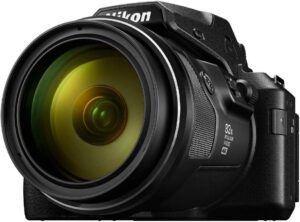
For video, the P950 can record 4K UHD at 30 fps without cropping, or Full HD at 60 fps. But image quality remains average, with a noticeable lack of sharpness and rolling shutter effects. These limitations make it better suited to amateur use than professional projects.
Despite its shortcomings, the Nikon Coolpix P950 stands out for its zoom range and versatility. You can use it for specific needs or daytime wildlife photography. It allows you to capture distant subjects without investing in interchangeable lenses.
Sony ZV-1 II
Introduced in June 2023, the Sony ZV-1 II is a very good compact camera for video. Its 20.1 MP sensor delivers good image quality, and its 18-50 mm equivalent zoom is well suited to vlogging and everyday content creation. It also has a fully articulating touchscreen, which is convenient for filming yourself. The camera is compact and lightweight, weighing only 292 g.
On the video side, the camera records 4K UHD at 30p and Full HD at up to 120 fps. S-Log2 and S-Log3 modes are useful if you want more flexibility in post-production. The three-capsule directional microphone with windshield provides very good sound quality, even outdoors. New features include Cinematic Vlog mode and a more intuitive smartphone-style touch interface. Dynamic Active digital stabilization also helps make handheld footage smoother.
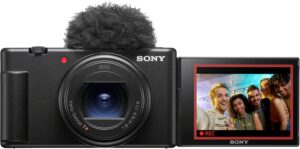
In use, the ZV-1 II is versatile and perfectly suited to video creation if you want a compact, high-performance model. Its ISO range of 125 to 12,800 and 24 fps burst rate are useful for photography too, although the lens becomes less bright at the long end, which can limit low-light performance.
In short, this camera sits right near the $1,000 budget limit, but it remains an excellent choice given its advanced features. It is a real step up from its predecessor. If you’re mainly planning to create video content, it is clearly worth considering.
Sony RX100 VI
Released in June 2018, the Sony RX100 VI is a compact and versatile expert camera. It stands out for its 8.3x zoom equivalent to 24-200 mm, a major change from the previous 24-70 mm range. This useful focal range is combined with SteadyShot optical stabilization. Its 20.1 MP sensor and Bionz X processor still deliver solid performance.
In terms of performance, the RX100 VI’s autofocus is very fast, with focusing claimed at just 0.03 seconds. In burst mode, it can reach 24 fps with continuous AF/AE tracking. For video, it records 4K UHD without cropping. There are also creative options such as high-frame-rate slow motion and S-Log profiles for more cinematic projects.
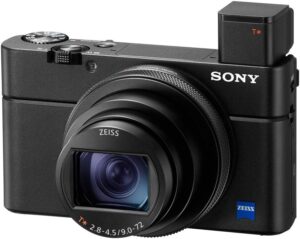
The RX100 VI is a lightweight, compact camera. It also has a retractable OLED viewfinder and a tilting touchscreen, both of which are convenient in everyday use. In terms of connectivity, it includes Wi-Fi, Bluetooth, and NFC, making it practical on the go. The main downside is the lack of a microphone jack, which can limit your video options.
As you can see, the RX100 VI is perfect for photographers who are often on the move and want excellent image quality with strong versatility. I’d even say it is a premium compact that still delivers on its promise, especially if you find it at a good price.
If you’re interested in this type of camera, I suggest you read our article on the best expert compact cameras right now!
Canon 250D
The Canon EOS 250D, also known as the Rebel SL3, is a small DSLR aimed at beginners who still prefer an optical viewfinder and a very simple shooting experience. It uses a 24.1 MP APS-C sensor and Canon’s DIGIC 8 processor, with Dual Pixel CMOS AF available in live view. It can also record 4K video, although with limitations compared with more recent mirrorless cameras.
Its main strength is ease of use. The vari-angle touchscreen is practical for learning, framing from different angles, and filming yourself occasionally. Of course, as a DSLR, it now feels a little dated next to current mirrorless bodies. But if you find it at a good price, it can still be a pleasant and accessible camera for getting started.
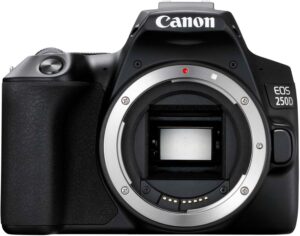
Practically speaking, the EOS 250D is aimed at beginners thanks to its intuitive interface, which explains the basic settings very well. It also offers a number of scene modes and creative filters, making it versatile for portraits and landscapes.
In conclusion, the Canon EOS 250D, like all SLRs, is a bit outdated compared to mirrorless cameras, but it still delivers great results. What’s more, it’s now available at a good price. Compared to its launch price, it’s a real bargain!
Pentax KF
Announced in November 2022, the Pentax KF is positioned as an evolution of the 2016 K-70. It keeps the main strengths of DSLRs while adding a few refinements. Of course, as mentioned above, it is still an SLR, so it feels outdated compared with modern mirrorless cameras in some areas. The camera features a 24 MP sensor paired with the Prime MII processor, with sensitivity up to ISO 102,400. The SAFOX X autofocus system is responsive enough for many situations, including wildlife photography. The vari-angle screen also has a better resolution than the K-70’s 1.03 million-dot display.
In terms of performance, the Pentax KF includes a pentaprism viewfinder with nearly 100% frame coverage and 0.95x magnification, which is rare in this price range. Like many Pentax cameras, it is weather-sealed and includes built-in sensor stabilization. Pixel Shift Resolution mode, which improves color detail and sharpness, is another strong point.
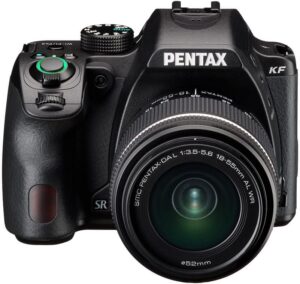
When it comes to video, the KF is clearly behind the times. It is limited to Full HD recording at 60 fps. If video is your priority, this camera will struggle to keep up with the competition. On the other hand, it remains an excellent choice for photographers looking for a solid, reliable camera without switching to mirrorless.
In short, the Pentax KF stands out for its robust construction, ergonomics, and good performance for the price. If you enjoy outdoor photography and want a reliable, affordable camera, this SLR remains a very interesting option.
So now you know what I consider to be the best mirrorless cameras under $1,000. Without getting ahead of myself too much, I’m pretty sure you’ll find a model that suits your needs. We’ve also written a final article on the best mirrorless cameras under $2,000 if you have a bigger budget, which can happen.
Feel free to share your thoughts in the comments. It’s always interesting to hear from you.
I’ll also take this opportunity to say that I’ll continue publishing this type of article. I hope you find them useful!
See you soon for more photo recommendations,

Written by Sylvain PONS
I've been passionate about photography since 2010, learning as I went along. Today, I dedicate myself to guiding others in their choice of camera gear and sharing a variety of tips to improve their photography skills.
Despite our care, a mistake may have slipped into this article. If you find any, please don't hesitate to let us know so we can correct it as soon as possible and keep our information up-to-date!