Los Volcanes Natural Park in Lanzarote
Last update: 04/15/2026
Our blog continues to grow thanks to you, our readers. This post may contain affiliate links, which means we can earn a small commission if you make a purchase through them, at no extra cost to you. This helps us to continue to bring you more and support our work!
If you like walking and discovering unique, lunar landscapes, I’ve put together an article about my guided hike in Los Volcanes Park. Located right next to the famous Timanfaya National Park, the experience was really great. I’d even say that a hike in Los Volcanes Park is among the must-dos in Lanzarote. Personally, I have such great memories of it. It allowed me to get up close to the lava fields and even go inside a volcanic crater (yes, yes, I promise!).
On top of that, being accompanied by a local guide is a real plus. I learned lots of information and interesting anecdotes as I walked through nature—something I wouldn’t have had on my own. I’d say it’s a very accessible hike: all the trails are fairly flat, with a slight elevation gain. The small challenge is that there’s no shade and you walk on sand and rocky paths. But if you’re well equipped (with good shoes, water, a snack, a cap, a hat and sunscreen), it’s not really an issue, don’t worry.

Honestly, if you’re planning your trip, I recommend opting for this activity. In this article, I’m sharing my experience, which was one of my favorites of my entire vacation in Lanzarote.
Our guided hike in the los Volcanes Park
When I booked this activity, I’ll admit I didn’t look at the route in detail. I wanted to keep the surprise to enjoy the moment even more! I simply knew I’d be walking among the volcanoes and that the hike was fairly accessible (just in case, haha). On this excursion, you’re picked up at a meeting point agreed with the organizer and then taken to the starting point of the hike. For me, the closest was Puerto Calero. We were picked up in a van at 9:30 a.m. to start our journey around 10 a.m.
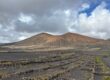
We found ourselves facing Montaña Negra, in a small group. There were six of us in total, French and Spanish. Well, for me it wasn’t an issue—I could listen in the language I wanted to our guide’s explanations. Just before setting off, the guide gave us a small snack to eat along the way: a banana and a cereal bar. It’s a small touch that’s always nice and useful, especially on a hike. She then gave us a quick briefing to explain the itinerary, while keeping the surprise effect that builds up. We then took our first steps on the hiking trail, slowly but surely. Let me explain: we made several stops with explanations from our guide about the lava layers and the little vegetation that manages to grow over the ash and pillars.
I found it super interesting. We were told that 300 years ago, there were six years of continuous volcanic eruptions. That’s what destroyed several villages. So we were walking over ancient lava flows and old villages. The guide also explained that the lava flows were slow and continuous: that’s what meant there were no casualties. The inhabitants had time to leave, even if it was complicated to rebuild their lives elsewhere.
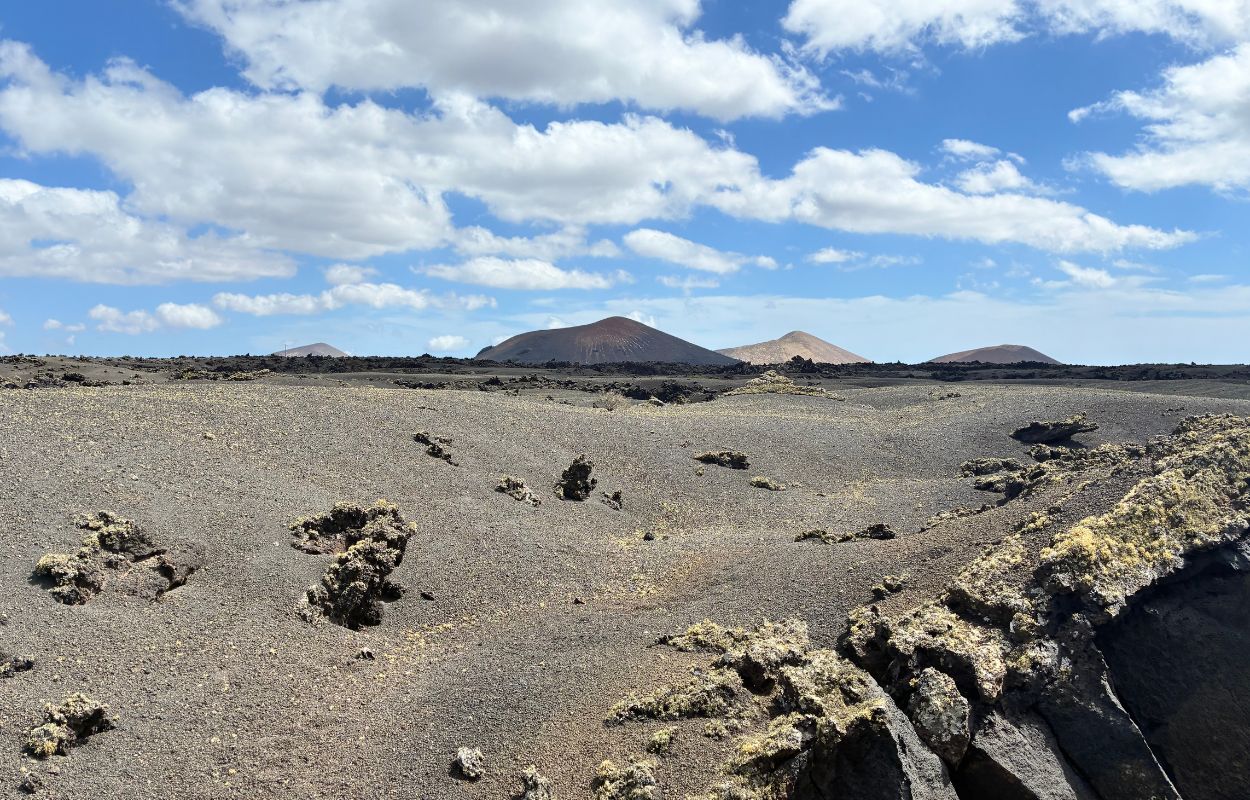
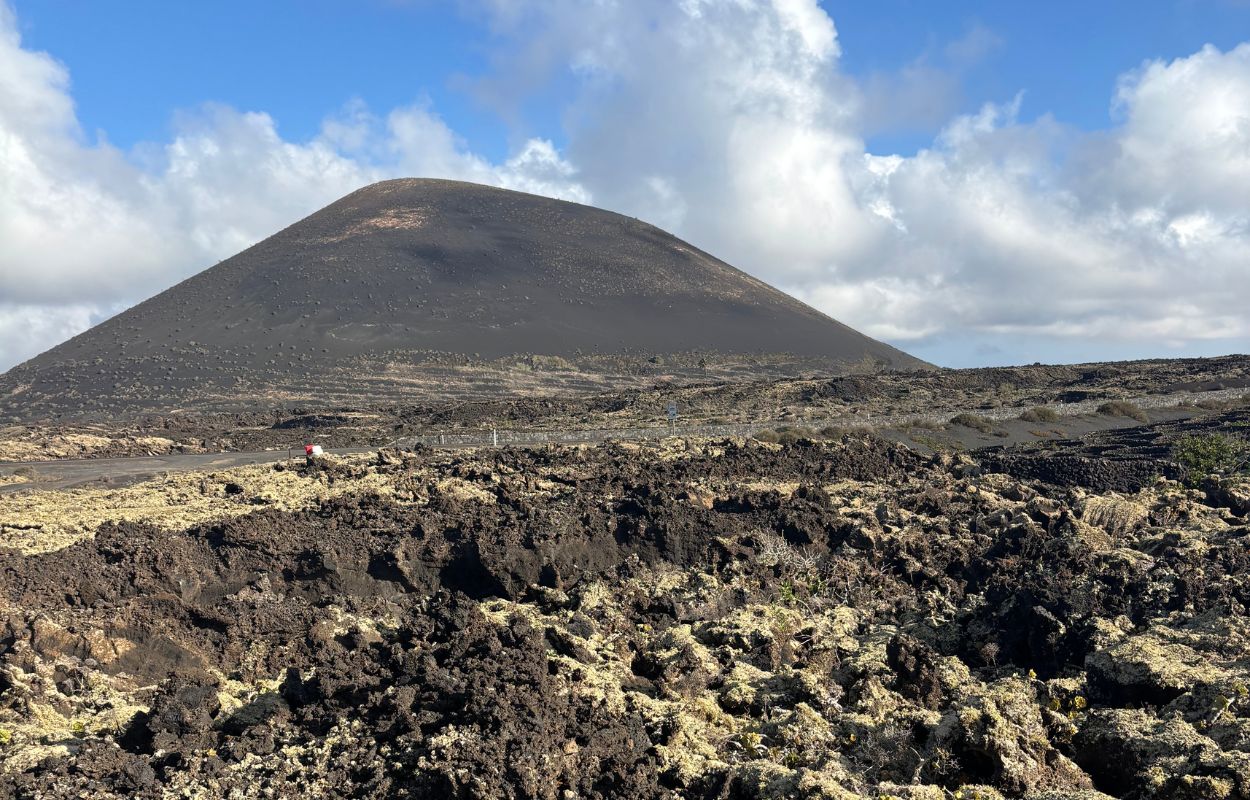
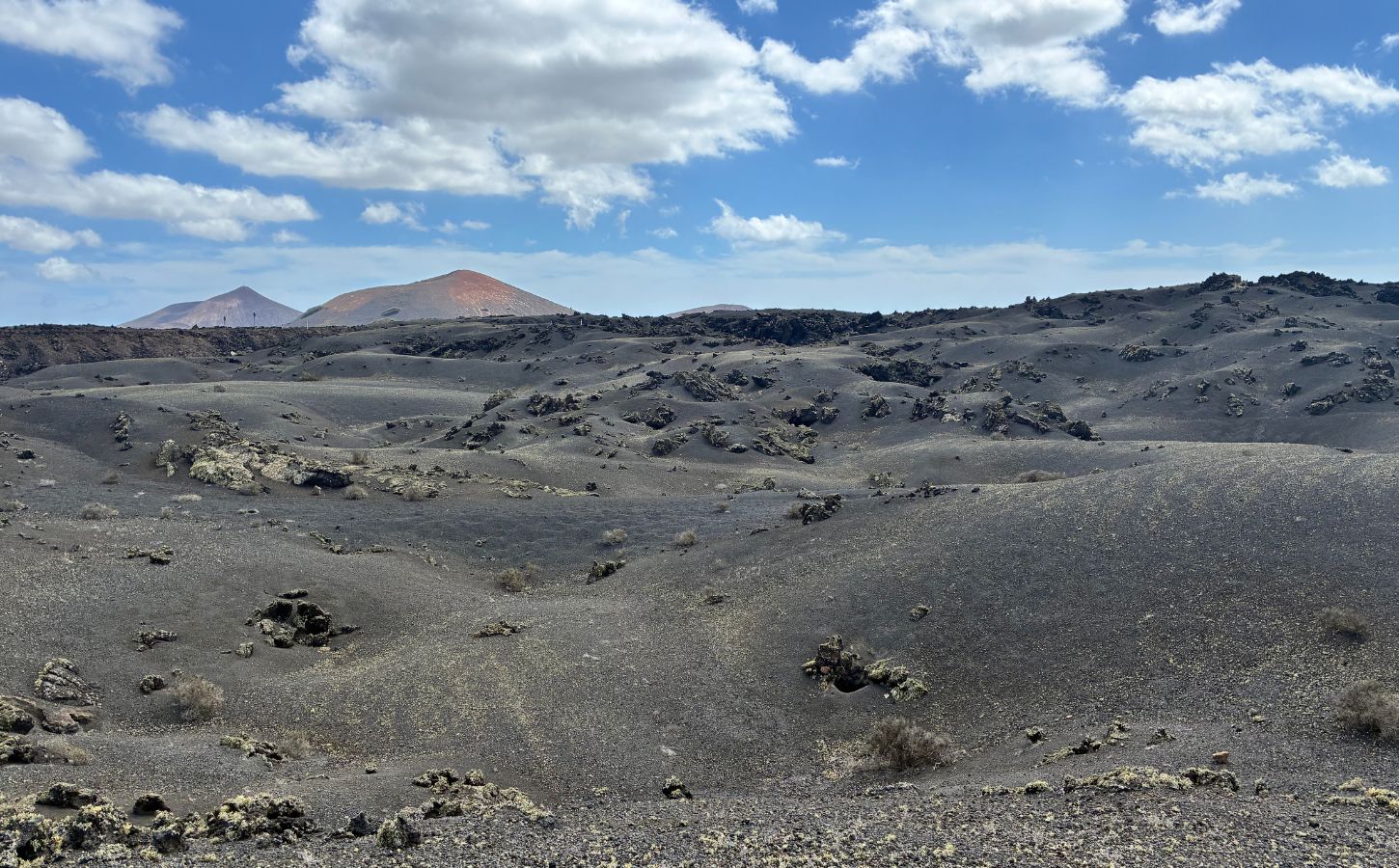
Heading toward Montaña Negra, we noticed there’s more vegetation on the mountain than in the surrounding fields. The explanation is simple but good to know: the mountains that were already there didn’t have lava flows. The flows stayed around them, but not on the mountains. We also noticed that all around the mountain, just at the bottom, there were olive trees, prickly pear trees and even a few palm trees. The guide explained that it was thanks to lapilli: the small volcanic stones that act like sponges by retaining water and moisture. They’re used to maintain the crops, because at night, contrary to what you might think, it’s very humid in Lanzarote. Even locals come to collect stones for their gardens. I find the hike gets more and more interesting: we learn as we approach Montaña Negra, and it’s only the beginning of our route.
We walked around Montaña Negra by walking on it and going up to a water tank. We saw some people climbing to the top, even though it’s forbidden. It’s a shame, but unfortunately there are always a few, even though it’s a protected area.
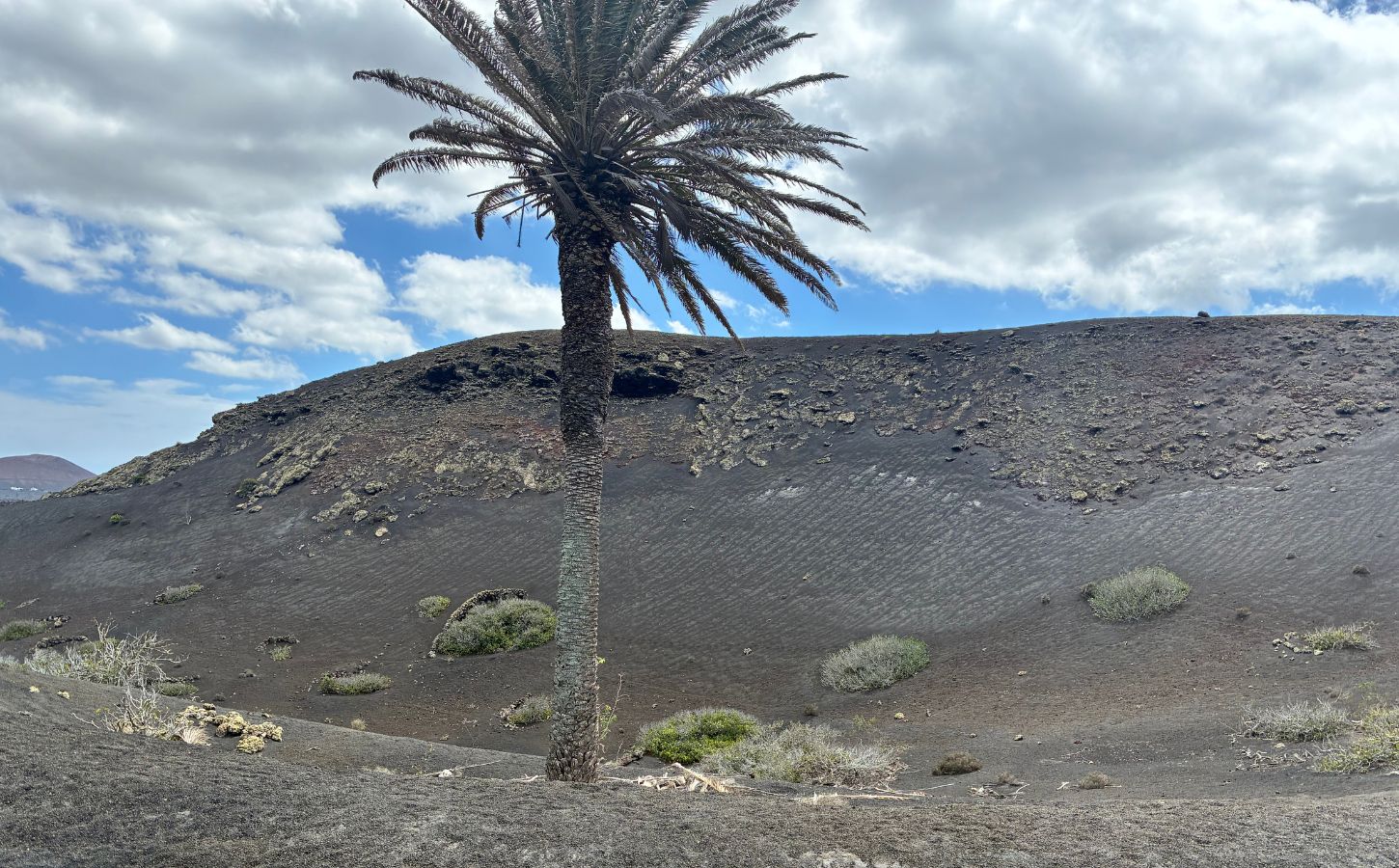
At the water tank (on the other side of Montaña Negra), we took a break to eat our snack and sit for a bit, as the sun was getting stronger and stronger. Honestly, you don’t really feel it, but we still got sunburned… But hey, that’s part of the game too, haha. During this little break, we had the company of the famous Lanzarote lizards: they’re more or less big, but all harmless. And they’re quite fond of bananas, actually. That’s the only reason they come up to you. They’re important because they’re the main land species populating the island.
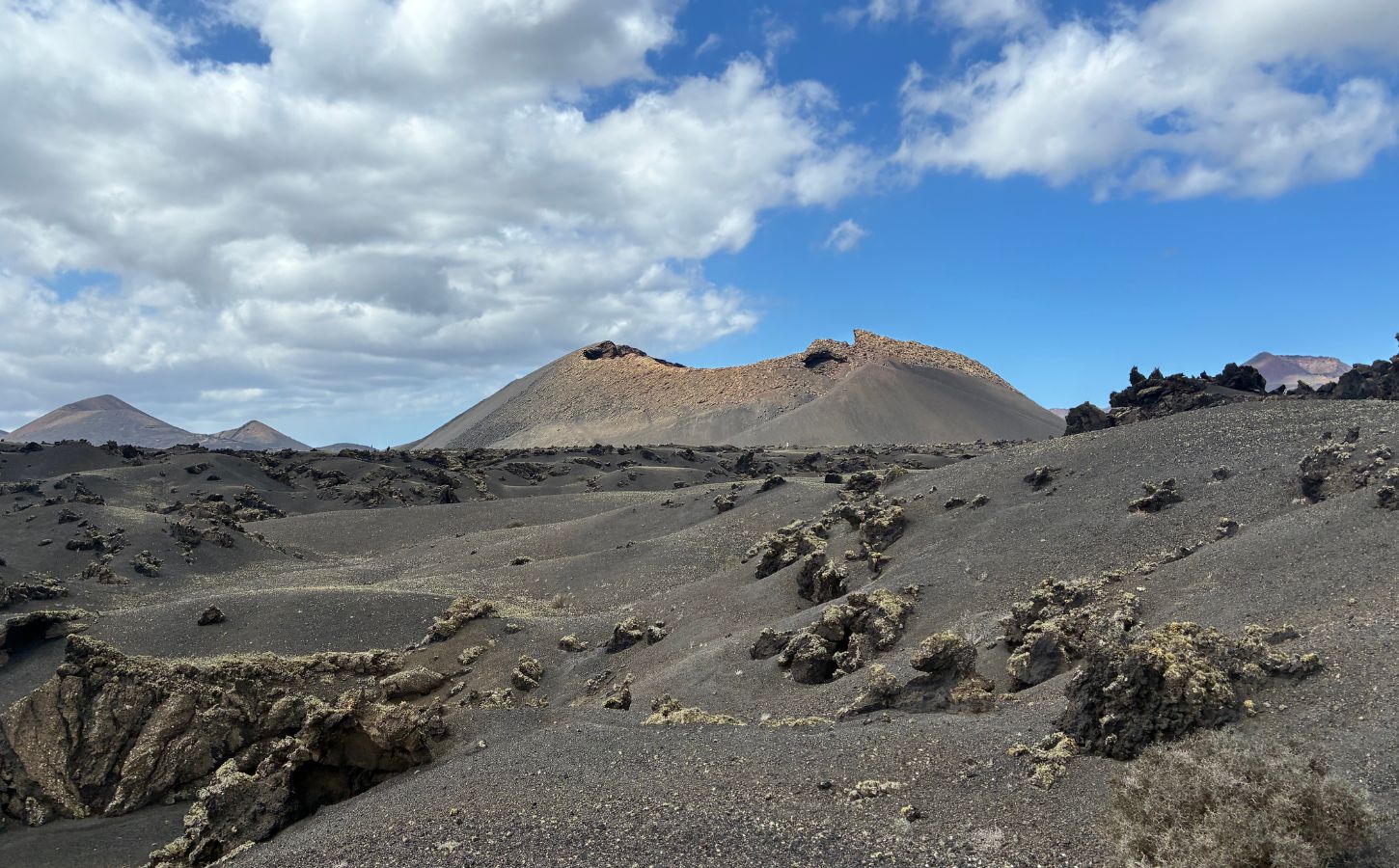
We continued our hiking route to the famous Volcán del Cuervo (“raven” in English). Its particular name is explained by the fact that, inside the crater, you’ll find many raven nests. It’s not common, but since there are hardly any trees in Lanzarote, the ravens had to find another habitat.
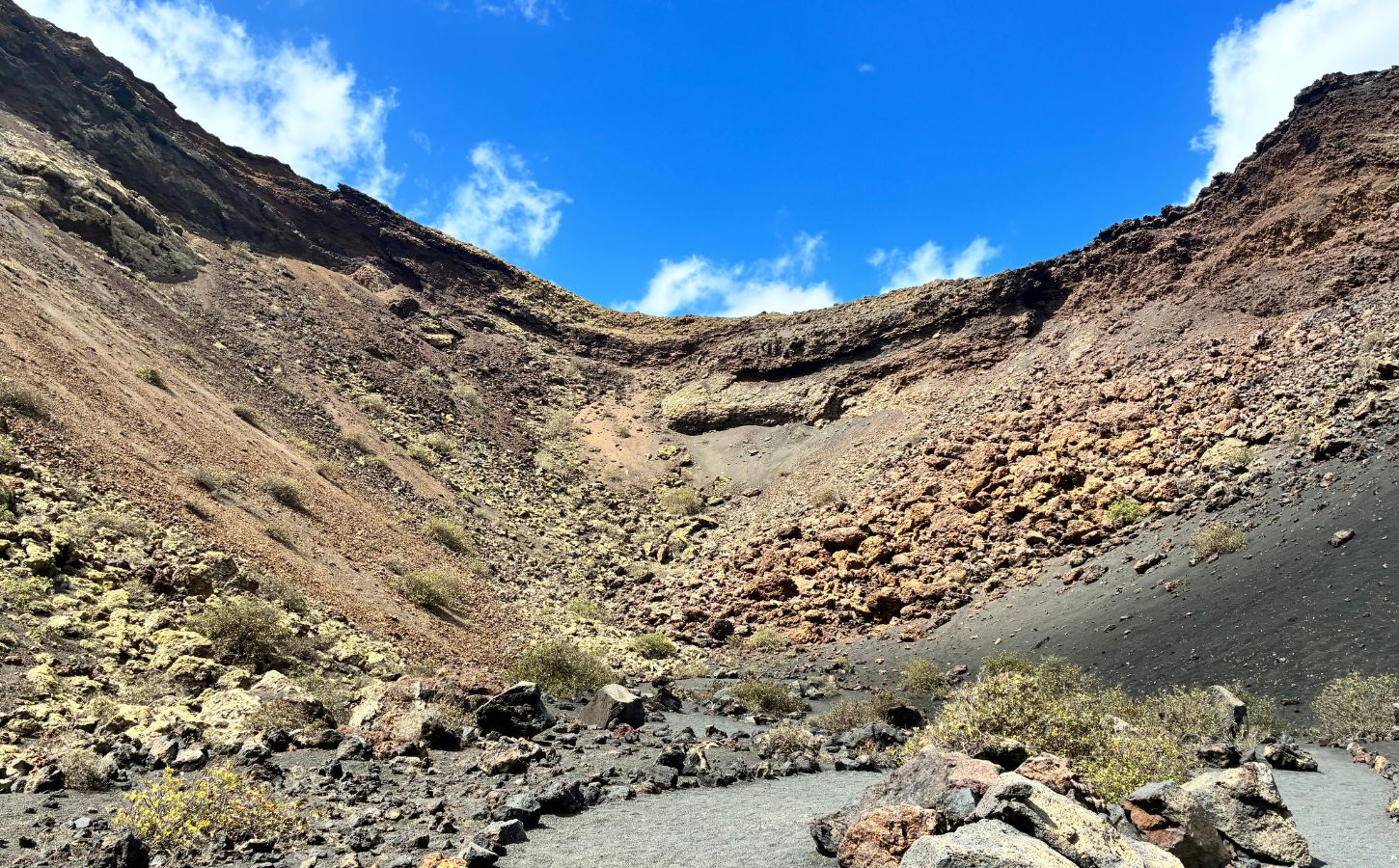
Speaking of the crater, we headed inside. Personally, I didn’t know what to expect regarding the inside of a crater. You imagine lots of things and, in the end, the crater looks like a mountain, a peak. It’s truly incredible: you can stroll around the crater in complete tranquility and freedom. It’s pretty unique, really. You wander between the huge ochre, purple, red and black cliffs, with some vegetation (succulents, for example). Even though, between us, vegetation is very limited in Lanzarote compared to other Canary Islands like Tenerife, La Gomera or La Palma, for example.

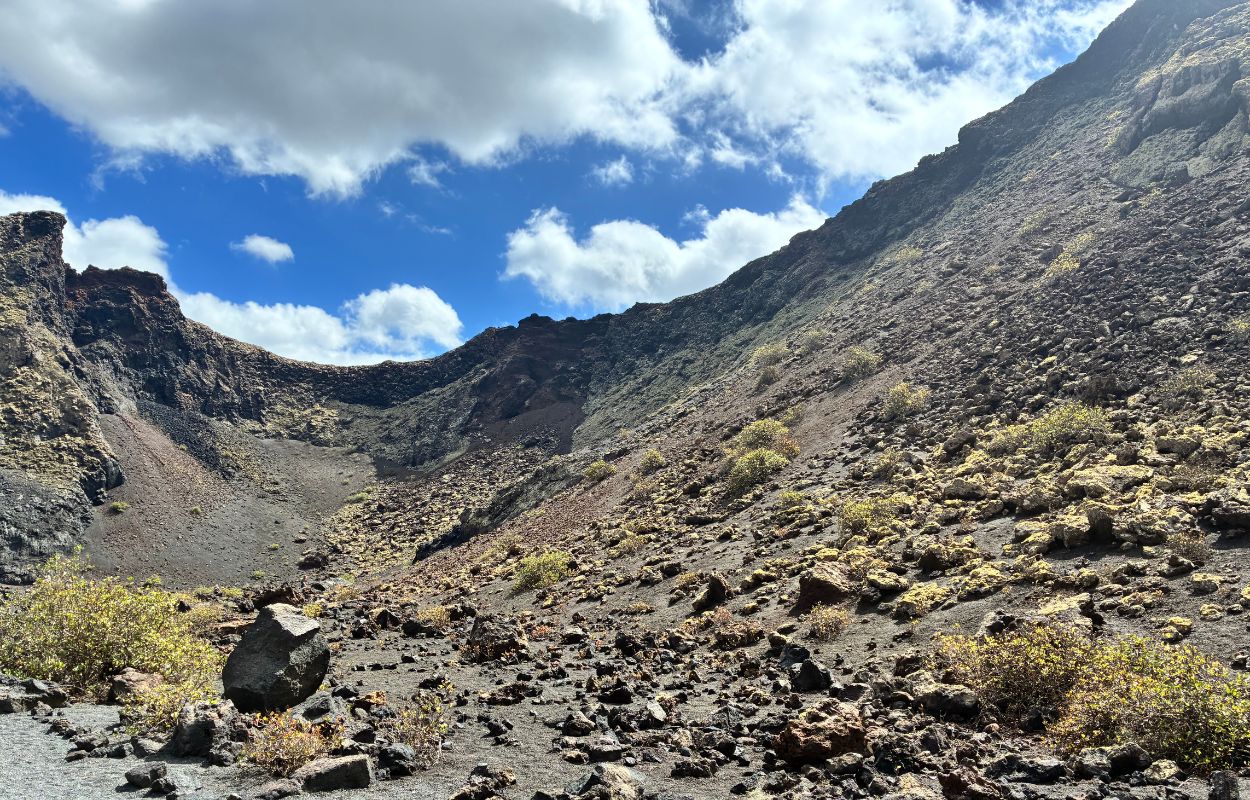
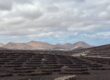
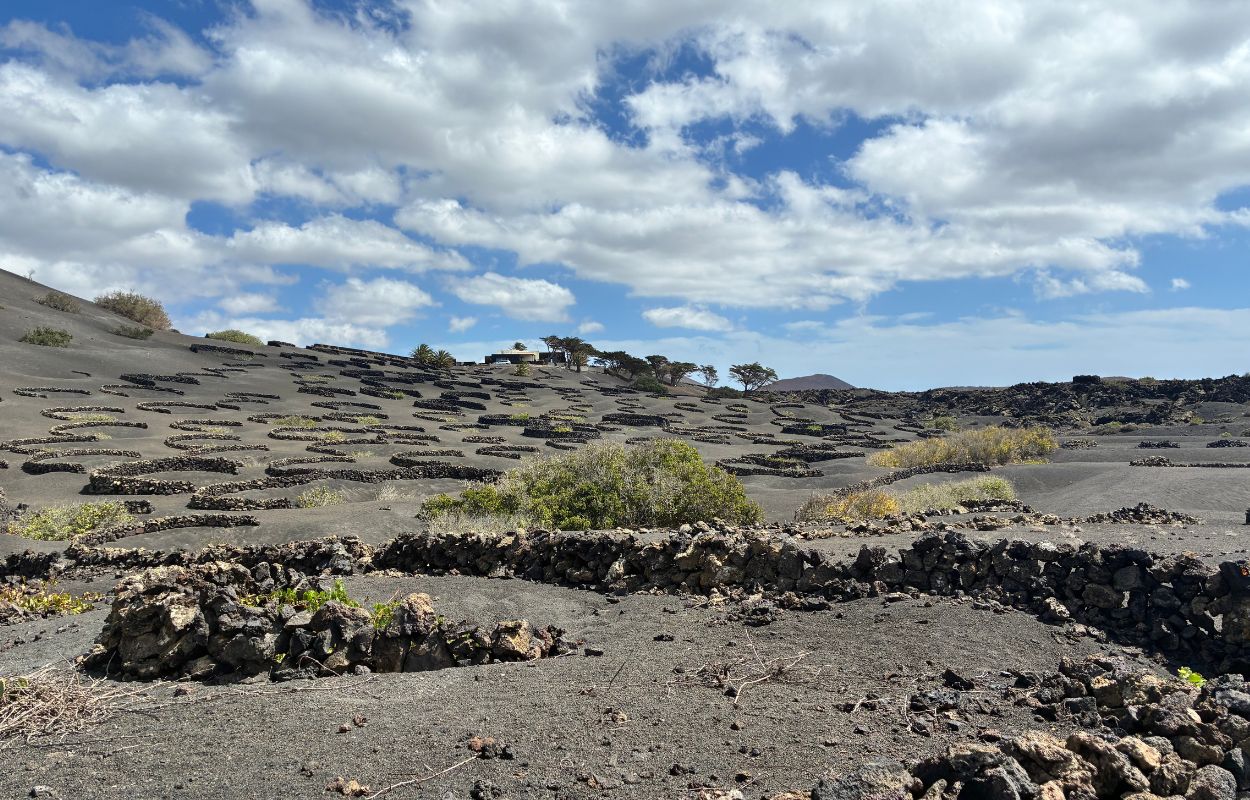
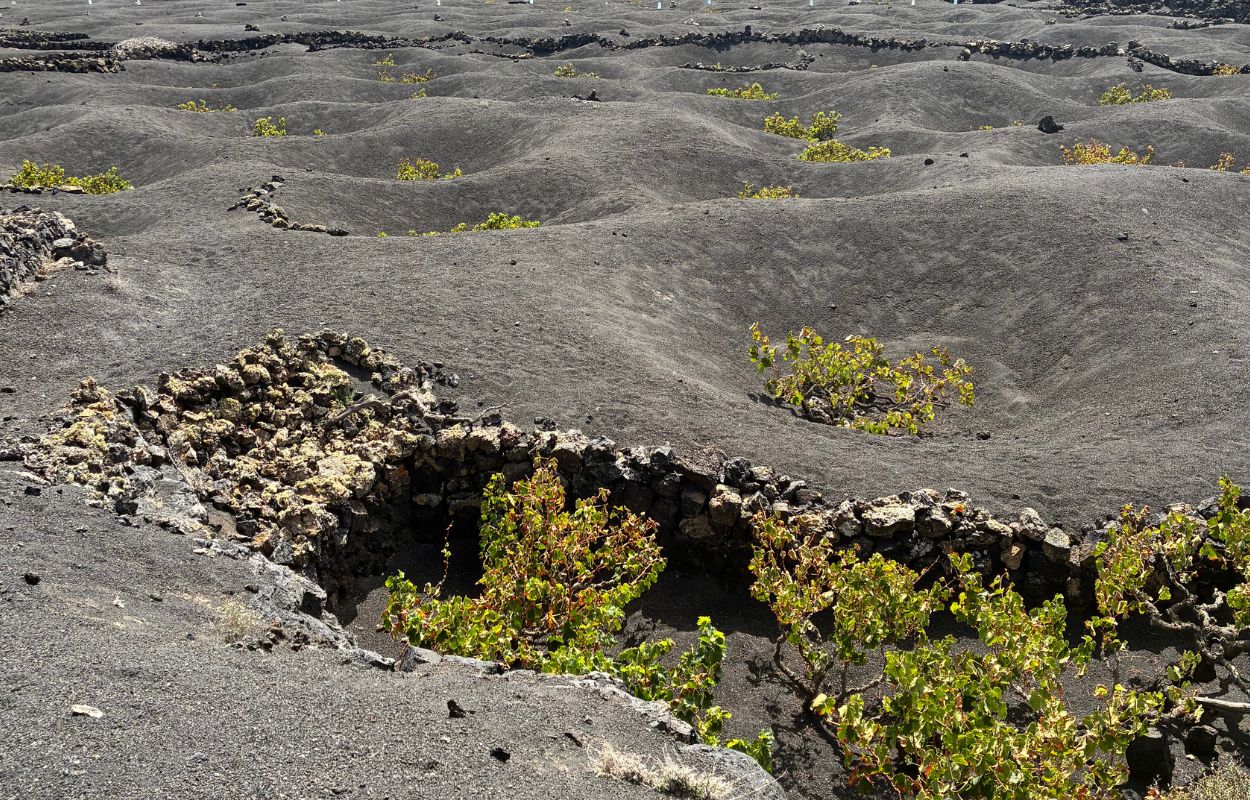
The guide gave us free time to discover the crater as we wished, take photos and above all enjoy the exceptional scenery. We then continued our route between the vineyards. Over there, the crops are unique and beautiful to look at. To give you an idea, for a single vine, you have to dig a hole three meters in diameter, with a small stone wall to protect it. That’s what gives us a unique landscape and, above all, one that’s typical of the island.
We were on the edge of fields that look like small black craters, with stone walls in an arc shape and, in the middle, a little vegetation: the vine. What’s more, it’s very regular and measured very precisely. It’s lovely to look at. If you look more closely at the production side, it’s very hard work and everything is done by hand. So there are fewer and fewer producers, especially since each vine requires a great deal of natural space and work. It’s a shame, but understandable.
I hope these landscapes and this production can endure over time. All these vineyards lead to the village of La Geria. If you’re interested, there are bodegas: places created by winegrowers to help you discover the history of the vineyard and, above all, offer tastings of white and red wines, with tapas. It’s a nice, typical thing to do. In our case, our beautiful hike ended a bit before the bodegas, and we were quietly taken back to the morning meeting point: Puerto Calero.
I enjoyed this hike/walk, which I found very complete. We had a friendly group, and in any case, the guide adapts well to our pace. She spoke French and Spanish very well. And then we learned interesting information about Lanzarote. The verdict on this lovely walk is therefore very positive. I’ll tell you more about it in detail just after.
Our review of our guided hike in the los Volcanes Park
As you’ve probably gathered, I had a very good time during this guided hike in Los Volcanes Park. Honestly, nothing to complain about in terms of organization: everything was well thought out and smooth. All we had to do was follow the route, enjoy, take photos and listen to the guide’s explanations. We really unplugged! I also found the hiking route great: accessible to everyone (no need to be seasoned hikers) and very complete. In the space of three hours, we saw a wonderful variety of spectacular panoramas: lava fields with their different layers, vegetation, mountains, craters and vineyards. I’m tempted to say: what more could you ask for?
The guide’s explanations are a real plus: they make the hiking circuit all the more enriching. I’ve given you some information, but rest assured, you’ll discover even more if you choose to do this outing in the very heart of Los Volcanes Park. I really felt it was more than just a hike: it was an immersive experience in the midst of the volcanoes. And that’s the memory I’ll keep! What I also appreciated was the group size. There were fewer than ten of us: it makes it possible to ask questions, chat, stop to admire the lunar landscapes and, above all, enjoy the peace and quiet. And then the explanations helped me really understand what makes Lanzarote so unique (and similar to Mars).
Specifically, the organization with which we did this guided hike is Canary Trekking. It’s a local organization that’s been around since 1998. Suffice to say that, over time, Canary Trekking has proven itself. This local agency specializes in guided hikes to explore Lanzarote’s typical volcanic landscapes: from the lava fields of Los Volcanes Park to the southern cliffs.
The reviews are unanimous, and I agree. Their approach is meant to be human and warm. With them, you hike in a small group, you take time to observe nature, listen to the guide’s explanations and, above all, fully enjoy unique settings at your own pace. The guides are very often French-speaking, but also English-, Spanish- and German-speaking. The advantage is that they know the island inside out: its history, geology, flora and, more specifically, the volcanic eruptions that have shaped the landscapes of this Canarian island.
Whether you’re coming to Lanzarote for a long stay or just passing through for a few days, Canary Trekking offers several routes suitable for all levels: from beginners to seasoned hikers. In any case, they always bring the same attention: clear explanations, a passion for nature and the island’s history, all in a calm and cheerful atmosphere. They’re also present on the other Canary Islands: Tenerife, Fuerteventura, Gran Canaria, La Gomera, La Palma, etc.
And then, walking along trails on the edge of black and ochre landscapes is gorgeous. You look everywhere, staying attentive. Honestly, if you like hiking, trekking or even lovely walks, I can only recommend Canary Trekking. This agency doesn’t offer touristy strolls or hikes, but authentic experiences. I’d say that’s their strong point and that a walk, trek or hike with them is a real plus for your trip to Lanzarote!
Guided hike in the los Volcanes Park - practical info
What are the prices for a guided hike in the los Volcanes Park?
For a hike in the protected area of Los Volcanes Park, prices really vary depending on what’s included: guide, transport, meals, equipment, etc.
In general, here’s what to expect (but this is still an average):
- For a standard 2–4 hour guided hike with a local guide, expect to pay between €25 and €40 per person.
- For a more complete guided hike, with pickup, drop-off, small group, in-depth explanations and a snack, expect between €40 and €70. The one I did is currently listed at €49 per person.
- For children (from 7 to 12 years old): it’s often 50% of the adult rate, depending on the organizer.
- Private groups and custom walks/hikes: prices rise quickly depending on the number of people, pickup location and added options.
Before each hike booking, I recommend always doing a quick check to see what options are included. Of course, I also recommend opting for organizations that work with local guides: it’s always a plus, in my opinion.
How long does a guided hike in the los Volcanes Park last?
In general, a guided hike in Los Volcanes Park lasts between two and four hours, i.e., a half-day or a little less. My route took three hours, including explanatory breaks, photo stops and even a short rest to catch our breath and eat our snack. Three hours may seem long under the sun and without shade. That’s why the hikes take place in the morning. Honestly, time flew by: between the frozen lava, the lava tubes and our guide’s anecdotes, you feel captivated. You want to keep going while taking your time.
There are also longer outings when several areas of the island are combined, with beautiful viewpoints over the Montañas del Fuego. In that case, the walking route is extended to five or six hours. And for the more motivated, you can also do multi-day treks. Quite a few French travelers want to visit Lanzarote this way, entirely on foot.
Best times for a guided hike in the los Volcanes Park
To fully enjoy your hike in Los Volcanes Park without putting up with the heat or the wind (Lanzarote is a very windy island, especially from May to September), I recommend choosing your period carefully. I went in September and I can tell you there was still quite a bit of wind. The wind finally drops between October and December. I’d say that’s the best time to hike in Los Volcanes Park.
During these months, temperatures remain mild and pleasant: they hover around 22 to 26°C during the day, while in the evening they cool down slightly. Plus, after summer, the wind gradually calms down, and that feels good! The weather stays clear, so you can still take beautiful photos without running into too many tourists on the hiking trails.
Spring, from March to May, is also a good time for hikes in Lanzarote. Vegetation is more present and colorful. The contrast between certain pink flowers, like bougainvillea, and the white houses is magnificent. There are also pink cactus flowers in the middle of the black stones and rocks (formed by lava): it really pops. Our guide showed us photos of the route we took in spring, and it’s true that it looks different. You see a bit more life in the heart of the lava fields. On the other hand, lichen grows just as well in summer as in spring on the black rocks: it almost becomes invasive.
Back to the spring season: temperatures and conditions are ideal for walks and hikes. In contrast, July and August are hotter, and you feel it even more in the middle of the volcanic lands, with no shade at all.
Whatever season you choose, I recommend setting off early in the morning. The temperatures are pleasant, with beautiful light over the hills and volcanoes, in a softer atmosphere.
Where to stay around the los Volcanes Natural Park?
To make the most of the famous Los Volcanes Park and its preserved landscapes, I recommend a few nice villages to stay in nearby.
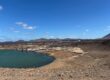
South of the park, Yaiza is just a few minutes away. It’s a pleasant, authentic village where you’ll likely stay in a white house. Plus, it remains quiet with a few amenities for grabbing groceries or a quick bite. There’s also the village of Uga, which is even more nestled among the mountains and lava fields, while remaining off the beaten path. Still in the south, I have to tell you about El Golfo, a small fishing village. It was my base during my stay in Lanzarote. It’s the kind of place that gives you a little pang when it’s time to leave. There are good restaurants, a wild beach and the famous Lago Verde.
If you’d rather focus on the north of Los Volcanes Park, I recommend Tinajo and Mancha Blanca. These are two charming villages for an immersion in local life! And above all, you’ll be surrounded by lava fields. Not to mention Playa Blanca and Puerto del Carmen, two seaside resorts with plenty of accommodation options, located about 20 minutes away by car.
You can also take a look at the map below to find your accommodation based on the location you want!
Book your accommodation next to the Los Volcanes Natural Park
Use the interactive map below to find your future place to stay!
Conclusion
Well, I hope you enjoyed this guided hike in Los Volcanes Park! As you’ve seen, it’s a route with varied landscapes unique to the island of Lanzarote. I’ll take this opportunity to tell you that the Volcán del Cuervo crater is open to the public: you can go there on your own.
For the rest of the park, I’d say it’s better to be accompanied by a local guide. It makes the experience all the more interesting. And then it feels good to be guided, without having to search for information—just listening and enjoying. But Lanzarote is also beautiful to discover on your own. If that’s what you prefer, I recommend checking out our guide to the best hikes in Lanzarote: there are lovely marked trails to take, with magnificent panoramas in the heart of nature. Even if these aren’t high-altitude trails, there’s plenty to explore even for seasoned hikers.
Let’s not forget two must-see spots, one of which is part of the Los Volcanes Natural Park and the second just next door: Charco Verde and Las Grietas.
See you soon for new discoveries in Lanzarote!

Written by Laura CALLES
Thanks to Mélanie and Sylvain, I had the chance to discover the Canary Islands, specifically Tenerife and Lanzarote, so that I could share these island paradises with you. Two real favorites of mine!
Despite our vigilance, an error may have crept into this article. If you spot one, please don't hesitate to let us know so that we can correct it immediately and keep our information up to date!