Los Volcanes Natural Park in Lanzarote
Last update: 06/19/2026
Our blog continues to grow thanks to you, our readers. This post may contain affiliate links, which means we can earn a small commission if you make a purchase through them, at no extra cost to you. This helps us to continue to bring you more and support our work!
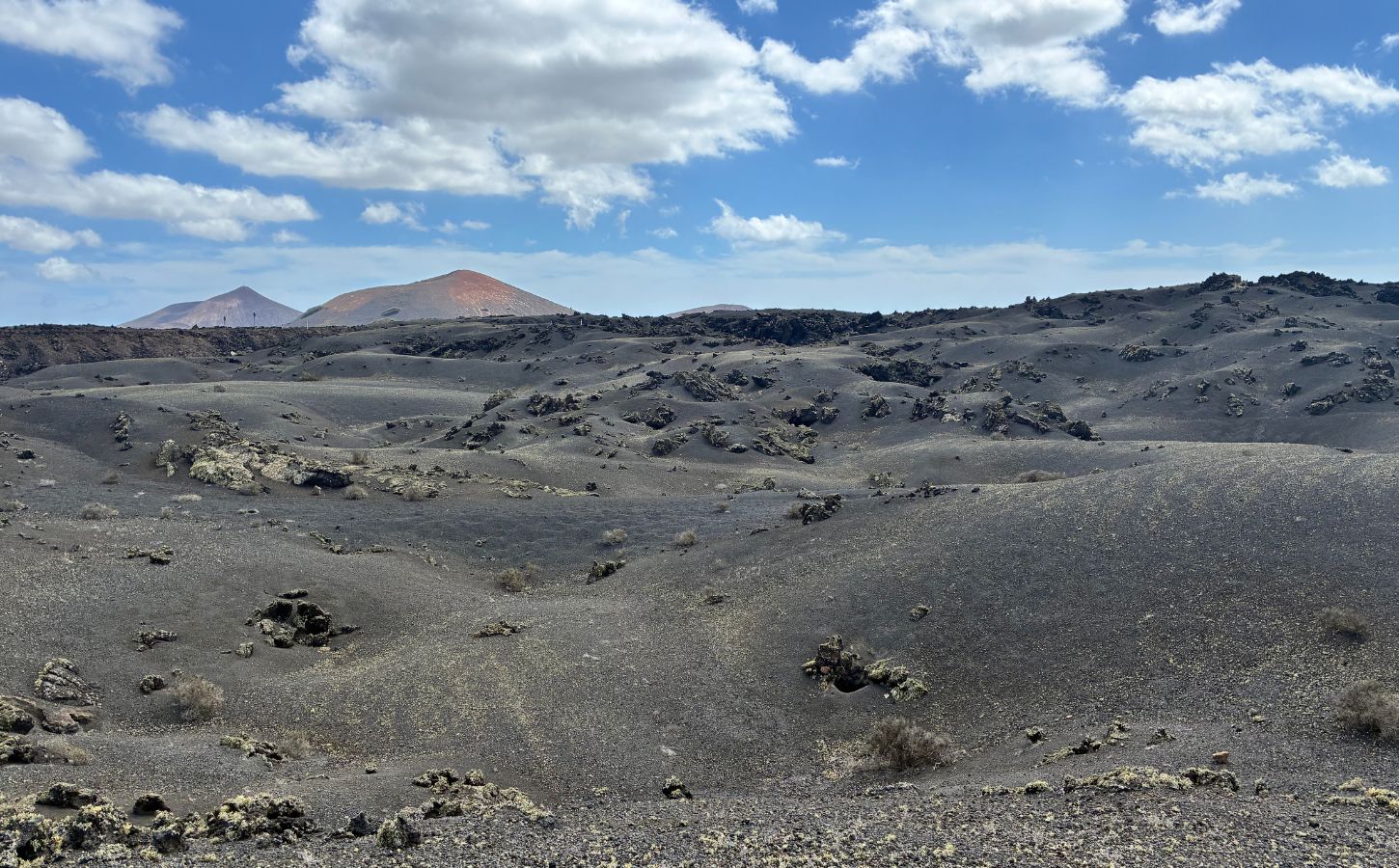
If you enjoy hiking and exploring unique, lunar-like landscapes, I’ve put together this article about my guided hike in Los Volcanes Park. Located right next to the famous Timanfaya National Park, it turned out to be a fantastic experience. I’d even say that hiking in Los Volcanes Park is one of the must-do activities in Lanzarote. I have such fond memories of it. The hike gave me the chance to get right up close to the lava fields and even walk inside a volcanic crater (yes, really!).
Having a local guide with us was another major advantage. Along the way, I learned all kinds of fascinating facts and anecdotes about the landscape—things I would never have discovered on my own. I’d describe it as a very accessible hike: the trails are mostly flat, with only a gentle elevation gain. The main challenge is that there’s no shade, and you’ll be walking over sand and rocky paths. Still, as long as you come prepared with good shoes, water, a snack, a cap or hat, and sunscreen, it shouldn’t be a problem.

Honestly, if you’re planning a trip to Lanzarote, I recommend adding this activity to your itinerary. In this article, I’m sharing an experience that became one of the highlights of my entire vacation on the island.
Our guided hike in Los Volcanes Park
When I booked this activity, I’ll admit that I didn’t study the route in detail. I wanted to keep some of the surprise and enjoy the experience even more! All I knew was that I’d be walking among volcanoes and that the hike was fairly accessible—always worth checking, haha. For this excursion, you’re picked up at a meeting point arranged with the organizer and driven to the trailhead. In my case, the closest pickup point was Puerto Calero. Our van collected us at 9:30 a.m., and we began the hike at around 10 a.m.
We found ourselves at the foot of Montaña Negra in a small group of six, with both French and Spanish participants. That worked perfectly for me, as I could choose which language to follow for the guide’s explanations. Before we set off, the guide gave each of us a small snack for the trail: a banana and a cereal bar. It was a thoughtful and useful touch, especially on a hike. She then gave us a quick briefing about the route while still keeping enough details under wraps to preserve the surprise. After that, we took our first steps along the trail at an easy pace. We stopped several times so our guide could explain the different layers of lava and the sparse vegetation that manages to grow through the ash and between the rocky formations.
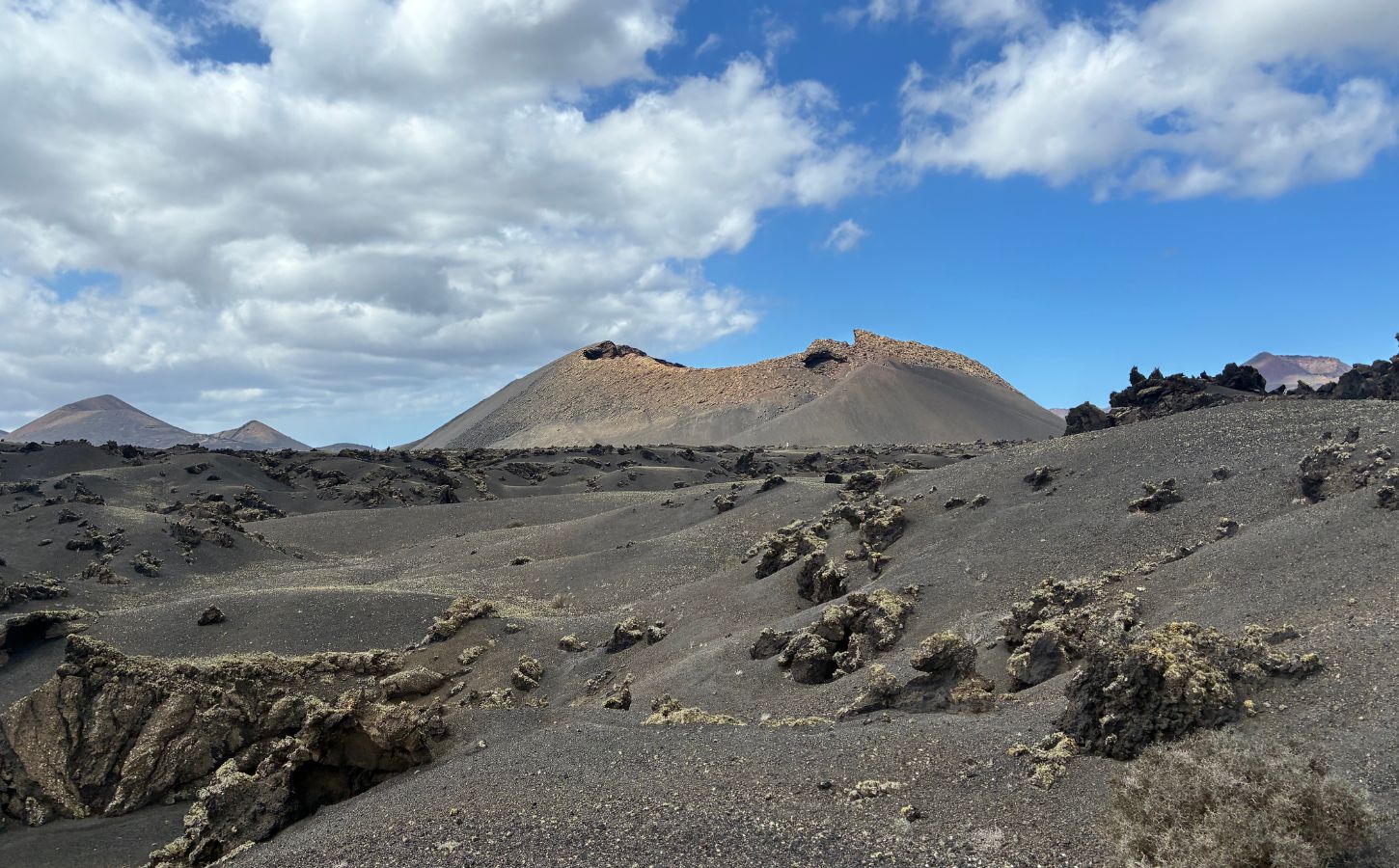
I found it fascinating. We learned that around 300 years ago, volcanic eruptions continued for six years and destroyed several villages. That meant we were walking over ancient lava flows and the remains of old settlements. The guide also explained that the lava advanced slowly and continuously, which is why there were no casualties. Residents had time to leave, even though rebuilding their lives elsewhere was far from easy.
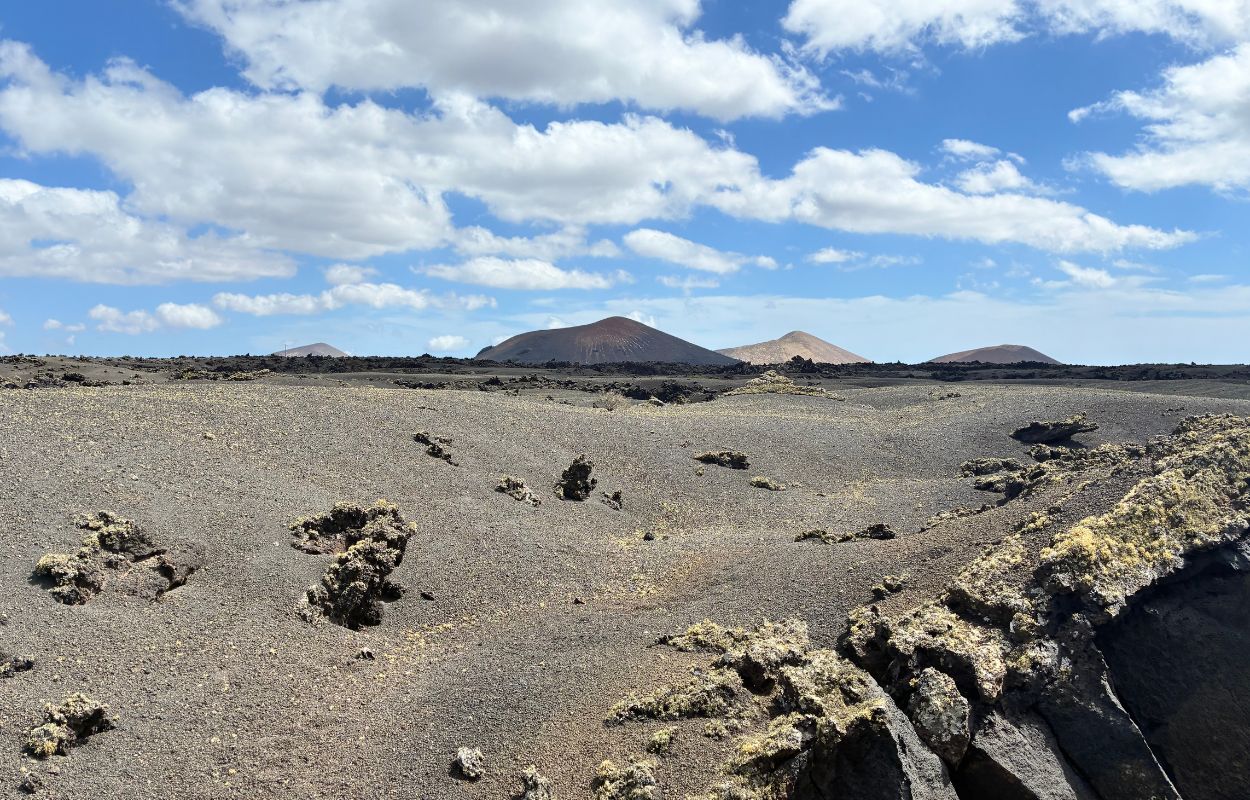
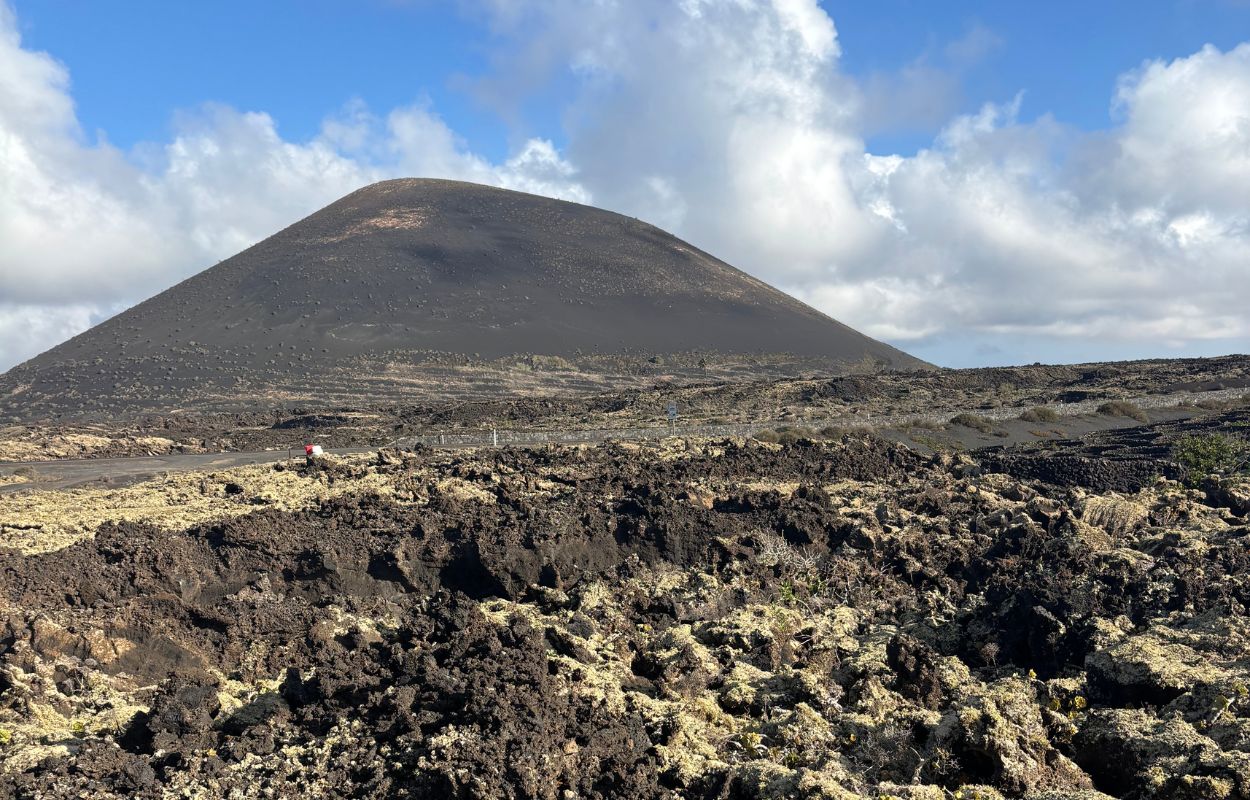
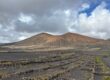
As we headed toward Montaña Negra, we noticed that the mountain had far more vegetation than the surrounding fields. The reason is simple but interesting: mountains that were already there were not covered by the lava flows. The lava moved around them rather than over them. At the base of the mountain, we also spotted olive trees, prickly pears, and even a few palm trees. The guide explained that this was thanks to lapilli, the small volcanic stones that act like sponges by trapping water and moisture. They help sustain crops because, contrary to what you might expect, Lanzarote becomes very humid at night. Local residents even collect these stones for their gardens. The hike became more interesting with every step toward Montaña Negra, and this was only the beginning of the route.
We followed a path around Montaña Negra, walking partway up the slope until we reached a water tank. We saw a few people climbing to the summit even though it is forbidden. It was a shame to see, but unfortunately, there are always some visitors who ignore the rules, even in a protected area.
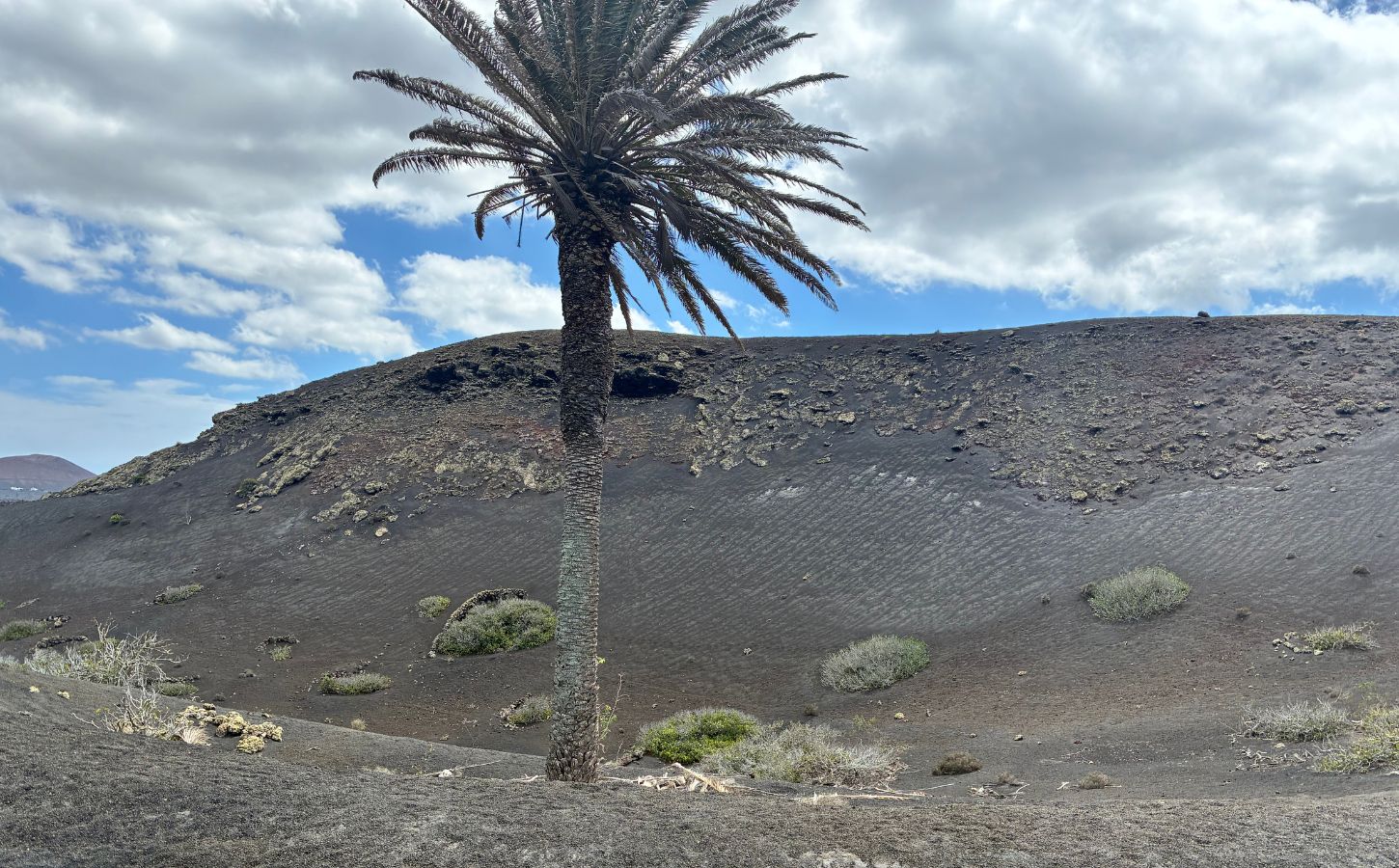
At the water tank, on the far side of Montaña Negra, we stopped to eat our snacks and sit down for a while as the sun grew stronger. You don’t necessarily feel how intense it is, but we still ended up with sunburn. That’s part of the experience too, I suppose, haha. During the break, we were joined by Lanzarote’s famous lizards. They vary in size, but they’re all harmless—and very fond of bananas. That’s really the only reason they come close. They’re important because they are the island’s main land-dwelling species.
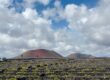
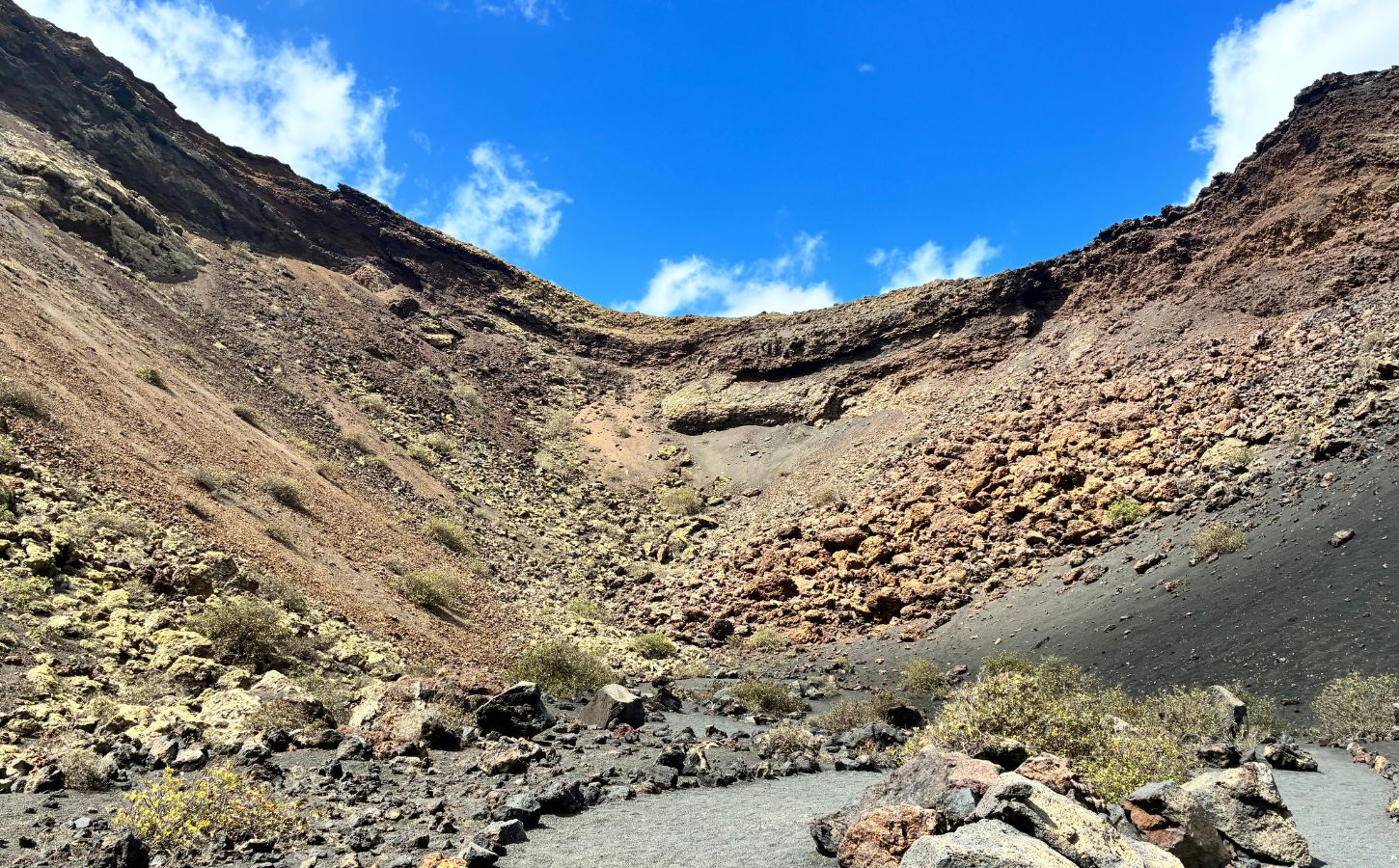
We then continued toward the famous Volcán del Cuervo, whose name means “raven” in English. The name comes from the many raven nests found inside the crater. It may seem unusual, but with so few trees on Lanzarote, the birds had to find another kind of habitat.
And yes, we went right inside the crater. I honestly had no idea what to expect. You imagine all sorts of things, but once you’re there, the crater feels almost like being enclosed by a mountain ridge. It’s remarkable: you can wander around peacefully and take in the surroundings at your own pace. The setting is truly unique. You walk between towering cliffs in shades of ocher, purple, red, and black, with a little vegetation here and there, including succulents. That said, Lanzarote has far less vegetation than other Canary Islands such as Tenerife, La Gomera, or La Palma.

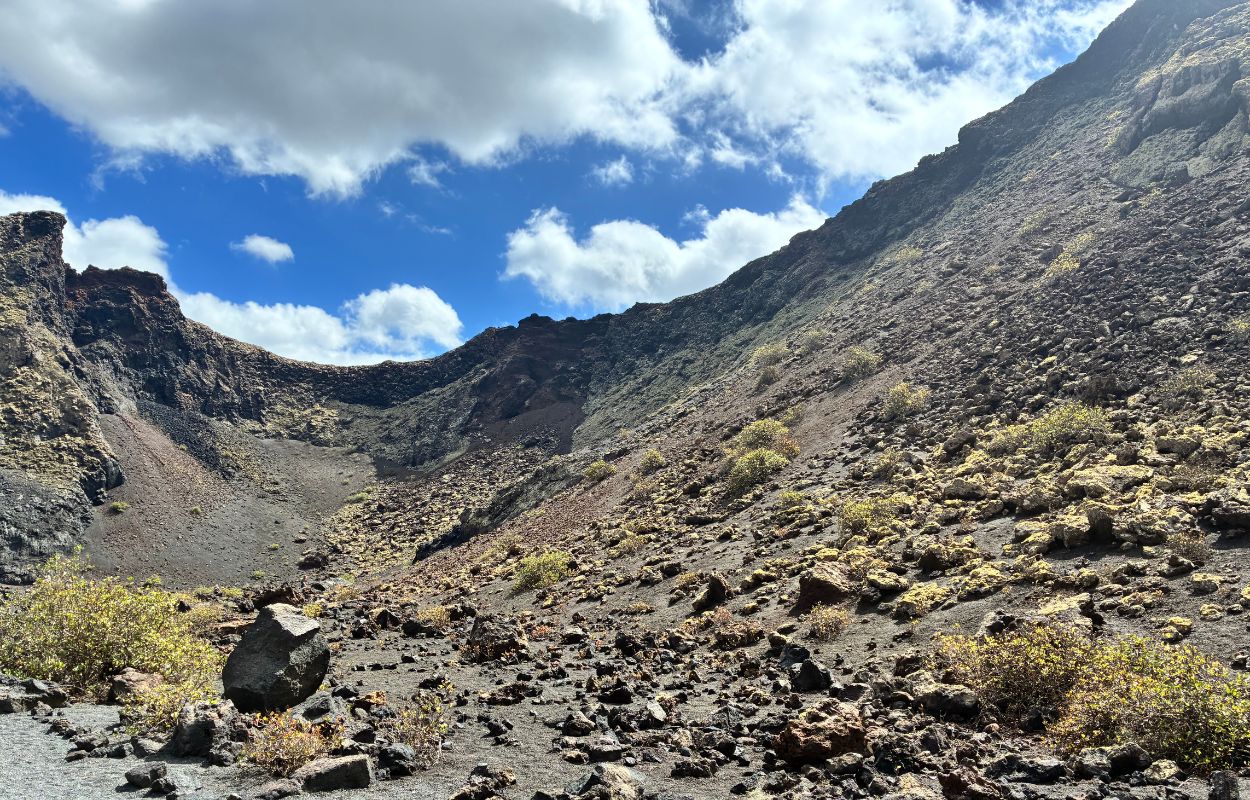
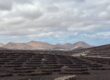
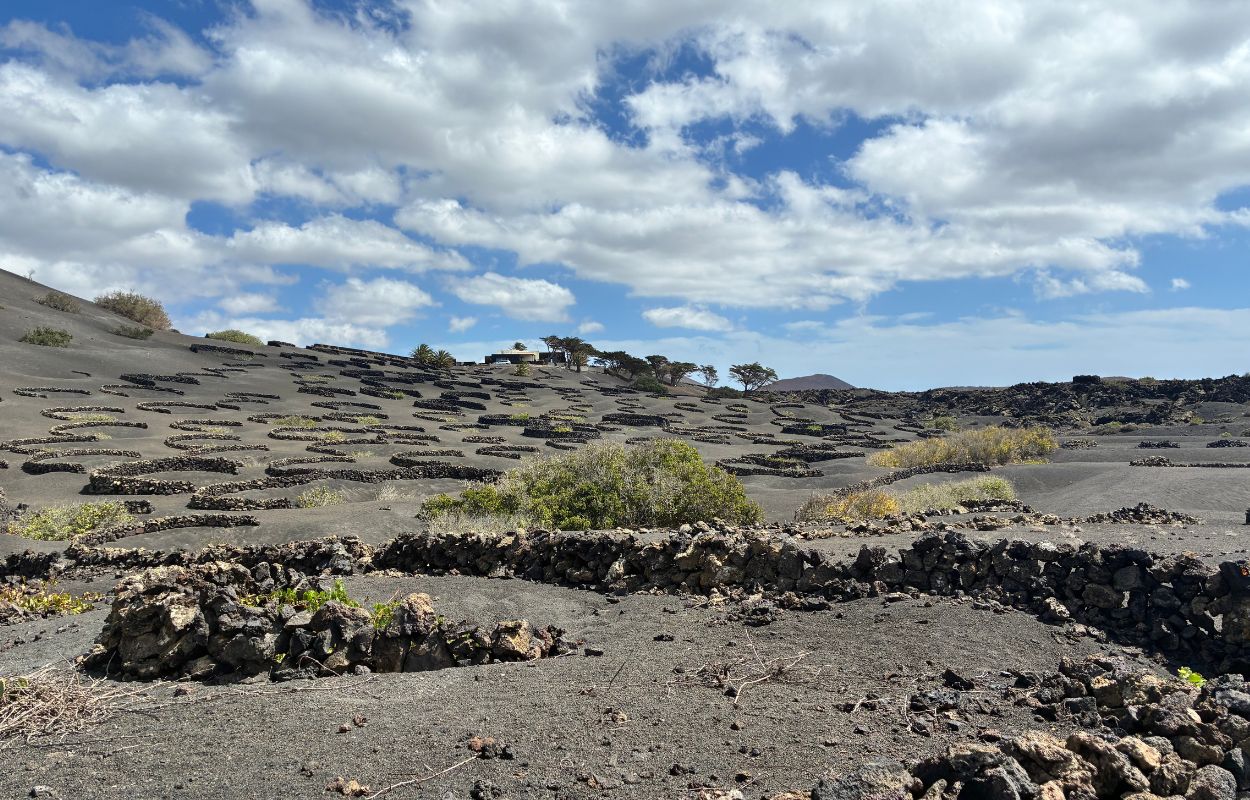
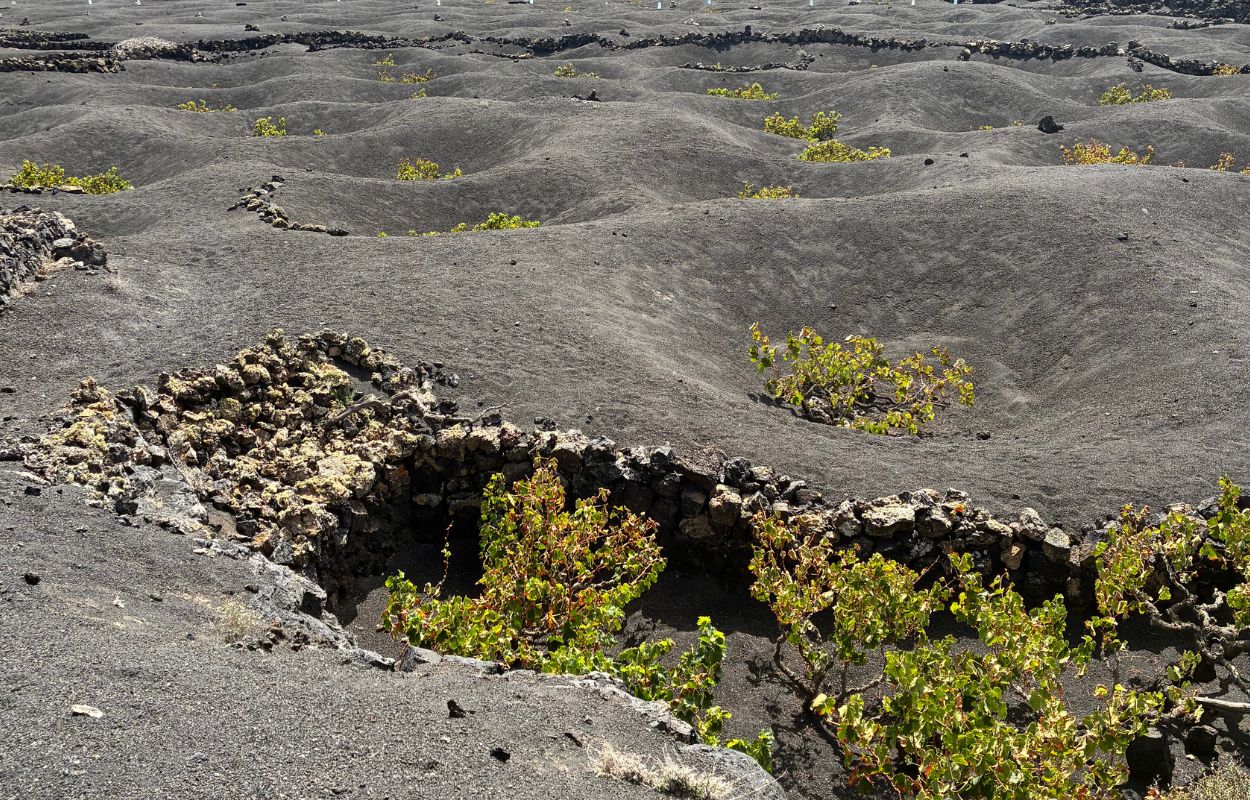
The guide gave us some free time to explore the crater however we liked, take photos, and simply enjoy the scenery. We then continued through the vineyards, where the growing methods are both distinctive and beautiful to see. To give you an idea, each vine requires a hole around three meters in diameter, along with a low stone wall for protection. This creates a landscape unlike anywhere else and one that is deeply characteristic of the island.
We walked along the edge of fields that looked like rows of small black craters, each bordered by a curved stone wall with a single vine growing in the center. The layout is strikingly regular and carefully measured. It’s beautiful to look at, although the work behind it is demanding and done entirely by hand. As a result, fewer and fewer people are producing wine this way, especially because every vine requires so much land and labor. It’s unfortunate, but understandable.
I hope these landscapes and this tradition can survive over time. The vineyards eventually lead toward the village of La Geria. If you’re interested, you’ll find bodegas there, created by local winegrowers to share the history of the vineyards and offer tastings of white and red wines, often with tapas. It’s a lovely and very local experience. In our case, the hike ended shortly before we reached the bodegas, and we were driven back to our original meeting point in Puerto Calero.
I really enjoyed this hike, which felt wonderfully varied and complete. We had a friendly group, and the guide adapted easily to our pace. She spoke both French and Spanish very well, and we learned so much about Lanzarote along the way. My overall impression of the experience was therefore extremely positive. I’ll share my detailed review just below.
Our review of the guided hike in Los Volcanes Park
As you’ve probably gathered, I had a wonderful time on this guided hike through Los Volcanes Park. The organization was excellent: everything felt smooth and well planned. All we had to do was follow the route, enjoy the views, take photos, and listen to the guide’s explanations. It gave us a real chance to switch off. I also loved the route itself. It was accessible to almost anyone, with no need to be an experienced hiker, yet it still offered an impressive amount of variety. In just three hours, we saw lava fields with different layers, vegetation, mountains, craters, and vineyards. What more could you ask for?
The guide’s explanations added so much to the experience and made the route far more enriching. I’ve shared some of what we learned here, but rest assured that there is plenty more to discover if you choose this outing in the heart of Los Volcanes Park. To me, it felt like much more than a hike: it was a genuinely immersive experience among the volcanoes, and that is the memory I’ll carry with me. I also appreciated the small group size. With fewer than ten people, we could ask questions, chat, stop to admire the lunar landscapes, and above all, enjoy the peace and quiet. The explanations also helped me understand what makes Lanzarote so distinctive—and why parts of it look so much like Mars.
The company we booked this guided hike with was Canary Trekking, a local operator that has been around since 1998. With that kind of experience, it has had plenty of time to build a solid reputation. The agency specializes in guided hikes through Lanzarote’s characteristic volcanic landscapes, from the lava fields of Los Volcanes Park to the cliffs in the south.
The reviews are overwhelmingly positive, and my experience matched them. The company’s approach is personal and welcoming. Groups are small, giving you time to observe the landscape, listen to the guide, and enjoy the scenery at your own pace. Guides often speak French, but English, Spanish, and German are also available. One of the biggest advantages is their in-depth knowledge of the island: its history, geology, flora, and especially the eruptions that shaped Lanzarote’s landscapes.
Whether you’re staying on Lanzarote for a while or only visiting for a few days, Canary Trekking offers several routes suitable for different ability levels, from beginners to experienced hikers. Whatever the route, the same care goes into each excursion: clear explanations, a passion for nature and local history, and a relaxed, cheerful atmosphere. The company also operates on other Canary Islands, including Tenerife, Fuerteventura, Gran Canaria, La Gomera, and La Palma.
Walking along trails surrounded by black and ocher landscapes is a beautiful experience. You find yourself looking in every direction and paying attention to every detail. If you enjoy hiking, trekking, or simply taking scenic walks, Canary Trekking is well worth considering. These are not generic tourist strolls, but more authentic experiences rooted in the island’s landscape and history. That, to me, is the company’s greatest strength, and a walk, trek, or hike with them can add something special to a trip to Lanzarote.
Guided hike in Los Volcanes Park: Practical information
How much does a guided hike in Los Volcanes Park cost?
Prices for a hike in the protected area of Los Volcanes Park vary considerably depending on what is included, such as the guide, transportation, meals, or equipment.
As a general guide, here’s what you can expect:
- For a standard two- to four-hour guided hike with a local guide, expect to pay between €25 and €40 per person.
- For a more comprehensive guided hike that includes pickup, drop-off, a small group, detailed explanations, and a snack, expect to pay between €40 and €70. The hike I took is currently listed at €49 per person.
- For children ages 7 to 12, the price is often around 50% of the adult rate, depending on the organizer.
- Private groups and custom walks or hikes can cost considerably more, depending on the number of participants, pickup location, and any additional options.
Before booking any hike, I recommend checking exactly which options are included. I’d also suggest choosing a company that works with local guides, as their knowledge can make a real difference.
How long does a guided hike in Los Volcanes Natural Park take?
A guided hike in Los Volcanes Park generally lasts between two and four hours, or roughly half a day. My route took three hours, including stops for explanations, photos, and a short break to catch our breath and eat our snacks. Three hours can sound like a long time in full sun with no shade, which is why these hikes usually take place in the morning. In practice, the time flew by. Between the solidified lava, lava tubes, and the guide’s anecdotes, there was always something to hold our attention. We wanted to keep moving while still taking our time.
Longer outings are also available, especially when several areas of the island are combined with viewpoints over the Montañas del Fuego. In those cases, the route may last five or six hours. More dedicated hikers can even join multi-day treks. Quite a few French travelers choose to explore Lanzarote this way, entirely on foot.
The best time for a guided hike in Los Volcanes Park
To enjoy a hike in Los Volcanes Park without having to contend with too much heat or wind—Lanzarote can be especially windy from May to September—it’s worth choosing your season carefully. I visited in September, and there was still a fair amount of wind. Conditions tend to become calmer between October and December, which I’d consider one of the best periods for hiking in Los Volcanes Park.
During these months, daytime temperatures remain mild and pleasant, generally ranging from 22 to 26°C, while evenings are slightly cooler. After summer, the wind gradually eases, which makes a noticeable difference. The skies are often clear as well, so you can still take beautiful photos without meeting quite as many people on the trails.
Spring, from March to May, is another good season for hiking in Lanzarote. There is more vegetation, and the landscape becomes more colorful. The contrast between pink flowers such as bougainvillea and the island’s white houses is beautiful. You may also see pink cactus flowers growing among the black lava stones and rocks, which creates a striking contrast. Our guide showed us photos of the same route in spring, and it really did look different. There seemed to be a little more life among the lava fields. Lichen, on the other hand, grows just as readily in summer as it does in spring on the black rocks, to the point that it can almost seem invasive.
Spring temperatures and conditions are generally ideal for walking and hiking. July and August, by contrast, are hotter, and the lack of shade makes the heat feel even stronger across the volcanic terrain.
Whatever time of year you choose, I recommend setting out early in the morning. Temperatures are more comfortable, the light over the hills and volcanoes is beautiful, and the overall atmosphere feels softer and calmer.
Where to stay near Los Volcanes Natural Park
To make the most of Los Volcanes Park and its protected landscapes, there are several appealing villages nearby where you can stay.
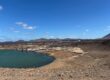
South of the park, Yaiza is only a few minutes away. It’s a peaceful, authentic village where you may well find yourself staying in one of the traditional white houses. There are also a few convenient places to pick up groceries or grab a quick bite. Another option is Uga, tucked even more deeply among the mountains and lava fields while remaining well away from the busiest tourist areas. Farther south, I also have to mention El Golfo, a small fishing village that served as my base during my stay in Lanzarote. It’s the kind of place that is hard to leave. You’ll find good restaurants, a wild beach, and the famous Lago Verde.
To stay north of Los Volcanes Park, consider Tinajo or Mancha Blanca. Both are charming villages that offer a closer look at everyday island life, and you’ll be surrounded by lava fields. There are also Playa Blanca and Puerto del Carmen, two seaside resorts with a wide range of accommodations, around 20 minutes away by car.
You can also use the map below to find accommodation in the area that suits you best.
Book your accommodation near Los Volcanes Natural Park
Use the interactive map below to find your future place to stay!
Conclusion
I hope you enjoyed following along on this guided hike through Los Volcanes Park. As you’ve seen, the route takes you through a wide variety of landscapes that are unique to Lanzarote. It’s also worth knowing that the Volcán del Cuervo crater is open to the public, so you can visit it independently.
For the rest of the park, I’d say that going with a local guide is the better option. The explanations make the experience far more interesting, and it’s nice to simply follow along without having to research everything yourself. At the same time, Lanzarote is also wonderful to explore independently. If that is more your style, take a look at our guide to the best hikes in Lanzarote. You’ll find several marked trails with beautiful views through the island’s natural landscapes. They may not be high-altitude routes, but there is still plenty to explore, even for experienced hikers.
Finally, don’t miss two other highlights: one lies within Los Volcanes Natural Park, while the other is just nearby—Charco Verde and Las Grietas.
See you soon for more discoveries in Lanzarote!

Written by Laura CALLES
Thanks to Mélanie and Sylvain, I had the chance to discover the Canary Islands, specifically Tenerife and Lanzarote, so that I could share these island paradises with you. Two real favorites of mine!
Despite our vigilance, an error may have crept into this article. If you spot one, please don't hesitate to let us know so that we can correct it immediately and keep our information up to date!