Our one-week trip to Kauehi Atoll
Last update: 06/30/2026
Our blog continues to grow thanks to you, our readers. This post may contain affiliate links, which means we can earn a small commission if you make a purchase through them, at no extra cost to you. This helps us to continue to bring you more and support our work!
After living here for five and a half years, we’ve been lucky enough to visit many islands in French Polynesia, both as a family with Melanie and Louis (and now Teo) and for work. Even though the global COVID-19 situation has only affected us slightly in the end, being stuck in Tahiti is still starting to get to us a little (I know that will make some people smile). The idea of escaping our little rock in the middle of the Pacific keeps coming back to mind. Easter weekend falls at just the right time this year, with four days off. It’s the perfect opportunity to get away — not from French Polynesia, since we can’t leave the territory without a compelling reason at the time of writing this article (April 2021), but at least from Tahiti.
So, we decided to leave the classic French Polynesian islands behind for this long weekend, especially since we’d already visited most of them anyway. The one tropical island we would still love to explore more deeply is Fakarava Atoll, in the Tuamotu Archipelago. I had already been there briefly twice, including during my catamaran cruise in the Tuamotus, but spending a full week there with the family sounded great. Several options were available for this four-day weekend. We usually go through the website “Séjour dans les îles,” which is reserved for French Polynesian residents and offers flight + hotel or guesthouse packages, often with half-board. I ran the numbers several times, and the result was clear: it was always cheaper than booking everything separately. A good deal for us.
Are you planning your trip to French Polynesia?
We decided to make your life easier by creating our own travel guide, where everything is organized, categorized, and summarized. Save research time and start traveling already!
Yes, I'm interested!


We had initially considered Manihi or Makemo Atoll, but those two seemed to have been removed from the “Séjour dans les îles” offers for the time being, probably because of the COVID-19 crisis. So we decided to go to Kauehi Atoll, in the Tuamotus. I had already spent a day there for work and had quickly seen the village and the church. I had good memories of it. So I thought to myself, “Why not?” We booked a full week on the atoll (right after selling a kidney to pay for four people, by the way, haha). But at the same time, especially in this crappy situation everyone knows too well, we’d rather spend our money on a week of vacation than leave it sitting in a bank account… Personal choice. Why seven days? Simply because, at the time, the atoll was served by only one flight a week, on Wednesdays. We booked the only guesthouse/lodge on the Polynesian island: the famous Kauehi Lodge, about which I had only heard and read good things. There were only three bungalows on site at the time, so we certainly weren’t going to be bothered by crowds!
Small detail: we all left more or less sick. Melanie had been feeling under the weather for several weeks because of a cold/sinusitis that just wouldn’t go away (yes, we do get colds in Tahiti), and I had just had a small relapse of ciguatera (food poisoning) after eating a “bad” fish a few days before leaving. It’s a real pain, especially when you’re heading to an atoll in the middle of the Pacific Ocean where fish is basically what you eat. To be continued.
Let’s go — I’ll take you along on our stay in Kauehi, this time in the form of a personal travel story.
Kauehi Atoll: the context
Kauehi is part of the Commune de Fakarava, along with six other atolls: Fakarava, Aratika, Niau, Raraka, Taiaro, and Toau. Taiaro was first recognized by UNESCO in 1977, and the wider Commune de Fakarava Biosphere Reserve now includes these seven low-lying coral islands and atolls. As mentioned above, air service is very limited and depends on Air Tahiti’s schedule. At the time of our trip, there was usually only one flight a week, with very rare additional flights during school vacations. I know some atolls are becoming more and more popular with local travelers, like Mataiva, but I don’t personally know anyone who has gone to Kauehi for vacation.
The atoll, located about 450 km from Tahiti, is 24 km long and 18 km wide. There are about 200 inhabitants. The locals mainly live from copra, especially since there is only one tourist accommodation, the one where we are staying. The atoll only really opened up to the outside world in 2001, with the construction of the airstrip. I think I read somewhere that about 2,000 to 2,500 people pass through the atoll each year, including, I suppose, many of the sailboats crossing the Pacific and its beautiful tropical islands.


Arrival in Kauehi and first impressions of Kauehi Lodge
After a one-hour flight from Tahiti, we stopped briefly on Aratika Atoll, which I also knew from a short work stop some time before. We took off again after dropping off three quarters of the plane, for a 10-minute flight to our final destination: Kauehi Atoll. We discovered the tiny airport, in the same style as most remote Tuamotu atolls: a small main hall and an area where the luggage is placed by hand as it comes off the plane. Aldo, who owns the guesthouse with Colette and where we would spend the week, welcomed us with flower leis.
A quick aside about luggage: we had decided not to make the same mistake as during our January stay in Mangareva, in the Gambier Islands. This time, we packed all of Teo’s food, which made the bags pretty heavy. We were on half-board, and we knew that the few stores in the village would not have much to offer — assuming they were even open… As soon as we arrived, we learned that the atoll had not been served by the usual supply boats for almost two months, so the stores were nearly empty. We had definitely done the right thing! I’ll talk more about this again at the end of the article in the practical section, but clearly, you need to think about bringing as much as you can from Tahiti when coming here. We even brought our own lunches (ham, cheese, bread, chips, etc.). In total: 53 kg of checked luggage. Fortunately, we had Air Tahiti excess baggage vouchers, the ones you can get with points and the Kaveka card. Air Tahiti still hadn’t decided to give babies a baggage allowance, so unfortunately Teo wasn’t entitled to a single kilo, not even for the stroller… too bad.


Anyway, we loaded our luggage into the guesthouse truck and drove slowly to the lodge, located about 2 km west of the airport, opposite the village. On the way, we caught some beautiful views of the lagoon and its turquoise water, which was already a pretty nice start. After 15 minutes on the track, we arrived in a beautiful coconut grove at the entrance to the property. Right away, we found a lovely flower-filled garden. We walked around while waiting for the previous guests to leave, sipping on a coconut.
The guesthouse is built around a large round living room, all in wood, with wooden floors, local materials, and tasteful decor. Everything is really clean, and it’s the kind of room where you actually enjoy spending time, looking out at the lagoon through the windows all around. Around this lounge area, covered wooden walkways let you move around and even push a stroller (I’ll admit, that’s probably not their main purpose!). There is also a kitchen where you can store your things in the fridge.
From the walkways, two staircases lead down to the beautiful white-sand beach in front of the guesthouse. The setting is truly beautiful and, honestly, it feels good to be here. From a few meters above the ground, the walkways offer a magical view over the turquoise lagoon, the coral scattered across the white-sand beach, and, above all, the constant parade of blacktip sharks cruising along the shore. The setting is heavenly, and neither words nor photos can fully capture the beauty of this place.


We finally discovered our bungalow, set at the end of two walkways. It was really spacious and had a large private bathroom. For us, it was perfect, and we knew we would feel very comfortable there for the whole week with our two children. At the time, the guesthouse had only three bungalows (2 standard and 1 premium with a fridge, a kitchenette, and a mezzanine with mattresses). The three bungalows were occupied by Tahitian residents, which makes sense, since nobody could enter French Polynesia at the time this article was written. There were families with children aged 4 to 6, all little boys — perfect for Louis, who would have friends for the whole vacation. We finally settled onto our small private terrace with a splendid view over the lagoon. Paradise was not that far away.
Oh yes, I almost forgot. The real highlight is the beautiful wooden pontoon that stretches out into the lagoon and ends in a small covered hut. It’s a superb spot, with a table, chairs, a sofa, and a bed where you can lie down. In short, it’s the magical spot — the one you may already have dreamed of — for watching the blue of the lagoon and the blacktip sharks passing by in less than two meters of water (of course, it’s not deep enough for proper snorkeling or exploring marine life). Even with overcast weather on the day we arrived, it was still the perfect place to wake up in the morning while waiting for breakfast, have lunch or an evening drink, play cards, or simply get lost in your thoughts…
We simply spent the end of the afternoon lounging in a meter of water in front of the guesthouse and discovering the coral reefs covering the area. In short, we enjoyed the moment. You don’t come to Kauehi to “do things,” because there really isn’t much to do. You come here with your family to relax, disconnect, and enjoy life with your children. The little ones loved moving among the blacktip sharks along the shore. At first, you might feel a little nervous getting in, but you get used to it pretty quickly. In the end, it’s almost like a little dog or cat coming to brush against your feet (a figure of speech, of course!).


A small anecdote: I told you at the beginning of the article that I had a relapse of ciguatera a few days before leaving Tahiti. Naturally, I mentioned it at the guesthouse. To put it bluntly, I have to say it really annoyed me not to be able to eat fish during my stay here. Teirei, the lady helping out at the guesthouse, told me about a traditional remedy she used to take whenever she had food poisoning on the atoll. When you live here, you eat fish almost all year round, and ciguatera poisoning, from what people call a “taero” fish in Tahitian, is common. Given the few symptoms I had this time, I thought it couldn’t hurt to try. She told me even her grandmother used to take it when she was sick. So there I was at dinner, taking the famous remedy: a good dose of Negrita rum, an egg yolk, a dose of brown sugar, and lemon juice (just the juice of 3 Tahitian lemons). The instructions were simple: start by eating a few pieces of fish at the beginning of the meal, follow it with the folk remedy, then continue by eating “a lot of fish.” In the end, it was easier to swallow than I expected, even if it warms you up a bit (mostly because of the rum, actually…).
In any case, I didn’t have any problems that evening or during the night, so it seemed to go well for me. We fell asleep in our beautiful bungalow, soothed by the sound of the lagoon…
The rest of our trip on Kauehi Atoll
Even though I decided to write this article as a travelogue rather than a practical guide (which would not really make sense anyway), I’m not going to tell you about each day we spent here, because I have to admit they were all quite similar! As I said, there aren’t tons of things to do.
We spent most of our time swimming in the sea with the blacktip sharks and enjoying the magical spot at the end of the pontoon. The days passed in much the same way: we would go there early in the morning around 5:30 or 6 am at dawn, return for a lunchtime aperitif while playing the famous UNO with Louis, and then spend a short half hour there at sunset shooting with my tripod and filters. It was also the perfect opportunity to test my KASE filters again, which I had received a few months earlier…

Among the nice things we did several times during our week here was kayaking along the coast, especially to the hoa located about 15 minutes from the guesthouse. For those who don’t really know what that means, hoas are specific areas on atolls where there is a connection between the ocean and the lagoon. In practical terms, to give you an idea, it is usually an area that is more or less underwater depending on the tides and the depth of the lagoon. In the one we explored, part of it is always underwater, which makes it very nice for swimming. You can walk almost everywhere, and there is also a completely dry area filled with pieces of coral of different sizes and small patches of sand. This is the type of area that can be flooded during big storm surges or cyclonic events. Clearly, during major weather events, it would be underwater. Anyway, I digress, sorry.
We often left from the guesthouse with the free kayaks and followed the turquoise coastline to reach the entrance of the hoa. Each time, we had to get out of the kayak and carry it for about ten meters over a sandbank to reach the flooded part of the hoa. From there, we could paddle again for about a hundred meters. At the end, it’s a dead end! You can swim in less than one meter of water here, and it’s great. From there, we often enjoyed wandering around the dry part of the hoa. There is nothing very specific to do here: a family stroll, looking for beautiful shells to make decorations with Louis, taking photos — in short, just having fun. We also spent a few late afternoons walking across this flat land in search of beautiful light.


Another nice thing to note during our week there was a small path starting from the guesthouse and crossing the coconut grove and forest toward the same hoa we reached by kayak. It’s a short, pleasant walk, perfect with children. You rediscover the typical vegetation of Polynesian motus, which is pretty cool. The path is marked with coconuts! We also had the chance to visit the ruins of the atoll’s lighthouse. It has almost completely collapsed, unlike the one I saw some time ago in Fakarava. Nothing too spectacular, but a nice little family walk.


Visiting Kauehi’s only village
During the week, we also took the opportunity to be dropped off at the atoll’s only village. We climbed back into the truck and headed toward the village. The track, mostly made of crushed coral, is pleasant enough. When we arrived, we discovered a small village where barely 200 people live today. The atmosphere really feels like the “end of the world”: you pass a few people, but not many, and see many old abandoned buildings from another era. We were told that since the decline of the pearl industry, the atoll has gradually been losing inhabitants. Apparently, up to 600 people once lived here during the golden age of pearls.
Even though the village looks abandoned, or almost, I think it has a certain charm. A few lanes, stray dogs, children playing here and there, a school, a church, and a few stores, all more or less closed. We spent two hours in this village from another time, very far from France and even from what we had seen in Tahiti. And yet, we were only just over an hour by plane from the capital…



Day trip to another motu
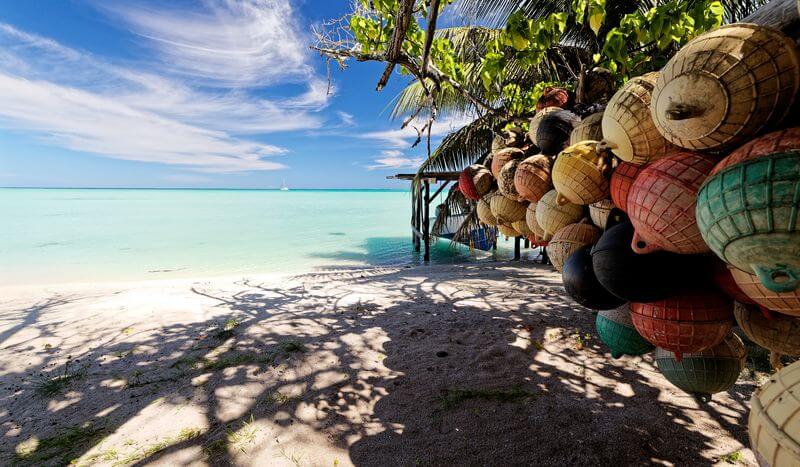
One funny thing about atolls is that people always offer you an “outing to a motu,” even though you’re already on a motu! The idea, of course, is to discover another part of the atoll, often a motu belonging to the guesthouse managers’ family. We left by boat from the guesthouse at 9 am in superb weather. A beautiful day ahead. We crossed the lagoon lengthwise, passing the village and the pass before reaching the other end. The crossing was relatively easy, without too many bumps, but also without much to see. There were very few coral heads or shallow areas like you find in some atolls, just a lot of blue.
After 30 to 40 minutes by boat, we reached the day’s famous spot: the beautiful motu Tehavare (“small lie”), located beside a magnificent hoa with crystal-clear colors. Everyone found their own spot in the shade of a few trees and coconut palms and settled in for the day. Here again, there wasn’t much to do. But the setting was really lovely for spending the day. We spent two hours walking and taking photos in this paradise-like end-of-the-world setting. The water was superb, the swimming too, and our blacktip shark friends were once again extremely present along the beach.
The guesthouse family slowly prepared the meal on site. On the menu: fresh poisson cru made with skipjack tuna and fresh coconut milk grated right there. They were also preparing “uto bread,” a local bread (or rather cake) made with sprouted coconut and flour, wrapped in a banana leaf and cooked on the barbecue. Then groupers and nasons were quietly grilled right by the sea. And finally, for dessert, there was po’e, prepared in advance and served this time with fresh coconut milk… Then it was time to eat, and we settled down by the water, feet in the sea. We tasted this delicious meal, honestly very good and full of flavor, in a setting that felt like a dream. I took the opportunity to fly my drone from the motu, gain some height, and observe the surroundings. It was as beautiful as ever.


We returned to the guesthouse at the end of the afternoon after spending an excellent day on this motu.
I’m coming to the end of this little travel story about our week here. I hope you enjoyed the walk and that it might even make you want to discover this atoll! I’ll leave you with a few practical tips.

Practical tips for traveling to Kauehi
Here is a summary of the things to remember when traveling here:
- Air service to the atoll is limited and depends on Air Tahiti’s current schedule. At the time of our trip, there was only one flight a week from Tahiti/Papeete, sometimes two apparently, often with a stopover in Aratika or Katiu.
- Residents can go through the “Séjour dans les îles” website or consider booking things separately, for example at the Tourism Fair and directly with the guesthouse, to see whether it is really cheaper… not sure.
- There is only one guesthouse on Kauehi Atoll, so there is no need to look much further.
- To find the best airfare to come here, have a look at this flight comparator, then you will need to take a flight with Air Tahiti, the scheduled airline serving this atoll from Tahiti.
- Be careful to bring everything you need for your baby, for example. See the article Traveling with a baby in French Polynesia.
- For lunch, the guesthouse did not prepare meals during our stay, so I advise you to bring what you need from Tahiti.
- Don’t forget mosquito repellent and some monoï, because we also served as meals for mosquitoes and nonos (tiny biting gnats that love fresh flesh).
I’ll leave you with those few words. We really had a lovely stay here in Kauehi, in a beautiful setting. The guesthouse is very pretty and well located, with a lovely white-sand beach, and we really enjoyed the meals, which were varied overall from day to day. You need to like fish, since you won’t be eating meat here, but it was always very good.
To nitpick on a few points where we think improvements could be made: there was no cleaning during the seven days we were there, and breakfast was always the same (bread/butter/jam/fruit). It would be nice to vary at least one element, such as uto pancakes, crêpes, or pancakes, even if we understand that supplies can sometimes be complicated here!
See you soon for a new article. For those who want to read another trip in the Tuamotus, I invite you to check out our trip to the atoll of Rangiroa!
See you soon,
Sylvain & Mel

Written by Sylvain PONS
From 2015 to 2021, French Polynesia was our home, with Mélanie and our children. I'm happy to share my experience and advice to help you organize an unforgettable stay in French Polynesia, based on my in-depth knowledge of the territory.
Despite our care, a mistake may have slipped into this article. If you find any, please don't hesitate to let us know so we can correct it as soon as possible and keep our information up-to-date!