Panasonic 42.5mm f/1.7 OIS review
Last update: 06/17/2026
Our blog continues to grow thanks to you, our readers. This post may contain affiliate links, which means we can earn a small commission if you make a purchase through them, at no extra cost to you. This helps us to continue to bring you more and support our work!
In early 2015, Panasonic introduced the Panasonic 42.5mm f/1.7 OIS. This lens was designed to compete with the Olympus 45mm f/1.8. Some people wondered why Panasonic released it when Olympus already offered almost the same features for less. But they were forgetting that Olympus lens sales go to Olympus, not Panasonic, haha, even though Micro 4/3 is a mount shared by both brands. This was especially true at the time, when almost all Olympus cameras had sensor stabilization and Panasonic cameras did not. One of the advantages of this 42.5mm over the Olympus 45mm is that it is stabilized. Like the 15mm f/1.7, this lens uses the Micro 4/3 mount. This makes it compatible with all Panasonic and Olympus bodies in this format, although there are a few limitations that I’ll mention below.
We’ve published a comprehensive guide to all the Micro 4/3 cameras currently available if you want to know more about the format.
After our full review of the Panasonic 15mm f/1.7, which is better suited to reportage and street photography, here is an 85mm full-frame equivalent lens that is more portrait-oriented. I also tested it on my Panasonic G90 with its 20MP Micro 4/3 sensor. The goal here is not to show brick walls or charts, although a little bit of that is necessary to highlight flaws, but mainly to show how the lens performs in real-world use.
The images shown were taken in RAW format and developed in DxO PhotoLab 5, with standard color rendering and corrections enabled, except for the images used to show optical flaws and those used in the gallery.
Here is our full review of the Panasonic 42.5mm f/1.7 OIS. We’ve also published a full review of the Panasonic G90.
Lens presentation
| Features | Visual |
|---|---|
|

|
At €400, Panasonic’s 42.5mm f/1.7 is more expensive than Olympus’s 45mm f/1.8. That’s a relatively high price considering it is only an 85mm f/3.5 full-frame equivalent. Of course, it is still an f/1.7 lens in terms of exposure. Its price has not dropped much since then, so its main rival remains the Olympus, which is also lighter.

The 42.5mm focal length on Micro 4/3 is equivalent to 85mm on full frame, a very popular focal length for portraits, although nothing stops you from using it for landscapes or other subjects. Its small size and stabilization also make it useful for street photography, since you can stay discreet with a very compact lens and use relatively slow shutter speeds. This is even more true with a Panasonic body: when the camera has in-body stabilization, it can work together with the lens’s optical stabilization to reduce the risk of camera shake when shooting in the evening or at night.
Ergonomics, design and handling
Build quality is very plastic-based, but still good. Of course, it doesn’t have the metallic feel of the 15mm developed in collaboration with Leica. The barrel is very streamlined, with no switches for moving from AF to MF or for turning stabilization on and off. These settings are handled from the camera body. The approach is similar to many of Tamron’s latest full-frame E-mount lenses for Sony, which also keep physical controls to a minimum. The goal is to keep things simple and make the lens as easy to use as the 15mm f/1.7 mentioned above. The lens hood has a traditional design and can be reversed, which helps reduce the space it takes up in your bag.
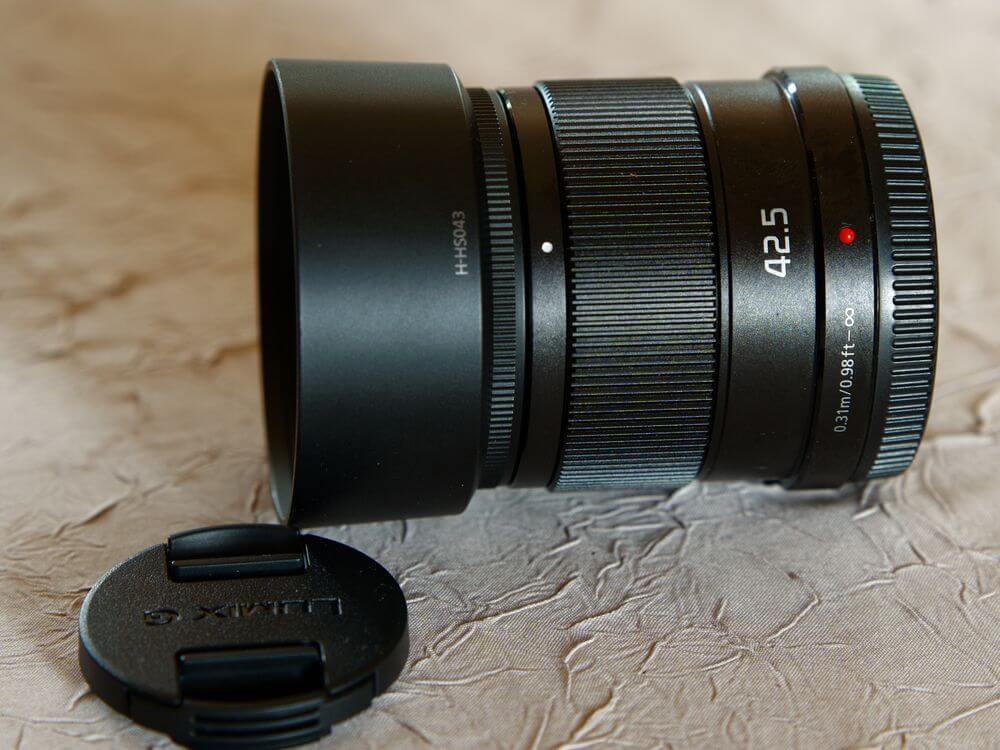
The lens has one aspherical element, which helps limit chromatic aberrations and maintain good quality across the frame. Bokeh is nicely rounded at wide apertures, but the seven-blade aperture quickly becomes visible at medium apertures. There is also optical image stabilization, which lets you use slower shutter speeds for handheld shots of static subjects and, at the same time, keep ISO lower for better image quality. However, this is mainly useful on a Panasonic body, as the lens stabilization will not work with Olympus bodies. The focusing ring is quite large for such a compact lens, but it isn’t especially smooth, so it’s better to use two fingers to turn it efficiently.

Autofocus system
For portrait photography, an autofocus system that can follow the subject is very important, especially in more “sporty” situations. Fortunately, Panasonic generally does a good job with autofocus on its lenses. As far as I know, the only prime lens I’ve seen criticized on this point is the 20mm f/1.7 pancake. Focusing is very fast and accurate in AF-S mode, which is not necessarily the most useful setting for portraits, but works well for other types of photography.
With AF-C, the issue comes from Panasonic’s contrast-detection autofocus. Although the camera can focus and follow the subject very quickly, you still have to deal with pumping in the viewfinder. If you’re not trying to follow a long sequence of action, it isn’t too annoying. But as soon as you want to keep the subject in focus until there’s an interesting reaction to capture, the “dance” in the viewfinder can quickly make you dizzy, haha.
Once again, if you want to use this lens’s excellent autofocus for sports, it is best to pair it with an Olympus body with phase-detection AF. However, while you don’t lose a physical aperture ring as you would with the 15mm f/1.7, for example, you do lose the ability to combine lens stabilization with the body’s stabilization. In that case, it may make more sense to go straight for the Olympus 45mm f/1.8.
Stabilisation
Many Panasonic cameras lacked in-body stabilization when this lens was released. Panasonic therefore chose to include optical stabilization in the 42.5mm f/1.7, whereas 85mm-equivalent lenses in other formats rarely have it. That’s not a bad choice when you’re working with a sensor that, at the same resolution, tends to be more sensitive to camera shake.
The stabilization in Panasonic’s 42.5mm f/1.7 is very effective. You can gain almost 4 EV on a non-stabilized camera, which means that if you take 1/100 sec. as a reference to avoid motion blur (which would be more or less logical with a 20MP Micro 4/3 camera without stabilization), you can go down to around 1/6 sec. Let’s say 1/10 sec. to keep a little safety margin. Combined with a Panasonic camera that has in-body stabilization, the gain can reach up to 6 or even 7 EV, or almost a 1-second exposure! Ultimately, it depends on what you want to shoot. Trying to photograph a sprinting child with a 1-second exposure will obviously result in blur, not to mention that children rarely sit still.
Image quality
Wide apertures maintain a high level of sharpness, even at the edges. The lens reaches excellent consistency across the frame from f/2.8 onward. Diffraction becomes noticeable at f/8 and significantly reduces sharpness at f/11 and f/16, so the sweet spot on my Panasonic G90 and other 20MP cameras is limited to roughly f/2.8 to f/5.6.
Below is an image from my test scene.

To show how sharpness changes from wide open to f/8, here’s a close-up from the center of my test shot. To see the progression, simply move your mouse over the different aperture values below the image.

Bokeh
Background bokeh is fairly soft, though not the smoothest, and it can still look a little busy. Even so, it shows that you can get very pleasing bokeh on Micro 4/3 without needing an expensive f/1.2 lens.


Distortion
Distortion is slight, but it is present. It’s best to correct it either in-camera or in your image editing software.


Vignetting
Vignetting is strong at full aperture, then decreases at f/2 and even more at f/2.8. You have to stop down to f/5.6 to reduce it as much as possible. After that, it doesn’t really change, but it remains present whatever the aperture.

Chromatic aberrations
There are very few chromatic aberrations. However, a little purple fringing can appear on some edges. It’s nothing to worry about, as it can be corrected in post-processing. To illustrate this, here are two 100% crops.


Flare
There is a fair amount of flare, with a noticeable loss of contrast when light sources are in the frame or near the edge.

Coma
In astrophotography, coma is quite visible at full aperture. Stars stretch out and show small wings. There is little improvement at f/2, so it is better to stop down to f/2.8 if you want a more noticeable improvement.


Sun stars
Sunstars are very diffuse, even at f/11 and f/16, where rays start to appear but remain very purple.


Focus breathing
Focus breathing is quite noticeable and can easily become annoying, especially when shooting video.
Alternatives to the Panasonic 42.5 mm f/1.7 OIS lens
I’ve already mentioned the 42.5mm’s main rival in this article: the 45mm f/1.8. There are a few other options too, although not many. As with the 15mm, I don’t know all these alternatives personally, so I’m mainly relying on the reviews I’ve found.
- The Olympus 45mm f/1.8 is a little lighter (10g) and cheaper than the Panasonic. It offers similar image quality and better bokeh, although its minimum focusing distance is longer. If you have an Olympus body, the 45mm f/1.8 is the obvious choice, as the Panasonic’s stabilization does not work.
- The 42.5 and 45mm f/1.2 lenses from Panasonic and Olympus are much more upmarket and much more expensive, with larger, heavier barrels. In that respect, they are less attractive than what you can find in larger formats. Both offer excellent image quality. The Olympus has a slight edge, but once again the Panasonic offers optical stabilization.
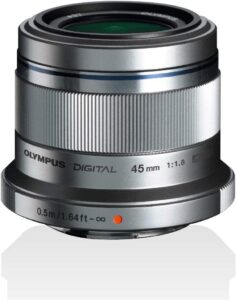
The Olympus 45mm f/1.8 will be the more obvious choice if you have an Olympus camera
See it on Amazon

The Panasonic 42.5mm f/1.2 is a superb high-end lens, but its price is still much higher
See it on Amazon
- The Panasonic 35-100mm f/2.8 and the Olympus 40-150 f/2.8 and f/4-5.6 are obviously more versatile. All three offer very good image quality. They are more expensive and, of course, heavier and bulkier. However, if you’re looking for a quality all-round zoom that covers the 42.5/45mm focal length, these are great options. Their build quality is also impressive. The Panasonic 35-100mm feels more plastic, but it is also very light. The Olympus 40-150 f/4 has a similar weight, but it has a smaller maximum aperture.
- The Panasonic 25-50mm f/1.7 is exceptional in more ways than one. It has a very wide aperture and excellent image quality. It is also exceptional in weight, size and price, but this time in the wrong way. The 42.5mm f/1.7 and this 25-50mm are clearly not lenses you would hesitate between. They are not aimed at the same type of photographer or videographer.
Panasonic 42.5mm f/1.7 OIS summary
| Benefits | Drawbacks |
|---|---|
|
|
Conclusion
To sum up, this Panasonic 42.5mm f/1.7 offers very good image quality in a lightweight, compact body, with strong autofocus and useful optical image stabilization for stills, especially if you have an older Panasonic camera without in-body stabilization. It is currently priced at around €350, which means it is still a little more expensive than the Olympus 45mm f/1.8, which can be found for under €300.
In short, it makes the most sense on a Panasonic body, but it does not really outperform the Olympus. Still, it remains pleasant to use and is a good option.
As always, if you liked our review, don’t hesitate to use the links in the article, or below, when buying. That way, you’ll be supporting our work and helping us produce more articles like this one. Of course, it will be at no extra cost to you.
If you’re looking for more lenses, take a look at our full guide to the best Micro 4/3 lenses.
We’ve also published a full review of the Olympus M.Zuiko Digital ED 75mm f/1.8. It’s a very interesting lens for portraits.
We hope to see you soon,
(I’d like to thank Alex once again for taking the time to test this!)

Written by Sylvain PONS
I've been passionate about photography since 2010, learning as I went along. Today, I dedicate myself to guiding others in their choice of camera gear and sharing a variety of tips to improve their photography skills.
Despite our care, a mistake may have slipped into this article. If you find any, please don't hesitate to let us know so we can correct it as soon as possible and keep our information up-to-date!